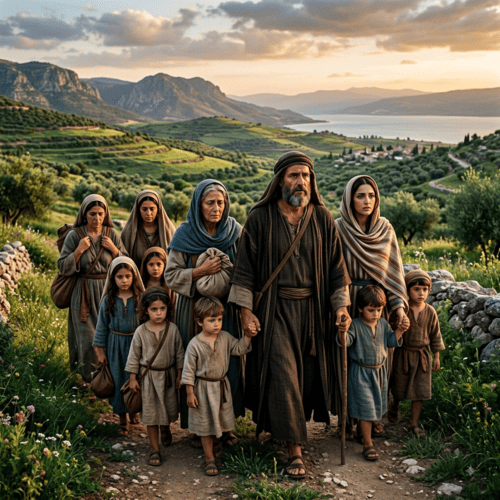

Here’s a hard truth: sometimes, the greatest threat to a marriage comes not from an outsider, but from the family closest to it.
Think of a husband who seeks his mother’s advice before turning to his wife. Or a wife who runs to her parents after every disagreement with spouse. Or parents who continue to pay the bills—and quietly expect to make decisions.
God saw the danger and establishes this principle on the very first pages of the Bible. Before sin entered the world, and long before there were any in-laws, God declared:
‘Therefore a man shall leave his father and his mother and cleave to his wife, and they shall become one flesh.’ (Genesis 2:24)
But what does it actually mean to leave? And what does it mean to cleave?
Where Genesis 2:24 Comes From
Genesis 2 tells the story of the first marriage. God made Adam first. Then He said, ‘It is not good that the man should be alone; I will make him a helper fit for him’ (Genesis 2:18). So God took a part from Adam’s side and made the woman. When Adam saw her, he said, ‘This at last is bone of my bones and flesh of my flesh’ (Genesis 2:23).
Then comes our verse. It begins with ‘Therefore’. This small word joins the two ideas together: because the woman came from the man, marriage joins them together again.
But notice something strange. Adam had no father or mother! So this verse isn’t really about Adam. It’s a rule for all his children—every man and woman who’d ever marry. Bible teachers call this a creation ordinance. That means a rule God built into the world at creation, before sin came. It’s not for one nation or one culture. It’s for everyone, everywhere.
Matthew Henry, the 18th-century Bible commentator, noticed how carefully God made the woman: ‘not made out of his head to rule over him, nor out of his feet to be trampled upon by him, but out of his side to be equal with him, under his arm to be protected, and near his heart to be beloved.’
Who spoke these words? Moses wrote them down. But Jesus says God Himself spoke them. He said that ‘he who created them from the beginning made them male and female, and said, “Therefore a man shall leave his father and his mother…”’ (Matthew 19:4–5).
So Genesis 2:24 isn’t a human custom. It’s the voice of God.
The Meaning of Leave and Cleave: Three Hebrew Words
The Old Testament was first written in Hebrew. Genesis 2:24 uses three key Hebrew words, and each one teaches us something important. The table below shows each word, what it means, where else the Bible uses it, and what it means for a married couple.
| WORD IN GENESIS 2:24 | HEBREW WORD AND MEANING | USED ELSEWHERE IN THE BIBLE | WHAT IT MEANS FOR YOUR MARRIAGE |
|---|---|---|---|
| Leave | ʿāzab—to leave behind, to forsake | God says of Israel, ‘they have forsaken me’ (Jeremiah 2:13) | Your parents are no longer your first loyalty. Your spouse is. |
| Hold fast (older Bibles: ‘cleave’) | dābaq—to stick, to cling, to be glued | Israel must ‘hold fast’ to God (Deuteronomy 10:20); Ruth ‘clung to’ Naomi (Ruth 1:14) | You stay faithful and close to your spouse for life, in good times and bad. |
| One flesh | bāśār ʾeḥād—one body, one family | Laban tells his relative Jacob, ‘Surely you are my bone and my flesh!’ (Genesis 29:14) | You become one new family: one body, one home, one shared life. |
Do you see the pattern? ‘Leave’ and ‘hold fast’ are the same words the Bible uses for Israel’s relationship with God. That tells us marriage is a covenant. A covenant is a solemn promise, made before God, that binds 2 people together. In love and loyalty.
Many today treat marriage like a contract. But a covenant is very different, as this table shows:
| A CONTRACT SAYS… | A COVENANT SAYS… |
|---|---|
| ‘I will do my part if you do yours.’ | ‘I am yours, whatever happens.’ |
| It can end when one side fails. | It lasts for life (Matthew 19:6). |
| It’s made between two people. | It’s made before God, who is the witness (Malachi 2:14). |
What about ‘one flesh’? It certainly includes sex, but it means much more. It means two lives become one shared life: one home, one table, one purse, one future. The very next verse says, ‘And the man and his wife were both naked and were not ashamed’ (Genesis 2:25). Nothing was hidden between them, and nothing needed to be.
Prophet Malachi calls a man’s wife ‘your companion and your wife by covenant’ (Malachi 2:14). John Gill, an 18th-century Baptist pastor, said husband and wife ‘are, as it were, glued together, and make but one’.
What Leaving Is—and What It Isn’t
Some people think leaving means cutting off our parents. It doesn’t. God also commands, ‘Honour your father and your mother’ (Exodus 20:12), and God doesn’t contradict Himself.
| LEAVING DOES NOT MEAN… | LEAVING DOES MEAN… |
|---|---|
| Cutting off your parents or ignoring them | Your spouse now comes before your parents |
| Refusing to care for them when they are old (1 Timothy 5:8) | Caring for your parents together, as a team |
| You must move to another city | You and your spouse make your own decisions |
| Never asking for their advice | You listen to their advice, but you do not take orders |
Jesus Himself shows the balance. He strongly rebuked religious men who used a trick called ‘Corban’ to avoid supporting their parents (Mark 7:10–13). And even in the midst of His agony on the cross, He made sure His mother would be cared for (John 19:26–27).
4 Things We Leave Behind
- Their authority. Numbers 30 shows an unmarried daughter’s promises were under her father’s care (verses 3–5). After marriage, they came under her husband’s care (verses 6–8). In marriage, the right to lead passes to the new home.
- Our dependence. If your parents still pay for everything, they may still decide everything. Learn to stand on your own feet as a couple.
- Our first loyalty. When your parents and your spouse disagree, you cannot simply take your parents’ side. Calvin said Moses shows that ‘it is less lawful to desert a wife than parents’.
- Our old ‘safe place’. Do not run home after every argument. Bring your problems to your spouse first, and to a wise pastor if you need help.
Why Must the Man Leave First?
Here’s a surprise. In ancient Israel, the husband usually didn’t move out. Gordon Wenham, a respected Old Testament scholar, explains: ‘It was the wife who left home to join her husband.’ Rebekah, for example, travelled a long way to marry Isaac (Genesis 24). So why does God say the man leaves? There are 2 reasons:
- Leaving is about the heart first. A man may live in the same house as his parents and still ‘leave’. What changes is his loyalty, not always his address.
- The husband is called to lead. The Bible calls this headship. Headship is a husband’s God-given duty to lead, protect and provide for his wife with self-giving love, like Christ (Ephesians 5:23–25). It never means bullying. A man cannot lead a new home while he is still being led by his old one.
Wives have a part to play here too. A wise wife helps her husband to leave well. She does not compete with his mother or make him choose in anger. Instead, she gives him every reason to come home to her with joy.
Isaac gives us a lovely picture: ‘Then Isaac brought her into the tent of Sarah his mother and took Rebekah, and she became his wife, and he loved her. So Isaac was comforted after his mother’s death’ (Genesis 24:67). His heart had moved to his wife.
Adam gives us a warning. After he sinned, he blamed his wife: ‘The woman whom you gave to be with me, she gave me fruit of the tree, and I ate’ (Genesis 3:12). He stopped holding fast. Every husband who blames instead of protecting repeats Adam’s mistake.
How Jesus and Paul Used Genesis 2:24
Genesis 2:24 didn’t stay in the Old Testament. The New Testament quotes it four times. Follow it through the Bible:
Timeline: Genesis 2:24 Across the Bible
- At creation (Genesis 2:24): God sets up marriage before sin enters the world.
- About 430 BC (Malachi 2:14–16): Malachi rebukes men who divorced ‘the wife of your youth’.
- About AD 30 (Matthew 19:4–6; Mark 10:6–9): Jesus uses the verse against easy divorce: ‘So they are no longer two but one flesh. What therefore God has joined together, let not man separate.’
- About AD 55 (1 Corinthians 6:16): Paul warns that sex with a prostitute joins two bodies. Sex is never ‘just physical’.
- About AD 60 (Ephesians 5:31–32): Paul shows that the verse was always pointing to Christ and His church.
Look closely at Jesus’ words. First, God is the one who joins a couple—a wedding is God’s work, not just a party or paperwork. Second, He says ‘the two’—not three, not four. Third, He says ‘let not man separate’—marriage is meant for life. Calvin warned that if separating a father from his son is wrong, ‘it is a still greater wickedness to dissolve the bond which God has preferred to all others.’
Answering Common Objections
Some people push back against this teaching. Here are 5 common objections, with a short biblical answer to each:
- ‘That was just ancient culture.’ Jesus answered this by going back to ‘the beginning’ (Matthew 19:4, 8). What God set up before any culture existed is for every culture.
- ‘One flesh means husband and wife have no different roles.’ Paul quotes Genesis 2:24 in the very passage where he teaches that husbands lead in love and wives respect their husbands (Ephesians 5:22–33). Unity and roles belong together.
- ‘Any two people who love each other can marry.’ Jesus joined Genesis 1:27 (‘male and female he created them’) to Genesis 2:24 (Matthew 19:4–5). The woman came from the man and is joined back to the man. Man and woman are part of God’s design for marriage.
- ‘Some Old Testament men had many wives.’ The Bible records this, but it does not approve it. Those homes were full of jealousy and pain, like Jacob’s home with Leah and Rachel. Calvin concluded that ‘polygamy is a corruption of legitimate marriage’.
- ‘We are married in our hearts, so we can live together now.’ God’s order is leave first, then hold fast, and then become one flesh. The public covenant comes first: ‘Let marriage be held in honour among all, and let the marriage bed be undefiled’ (Hebrews 13:4).
Leaving When You Live With Your Parents
A WORD FOR JOINT FAMILIES
In India, Africa, Asia and the Middle East, many married couples live with the husband’s parents. Is this wrong? No. The Bible doesn’t command a separate house. The real question isn’t ‘Where do you live?’ but ‘Who leads your home?’
Old Testament scholar Bruce Waltke suggests Moses may have been correcting cultures that put the bond with parents above the bond of marriage. Jacob’s story shows the danger. He lived for years under his father-in-law Laban, who controlled him and ‘changed my wages ten times’ (Genesis 31:7). If you live with family, these habits will help:
- Decide together. Agree as a couple first, then speak to your parents with one voice.
- Protect your spouse. A husband must kindly but firmly defend his wife’s place in the home.
- Keep private things private. Your marriage problems aren’t for the whole family.
- Keep honouring. Give your parents respect, time and practical care.
The Marriage Behind Every Marriage
After quoting Genesis 2:24, Paul says something amazing: ‘This mystery is profound, and I am saying that it refers to Christ and the church’ (Ephesians 5:32). In the Bible, a mystery is a truth God once kept hidden but has now made plain.
Here’s the mystery. Every marriage is a small picture of a greater marriage. The Son of God came down from heaven—though He never stopped being God (Philippians 2:6–7)—to win His bride, the church. ‘Christ loved the church and gave Himself up for her’ (Ephesians 5:25). God opened Adam’s side to make his bride, and a soldier’s spear opened Christ’s side on the cross (John 19:34). Matthew Henry saw it: ‘out of the side of Christ, the second Adam, His spouse the church was formed’.
And Christ holds fast. He promises, ‘I will never leave you nor forsake you’ (Hebrews 13:5).
Perhaps you’re already married and you haven’t left or held fast as you should. There’s hope. Christ didn’t choose a perfect bride; He chose a failing one and made her clean (Ephesians 5:26–27). Confess your failure to God and to your spouse, and start again today.
And if you’re preparing for marriage, here’s the best preparation of all: be held fast by Christ first. As Timothy Keller wrote, to be ‘fully known and truly loved is, well, a lot like being loved by God.’
Only a husband and wife who’re secure in that love first, can love each other—until the day when ‘the marriage of the Lamb has come’ (Revelation 19:7).
Tough Questions, Honest Answers
Why does ‘cleave’ also mean ‘to split’?
English has 2 very old words that ended up spelt the same way. 1 Old English word, clēofan, meant ‘to split’, as with a meat cleaver. Another, clifian, meant ‘to stick to’. In Genesis 2:24, ‘cleave’ always means ‘stick to’, which is why modern Bibles like the ESV say ‘hold fast’ instead. It’s a helpful reminder: God wants a husband and wife joined together, never split apart.
Does leaving and cleaving apply to the wife as well?
Yes. Genesis 2:24 speaks of the man, but the Bible gives the same call to women. Psalm 45:10 says to a royal bride, ‘Hear, O daughter, and consider, and incline your ear: forget your people and your father’s house.’ ‘Forget’ here does not mean she stops loving them. It means her family of birth no longer comes first. Matthew Henry wrote that the son must leave his parents ‘and the daughter forget them, to cleave to her husband’.
What should I do if my spouse keeps putting their parents first?
First, talk to your spouse alone, not in front of the family. Speak calmly about specific events, and avoid words like ‘always’ and ‘never’. Read Genesis 2:24 together as God’s word to you both, not as a weapon. Do not attack your spouse’s parents, because that will only push your spouse to defend them. Pray together, and if nothing changes, ask a wise pastor or an older Christian couple to help. Your goal is to win your spouse, not to win an argument.
Does having sex make a couple married?
No. Sex creates a deep bond, but it doesn’t create a marriage. Paul says a man joined to a prostitute ‘becomes one body with her’ (1 Corinthians 6:16), yet he never calls her his wife. In Exodus 22:16–17, a man who slept with an unmarried woman had to marry her—unless her father refused. Jesus also told the Samaritan woman, ‘the one you now have is not your husband’ (John 4:18). Marriage needs a public covenant, not just a physical union.
How should parents ‘let go’ of a married child?
Christian parents raise children in order to send them out. Our children are God’s by ownership, and ours merely by stewardship. From the very start, the goal is a son or daughter who is ready to leave and build a godly home. After the wedding, give advice when you are asked, not all the time. Never take sides against your child’s spouse; treat him or her as your own family. Give help and gifts without conditions attached. Most of all, keep praying for them, because letting go well is one of the greatest gifts parents can give.
Will we still be married in heaven?
No. Jesus said, ‘in the resurrection they neither marry nor are given in marriage, but are like angels in heaven’ (Matthew 22:30). Paul also teaches that a wife is bound to her husband ‘while he lives’ (Romans 7:2). This is not a loss. Earthly marriage is a picture, and in heaven we will enjoy the real thing: the marriage of Christ and His church. Christian husbands and wives will still know and love each other, but with a perfect love shared with the whole family of God.
What if I am married to someone who isn’t a Christian?
Genesis 2:24 is a creation ordinance, so it applies to all marriages, not only Christian ones. Your marriage is real in God’s eyes. Paul says that if an unbelieving wife ‘consents to live with him, he should not divorce her’ (1 Corinthians 7:12), and the same applies to wives. Stay faithful, keep praying, and let your godly life speak, since spouses ‘may be won without a word’ (1 Peter 3:1). But if you are still single, the Bible is clear that believers should marry ‘only in the Lord’ (1 Corinthians 7:39).
Related Reads
- Complementarian vs Egalitarian: What Does the Bible Actually Teach About Gender Roles?
- Bone of My Bones: Why Eve Was Created From Adam’s Body
- Genesis 3:16: What Does ‘Your Desire Will Be For Your Husband’ Mean?
- What Does Ephesians 5:21 Mean for Husbands and Wives?
- Paul’s Mandate for Men: Headship Or Servant Leadership? Or Both?
- Saving a Hasty Marriage: God’s Perspective
- Unequally Yoked in Marriage: Recipe for Disaster?