Most Bible-reading plans die in Leviticus.
Genesis has floods and family drama. Exodus has plagues and a parted sea. Then come chapters on skin diseases, mould on walls and a goat’s kidneys. Many readers quietly give up.
Yet in one ancient Jewish tradition, children began their Bible lessons with Leviticus, not Genesis. And the New Testament can’t stop talking about it. Without Leviticus, words like atonement, Lamb of God and high priest lose their meaning.
Leviticus isn’t a dusty rulebook Jesus threw away. It’s more like an architect’s drawing of a building yet to be built. When Jesus came, the building appeared—and it matched the drawing exactly.
LEVITICUS AT A GLANCE
What it is: The third book of the Bible, written by Moses.
Where it happens: At Mount Sinai, just after Israel built the tabernacle (God’s tent-house).
The big question: How can a holy God live among sinful people without destroying them?
The short answer: Only through a priest, a sacrifice and blood.
Jesus in the Old Testament — Book 3 of 39
This post is the third instalment in our series tracing Christ through every book of the Old Testament. See the full series index.
Are We Just Reading Jesus Into Leviticus?
Fair question. Some think Christians see Jesus everywhere, the way children see faces in clouds.
But the idea started with Jesus Himself.
“For if you believed Moses, you would believe me; for he wrote of me.” (John 5:46)
After His resurrection, Jesus began “with Moses and all the Prophets” and explained “the things concerning Himself” (Luke 24:27). That includes Leviticus.
Shadow and Substance
The New Testament gives us a helpful picture. Hebrews 10:1 says the law was “but a shadow of the good things to come”. Paul says these things “are a shadow of the things to come, but the substance belongs to Christ” (Colossians 2:17).
When a friend walks towards you around a corner, you see her shadow first. The shadow is real and has her shape, but you can’t hug it. Leviticus is the shadow. Jesus is the Friend.
Bible teachers call this a type: a real person, event or object that God designed to point ahead to Christ. It differs from allegory, which ignores history and invents hidden meanings.
Geerhardus Vos gave a wise rule: first ask what a ritual meant to Israel; only then ask how it points to Christ. The meaning grows, but never changes direction. Patrick Fairbairn warned true types rest on real history and Scripture’s teaching, not imagination. The Westminster Confession of Faith (1647) says the Old Testament “sacrifices… and other types and ordinances” were “all foresignifying Christ to come” (7.5)—that is, showing Him ahead of time.
5 REASONS THIS ISN’T WISHFUL THINKING
- Jesus said so. He claimed Moses wrote about Him (John 5:46).
- Hebrews explains it. Hebrews 7–10 reads like an inspired guide to Leviticus 8–16.
- Leviticus admits it’s unfinished. Its priests sin and die. Its sacrifices never stop.
- The prophets expected more. Isaiah spoke of a person who would be a guilt offering (Isaiah 53:10). A psalm promised a new kind of priest (Psalm 110:4).
- History agrees. When Rome destroyed the Temple in AD 70, the sacrifices stopped for good—because the true Sacrifice had already come.
How Sure Can We Be?
| LABEL | WHAT IT MEANS | EXAMPLE FROM LEVITICUS |
|---|---|---|
| Clear | The New Testament says it directly | The Day of Atonement points to the cross (Hebrews 9) |
| Likely | It fits a clear New Testament pattern | The shared peace-offering meal and the Lord’s Supper |
| Possible | An interesting idea, but the Bible doesn’t say it | The two birds used to cleanse a healed person (Leviticus 14) |
The Offerings: 5 Pictures of One Sacrifice
Leviticus opens with 5 kinds of offering (chapters 1–7). An offering was a gift brought to God, often an animal killed at the altar. Every smoking altar shouted one message: sin is deadly serious, and a life must be given.
John Calvin, the 16th-century pastor of Geneva, asked what could be more pointless than trying to please God with the smell of burning fat. The rituals only made sense because they pointed to Christ (Institutes 2.7.1).
The 5 Offerings (Leviticus 1–7)
| Offering | What happened | What it taught | How it points to Jesus | How sure? |
|---|---|---|---|---|
| Burnt offering (Leviticus 1) | The whole animal was burned | Complete surrender to God | Jesus offered His whole life to the Father (Hebrews 10:5–10) | Clear |
| Grain offering (Leviticus 2) | Flour, oil and incense | Thankful dedication | Named in Psalm 40:6, which Hebrews 10 applies to Jesus | Likely |
| Peace offering (Leviticus 3) | A meal shared with God | Friendship with God | Jesus “is our peace” (Ephesians 2:14); the Lord’s Supper (1 Corinthians 10:16–18) | Likely |
| Sin offering (Leviticus 4) | Blood on the altar; body burned outside the camp | Sin makes God’s house unclean | Jesus “suffered outside the gate” (Hebrews 13:12) | Clear |
| Guilt offering (Leviticus 5–6) | Repay what was taken, plus one-fifth | Sin is a debt | The Messiah “makes an offering for guilt” (Isaiah 53:10) | Clear |
Why All This Talk About Blood?
“For the life of the flesh is in the blood, and I have given it for you on the altar to make atonement for your souls, for it is the blood that makes atonement by the life.” (Leviticus 17:11)
Atonement means making things right between God and sinners by dealing with sin. Jay Sklar, a leading Leviticus scholar, shows the Hebrew word kipper carries two ideas: paying a ransom to rescue the guilty, and cleansing the stain sin leaves. At the cross, Jesus does both.
Blood was God’s sign of a life given up in death: “without the shedding of blood there is no forgiveness of sins” (Hebrews 9:22).
The Priest Who Never Needs Replacing
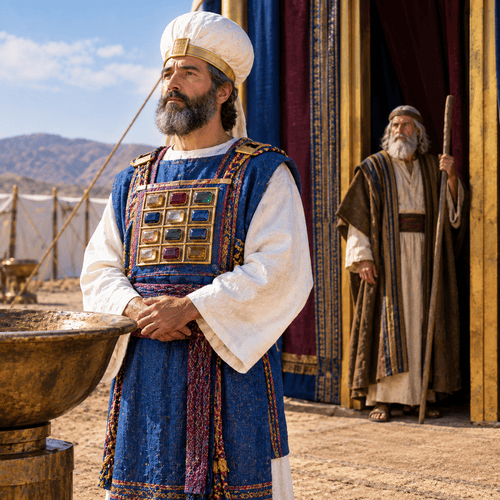
A priest is a go-between who stands between a holy God and sinful people. In Leviticus 8–9, Aaron and his sons are washed, dressed, anointed with oil and marked with blood. Only then can they serve.
But Aaron was only a picture:
Aaron Compared With Jesus
| AARON | JESUS |
|---|---|
| Had to offer a sacrifice for his own sins first (Leviticus 16:6) | Is “holy, innocent, unstained” (Hebrews 7:26) |
| Died and was replaced (Numbers 20:28) | “Holds his priesthood permanently” (Hebrews 7:24) |
| Entered a tent made by human hands | Entered “heaven itself” (Hebrews 9:24) |
| Offered animals again and again | Offered Himself “once for all” (Hebrews 7:27) |
The Heidelberg Catechism (1563) calls Christ our only High Priest, who set us free by the one sacrifice of His body and keeps pleading for us before the Father (Q&A 31). Aaron died; Jesus lives for ever.
The Day of Atonement: The Heart of the Book
Leviticus 16 describes Israel’s most important day—the Day of Atonement, still called Yom Kippur. Once a year, the high priest went alone behind the thick curtain into the Most Holy Place, where God’s presence dwelt.
L Michael Morales argues this chapter sits at the centre of the five books of Moses, like the hub of a wheel. His book title asks, with Psalm 24:3, Who Shall Ascend the Mountain of the Lord? Leviticus answers: one man, once a year, with animal blood. The gospel answers better: one Man, once for all, with His own blood.
The Mercy Seat
Inside the Most Holy Place stood the ark of the covenant, a gold-covered box holding the stone tablets of the law. Its lid was the mercy seat, and on this day the high priest sprinkled blood on it (Leviticus 16:15). Picture it: God’s broken law inside, God’s presence above, and blood in between.
When the Old Testament was translated into Greek, the mercy seat was called the hilastērion. Paul uses that very word for Jesus: God “put forward” Christ “as a propitiation by his blood” (Romans 3:25). Propitiation means a sacrifice that turns away God’s just anger by fully satisfying it. John Calvin believed Paul was deliberately pointing back to the mercy seat here.
So Jesus does more than bring blood to the mercy seat. He is the mercy seat—the place where God’s justice and God’s mercy meet.
Two Goats, One Gospel
Each of the two goats shows one side of what Jesus does.
The Two Goats of Leviticus 16
| GOAT ONE: THE LORD’S GOAT | GOAT TWO: THE SCAPEGOAT | |
|---|---|---|
| What happened | Killed; its blood was sprinkled on the mercy seat (16:15) | The priest laid hands on it, confessed Israel’s sins over it and sent it into the wilderness (16:21–22) |
| What it pictured | The penalty for sin is paid | Sin is carried far away |
| Fulfilled in Jesus | “By means of his own blood” He secured “an eternal redemption” (Hebrews 9:12) | “The Lamb of God, who takes away the sin of the world!” (John 1:29) |
| How sure? | Clear | Likely |
The scapegoat is linked to the Hebrew word Azazel (16:8), which may mean “complete removal” or name a wilderness spirit. Either way, the sin is gone for good: “As far as the east is from the west, so far does he remove our transgressions from us” (Psalm 103:12).
The priest’s hands on the goat pictured guilt passing onto it. Jesus brings a far greater exchange: “For our sake he made him to be sin who knew no sin, so that in him we might become the righteousness of God” (2 Corinthians 5:21).
DID THE SACRIFICES ONLY COVER SMALL MISTAKES?
The claim: Some say the sacrifices only covered accidental sins.
The text: Leviticus 16:21 covers “all their transgressions”—the Hebrew word (pesha’) means deliberate rebellion.
The limit: Yet defiant sins had no sacrifice (Numbers 15:30).
The good news: In Jesus, “everyone who believes is freed from everything from which you could not be freed by the law of Moses” (Acts 13:39).
The Torn Curtain and the Seated Saviour
A thick curtain kept everyone out of the Most Holy Place. But when Jesus died, “the curtain of the temple was torn in two, from top to bottom” (Matthew 27:51). God tore it from above. Now we enter “by the new and living way that he opened for us through the curtain, that is, through his flesh” (Hebrews 10:20).
The tabernacle had a lampstand, table, altars and basin—but no chair. The priest’s work was never done. Hebrews notices: “every priest stands daily at his service… But when Christ had offered for all time a single sacrifice for sins, he sat down at the right hand of God” (Hebrews 10:11–12). Jesus sat down because the work is finished.
Clean, Unclean and the Touch of Jesus
Leviticus 11–15 talks about being clean and unclean. This was not mainly about dirt, or always about sin. It meant being unfit, for a time, to come near God’s house—through skin disease, bodily fluids or touching a dead body, for example.
In Leviticus, uncleanness spreads by touch (compare Haggai 2:12–13). Now watch Jesus:
- He touches a leper. Instead of becoming unclean, Jesus makes him clean, then sends him to the priest to “offer for your cleansing what Moses commanded” (Mark 1:44)—a reference to Leviticus 14.
- A bleeding woman touches Him. Her twelve-year bleeding made her unclean (Leviticus 15:25). She touches His cloak and is healed (Mark 5:25–34).
- He takes a dead girl by the hand. Touching the dead made a person unclean, but Jesus’s touch raises her (Mark 5:41–42).
In Leviticus, uncleanness is contagious. In Jesus, holiness is contagious.
What About the Food Laws?
Why could Israel eat sheep but not pigs? Leviticus explains: “I the LORD am holy and have separated you from the peoples, that you should be mine” (Leviticus 20:26). The food rules marked Israel as set apart.
That is why Jesus “declared all foods clean” (Mark 7:19), and why Peter’s vision of unclean animals was really about people: “God has shown me that I should not call any person common or unclean” (Acts 10:28). In Christ, the wall between Jew and Gentile is down (Ephesians 2:14).
Holiness, Life and the Only Law-Keeper
Leviticus repeats one command again and again: “You shall be holy, for I am holy” (1 Peter 1:16, quoting Leviticus 11:44).
Leviticus also promises: “if a person does them, he shall live by them” (Leviticus 18:5). Obey, and live. But no sinner has ever obeyed fully, so Paul quotes this verse to show that the law cannot save us (Galatians 3:12; Romans 10:5).
But one Person did keep it. Jesus loved God with all His heart. He perfectly obeyed Leviticus 19:18, “you shall love your neighbour as yourself”, which He called the second great commandment (Matthew 22:39).
TWO THINGS JESUS DID FOR US
He lived for us. He kept the law we broke, so His perfect record can be counted as ours.
He died for us. “Christ redeemed us from the curse of the law by becoming a curse for us” (Galatians 3:13).
So holiness isn’t a ladder we climb to reach God. It’s the grateful life of people whom God has already reached.
Feasts, Freedom and God Living With Us
Several of Israel’s yearly feasts in Leviticus 23 are fulfilled in Jesus.
The Feasts of Leviticus 23
| FEAST | WHAT ISRAEL DID | HOW IT POINTS TO JESUS | HOW SURE? |
|---|---|---|---|
| Passover and Unleavened Bread | Killed a lamb; ate bread without yeast | “Christ, our Passover lamb, has been sacrificed” (1 Corinthians 5:7) | Clear |
| Firstfruits | Waved the first sheaf of harvest “on the day after the Sabbath” (23:11) | Jesus rose on Sunday as “the firstfruits” of all who will rise (1 Corinthians 15:20) | Clear |
| Weeks (Pentecost) | Celebrated the harvest fifty days later | The Spirit came and about 3,000 people were saved (Acts 2) | Likely |
| Trumpets | Blew trumpets | Some link it to Jesus’s return (1 Thessalonians 4:16) | Possible |
| Booths | Lived in tents for seven days | Jesus “dwelt” (literally “pitched his tent”) among us (John 1:14) and offered living water at this feast (John 7:37–39) | Likely |
One word of caution: these feasts aren’t a secret calendar for predicting future dates. They’re shadows, and Christ is the substance.
Jubilee and the Kinsman-Redeemer
Every 50th year was the Year of Jubilee (Leviticus 25): debts cancelled, slaves freed, land returned. Israel was to “proclaim liberty throughout the land” (25:10).
In His first sermon, Jesus read from Isaiah 61, which uses this same Jubilee language: “He has sent me to proclaim liberty to the captives… to proclaim the year of the Lord’s favour” (Luke 4:18–19). Then He said, “Today this Scripture has been fulfilled in your hearing” (Luke 4:21).
Leviticus 25 also describes a kinsman-redeemer—a close relative who buys back a family member’s land or freedom (25:25, 47–49). Jesus became our relative so He could redeem us; He “is not ashamed to call them brothers” (Hebrews 2:11).
Finally, Leviticus 26:12 reveals God’s deepest desire: “I will walk among you and will be your God, and you shall be my people.” Paul applies it to the church (2 Corinthians 6:16), and Revelation shows its final fulfilment (Revelation 21:3).
Don’t Skip Leviticus
So when your reading plan reaches Leviticus, do not skip it. Andrew Bonar, a 19th-century Scottish minister, wrote a whole commentary to help ordinary Christians find Christ there. You can too.
Read slowly. Watch the priest wash. Watch the blood fall on the mercy seat. Watch the goat disappear into the wilderness. Then lift your eyes to the One who suffered outside the gate, carried our sins far away and sat down. The work was done.
The shadow was never the point. The Saviour was.
Tough Questions, Honest Answers
Do Christians still have to keep the laws of Leviticus?
Christians have long seen three kinds of law in the books of Moses, as the Westminster Confession of Faith explains in chapter 19. The ceremonial laws—sacrifices, feasts, food and cleanness rules—were shadows of Christ, so now that He has come we no longer keep them (Hebrews 10:1). The civil laws governed Israel as a nation, and they ended with that nation, although their basic fairness can still guide good laws today. The moral law, summed up in the Ten Commandments and in loving God and neighbour, reflects God’s own character and still guides believers (Romans 13:8–10). We do not obey it to earn salvation. We obey it as thankful children who have already been saved by grace.
What does Leviticus 19:28 mean for tattoos today?
The verse says, “You shall not make any cuttings on your body for the dead or tattoo yourselves: I am the LORD.” Notice the words “for the dead”. The command sits among laws against pagan practices, and many scholars think it forbade marks linked to pagan mourning and worship. The New Testament does not repeat this command, so most Bible teachers do not see it as a timeless ban on every tattoo. But the principle behind it still stands: your body belongs to the Lord, who bought you at a price (1 Corinthians 6:19–20). Before getting a tattoo, ask what it says, why you want it and whether it honours Christ.
Does Leviticus 18:22 still apply now that Jesus has fulfilled the law?
Leviticus 18:22 says, “You shall not lie with a male as with a woman; it is an abomination.” Some argue that this verse ended along with the food laws. But Leviticus 18 says the nations of Canaan were judged for these same sins (18:24–25), so these were not rules for Israel alone. The New Testament also repeats this sexual ethic: Paul teaches it in Romans 1:26–27, and one of the words he uses in 1 Corinthians 6:9 appears to be built from the Greek translation of Leviticus 20:13. That shows it belongs to God’s moral law, not the ceremonial law. Yet Paul immediately adds good news for every sinner who turns to Christ: “And such were some of you. But you were washed, you were sanctified, you were justified in the name of the Lord Jesus Christ” (1 Corinthians 6:11).
Why did God kill Nadab and Abihu for “unauthorised fire”?
Aaron’s sons “offered unauthorised fire before the LORD, which he had not commanded them”, and fire from the LORD consumed them (Leviticus 10:1–2). In the very first days of Israel’s priesthood, they chose to worship God their own way. God explained, “Among those who are near me I will be sanctified” (10:3). The lesson is that God decides how He is to be worshipped; sincere feelings are not enough. The story also shows why we need a perfect priest. Jesus never offered anything the Father had not commanded, and through Him we may safely approach the God who is still “a consuming fire” (Hebrews 12:29).
Why was a mother unclean for longer after having a daughter?
Leviticus 12 says a mother was unclean for 40 days after a boy’s birth and 80 days after a girl’s. This was not because girls were worth less, since the offering required was exactly the same “whether for a son or for a daughter” (12:6). Being unclean here was not a sin; it was linked to the loss of blood in childbirth. The Bible does not explain why the time was doubled, so we should not be too confident about any theory. What we do know is beautiful: Mary kept this law after Jesus was born and brought two birds, the offering allowed for poor families (Luke 2:22–24; Leviticus 12:8). The Son of God was “born under the law, to redeem those who were under the law” (Galatians 4:4–5).
Should Christians celebrate the Jewish feasts today?
Some teachers, often called Hebrew Roots teachers, say Christians must keep the feasts of Leviticus 23. But Paul writes, “Let no one pass judgement on you… with regard to a festival or a new moon or a Sabbath. These are a shadow of the things to come, but the substance belongs to Christ” (Colossians 2:16–17). He was also alarmed when Gentile believers began observing “days and months and seasons and years” as if these were required (Galatians 4:10–11). A Christian may learn from a Passover meal as a teaching tool. But no feast is required, and none makes us more holy before God. Our new covenant celebrations are the Lord’s Supper and the Lord’s Day, which point to the Christ whom the old feasts promised.
Will animal sacrifices return in a future temple?
Some Christians expect a rebuilt temple where animal sacrifices will be offered again during a future thousand-year reign, based on Ezekiel 40–48. But Hebrews says Christ was offered “once for all” (Hebrews 10:10) and that “where there is forgiveness of these, there is no longer any offering for sin” (10:18). Going back to animal blood after the cross would be like going back to the shadow after the person has arrived. Ezekiel used the temple language his first readers understood to describe a glorious future with God dwelling among His people. The New Testament shows where that vision leads: Jesus called His body the temple (John 2:21), and in the new creation John “saw no temple in the city, for its temple is the Lord God the Almighty and the Lamb” (Revelation 21:22).