Who led Israel out of Egypt?
Most of us would answer, ‘Moses.’ But a short letter in the New Testament answers differently: Jesus.
‘Now I want to remind you, although you once fully knew it, that Jesus, who saved a people out of the land of Egypt, afterward destroyed those who did not believe’ (Jude 5).
Jesus was born more than a 1000 years after the exodus. So how could he be there? Jesus Himself gives the key: ‘For if you believed Moses, you would believe me; for he wrote of me’ (John 5:46).
This post puts that claim to the test. Come discover Jesus hidden in plain sight in Exodus. He’s indeed there—often in person, and at other times in pictures God built into real history.
Exodus at a Glance
- Chapters 1–4: The Israelites are slaves in Egypt. God calls Moses from a burning bush.
- Chapters 5–13: Ten plagues fall on Egypt. At the first Passover, a lamb’s blood saves Israel’s firstborn sons.
- Chapters 14–18: All Israel crosses the Red Sea and travels through the desert.
- Chapters 19–24: God makes a covenant with Israel at Mount Sinai.
- Chapters 25–40: Israel sins with a golden calf and is forgiven. The tabernacle is built, and God’s glory fills it.
Jesus in the Old Testament — Book 2 of 39
This post is the second instalment in our series tracing Christ through every book of the Old Testament. See the full series index.
Are Christians Force-fitting Jesus into Exodus?
Some say Christians ‘read Jesus into’ Exodus as in the rest of the Old Testament. Here are 4 reasons why that isn’t the case.
- Jesus taught us to read this way. After He rose, ‘beginning with Moses and all the Prophets, He interpreted to them in all the Scriptures the things concerning Himself’ (Luke 24:27).
- The apostles did it with Exodus. Paul says of the rock in the desert, ‘the Rock was Christ’ (1 Corinthians 10:4). He adds these events ‘were written down for our instruction’ (1 Corinthians 10:11).
- The prophets expected a new exodus. God promised, ‘Behold, I am doing a new thing… I will make a way in the wilderness’ (Isaiah 43:19). Christians didn’t invent this hope. Jesus fulfilled it.
- God is the true Author. Moses wrote real history, but God guided his pen and built patterns into it that point to His Son.
John Calvin, the 16th-century French pastor, put it simply: ‘we ought to read the Scriptures with the express design of finding Christ in them’.
A Picture, Not a Guessing Game
The key word here is typology. A type, unlike an allegory, is like a shadow. It tells us something real is coming (Hebrews 8:5). Allegory is different. In allegory, a reader invents hidden meanings. The table shows how to tell them apart.
Typology or Allegory? How to Tell the Difference
| QUESTION TO ASK | TYPOLOGY (A PICTURE GOD DESIGNED) | ALLEGORY (A MEANING PEOPLE INVENT) |
|---|---|---|
| Did the event really happen? | Yes. It is real history. | It does not matter. The story is only a code. |
| Is the fulfilment greater? | Yes. Christ is always the better version. | Not always. |
| Who decides the meaning? | God, as the rest of Scripture shows. | The reader’s imagination. |
| Example | The Passover lamb points to Christ (1 Corinthians 5:7). | ‘The tent pegs stand for the apostles.’ |
Geerhardus Vos, a Dutch-American professor at Princeton Seminary, gave a wise rule. An Old Testament picture must first have meant something real to Israel. Only then can it point forward to Christ.
Jesus Was Actually There
Exodus doesn’t only give us pictures of Jesus. It shows him in person. Bible teachers call this a Christophany—an appearance of Christ before He was born as a man.
The Angel Who Speaks as God
In Exodus 3, ‘the angel of the LORD appeared to him in a flame of fire out of the midst of a bush’ (verse 2). Yet the one speaking says, ‘I am the God of your father, the God of Abraham, the God of Isaac, and the God of Jacob’ (verse 6).
‘Angel’ simply means ‘messenger’. This messenger is sent by the LORD, yet He speaks as the LORD. God later says of Him, ‘He will not pardon your transgression, for my name is in Him’ (Exodus 23:21). Only God forgives sin. Only God carries God’s own name.
Can someone be sent by God and also be God? The Father sent the Son, and ‘the Word was God’ (John 1:1). Justin Martyr taught in the 2nd century that Christ spoke from the bush. Calvin agreed this ‘angel’ was the eternal Son (Institutes 1.13.10).
The Great ‘I AM’
God told Moses His name: ‘I AM WHO I AM’ (Exodus 3:14). Centuries later Jesus said, ‘before Abraham was, I am’ (John 8:58). The intended message wasn’t lost on His hearers. They picked up stones to kill Him (John 8:59). They knew He was claiming God’s name.
DOES JUDE 5 SAY JESUS OR LORD?
We have thousands of early handwritten copies of the New Testament. In Jude 5, some copies say ‘Lord’, but some of the oldest and most trusted say ‘Jesus’. The ESV and the standard Greek New Testament (Nestle-Aland, 28th edition) both print ‘Jesus’. Bruce Metzger, a leading expert on these copies, judged ‘Jesus’ to be what Jude wrote.
Redemption (Exodus 1–18): Jesus the Rescuer
The first half of Exodus is about redemption—God setting His people free. Here are five pictures of a greater rescue, each one named in the New Testament.
Five Pictures of Jesus in Israel’s Rescue
| IN EXODUS | WHAT IT MEANT FOR ISRAEL | HOW IT POINTS TO JESUS |
|---|---|---|
| God calls Israel ‘my firstborn son’ (4:22) | God brought his ‘son’ out of Egypt. | Jesus is the true Son. As a child, he too came out of Egypt (Matthew 2:15). |
| The Passover lamb (Exodus 12) | A perfect lamb died so the firstborn could live. | Jesus is ‘our Passover lamb’ and died at Passover time (1 Corinthians 5:7). |
| The Red Sea (Exodus 14) | Israel passed safely through the waters of judgement. | Luke calls the death of Jesus His ‘departure’—in Greek, His exodos (Luke 9:31). |
| Manna (Exodus 16) | Bread from heaven kept Israel alive. | Jesus said, ‘I am the bread of life’ (John 6:35). |
| Water from the rock (Exodus 17) | Moses struck the rock, and water flowed. | Paul says, ‘the Rock was Christ’ (1 Corinthians 10:4). |
The Blood on the Door
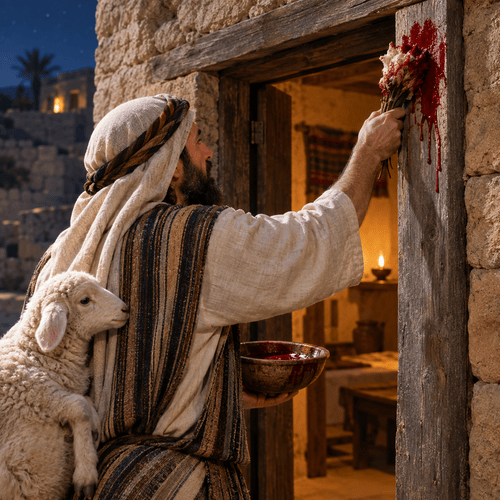
God said, ‘when I see the blood, I will pass over you’ (Exodus 12:13). What saved each family? Not their goodness. Not how strong their faith felt that night. It was the blood.
The lamb had to be ‘without blemish’, with no bone broken (Exodus 12:5, 46). When Jesus died, the soldiers didn’t break His legs, ‘that the Scripture might be fulfilled’ (John 19:36). This is substitution—one life given in place of another. God ‘did not spare His own Son but gave Him up for us all’ (Romans 8:32).
The True and Better Rock
God said, ‘I will stand before you there on the rock’, and Moses struck it (Exodus 17:6). The rod of judgement came down where God Himself stood. Tim Keller put it memorably: ‘Jesus is the true and better Rock of Moses who, struck with the rod of God’s justice, now gives us water in the desert.’
Covenant (Exodus 19–24): A Mediator and a Wedding
At Mount Sinai, God made a covenant with Israel. Before the Ten Commandments, He said, ‘I am the LORD your God, who brought you out of the land of Egypt, out of the house of slavery’ (Exodus 20:2). God didn’t say, ‘Obey, and then I will save you.’ He saved first. His law was a gift for people already rescued.
The Wedding at Sinai
The prophets remembered Sinai as a wedding day. God recalled Israel’s ‘love as a bride, how you followed me in the wilderness’ (Jeremiah 2:2). He called Himself their husband (Jeremiah 31:32). And Israel made their vow: ‘All that the LORD has spoken we will do’ (Exodus 19:8).
Then Moses threw blood on the people and said, ‘Behold the blood of the covenant’ (Exodus 24:8). At the Last Supper, Jesus echoed those words: ‘this is my blood of the covenant, which is poured out for many for the forgiveness of sins’ (Matthew 26:28). The new covenant would be sealed with His own blood.
Moses and the Greater Mediator
Within weeks, Israel broke their vows by worshipping a golden calf. It was like unfaithfulness on the wedding night. God, ‘whose name is Jealous’ (Exodus 34:14), had every right to walk away. This is a faithful husband’s rightful love, not selfishness.
But Moses stood in the gap as mediator—a go-between. He even prayed, ‘please blot me out of your book’ (Exodus 32:32). Moses couldn’t die for their sin for he was a sinner too. Jesus could, and He did: ‘Christ redeemed us from the curse of the law by becoming a curse for us’ (Galatians 3:13).
Moses and Jesus: The Servant and the Son
| MOSES | JESUS |
|---|---|
| He spoke God’s words to the people (Exodus 20:19). | He is the prophet ‘like’ Moses whom we must hear (Deuteronomy 18:15; Acts 3:22). |
| His face shone after he met with God (Exodus 34:29). | His face ‘shone like the sun’ on the mountain (Matthew 17:2). |
| He was ‘faithful in all God’s house as a servant’ (Hebrews 3:5). | He is ‘faithful over God’s house as a son’ (Hebrews 3:6). |
Presence (Exodus 25–40): God Moves In
The last part of Exodus is full of curtains, gold and measurements. But the goal is beautiful: ‘let them make me a sanctuary, that I may dwell in their midst’ (Exodus 25:8). The holy God wanted to live with sinful people.
John says, ‘the Word became flesh and dwelt among us’ (John 1:14). The Greek word for ‘dwelt’ means ‘pitched his tent’. John adds Jesus was ‘full of grace and truth’. This echoes Exodus 34:6, where God is ‘abounding in steadfast love and faithfulness’. Jesus is the true tabernacle.
What the Tabernacle Teaches Us About Jesus
| PART OF THE TABERNACLE | WHAT IT DID FOR ISRAEL | HOW JESUS FULFILS IT |
|---|---|---|
| The tent itself | God lived among his people. | Jesus is God living among us in a human body (John 1:14). |
| The bronze altar | Animals died there as sacrifices for sin. | Jesus offered his body ‘once for all’ (Hebrews 10:10). |
| The mercy seat (the gold lid on the ark of the covenant) | Once a year, blood was sprinkled here to cover Israel’s sin. | Jesus is our propitiation—the sacrifice that turns away God’s anger (Romans 3:25). |
| The curtain | It kept people out of God’s most holy room. | Jesus opened the way ‘through the curtain, that is, through his flesh’ (Hebrews 10:20). |
| The high priest | He carried the names of Israel’s tribes ‘on his heart’ before God (Exodus 28:29). | Jesus ‘always lives to make intercession’ for his people (Hebrews 7:25). |
In the Septuagint, the Greek Old Testament used in the time of Jesus, the mercy seat is called hilastērion. Paul uses that very word for Jesus in Romans 3:25.
After the golden calf, God saw Israel at their worst, yet still came to live among them.
How Far Should We Go?
The Westminster Confession of Faith (1646) says the Passover lamb and other types were ‘all foresignifying Christ to come’ (7.5)—signs pointing ahead to Him. But not every detail is a type.
THREE LEVELS OF CONFIDENCE WHEN SEEING CHRIST IN EXODUS
Clear—the New Testament says it directly: the Passover lamb, the manna, the rock, the tabernacle, the mercy seat, the curtain and the blood of the covenant.
Strong—a clear New Testament pattern: Moses as mediator, the high priest, Israel as God’s son and the Sabbath rest.
Careful—possible, but not stated: meanings for every colour, metal and tent peg. Enjoy these as ideas, but don’t build doctrines on them.
Answering Common Objections
‘Moses did not know about Jesus.’ Moses valued ‘the reproach of Christ’ (Hebrews 11:26). The prophets wrote about Christ’s sufferings even beyond what they fully understood (1 Peter 1:10–11).
‘The exodus never happened.’ Typology needs real history, and Paul insists ‘these things happened’ (1 Corinthians 10:11).
So, Did Moses Write About Christ?
Yes. Moses wrote about the Son who spoke from the bush, the Lamb whose blood saves, the Rock that was struck, the Mediator who stands in the gap and the God who moves in with His people. Charles Spurgeon once told a young preacher that just as every English village has a road to London, every text in the Bible has a road to Christ.
Exodus ends with God’s glory filling a tent. The Bible ends with His glory filling a city. And a bride ready for her husband. If we trust in Christ, our exodus has already begun. Indeed, we’re rescued by the Lamb, bound by covenant and living in God’s presence.
Tough Questions, Honest Answers
Why did God harden Pharaoh’s heart?
Exodus says both that Pharaoh ‘hardened his heart’ (Exodus 8:15) and that ‘the LORD hardened the heart of Pharaoh’ (Exodus 9:12). Pharaoh wasn’t an innocent man forced to sin. He freely chose pride and cruelty, and God, as the King over all, gave him over to the hardness he wanted. Paul explains God’s purpose: ‘For this very purpose I have raised you up, that I might show my power in you, and that my name might be proclaimed in all the earth’ (Romans 9:17). God rules even over evil rulers, and yet people are still responsible for their choices. Both truths are taught side by side in Scripture.
Did the exodus really happen, and when?
The Bible dates the exodus 480 years before Solomon began building the temple (1 Kings 6:1), which points to about 1446 BC. Some Bible-believing scholars prefer a date in the 1200s BC. Direct evidence is limited, which isn’t surprising, because escaping slaves leave little behind and Egyptian kings rarely recorded their defeats. But an Egyptian monument called the Merneptah Stele, from about 1208 BC, already names Israel as a people in Canaan. Most importantly, Jesus and the apostles treated the exodus as real history, and the gospel depends on God acting in real history.
Were the 10 plagues aimed at the gods of Egypt?
Yes. God said, ‘on all the gods of Egypt I will execute judgments: I am the LORD’ (Exodus 12:12). Egyptians treated the Nile as a source of life, yet it turned to blood. They worshipped the sun god Ra, yet darkness covered the land for three days. We should not force every plague to match one particular god, as some writers do. The main lesson is clear: the idols Egypt trusted could not protect it, but the LORD rules over all creation.
Why did God try to kill Moses in Exodus 4:24–26?
This short story shocks many readers: ‘the LORD met him and sought to put him to death’ (Exodus 4:24). The reason seems to be that Moses had not circumcised his son. Circumcision was the sign of God’s covenant with Abraham, and anyone who refused it was to be cut off (Genesis 17:14). The man chosen to lead God’s covenant people was ignoring the covenant in his own home. His wife Zipporah acted quickly, circumcised the boy, and God let Moses go.
Should Christians celebrate Passover today?
Passover pointed forward to Christ, and Christ has fulfilled it: ‘Christ, our Passover lamb, has been sacrificed’ (1 Corinthians 5:7). At his last Passover meal, Jesus gave his church the Lord’s Supper as the new covenant meal (Luke 22:19–20). Christians are not required to keep Old Testament festivals, which Paul calls ‘a shadow of the things to come’ (Colossians 2:17). Attending a Passover meal to learn about its history can be helpful. But the meal Christ commands His people to keep is the Lord’s Supper.
Do the 10 Commandments still apply to Christians?
Yes, but not as a way to earn salvation. God gave the commandments to people he had already rescued (Exodus 20:2), so they were never a ladder to climb up to God. Jesus kept the law perfectly in our place and did not come ‘to abolish the Law or the Prophets… but to fulfil them’ (Matthew 5:17). The moral law still shows us what love for God and neighbour looks like (Romans 13:8–10). Christians obey it out of thankfulness, by the power of the Holy Spirit, not out of fear. Our series on the Ten Commandments explores each one in turn.
Why was Moses not allowed to enter the Promised Land?
At Meribah, God told Moses to speak to a rock, but Moses struck it twice in anger (Numbers 20:8–11). God said, ‘Because you did not believe in me, to uphold me as holy in the eyes of the people of Israel, therefore you shall not bring this assembly into the land’ (Numbers 20:12). Even the great lawgiver could not lead God’s people into their rest. That task went to Joshua, whose name in Greek is the same as ‘Jesus’. Hebrews says that even Joshua did not give the final rest (Hebrews 4:8)—only Christ does. Beautifully, Moses did stand in the land at last, talking with Jesus on the Mount of Transfiguration (Matthew 17:3).