A bronze snake on a pole. A rock that pours out water in the desert. A star seen by a greedy fortune-teller. These strange pictures come from a book most Christians skip. Yet Jesus pointed to one of them and said, in effect, “That’s about Me.”
Numbers sounds like a maths lesson. But inside it are some of the clearest pictures of Jesus in the Old Testament.
Numbers at a Glance
The journey: About 40 years, from Mount Sinai to the edge of the Promised Land.
The big problem: The people grumble and refuse to trust God.
The big message: God stays faithful to an unfaithful people.
Jesus in the Old Testament — Book 4 of 39
This post is the fourth instalment in our series tracing Christ through every book of the Old Testament. See the full series index.
Is It Fair to Look for Jesus in Numbers?
Some people say Christians “read Jesus into” old stories. That’s a fair challenge. Here are 5 reasons we believe Jesus is truly there.
- Jesus said so. After He rose from the dead, “beginning with Moses and all the Prophets, he interpreted to them in all the Scriptures the things concerning himself” (Luke 24:27). “Moses” means the first five books of the Bible, and Numbers is one of them.
- The apostles said so. Paul looked back at Israel’s years in the desert and wrote: “Now these things happened to them as an example, but they were written down for our instruction” (1 Corinthians 10:11).
- Jesus was already there. Jude writes that “Jesus, who saved a people out of the land of Egypt, afterward destroyed those who did not believe” (Jude 5). Paul warns, “We must not put Christ to the test, as some of them did and were destroyed by serpents” (1 Corinthians 10:9). Both verses describe events in Numbers. Christ was not only the goal of the story. He was active inside it.
- Jews read Numbers this way before Jesus was born. The Dead Sea Scrolls and an ancient Aramaic paraphrase called Targum Onkelos both read Numbers 24:17 as a promise of the Messiah (God’s chosen King).
- The church has confessed it for centuries. The Westminster Confession of Faith (1646) says Israel’s sacrifices and signs were “all foresignifying Christ to come” (7.5). In plain English: they were signposts pointing to Jesus.
Key Term: Typology
A type is a real person, event or object in the Old Testament that God designed to point forward to something greater in Christ. For example, the Passover lamb was a real lamb, but it pointed to Jesus, “the Lamb of God” (John 1:29). Paul uses the Greek word typos (“pattern”) about Israel in the desert (1 Corinthians 10:6). Studying these patterns is called typology.
Doesn’t This Open the Door to Wild Ideas?
It can. In the early church, Origen of Alexandria found hidden meanings in tiny details of Numbers, such as the names of campsites. This is called allegory. It treats the story like a secret code, and the real history gets lost.
Augustine of Hippo gave us a better balance: the New Testament is hidden in the Old, and the Old is made plain in the New. Geerhardus Vos added a wise rule. First ask what a picture meant to Israel at the time; only then trace the line to Christ. Sidney Greidanus, in Preaching Christ from the Old Testament, mapped out tested roads from a text to Jesus, such as promise and fulfilment, and types.
THREE TESTS FOR A TRUE PICTURE OF CHRIST
Real history: The event truly happened. A shadow needs a real object to cast it.
Real connection: The picture and Christ share the same saving purpose, not just a surface likeness.
Greater fulfilment: Christ is always bigger than the picture. The bronze serpent healed bodies for a time; Jesus gives eternal life.
How Strong Is the Evidence? Three Levels
Not every link is equally strong, so we sort them into three levels. This keeps us honest.
Level 1: The New Testament Quotes or Explains the Passage
| WHAT HAPPENS IN NUMBERS | HOW IT POINTS TO JESUS | NEW TESTAMENT PROOF |
|---|---|---|
| A bronze serpent is lifted on a pole to heal dying people (21:4–9) | Jesus is lifted up on the cross to give life to all who believe | John 3:14–15 |
| God gives water from the rock (20:2–13) | Christ is the true source of life-giving water | 1 Corinthians 10:4 |
| God calls Moses “faithful in all my house” (12:7) | Moses was a faithful servant; Jesus is the faithful Son | Hebrews 3:2–6 |
| Ashes of a red heifer (young cow) make unclean people clean (chapter 19) | Christ’s blood cleanses our conscience far more deeply | Hebrews 9:13–14 |
| No bone of the Passover lamb may be broken (9:12) | None of Jesus’ bones were broken on the cross | John 19:36 |
| The people grow tired of manna, the bread from heaven (chapter 11) | Jesus is the true bread from heaven | John 6:31–35 |
| The people refuse to enter Canaan out of unbelief (chapter 14) | A warning not to miss the rest Christ gives | Hebrews 3:7–4:11; Jude 5 |
Level 2: The New Testament Clearly Echoes the Passage
| WHAT HAPPENS IN NUMBERS | HOW IT POINTS TO JESUS | NEW TESTAMENT ECHO |
|---|---|---|
| Balaam sees “a star” and “a scepter” rising from Israel (24:17) | Jesus is the King whose star the wise men followed | Matthew 2:2; Revelation 22:16 |
| Moses asks for a leader so Israel will not be “as sheep that have no shepherd” (27:17) | Jesus sees the crowds “like sheep without a shepherd” | Matthew 9:36 |
| Moses renames Hoshea as Joshua (13:16) | “Joshua” and “Jesus” are the same name: “the LORD saves” | Hebrews 4:8 |
| Aaron’s dead wooden staff blossoms (chapter 17) | God chooses His true High Priest and brings life out of death | Hebrews 5:4–5; 9:4 |
| The red heifer is killed outside the camp (19:3) | Jesus “suffered outside the gate” | Hebrews 13:11–12 |
Level 3: A Careful Reading of the Whole Bible Suggests the Link
| WHAT HAPPENS IN NUMBERS | HOW IT MAY POINT TO JESUS | COMPARE |
|---|---|---|
| Aaron stands “between the dead and the living” to stop a plague (16:48) | Jesus stands between us and God’s judgement | Hebrews 7:25 |
| A person who killed someone by accident goes free when the high priest dies (35:25) | The death of our High Priest sets us free | Hebrews 6:18 |
| Phinehas turns away God’s anger and receives a “covenant of peace” (25:10–13) | Jesus turns away God’s anger and brings peace | Romans 5:1, 9 |
| The Angel of the LORD blocks Balaam’s path with a sword (22:22–35) | Many believe this was God the Son before He became human | Joshua 5:13–15 |
Our case rests on Levels 1 and 2. Now let us look closely at the three most powerful pictures.
The Bronze Serpent: Look and Live
In Numbers 21, the people complain against God: “We loathe this worthless food” (21:5). They mean the manna God gave them every morning. So God sends poisonous snakes, and many die. The people confess their sin, and God gives a strange cure:
“Make a fiery serpent and set it on a pole, and everyone who is bitten, when he sees it, shall live.” So Moses made a bronze serpent and set it on a pole. And if a serpent bit anyone, he would look at the bronze serpent and live. (Numbers 21:8–9)
Jesus explained what this meant:
And as Moses lifted up the serpent in the wilderness, so must the Son of Man be lifted up, that whoever believes in him may have eternal life. (John 3:14–15)
Notice three things.
- The cure looked like the curse. The healing snake looked like the killers. On the cross, Jesus took the shape of our curse: “For our sake he made him to be sin who knew no sin” (2 Corinthians 5:21).
- The cure was lifted up. In John’s Gospel, “lifted up” points to the cross, and also to glory, because the cross is where Jesus wins (John 12:32–33).
- The cure came by looking, not working. A bitten person did not mix medicine or pay money. They simply looked. That is faith: trusting God’s answer instead of your own effort.
John Calvin, in his commentary on John, wrote: the bronze serpent healed the body for a short time, but Christ gives life to the soul forever. Charles Spurgeon came to faith as a teenager when a preacher urged him to “look” to Christ (Isaiah 45:22). A dying sinner is saved by a look of faith, not a lifetime of labour.
A WARNING FROM HISTORY
Centuries later, Israel was burning incense to Moses’ bronze serpent, now called Nehushtan. So King Hezekiah “broke in pieces the bronze serpent that Moses had made” (2 Kings 18:4).
The lesson: the picture is not the Saviour. We never trust objects, rituals or buildings. We trust the Christ they point to.
The Rock That Followed Them
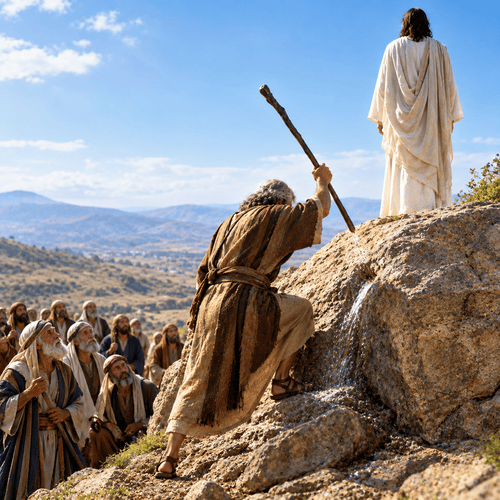
In Numbers 20, Israel has no water, and the people turn on Moses again. God tells Moses to speak to a rock. Instead, Moses loses his temper. He “struck the rock with his staff twice, and water came out abundantly” (20:11). Centuries later, Paul made a stunning claim:
For they drank from the spiritual Rock that followed them, and the Rock was Christ. (1 Corinthians 10:4)
Paul is not repeating the old Jewish legend of a well that rolled behind Israel. He is saying that the real source of Israel’s water and life was Christ Himself, present with them.
John Calvin explained that the Bible often gives a sign the name of the thing it points to. The rock was the sign; Christ was the reality. Tim Keller, the New York pastor, put it memorably: “Jesus is the true and better Rock of Moses who, struck with the rod of God’s justice, now gives us water in the desert.” Jesus still offers that water: “If anyone thirsts, let him come to me and drink” (John 7:37).
A PICTURE WORTH PONDERING (LEVEL 3)
In Exodus 17, God told Moses to strike the rock. In Numbers 20, He said only to speak to it. Many Bible teachers see a picture here. Christ, our Rock, was “offered once to bear the sins of many” (Hebrews 9:28). He never needs to be struck again; now we simply come and ask. The New Testament does not state this directly, so we hold it gently.
The Star Out of Jacob
Balak, king of Moab, is afraid of Israel. So he pays Balaam, a famous foreign fortune-teller, to curse them. But every time Balaam opens his mouth, blessing comes out. In his fourth message, he looks far into the future:
I see him, but not now; I behold him, but not near: a star shall come out of Jacob, and a scepter shall rise out of Israel; it shall crush the forehead of Moab. (Numbers 24:17)
- “Not now… not near”: Balaam sees a King far in the future.
- “A star”: In the ancient world, a star often stood for a king.
- “A sceptre”: The royal rod a king holds. It echoes the promise that “the scepter shall not depart from Judah” (Genesis 49:10).
- “Crush the forehead”: This recalls God’s first promise, that a son of Eve would strike the serpent’s head (Genesis 3:15).
Jewish readers saw the Messiah here long before Jesus. Targum Onkelos turns the verse into a promise that the Messiah would be anointed from Israel. In AD 132, Rabbi Akiva applied it to a rebel leader, calling him Bar Kokhba, “son of the star”.
King David gave a first, partial fulfilment when he defeated Moab (2 Samuel 8:2). The full fulfilment came in Bethlehem, when wise men from the East asked, “Where is he who has been born king of the Jews? For we saw his star when it rose” (Matthew 2:2). Jesus later said, “I am the root and the descendant of David, the bright morning star” (Revelation 22:16).
God even announced His King through the mouth of a hired enemy.
The Shape of Numbers: From Death to Life
Dennis Olson, in The Death of the Old and the Birth of the New, wrote Numbers is built around two headcounts: a generation that dies in the desert, and a new one ready to enter the land. That’s the shape of the gospel: death, then new life.
Timeline: Israel’s Journey Through Numbers
- Chapters 1–10 (Mount Sinai): God counts the people and places His tent, the tabernacle, at the centre of the camp.
- Chapters 11–14 (To Kadesh): The people grumble; ten spies spread fear; Israel refuses to enter Canaan.
- Chapters 15–19 (The wandering years): Korah rebels, Aaron’s staff blossoms, and God gives the red heifer law.
- Chapters 20–25 (Towards Moab): The rock, Aaron’s death, the bronze serpent, Balaam and Israel’s sin at Peor.
- Chapters 26–36 (Plains of Moab): A new generation is counted and made ready for the Promised Land.
Jesus lived this story, but He got it right. Israel was tested for 40 years in the desert and failed. Jesus was tested for 40 days in the desert and stood firm (Matthew 4:1–11). He is the true and faithful Israel who passed the test for us.
Four Objections, Four Answers
| OBJECTION | ANSWER |
|---|---|
| “Christians just read Jesus into old stories.” | Jesus said Moses “wrote of me” (John 5:46), and Jews saw the Messiah in Numbers 24:17 before Jesus was born. |
| “This is just allegory. Anything can mean anything.” | We use clear tests (real history, real connection, greater fulfilment) and build on links the New Testament makes itself. |
| “Numbers is myth, not history.” | Paul says these things “happened” (1 Corinthians 10:11). A true picture needs a real event. |
| “Christ is only the end of the story.” | Jude 5 and 1 Corinthians 10:9 show Christ active in the desert, saving and judging. |
What Numbers Asks of Us Today
- Stop grumbling. “Nor grumble, as some of them did and were destroyed by the Destroyer” (1 Corinthians 10:10). Grumbling quietly says, “God is not good enough for me.”
- Keep believing. “Take care, brothers, lest there be in any of you an evil, unbelieving heart” (Hebrews 3:12).
- Keep walking home. “There remains a Sabbath rest for the people of God” (Hebrews 4:9).
- Look to Christ. Whatever has bitten you, whether guilt, shame or fear, look to the One lifted up on the cross, and live.
Conclusion: The Face That Shines
Numbers is the story of a stubborn people and their faithful God. In the middle of all the grumbling, God gave His priests a blessing to speak over Israel:
The LORD bless you and keep you; the LORD make his face to shine upon you and be gracious to you; the LORD lift up his countenance upon you and give you peace. (Numbers 6:24–26)
Where does God’s face shine on us? “In the face of Jesus Christ” (2 Corinthians 4:6). He is the Rock who was struck, the One lifted up for dying sinners and the bright morning Star. Look to Him, and live.
Tough Questions, Honest Answers
Why is it called the book of Numbers?
The English name comes from the Greek translation of the Old Testament, which called the book Arithmoi, meaning “Numbers”. The Latin Bible followed with Numeri. The name comes from the two great counts of Israel’s fighting men in chapters 1 and 26. The Hebrew title is Bemidbar, which means “In the Wilderness” and comes from the book’s first verse. Both names are helpful. One reminds us that God knows and counts His people; the other reminds us where the story happens, in the hard, dry land between slavery and the promised home.
Was Jesus a Nazirite?
No. A Nazirite was a person who made a special vow to God for a set time (Numbers 6). They could not drink wine, cut their hair or go near a dead body. Jesus drank wine (Matthew 11:19) and touched the funeral stretcher of a widow’s dead son (Luke 7:14). Matthew 2:23 calls Him “a Nazarene”, but that simply means He grew up in the town of Nazareth. Jesus did not need the outward rules of the vow, because He was already “holy, innocent, unstained, separated from sinners” (Hebrews 7:26). In fact, instead of avoiding the unclean, He touched them and made them clean.
Why was Moses not allowed to enter the Promised Land?
God told Moses to speak to the rock, but Moses struck it twice in anger (Numbers 20:8–11). He also said, “Shall we bring water for you out of this rock?” (20:10), as if the power belonged to him and Aaron. God’s verdict was clear: “you did not believe in me, to uphold me as holy in the eyes of the people of Israel” (20:12). Leaders who speak for God are judged more strictly (James 3:1). Yet God’s grace did not end there. Centuries later, Moses stood on a mountain in the Promised Land, talking with the glorified Jesus (Matthew 17:1–3).
Why was God angry with Balaam after telling him to go?
At first God told Balaam plainly, “You shall not go with them” (Numbers 22:12). But when King Balak offered more honour and money, Balaam asked God again, hoping for a different answer. God allowed him to go, but God also saw his heart. The New Testament says Balaam “loved gain from wrongdoing” (2 Peter 2:15). His outward obedience hid a greedy inner desire, and God’s anger was aimed at that heart. Later, Balaam taught Balak how to lead Israel into sin (Numbers 31:16; Revelation 2:14). God cares not only about what we do, but why we do it.
Are the huge numbers in the census meant literally?
The first census counts 603,550 fighting men (Numbers 1:46). With women and children added, that suggests more than two million people in the desert. Many faithful scholars take these numbers at face value, noting that God fed the people with miraculous manna for forty years. Others, including Gordon Wenham in his commentary on Numbers, discuss how the Hebrew word eleph, usually “thousand”, can sometimes mean a clan or military unit, which would make the totals smaller. Both sides believe the Bible is fully true; they differ over what one word means here. Either way, the main point stands: God kept a large, weak and sinful people alive where no one could survive without Him.
What is the red heifer, and is it linked to a Third Temple?
A red heifer is a young red cow with no defect. In Numbers 19 it was burned, and its ashes were mixed with water to make people clean after touching a dead body. In recent years, some groups have brought red heifers to Israel, hoping to prepare for a rebuilt temple in Jerusalem. Christians can watch this news calmly. Hebrews 9:13–14 teaches that the red heifer pointed to Christ, whose blood cleanses far more deeply. Once the real thing has come, there is no need to go back to the shadow (Hebrews 10:1, 18). Our hope is not in a new building but in the finished work of Jesus.
Does the medical snake symbol come from Moses’ bronze serpent?
Probably not directly. The best-known medical symbol is the Rod of Asclepius, a single snake wound around a staff, which comes from ancient Greek stories about a god of healing. The symbol with two snakes and wings, called the caduceus, belongs to the Greek god Hermes and is often used by mistake. Still, many people notice how closely it resembles Moses’ bronze serpent on a pole. Christians can use that likeness to start a conversation. The ancient world looked for healing in myths, but God gave real healing through a real event in history, and final healing through His Son lifted up on the cross.