Most Christians skip Deuteronomy. It looks like a long list of old rules.
But Jesus didn’t skip it. When Satan attacked Him in the desert, Jesus was hungry, alone and weak. He didn’t argue. He answered the devil three times—and all three of His answers came from Deuteronomy.
So here’s a hard question: if the Son of God chose this book as His sword, why do we leave it on the shelf?
Deuteronomy isn’t a dusty rule book. It’s full of Jesus. We meet Him as the Prophet who speaks God’s words, the Covenant-Keeper who obeys where we failed, and the Curse-Bearer who took our punishment on a tree.
Jesus in the Old Testament — Book 5 of 39
This post is the fifth instalment in our series tracing Christ through every book of the Old Testament. See the full series index.
The Big Picture: Deuteronomy in One Minute
Deuteronomy is Moses’ last sermon. After 40 years in the desert, Israel stands at the edge of the land God promised to Abraham. Moses knows he will die before they cross the Jordan River. So he preaches with a burning heart: remember what God has done, love Him and obey Him.
But again and again, the book admits Israel will fail—and points past Moses to Someone greater.
Our Rule: Let the Bible Show Us Where Jesus Is
Some people say Christians “see Jesus everywhere”, even where He isn’t there. That’s a fair warning. So we follow one rule: we let the New Testament show us where Jesus is in Deuteronomy.
How Strong Is Each Link to Jesus? (Level 1 is the strongest)
| LEVEL | WHAT IT MEANS | EXAMPLE FROM DEUTERONOMY |
|---|---|---|
| Direct fulfilment | A New Testament writer quotes Deuteronomy and says it is about Jesus. | The Prophet like Moses (18:15), quoted in Acts 3:22 |
| Picture explained by the apostles | A New Testament writer shows that a person or event in Deuteronomy points to Jesus. | Moses as a servant and Jesus as the Son (Hebrews 3:1–6) |
| Pattern in the Bible’s story | The Bible’s big storyline shows the link, and it agrees with Levels 1 and 2. | The king who must obey God’s law (17:14–20) |
Most of what follows is Level 1 or 2. We are not guessing.
1. Jesus Said Moses Wrote About Him
Jesus made a bold claim to the religious leaders of His day:
“For if you believed Moses, you would believe me; for he wrote of me.” (John 5:46, ESV)
Moses wrote the first five books of the Bible, and Deuteronomy is the last of them. After rising from the dead, Jesus explained:
“And beginning with Moses and all the Prophets, he interpreted to them in all the Scriptures the things concerning himself.” (Luke 24:27, ESV)
So looking for Jesus in Deuteronomy is not our idea. It is His.
A PASTOR’S RULE FOR READING THE BIBLE
John Calvin, the 16th-century pastor of Geneva, wrote on John 5:39: “We ought to read the Scriptures with the express design of finding Christ in them.” In other words, open any page of the Bible looking for Jesus.
2. Jesus the Prophet Like Moses
This is the clearest promise of Jesus in the whole book:
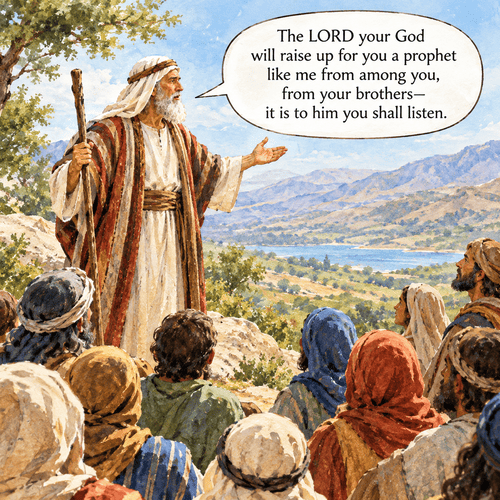
“The LORD your God will raise up for you a prophet like me from among you, from your brothers—it is to him you shall listen.” (Deuteronomy 18:15, ESV)
Why was this Prophet needed? At Mount Sinai, God spoke out of fire, and the people were terrified. They begged, “Let me not hear again the voice of the LORD my God … lest I die” (18:16). God agreed. Sinful people cannot stand before a holy God on their own. They need a mediator—someone to stand between them and God. So God promised, “I will put my words in his mouth” (18:18).
Was This Prophet Simply Joshua?
No. The last chapter of Deuteronomy answers this:
“And there has not arisen a prophet since in Israel like Moses, whom the LORD knew face to face.” (Deuteronomy 34:10, ESV)
This was written after Moses died, by someone who had seen other prophets, including Joshua. None was like Moses. The promise was still open.
Israel Was Still Waiting When Jesus Came
- Priests question John the Baptist: “Are you the Prophet?” (John 1:21). Everyone knew which Prophet they meant.
- The crowds see a miracle: After Jesus fed 5,000 people, they said, “This is indeed the Prophet who is to come into the world!” (John 6:14).
- The Dead Sea Scrolls agree: A Jewish scroll from before Jesus’ birth, called 4QTestimonia, lists Deuteronomy 18:18–19 among promises of God’s coming Deliverer.
- The apostles name Him: Peter and Stephen both preached that Jesus is this Prophet (Acts 3:22–23; 7:37).
Then the Father spoke. On a mountain where Jesus shone like the sun, with Moses beside Him, a voice said, “This is my beloved Son, with whom I am well pleased; listen to him” (Matthew 17:5). “Listen to him” echoes Deuteronomy 18:15. This is the Prophet Moses promised.
Moses and Jesus: Alike, but Jesus Is Greater
| MOSES | JESUS |
|---|---|
| Stood between God and Israel at Mount Sinai | Stands between God and all His people for ever (1 Timothy 2:5) |
| Saw only God’s back (Exodus 33:23) | Is “at the Father’s side” and makes Him known (John 1:18) |
| Was faithful in God’s house “as a servant” (Hebrews 3:5) | Is faithful over God’s house “as a son” (Hebrews 3:6) |
As the American pastor Timothy Keller put it, “Jesus is the true and better Moses who stands in the gap between the people and the Lord.”
3. Jesus the True Son: Winning Where Israel Lost
Deuteronomy calls Israel God’s son: “as a man disciplines his son, the LORD your God disciplines you” (8:5). For 40 years God tested Israel in the desert, teaching them “that man does not live by bread alone” (8:3). Israel failed again and again.
Centuries later, Jesus—God’s true Son—went without food in the desert for 40 days. Satan tested Him at the very points where Israel had fallen.
Three Tests in the Desert: Israel Failed, Jesus Passed
| THE TEST | WHAT ISRAEL DID | WHAT JESUS DID | JESUS QUOTED |
|---|---|---|---|
| Hunger | Complained about food (Exodus 16) | Refused to make bread for Himself | Deuteronomy 8:3 (Matthew 4:4) |
| Testing God | Demanded proof that God was with them at Massah (Exodus 17) | Refused to jump from the temple | Deuteronomy 6:16 (Matthew 4:7) |
| False worship | Bowed down to a golden calf (Exodus 32) | Refused to bow down to Satan | Deuteronomy 6:13 (Matthew 4:10) |
Moses, too, went 40 days without bread while praying for Israel (9:9, 18). Scholar Dale Allison, in The New Moses, shows how carefully Matthew presents Jesus as a greater Moses.
Why does this matter? Adam failed. Israel failed. We fail. But Jesus obeyed perfectly—for us. When we trust Him, God counts His obedience as ours.
4. Jesus Inside Israel’s Great Confession
Deuteronomy 6:4 is the most famous verse in the Jewish faith. It is called the Shema (say “sh-MAH”), from the Hebrew word for “hear”:
“Hear, O Israel: The LORD our God, the LORD is one.” (Deuteronomy 6:4, ESV)
Jesus called this the most important commandment (Mark 12:29–30). But look what the New Testament does with it.
- Paul places Jesus inside the Shema: “for us there is one God, the Father … and one Lord, Jesus Christ” (1 Corinthians 8:6). Paul takes the Shema’s key words, “God” and “Lord”, and includes Jesus in the identity of the one true God. British scholar Richard Bauckham calls this “christological monotheism”.
- Angels must worship Jesus: The Song of Moses ends, “bow down to him, all gods” (32:43). Hebrews 1:6 quotes the ancient Greek form of this verse, “Let all God’s angels worship him”, and applies it to Jesus. Only God may be worshipped.
- Jesus is the Rock: Deuteronomy 32 calls God “the Rock” again and again. Paul writes, “the Rock was Christ” (1 Corinthians 10:4).
A Room Waiting for Light
Benjamin B. Warfield, the Princeton theologian, compared the Old Testament to “a chamber richly furnished but dimly lighted”. When Christ came, the light was switched on. Nothing new was carried into the room. We simply saw what had been there all along.
5. Jesus the Covenant-Keeper and Curse-Bearer
Deuteronomy is shaped like an ancient treaty between a great king and his servant people, as Old Testament scholar Meredith Kline showed in Treaty of the Great King.
Deuteronomy Follows the Pattern of an Ancient Treaty
| PART OF THE TREATY | WHERE IN DEUTERONOMY | WHAT IT SAYS |
|---|---|---|
| Who the King is | 1:1–5 | The LORD speaks through Moses. |
| What the King has done | 1:6–4:49 | God rescued Israel and led them. |
| The King’s commands | Chapters 5–26 | Love God and keep His laws. |
| Blessings and curses | Chapters 27–30 | Obey and be blessed; disobey and be cursed. |
| What happens next | Chapters 31–34 | Joshua will lead, and the covenant continues. |
The Problem: No One Keeps It
“Cursed be anyone who does not confirm the words of this law by doing them” (27:26). Paul quotes this in Galatians 3:10. Anyone who tries to be right with God by keeping the law is under a curse, because no one keeps it perfectly.
The Shock: God’s Curse on a Tree
Deuteronomy 21 says that if an executed criminal’s body was hung on a tree, it had to be buried before night, “for a hanged man is cursed by God” (21:23).
To Jews in Jesus’ day, a crucified Messiah looked cursed by God—“a stumbling block” (1 Corinthians 1:23). But Paul turns this into the good news:
“Christ redeemed us from the curse of the law by becoming a curse for us—for it is written, ‘Cursed is everyone who is hanged on a tree’.” (Galatians 3:13, ESV)
WHY DID JESUS DIE ON A CROSS?
The Heidelberg Catechism asks: “Is it significant that he was ‘crucified’ instead of dying some other way?” It answers: “Yes. This death convinces me that he shouldered the curse which lay on me, since death by crucifixion was accursed by God.” (Question 39)
- He kept the covenant: Jesus obeyed every command and earned its blessing.
- He carried its curse: Jesus died on a tree and took the punishment we deserved.
- He shares the result: Everyone who trusts Him receives His blessing instead of their curse.
This is also strong evidence. No one would invent a cursed Messiah.
6. Jesus Gives the New Heart Deuteronomy Promised
Deuteronomy is honest about the human heart. After 40 years of miracles, Moses said, “to this day the LORD has not given you a heart to understand” (29:4).
Circumcision was the sign God gave Abraham’s family: a small cut in a boy’s flesh marking him as one of God’s people. But God wanted more than an outward sign. He commanded, “Circumcise therefore the foreskin of your heart” (10:16). Israel could not. So God promised to do it Himself:
“And the LORD your God will circumcise your heart and the heart of your offspring, so that you will love the LORD your God with all your heart and with all your soul, that you may live.” (Deuteronomy 30:6, ESV)
Notice the change. In chapter 10, God says, “You do it.” In chapter 30, He says, “I will do it.” The command shows our need; the promise shows His grace. Paul tells believers, “In him also you were circumcised with a circumcision made without hands” (Colossians 2:11).
GOD CHANGES HEARTS
The Synod of Dort (1618–19), a great gathering of church leaders in the Netherlands, said when God saves a sinner, He “opens the closed heart, softens the hard heart, and circumcises the heart that is uncircumcised.” That is Deuteronomy 30:6 happening today.
Moses added, “the word is very near you” (30:14). Paul calls this “the word of faith that we proclaim” (Romans 10:8). He is not twisting Moses. Deuteronomy 30:1–6 describes the day after Israel’s exile (being taken from their land as prisoners), when God would change their hearts. Paul says that day has come in Christ.
7. Pictures of Jesus in Israel’s Daily Life
Everyday Laws in Deuteronomy That Point to Jesus
| WHAT DEUTERONOMY SAYS | WHAT IT PICTURED | HOW JESUS FULFILS IT |
|---|---|---|
| Worship at “the place that the LORD your God will choose” (12:5) | God living among His people | Jesus is God living with us (John 1:14). |
| The king must copy out God’s law and not gather horses, wives or gold (17:14–20) | A king who rules under God | Solomon broke all three rules (1 Kings 10–11). Jesus came “to do your will, O God” (Hebrews 10:7). |
| Cities of refuge for someone who killed by accident (19:1–13) | A safe place from punishment | Believers “have fled for refuge” to the hope God gives in Christ (Hebrews 6:18). |
| A close relative must protect a dead man’s widow and family line (25:5–10) | A family redeemer | This law stands behind Ruth’s story. Jesus came from the family line of Boaz and Ruth (Matthew 1:5). |
8. Moses on the Mountain: Why the Law Cannot Bring Us Home
Deuteronomy ends sadly. From Mount Nebo, God shows Moses the Promised Land and says, “you shall not go over there” (34:4). Moses dies outside the land.
Moses gave the law, but he could not bring God’s people into rest. Joshua led them in. In Hebrew, Joshua’s name is Yeshua—the same name as Jesus. Yet Hebrews 4:8 says, “if Joshua had given them rest, God would not have spoken of another day later on.” True rest comes only through the greater Joshua.
But centuries later, Moses did stand in the Promised Land—on the mountain where Jesus shone, speaking with Him about “his departure” (Luke 9:31). The Greek word is exodos. Moses finally entered, beside the One who would lead a far greater exodus.
Answering Two Common Objections
“The Prophet Like Moses Just Means the Later Prophets”
Many Jewish teachers read Deuteronomy 18 this way, and it is partly right. Calvin taught that the promise covers the whole line of true prophets, with Christ as their head. But 34:10 shows that line never produced a prophet like Moses. The line pointed forward to one final Prophet.
“Christians Just Imagine Jesus in the Old Testament”
Jesus Himself said Moses wrote about Him, and our main links come straight from New Testament quotations. To reject them is to reject how Jesus read His own Bible.
Conclusion: Listen to Him
Deuteronomy’s deepest message is not “Try harder.” It is “Look for Someone greater.” In this book, Jesus stands before us as:
- The Prophet: He speaks God’s final word, and the Father says, “listen to him.”
- The Covenant-Keeper: He obeyed completely where Israel failed and where we fail.
- The Curse-Bearer: He hung on a tree to take the curse sinners deserve.
Moses said, “I have set before you life and death … Therefore choose life” (30:19). Today that choice has a name: Jesus.
Charles Haddon Spurgeon said that “from every text in Scripture, there is a road to the metropolis of the Scriptures, that is Christ.” A metropolis is a capital city. Every road in Deuteronomy leads to Jesus.
Tough Questions, Honest Answers
Does Deuteronomy 18:18 predict Muhammad?
Some Muslim teachers say “from among their brothers” means the Arabs, because Arabs are traced back to Ishmael, the brother of Isaac. But Deuteronomy explains its own words. In 17:15, a king “from among your brothers” means a fellow Israelite, not a foreigner. In 18:2, the Levites have “no inheritance among their brothers”—meaning the other tribes of Israel. The Prophet must also be like Moses, who knew God “face to face” and did great signs (34:10–12). The apostles, who were Jews, named Jesus as this Prophet more than 500 years before Muhammad was born (Acts 3:22).
Did Moses really write Deuteronomy?
Since the 1800s, some scholars have claimed that Deuteronomy was written centuries after Moses, in King Josiah’s time (around 622 BC). But the book’s shape matches treaties from Moses’ own era, not later ones, as the Egyptologist Kenneth Kitchen has shown. Deuteronomy itself says, “Moses wrote this law and gave it to the priests” (31:9). Jesus also spoke of its laws as coming from Moses (Matthew 19:7–8). The account of Moses’ death in chapter 34 was probably added by Joshua or another inspired writer, and this does not change who wrote the rest. If we trust Jesus, we can trust what He said about Moses.
Does “the LORD is one” (Deuteronomy 6:4) rule out the Trinity?
No. The Shema teaches that there is only one true God, against the many false gods of the nations around Israel. The Hebrew word for “one”, echad, can describe a unity made of more than one part, as when a husband and wife become “one flesh” (Genesis 2:24). The Trinity does not teach three gods. It teaches one God in three persons: Father, Son and Holy Spirit. Jesus affirmed the Shema (Mark 12:29) and also said, “I and the Father are one” (John 10:30).
Are Christians bound by the laws of Deuteronomy today?
Christians have long seen three kinds of law in Moses’ writings. Moral laws, such as the Ten Commandments in Deuteronomy 5, show God’s unchanging character and still guide believers. Ceremonial laws, such as sacrifices and food rules, were “a shadow of the good things to come” (Hebrews 10:1) and ended when Christ fulfilled them. Civil laws governed Israel as a nation, and the Westminster Confession of Faith (19.4) says they are no longer binding except for their “general equity”—the fair principle behind them. For example, Paul uses the law about not muzzling an ox (25:4) to teach that Christian workers deserve to be paid (1 Corinthians 9:9–14). We obey God’s law not to earn salvation, but out of love for the Saviour who kept it for us.
How can the God of Deuteronomy’s conquest commands be the God revealed in Jesus?
Deuteronomy 7 and 20 command Israel to destroy the nations of Canaan. These commands were for one time and one place, not a rule for all history. God had waited more than 400 years, because “the iniquity of the Amorites is not yet complete” (Genesis 15:16), and these nations even burned their own children in sacrifice (Deuteronomy 12:31). This was God’s judgement on sin, not hatred of a race: Rahab the Canaanite was saved (Joshua 6:25), and Israel was later driven out of the land for the same sins. The same holy God is revealed at the cross, where Jesus took God’s judgement on Himself so that His enemies could be forgiven.
What does “the secret things belong to the LORD” (Deuteronomy 29:29) mean?
This verse separates what God keeps hidden from what He has made known. Some things, such as the details of the future or the reasons for certain suffering, belong to God alone. Other things He has clearly revealed, and these “belong to us and to our children forever, that we may do all the words of this law.” John Calvin often warned believers not to dig into God’s hidden plans beyond what Scripture says. This verse brings peace: we do not need to know everything, because we know the God who does. And in Jesus, God has revealed His greatest secret—His plan to save sinners (Romans 16:25–26).
Who buried Moses, and why does Jude mention his body?
Deuteronomy 34:6 says God Himself buried Moses, “but no one knows the place of his burial to this day.” Many Bible teachers suggest God hid the grave so that Israel would not turn it into a place of worship. Jude 9 says the archangel Michael argued with the devil “about the body of Moses.” Jude probably draws on an old Jewish tradition, but using one detail from it does not mean he approved of everything in that tradition. Jude’s real point is humility: even a mighty angel did not insult the devil but said, “The Lord rebuke you,” leaving judgement to God.