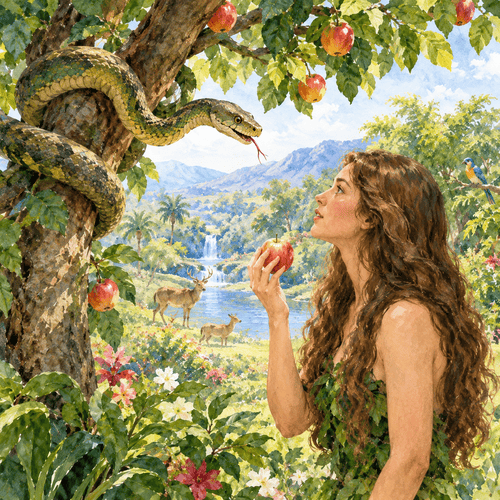
Eve took the fruit first. She ate the fruit first before handing it to her husband. So why does the apostle Paul never write, ‘Sin came into the world through one woman’?
Instead, he writes this:
“Therefore, just as sin came into the world through one man, and death through sin, and so death spread to all men because all sinned—”
Romans 5:12
Did Paul forget about Eve? Does this prove the Bible looks down on women? No. Paul knew exactly what Eve did, and he wrote about it twice. Naming Adam wasn’t a slip of the pen. It was a deliberate argument. Let’s walk through that argument step by step.
Eve Sinned First: The Puzzle
Start with the facts. Genesis 3:6 says the woman ‘took of its fruit and ate, and she also gave some to her husband who was with her, and he ate’. Eve ate. Then Adam ate. Paul knew this well. He writes ‘the serpent deceived Eve by his cunning’ (2 Corinthians 11:3). He also says ‘the woman was deceived and became a transgressor’ (1 Timothy 2:14).
So Paul had every chance to blame Eve for ruining the human race. He didn’t. In Romans 5:12–19 he speaks of ‘one man’ or ‘one trespass’ again and again. He even gives the man a name: ‘Adam, who was a type of the one who was to come’ (Romans 5:14).
KEY TERMS MADE SIMPLE
Original sin: the guilt and sin-bent nature every human receives because of Adam’s first sin.
Trespass or transgression: crossing a line God has drawn.
Type: a real Old Testament person or event that points forward to someone greater, like a shadow.
Some say the Greek word anthrōpos (‘man’) can mean both Adam and Eve. But verse 14 closes that door. Paul names Adam and calls him a picture of Christ. Christ is one person, so the ‘one man’ is one person too.
To solve the puzzle, we must go back to the garden.
What Genesis 2–3 Shows About Adam’s Role
Genesis gives 5 clues pointing to Adam as the one God held responsible.
- God gave the command to Adam. ‘And the LORD God commanded the man’ not to eat from the tree of the knowledge of good and evil (Genesis 2:16–17). Look at the timing. Eve is formed later, in verses 21–22. Adam heard the command from God’s own mouth. Eve heard it from Adam.
- Adam was made the guard. ‘The LORD God took the man and put him in the garden of Eden to work it and keep it’ (Genesis 2:15). The same two Hebrew words later describe priests who served and guarded God’s house (Numbers 3:7–8).
- Adam was standing right there. Eve gave the fruit ‘to her husband who was with her’ (Genesis 3:6). He watched, said nothing, and ate.
- God called Adam first. ‘But the LORD God called to the man and said to him, “Where are you?”’ (Genesis 3:9). In Hebrew, ‘you’ here is singular and masculine. God spoke first to the man, though the woman ate first.
- God tied the curse to Adam. ‘Because you have listened to the voice of your wife … cursed is the ground because of you’ (Genesis 3:17). Then ‘he drove out the man’ (Genesis 3:24).
Genesis 2–3 at a Glance: Adam’s Role Compared with Eve’s
| QUESTION | ADAM | EVE |
|---|---|---|
| Who heard the command directly from God? | Adam (Genesis 2:16–17) | No—she was made after the command was given (2:22) |
| Who was given the job of guarding the garden? | Adam (2:15) | She joined him later as his helper (2:18) |
| Who ate the fruit first? | No | Eve (3:6) |
| Whom did God call to account first? | Adam (3:9) | Questioned second (3:13) |
| Whose sin is linked to the curse on the ground? | Adam (3:17) | She received her own consequence (3:16) |
Geerhardus Vos, the Dutch-American scholar, described the garden as a time of testing. If Adam obeyed, he would receive a life that could never be lost. If he disobeyed, death would follow. The test was given to Adam, so its result was Adam’s to carry.
DID YOU NOTICE? EVE’S WORDS WEREN’T QUITE GOD’S WORDS
What Eve said: When the serpent spoke, Eve said God had told them not to eat the fruit, adding, ‘neither shall you touch it’ (Genesis 3:3).
What God said: In Genesis 2:17, God said nothing about touching the tree.
Why it matters: Whether Eve or Adam added these words, the serpent attacked where God’s word was received second-hand—while the man who heard it first stood silent.
Romans 5:12–21 Explained
In Romans 5, Paul compares two men: Adam and Jesus Christ. Each did one great act that changed countless other lives. Three words help us understand how.
3 WORDS THAT UNLOCK ROMANS 5
Covenant: a binding agreement God makes with people, with promises and conditions.
Federal head: a representative who acts for a whole group. ‘Federal’ comes from the Latin foedus, meaning ‘covenant’.
Imputation: counting something to someone’s account. Adam’s guilt is counted to his descendants; Christ’s righteousness to all who trust Him.
Here is a simple picture. When a country’s leader declares war, the whole nation is at war—even citizens who were never asked. The leader acts, and everyone he represents is included.
Was Adam really in a covenant? The prophet Hosea says so: ‘But like Adam they transgressed the covenant; there they dealt faithlessly with me’ (Hosea 6:7). The Westminster Larger Catechism (1647) sums up the Bible’s teaching:
“The covenant being made with Adam as a public person, not for himself only, but for all his posterity, all mankind descending from him by ordinary generation, sinned in him, and fell with him in that first transgression.”
Westminster Larger Catechism, Question 22
A ‘public person’ acts for others. ‘Posterity’ means everyone who comes after him.
What Does ‘Because All Sinned’ Mean?
Romans 5:12 ends with ‘because all sinned’. Does Paul mean we die because we each commit our own sins? Look at verse 14:
“Yet death reigned from Adam to Moses, even over those whose sinning was not like the transgression of Adam”
Romans 5:14
People died before Moses received the law. Babies die, though they have never broken a command like Adam did. So death is not only punishment for our personal sins. It is punishment for Adam’s sin, counted to us.
John Murray, the Scottish theologian who taught at Westminster Theological Seminary, made this point in The Imputation of Adam’s Sin (1959). He noticed that in every verse from 15 to 19, Paul says one trespass by one man brought death and condemnation. So ‘all sinned’ means all sinned in Adam. His act was counted as ours, because he stood for us.
2 Men, 2 Results: Adam and Christ in Romans 5 and 1 Corinthians 15
| ADAM | CHRIST | |
|---|---|---|
| What he did | ‘One man’s disobedience’ (Romans 5:19) | ‘One man’s obedience’ (Romans 5:19) |
| What it brought | Condemnation and death (Romans 5:18) | Justification and life (Romans 5:18) |
| Who is included | All who are ‘in Adam’ (1 Corinthians 15:22) | All who are ‘in Christ’ (1 Corinthians 15:22) |
| How it reaches us | Counted to us as members of Adam’s race | Counted to us through faith in Christ |
| His title | ‘The first man Adam’ (1 Corinthians 15:45) | ‘The last Adam’ (1 Corinthians 15:45) |
Charles Hodge of Princeton showed that both sides stand or fall together. If God cannot count Adam’s sin to us, there is no pattern for counting Christ’s righteousness to us either.
Why It Isn’t Just About Biology
Some say we receive Adam’s sin like eye colour—passed down through our parents’ bodies. There is truth here: we are born with a sinful nature (Psalm 51:5). But biology alone cannot explain Paul. Here is why:
“The man called his wife’s name Eve, because she was the mother of all living.”
Genesis 3:20
Every human has Eve as a mother just as surely as Adam as a father. If sin passed down only through the body, Paul would say sin came ‘through two people’. He says ‘one man’.
So what did Adam have that Eve did not? A different role. He was the covenant head, standing before God for everyone who would ever be born.
John Calvin, the French pastor and theologian of Geneva, called Adam not only the first father of the race but, in a sense, its ‘root’. Herman Bavinck, the Dutch theologian, taught that humanity is one living whole, like a body joined to its head. When the head fell, the body fell with him.
THINK ABOUT IT: WHAT IF ONLY EVE HAD EATEN?
What we cannot know: Scripture doesn’t say what would have happened had Adam refused.
What we can see: The future of the human race didn’t hang on the first bite. It hung on the choice of the one man God appointed to stand for all.
1 Timothy 2:14 and 2 Corinthians 11:3: Does Paul Contradict Himself?
“For Adam was formed first, then Eve; and Adam was not deceived, but the woman was deceived and became a transgressor.”
1 Timothy 2:13–14
Is Paul now blaming Eve? No. He’s answering a different question.
2 Sets of Passages, 2 Different Questions
| ROMANS 5 AND 1 CORINTHIANS 15 | 1 TIMOTHY 2 AND 2 CORINTHIANS 11 | |
|---|---|---|
| The question Paul answers | Who stood for the whole human race before God? | How does deception work, and who was tricked? |
| The main person named | Adam | Eve |
| Paul’s point | Adam’s one trespass brought death and condemnation to all | Eve believed the serpent’s lies; believers must not be fooled in the same way |
| Is anyone excused? | No—Adam sinned with his eyes open | No—Eve ‘became a transgressor’ |
Notice what this says about Adam: he ‘was not deceived’. He knew exactly what he was doing, which in one sense makes his sin more serious.
Augustine, the North African bishop of Hippo, reflected on this in The City of God. He believed Adam was not fooled by the serpent at all, but joined his wife in sin because he couldn”t bear to be separated from her. Adam chose his wife over God.
A WARNING AGAINST A COMMON MISTAKE
The mistake: Claiming the serpent chose Eve because women are more easily fooled. The Bible never says this.
What the text shows: Eve received the command second-hand, while Adam—the guard—stayed silent.
The balance: Both were truly guilty. Both needed grace.
Who Did Church History Blame?
Many writers have blamed Eve—sometimes harshly. Their words show how different Paul’s view is.
Timeline: How Writers Have Answered the Question
- About 180 BC—Ben Sira: This Jewish book outside the Bible says, ‘From a woman sin had its beginning, and because of her we all die’ (Sirach 25:24).
- About AD 200—Tertullian: The North African writer told women, ‘You are the devil’s gateway’—harsh words that Paul never used.
- AD 413–426—Augustine: The City of God says Adam sinned out of loyalty to his wife, not deception.
- About 1270—Thomas Aquinas: His Summa Theologiae argued that if Eve alone had sinned, her children would not have inherited original sin. His reasons came from medieval science, but he saw that Adam’s sin decided the outcome.
- 1559—John Calvin: His Institutes of the Christian Religion taught that unfaithfulness—refusing to trust God’s word—was the root of the fall.
- 1647—The Westminster Assembly: Its catechisms call Adam ‘a public person’.
- Early 1700s—Matthew Henry: The English commentator defended Eve’s dignity (below).
“The woman was made of a rib out of the side of Adam; not made out of his head to rule over him, nor out of his feet to be trampled upon by him, but out of his side to be equal with him, under his arm to be protected, and near his heart to be beloved.”
Matthew Henry, commentary on Genesis 2:21–25
Herexs the surprise: placing responsibility on Adam protects women. Paul refuses to say, ‘It is all the woman’s fault.’ Both men and women are made in God’s image (Genesis 1:27), and wives are ‘heirs with you of the grace of life’ (1 Peter 3:7). Headship is not about being worth more. It is about being answerable for more.
Is It Fair to Be Judged for Adam’s Sin?
It can feel unjust to suffer for another person’s act. Here are four honest answers.
- The same rule saves us. If we refuse Adam as our representative, we must refuse Christ too. ‘For as by the one man’s disobedience the many were made sinners, so by the one man’s obedience the many will be made righteous’ (Romans 5:19).
- Adam was the best representative we could have had. Robert Charles (R. C.) Sproul, the American theologian, often said this. Adam had no sinful nature, lived in a perfect world and heard God directly. None of us would have done better.
- We agree with Adam every day. Everyone old enough to choose repeats Adam’s choice, ‘for all have sinned and fall short of the glory of God’ (Romans 3:23).
- Ezekiel 18 speaks about something different. Ezekiel says, ‘The son shall not suffer for the iniquity of the father’ (Ezekiel 18:20). This concerns personal punishment in Israel’s life, not the headship God set up at creation. Otherwise, Christ could not carry our sins either.
In the end, we stand where Abraham stood: ‘Shall not the Judge of all the earth do what is just?’ (Genesis 18:25).
No Adam, No Gospel
Why does this matter? Because Paul’s gospel is built on two heads: Adam and Christ.
WHY WE CANNOT REMOVE ADAM WITHOUT REMOVING CHRIST
Adam was a real man. Luke traces Jesus’ family line back to ‘Adam, the son of God’ (Luke 3:38).
Adam’s sin was a real act. Paul speaks of ‘one trespass’ (Romans 5:18). A symbol cannot trespass.
Christ came as the last Adam. Adam disobeyed in a garden of plenty; Jesus obeyed in the wilderness and on the cross.
The rescue came through the woman. The woman’s offspring would crush the serpent (Genesis 3:15), and Jesus was ‘born of woman’ (Galatians 4:4). Eve’s story ends not in shame but in the Saviour.
Richard B. Gaffin Jr., long-time Westminster Theological Seminary professor, sums it up in his book title: No Adam, No Gospel. If no real Adam brought real death, Paul’s comparison with Christ falls apart.
Which Adam Do We Belong To?
So why does Paul blame Adam, not Eve? Not because Eve was innocent, and not because women matter less. God made Adam the covenant head of the human race, gave him the command, called him to account and counted his act to all who came from him.
That pattern is also the doorway to hope. Everyone is born ‘in Adam’, but no one has to stay there. ‘For as in Adam all die, so also in Christ shall all be made alive’ (1 Corinthians 15:22). The real question is not only, ‘Who is to blame?’ It is, ‘Which Adam do I belong to?’
Tough Questions, Honest Answers
How did Jesus avoid inheriting original sin?
Jesus was fully human, but He did not come into the world under Adam’s headship. The Westminster Larger Catechism says Adam’s covenant covered all ‘descending from him by ordinary generation’, and Jesus was not conceived in the ordinary way. The angel told Mary, ‘The Holy Spirit will come upon you, and the power of the Most High will overshadow you; therefore the child to be born will be called holy—the Son of God’ (Luke 1:35). So Jesus came as a new head, the last Adam, not as someone Adam represented. That is why He could live a perfect life and die as a spotless sacrifice (Hebrews 4:15). This was God’s miracle in the conception, not the result of Mary being sinless.
If babies carry original sin, what happens to babies who die?
The Bible teaches that even babies belong to Adam’s fallen race (Psalm 51:5). But Scripture also gives grieving parents real hope. When King David’s baby son died, David said, ‘I shall go to him, but he will not return to me’ (2 Samuel 12:23). The Westminster Confession of Faith (10.3) teaches that ‘elect infants, dying in infancy, are regenerated, and saved by Christ, through the Spirit’. Many trusted teachers, including Charles Spurgeon and Benjamin Breckinridge Warfield, believed God saves all who die in infancy. Either way, such children are saved by grace in Christ, not by their own innocence. We can rest in the promise that ‘the Judge of all the earth’ will ‘do what is just’ (Genesis 18:25).
Why did God put the tree in the garden if He knew Adam would sin?
The tree was not a trap, because God ‘tempts no one’ (James 1:13). It was a test of love and trust: would Adam obey God simply because God had spoken? Obedience means little where there is no real choice. God was never taken by surprise. He ‘chose us in him before the foundation of the world’ (Ephesians 1:4), so His rescue plan in Christ was ready before the fall happened. God allowed the fall in order to show His justice, mercy and love more fully than an untested garden ever could.
Did Adam and Eve go to heaven?
The Bible does not say so directly, but there are strong signs of hope. Right after the fall, God promised that the woman’s offspring would crush the serpent (Genesis 3:15). Adam then named his wife Eve, ‘the mother of all living’ (Genesis 3:20)—a hopeful name given just after death had been announced. God clothed them with garments of skin (Genesis 3:21), which many see as a picture of God covering sinners. When Seth was born, Eve said, ‘God has appointed for me another offspring’ (Genesis 4:25). These are words of faith in God’s promise, and faith in God’s promise is how sinners have always been saved.
Do Catholics, Orthodox Christians and Jews believe in original sin?
Roman Catholics believe in original sin, but teach that baptism removes its guilt and that Mary was kept free from it. Eastern Orthodox Christians usually speak of ‘ancestral sin’: we inherit death and a weakened nature from Adam, but not his guilt. Most Jewish teaching rejects original sin and speaks instead of an ‘evil inclination’ (yetzer hara) that each person must resist. The Bible goes further than all three. Paul says that ‘by the one man’s disobedience the many were made sinners’ (Romans 5:19). We share Adam’s guilt, not only his weakness—so we need Christ’s righteousness counted to us, not merely help to try harder.
Was the forbidden fruit an apple?
Genesis never says what kind of fruit it was. The Hebrew word simply means ‘fruit’. The apple idea probably grew up in the Latin-speaking church, because the Latin word malum can mean both ‘apple’ and ‘evil’. European painters then made the apple famous. The type of fruit does not matter at all. What mattered was that God had said, ‘You shall not eat’, and Adam chose his own way over God’s word.
How can I be set free from Adam’s sin?
You cannot free yourself by trying harder, because the problem is not only what you do but whose family you belong to. God’s answer is a new head. Everyone ‘in Adam’ dies, but everyone ‘in Christ’ will be made alive (1 Corinthians 15:22). You move from Adam to Christ by turning from your sin and trusting in Jesus, who lived perfectly and died in the place of sinners. Then His obedience is counted as yours: ‘by the one man’s obedience the many will be made righteous’ (Romans 5:19). The same God who held Adam responsible now welcomes you in Christ.