Here’s a bold claim: the book of Joshua isn’t really about Joshua.
Yes, it has falling walls, a river that stops, a sun that stands still. Many readers see only old war stories in the book.
But look closer. In the Septuagint—the Greek translation of the Old Testament used by the first Christians—Joshua’s name is Iēsous. That’s exactly the same name as Jesus. Is that just a coincidence? Not at all.
Here are 9 ways Joshua points forward to Jesus Christ. No guesswork—just the Bible’s own clues.
The 9 Ways at a Glance
Each row shows a scene in Joshua, what it points to in Jesus and a verse to look up. Each of the 9 ways is explained in detail below.
| WAY | IN JOSHUA | FULFILLED IN JESUS | KEY VERSE |
|---|---|---|---|
| 1 | Joshua’s name means ‘the LORD saves’ | The Saviour who saves His people from sin | Matthew 1:21 |
| 2 | The Commander with a drawn sword (5:13–15) | The Son of God leading His people | Hebrews 2:10 |
| 3 | Crossing the Jordan (3–5) | Our forerunner through death | Hebrews 6:20 |
| 4 | Rahab’s scarlet cord (2) | Saved under the sign of blood | 1 Peter 1:18–19 |
| 5 | Achan and the Valley of Achor (7) | Trouble turned into hope | Hosea 2:15 |
| 6 | Kings under foot, bodies on trees (10) | The King who conquers and bears the curse | Galatians 3:13 |
| 7 | Cities of refuge (20) | A safe place for the guilty | Hebrews 6:18 |
| 8 | Inheritance and rest (21) | The lasting rest God promised | Hebrews 4:8–9 |
| 9 | Joshua’s covenant and death (24) | The Mediator who lives for ever | Hebrews 7:24–25 |
Jesus in the Old Testament — Book 6 of 39
This post is the sixth instalment in our series tracing Christ through every book of the Old Testament. See the full series index.
First, Is It Fair to Look for Jesus in Joshua?
Do Christians simply ‘read Jesus into’ the Old Testament? Let Jesus answer.
On the road to Emmaus, ‘beginning with Moses and all the Prophets, He interpreted to them in all the Scriptures the things concerning Himself’ (Luke 24:27). He also said of Moses, ‘he wrote of me’ (John 5:46).
So looking for Christ in the Old Testament isn’t our idea. It’s His.
The Westminster Confession of Faith (1646) agrees. It says God taught Israel through ‘types and ordinances… all foresignifying Christ to come’ (7.5). In simple words, many Old Testament events were God’s picture-lessons about Jesus.
KEY TERM: TYPOLOGY
A type is a real Old Testament person, event or object that God designed to point to something greater in Christ. Typology studies these patterns. Scottish scholar Patrick Fairbairn, in The Typology of Scripture, showed that a true type has three marks:
- Real history: It truly happened.
- God’s design: The Bible itself makes the link, not our imagination.
- Greater fulfilment: Christ fulfils it in a bigger, better way.
Allegory, by contrast, invents hidden meanings with no clear biblical support. We avoid it.
1. His Name Means ‘The LORD Saves’
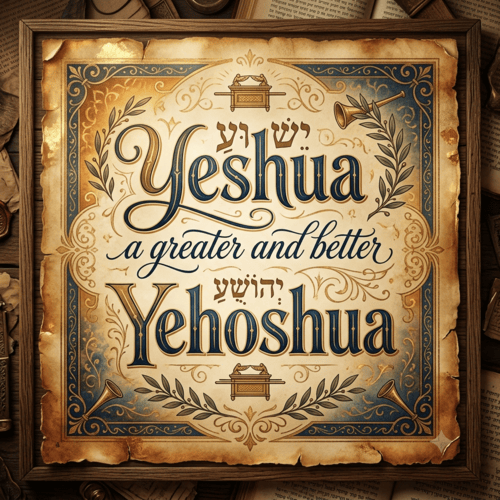
Joshua’s first name was Hoshea, meaning ‘salvation’. Then ‘Moses called Hoshea the son of Nun Joshua’ (Numbers 13:16), adding God’s own name. Joshua means ‘the LORD saves’.
In Hebrew, Joshua is Yehoshua, often shortened to Yeshua. In Greek it becomes Iēsous—Jesus. That’s why an angel told Joseph: ‘you shall call his name Jesus, for he will save his people from their sins’ (Matthew 1:21).
Notice this: Moses, who gave the law, died outside the land. It took a man named ‘Jesus’ to bring God’s people home, as Justin Martyr observed in the second century. The law shows our need; only the Saviour brings us in.
Read our post: Joshua & Yeshua: Exploring the Name and Life Connections
2. The Commander with a Drawn Sword
Near Jericho, Joshua meets a stranger. ‘Behold, a man was standing before him with his drawn sword in his hand’ (Joshua 5:13). Joshua asks, ‘Are you for us, or for our adversaries?’ The answer is surprising: ‘No; but I am the Commander of the army of the LORD’ (5:14).
Joshua falls down and worships, and the stranger doesn’t stop him. He says, ‘Take off your sandals from your feet, for the place where you are standing is holy’ (5:15). These are almost the same words God spoke to Moses at the burning bush (Exodus 3:5).
Yet when John bowed before an angel, it said at once, ‘You must not do that!’ (Revelation 22:9). Angels refuse worship. This Commander accepts it, because He is God the Son.
KEY TERM: CHRISTOPHANY
A Christophany is a visible appearance of Christ, the eternal Son of God, before He was born in Bethlehem. Joshua 5 gives one of the clearest examples.
His answer, ‘No’, matters too. He came not to take sides but to take charge. The real question is never ‘Is God on my side?’ but ‘Am I on His?’
Read our post: Who Was Joshua 5’s Commander of the Lord’s Army?
3. Through the Jordan into a New Life
In Joshua 3, River Jordan is in flood. The priests carry the ark of the covenant—the gold-covered chest that showed God’s presence among His people—into the water. The river stops flowing. Then the priests ‘stood firmly on dry ground in the midst of the Jordan… until all the nation finished passing over’ (Joshua 3:17).
God’s presence goes first into danger and stays until every last person is safe. Hebrews calls Jesus our ‘forerunner’ (Hebrews 6:20). He went first into the deep waters of death, and He holds the way open until all His people are home.
Israel crossed ‘opposite Jericho’ (3:16). Ancient tradition places Jesus’s baptism, ‘in Bethany across the Jordan’ (John 1:28), in this same area. Where Joshua began his mission, Jesus began His.
WHAT HAPPENED AT GILGAL? 4 PICTURES OF THE GOSPEL (JOSHUA 5)
At Gilgal, their first camp in the land, 4 events pointed to Christ.
- Circumcision: The new generation received the sign of God’s covenant, His binding promise to His people. In Christ, believers are ‘circumcised with a circumcision made without hands’ (Colossians 2:11).
- Shame removed: God said, ‘Today I have rolled away the reproach of Egypt from you’ (Joshua 5:9). ‘Reproach’ means shame, and Christ removes ours.
- Passover: Israel ate the Passover meal in the land for the first time. ‘Christ, our Passover lamb, has been sacrificed’ (1 Corinthians 5:7).
- Manna stopped: ‘The manna ceased the day after they ate of the produce of the land’ (5:12). Desert food gave way to the food of the promised land, pointing to Jesus, ‘the bread of life’ (John 6:35).
4. Rahab and the Scarlet Cord
Rahab was a Canaanite prostitute in a city under God’s judgement. Yet she believed: ‘the LORD your God, he is God in the heavens above and on the earth beneath’ (Joshua 2:11).
The spies gave her a sign: a scarlet (bright red) cord tied in her window. Her whole family would live, but only if they stayed inside. ‘If anyone goes out of the doors of your house into the street, his blood shall be on his own head’ (2:19).
Does that sound familiar? It should.
Passover in Egypt and Rahab in Jericho: The Same Rescue Pattern
| FEATURE | PASSOVER (EXODUS 12) | RAHAB (JOSHUA 2) |
|---|---|---|
| The sign | Red blood on the doorframe | A red cord in the window |
| Who is safe | Everyone inside the house | Everyone inside the house |
| The warning | ‘None of you shall go out of the door of his house’ (12:22) | Whoever goes out ‘into the street’ is not protected (2:19) |
| The result | God’s judgement passes over them | God’s judgement passes over them |
The early church saw this clearly. Clement of Rome, writing around AD 96, said the scarlet thread showed ‘that through the blood of the Lord there shall be redemption’ (1 Clement 12). Redemption means being bought back and set free.
Rahab ‘has lived in Israel to this day’ (Joshua 6:25). She became an ancestor of King David and of Jesus Himself (Matthew 1:5), and Hebrews 11:31 lists her among the heroes of faith.
No one is too far gone for God’s grace. The only safe place is under the blood.
5. Achan and the Valley of Trouble
After Jericho, Israel suffered a shocking defeat at little Ai. Why? Achan had secretly taken things ‘devoted’ to God—marked for God alone. Yet the Bible says ‘the people of Israel broke faith’ (Joshua 7:1). One man’s sin brought guilt on the whole nation.
KEY TERM: REPRESENTATIVE HEADSHIP
One person can stand for many. Adam’s sin brought death to the human race; Christ’s obedience brings life to all who trust Him (Romans 5:18–19). Bad news in Adam—wonderful news in Christ.
Achan was judged in the Valley of Achor, meaning ‘trouble’ (7:24–26).
Yet God later promised through Hosea: ‘I will… make the Valley of Achor a door of hope’ (Hosea 2:15).
How can a valley of trouble become a door of hope? Only because a greater Joshua took the trouble on Himself. Achan stole what belonged to God and was destroyed. Jesus stole nothing, yet God ‘made him to be sin who knew no sin’ (2 Corinthians 5:21).
DID YOU KNOW?
The Hebrew word for Rahab’s ‘cord’ (tiqvah) is the same word Hosea uses for ‘hope’. Rahab’s cord of hope and Achor’s door of hope both lead us to the same Saviour.
6. Enemies Under His Feet
In Joshua 10, 5 kings join forces against Israel. God fights for His people: ‘the LORD fought for Israel’ (10:14). After the battle, Joshua calls his captains: ‘Come near; put your feet on the necks of these kings’ (10:24).
This picture runs through the Bible. God promised His King: ‘Sit at my right hand, until I make your enemies your footstool’ (Psalm 110:1). Paul says Christ ‘must reign until he has put all his enemies under his feet’ (1 Corinthians 15:25).
But look at what happens next. The kings’ bodies ‘hung on the trees until evening’ and were taken down at sunset (Joshua 10:26–27). Joshua was obeying God’s law: ‘a hanged man is cursed by God’ (Deuteronomy 21:23).
Here’s the wonder of the gospel. Paul applies that very law to Jesus: ‘Christ redeemed us from the curse of the law by becoming a curse for us’ (Galatians 3:13). Joshua hanged his enemies on trees. Jesus hung on the tree Himself, in the place of His enemies—and then rose to put every enemy under His feet.
7. The Cities of Refuge
In ancient Israel, if you killed someone by accident, a relative called ‘the avenger of blood’ could hunt you down (Joshua 20:3). So God named six cities of refuge where such a person could run and be safe.
How the Cities of Refuge Point to Christ
| IN JOSHUA 20 | IN CHRIST |
|---|---|
| The person in danger had to run to the city. | We must run to Christ by faith. |
| Inside the city, the avenger could not touch him. | ‘There is therefore now no condemnation for those who are in Christ Jesus’ (Romans 8:1). |
| Freedom came with the death of the high priest (20:6). | Freedom comes through the death of Jesus, our great High Priest. |
The last row is stunning: the person stayed ‘until the death of him who is high priest’ (20:6). Hebrews calls believers ‘we who have fled for refuge’ (Hebrews 6:18). Jesus is our refuge—and the High Priest whose death sets us free.
Read our post: Cities of Refuge: Foreshadowing Our Safe Haven in Jesus
8. The Inheritance and the Rest Still to Come
By Joshua 21, the story reaches a happy high point: ‘the LORD gave them rest on every side… Not one word of all the good promises that the LORD had made to the house of Israel had failed; all came to pass’ (Joshua 21:44–45).
SCHOLAR INSIGHTS
Dale Ralph Davis titled his Joshua commentary No Falling Words: not one of God’s words falls to the ground unkept. Graeme Goldsworthy describes God’s kingdom as ‘God’s people in God’s place under God’s rule’. Joshua gives us an early picture of it.
But there’s a problem. God had already told Joshua, ‘there remains yet very much land to possess’ (13:1). And soon after Joshua died, Israel turned away from the LORD (Judges 2:10–11). The rest did not last.
Hebrews explains why: ‘For if Joshua had given them rest, God would not have spoken of another day later on’ (Hebrews 4:8). Remarkably, the Greek name here is Iēsous—Jesus. The first Joshua’s rest did not last; the greater Jesus gives a rest that does. ‘So then, there remains a Sabbath rest for the people of God’ (4:9).
Two Leaders, Two Rests
| THE REST JOSHUA GAVE | THE REST JESUS GIVES |
|---|---|
| A piece of land in Canaan | ‘An inheritance that’s imperishable, undefiled, and unfading’ (1 Peter 1:4) |
| Enemies pushed back for a time | Sin, death and Satan defeated for ever |
| Lost when Israel disobeyed | Kept safe by Christ’s perfect obedience |
| Faded after Joshua died | Secured by a Saviour who lives for ever |
Jesus still calls today: ‘Come to me, all who labor and are heavy laden, and I will give you rest’ (Matthew 11:28).
9. The Judge and Mediator Who Never Dies
The hardest part of Joshua is the war. How can the destruction of Canaanite cities point to Jesus?
SCHOLAR INSIGHT
Presbyterian scholar Meredith G Kline used the phrase ‘intrusion ethics’. He meant that in the conquest, God’s final judgement broke into history early. Canaan was a small preview of the last day, when every sin not covered by Christ will be judged.
The Son of God who met Joshua with a drawn sword will return as Judge: ‘in righteousness he judges and makes war’ (Revelation 19:11). Until then, ‘we do not wrestle against flesh and blood’ (Ephesians 6:12). Our weapon is the gospel.
Joshua was also a covenant mediator—a go-between who stands between God and His people. In Joshua 24 he called Israel to decide: ‘choose this day whom you will serve… But as for me and my house, we will serve the LORD’ (24:15).
Then comes a sad line: ‘Joshua the son of Nun, the servant of the LORD, died’ (24:29).
That’s the ending of every human saviour—but not of Jesus. He ‘holds his priesthood permanently, because he continues forever… he always lives to make intercession for them’ (Hebrews 7:24–25). Intercession means pleading on someone’s behalf. Our Joshua will never leave His people without a leader.
So, Is Joshua Really About Jesus?
Charles Spurgeon once passed on an older minister’s advice: just as every English town has a road to London, every text of Scripture has a road to Christ. In Joshua, that road is a highway.
Joshua gave Israel land but not new hearts; he died, and they wandered. Jesus does what Joshua could not. He is the refuge for the guilty, the rest for the weary and the King who will put every enemy under His feet.
Joshua leaves us one question: whom will you serve?
To see how Christ appears in every Old Testament book, explore our series pillar, Jesus in the Old Testament: Where He Appears in All 39 Books.
Tough Questions, Honest Answers
Was the conquest of Canaan genocide?
No—not in the modern sense of killing people because of their race. God waited over 400 years, saying ‘the iniquity of the Amorites is not yet complete’ (Genesis 15:16). The Canaanites were judged for real and terrible sins, including burning their children as sacrifices (Deuteronomy 12:31). The judgement was not about ethnicity: Rahab the Canaanite was saved, while Achan the Israelite was judged. The command was also for one time and place only, and it gives no nation today the right to wage holy war. Many scholars also note that phrases like ‘left none remaining’ were common ancient war language, since the same peoples appear again later (Judges 1). The God who gives life has the right to judge sin, and He still offers mercy to all who turn to Him.
Did the sun really stand still in Joshua 10?
The Bible says ‘the sun stopped in the midst of heaven and did not hurry to set for about a whole day’ (Joshua 10:13). We believe this was a real miracle, because the God who made the sun can easily control it. Christians differ on how it happened. Some believe God stopped or slowed the turning of the earth; others believe He made the daylight last longer in another way. The Bible uses everyday language here, just as we still say ‘sunrise’ today. What matters most is the text’s own point: ‘There has been no day like it before or since, when the LORD heeded the voice of a man, for the LORD fought for Israel’ (10:14).
Was Rahab wrong to lie to protect the spies?
Rahab told the king’s men that the spies had left, when they were really hiding on her roof (Joshua 2:4–6). Christians have debated this for centuries. John Calvin held that her lie was not free from fault, even though her faith was real. The New Testament praises Rahab’s faith and her welcome of the spies (Hebrews 11:31; James 2:25), but it never praises the lie itself. God saved and used an imperfect woman, just as He uses imperfect people today. That should comfort us, because we are saved by grace through faith, not by being perfect.
Is there archaeological evidence for the fall of Jericho?
Yes, although the dating is still debated. In the 1930s, John Garstang dated a destroyed city at Jericho to around 1400 BC, close to the Bible’s timeline. In the 1950s, Kathleen Kenyon argued that the city fell around 1550 BC, too early for Joshua. In 1990, archaeologist Bryant Wood re-examined the pottery and argued again for a date near 1400 BC. Diggers found fallen mud-brick walls and many jars of burnt grain. This fits a short siege just after the spring harvest (Joshua 3:15) and a city that was burned rather than robbed (Joshua 6:24). The debate goes on, but the evidence does not disprove the Bible.
Does Joshua 21:43 contradict Judges 1?
Joshua 21:43 says God gave Israel all the land, yet Judges 1 shows many Canaanites still living there. This is not a contradiction. The book of Joshua itself says ‘there remains yet very much land to possess’ (13:1) and speaks of nations that still remained (23:4–5). God truly gave Israel the land and broke the power of its kings. But Israel had to take hold of it step by step, and often failed to obey. God’s promises were perfect; Israel’s faithfulness was not.
Can Christians claim Joshua 1:9 as a personal promise?
Joshua 1:9 was first spoken to Joshua for a special task: leading Israel into Canaan. So it is not a promise that we will win every goal we set, like a new job or a sports match. But the heart of the verse—‘the LORD your God is with you wherever you go’—is given to all believers. Jesus promised, ‘I am with you always, to the end of the age’ (Matthew 28:20). Hebrews 13:5 even takes a promise first given to Joshua and applies it to ordinary Christians: ‘I will never leave you nor forsake you.’ Our courage rests not on our own strength but on Christ’s presence with us.
Does the land promise in Joshua still apply to modern Israel?
Christians hold different views on this question, and many believe God still has a special land plan for the Jewish nation. Our view is that the land promise finds its fullest fulfilment in Christ. Paul says God promised Abraham he would be ‘heir of the world’ (Romans 4:13), not just of Canaan, and Abraham himself ‘was looking forward to the city that has foundations’ (Hebrews 11:10). Jesus said the meek ‘shall inherit the earth’ (Matthew 5:5). All who belong to Christ, whether Jew or Gentile, are ‘heirs according to promise’ (Galatians 3:29). This view does not mean any hostility to Jewish people. Like Paul, we long for them to be saved (Romans 10:1).