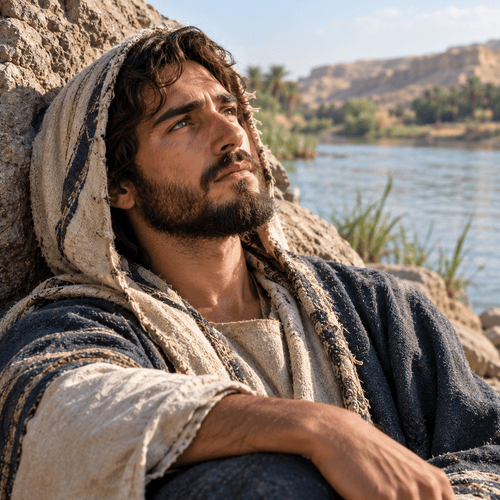
About 600 years before Jesus was born, a priest sat by a river in what’s now Iraq. Suddenly the sky opened. He saw a throne shining like blue sapphire. And sitting on the throne of God was someone who looked like a man.
Who was that man?
Most people find Ezekiel strange: wheels full of eyes, a valley of dead bones and a giant temple measured wall by wall. But skip Ezekiel, and you miss 1 of the clearest pictures of Jesus in the Old Testament. Here are 8 places where Ezekiel points to Christ.
Jesus in the Old Testament — Book 26 of 39
This post is the 26th instalment in our series tracing Christ through every book of the Old Testament. See the full series index.
Who Was Ezekiel?
Ezekiel was a priest. His name means ‘God strengthens’. He lived through the exile—the time when Babylon forced God’s people to live far from home as punishment for turning away from Him. Ezekiel was far from Jerusalem and far from the temple, the place where God had promised to live among His people. Into that darkness, God gave him visions of hope.
Timeline: Ezekiel’s Life at a Glance
- 597 BC: Babylon takes Ezekiel and about 10,000 others from Jerusalem (2 Kings 24:14).
- 593 BC: By the Chebar canal, Ezekiel sees God’s glory and is called as a prophet (Ezekiel 1:1–3).
- 586 BC: Babylon destroys Jerusalem and burns the temple.
- 573 BC: Ezekiel sees the vision of a new temple (Ezekiel 40:1).
Is It Fair to Look for Jesus in Ezekiel?
Some say Christians ‘read Jesus into’ the Old Testament. But on the day He rose from the dead, Jesus Himself, ‘beginning with Moses and all the Prophets… interpreted to them in all the Scriptures the things concerning himself’ (Luke 24:27). Ezekiel is 1 of those Prophets. Peter adds ‘the Spirit of Christ’ was in the prophets as they wrote (1 Peter 1:11).
Geerhardus Vos, a Dutch-American Bible teacher at Princeton, taught God’s revelation grows like a plant. The seed already holds the whole tree, but you only see the tree later. Long before him, Augustine of Hippo said: ‘The New is in the Old concealed; the Old is in the New revealed.’
But we must be careful not to invent hidden meanings. Edmund Clowney, the first president of Westminster Theological Seminary, taught we first ask what a passage meant to its first readers, and only then trace its line to Christ.
4 Ways Christ Appears in the Old Testament
| WAY | WHAT IT MEANS | EXAMPLE IN EZEKIEL |
|---|---|---|
| Theophany | God shows Himself in a visible form, often like a man | The man on the throne (1:26) |
| Prophecy | A clear promise about a future person or event | ‘One shepherd, my servant David’ (34:23) |
| Type | A real person, place or thing that pictures something greater to come | The temple, pointing to Jesus’ body (John 2:21) |
| Pattern | A theme that repeats and reaches its high point in Christ | Death to life in the valley of bones (chapter 37) |
1. The Man on the Throne (Ezekiel 1:26–28)
Ezekiel’s first vision is wild: a storm of fire, four living creatures and wheels full of eyes. Above them is a throne. Then he writes:
‘Seated above the likeness of a throne was a likeness with a human appearance’ (Ezekiel 1:26).
This is a theophany (say: thee-OFF-uh-nee), which means ‘God-showing’—a moment when the invisible God shows Himself in a form people can see. He does not say, ‘I saw God.’ He saw ‘the appearance of the likeness of the glory of the LORD’ (1:28). Then he fell on his face.
So who was this man on the throne? John gives us the key. When Isaiah saw the Lord on His throne, ‘he saw his glory and spoke of him’ (John 12:41)—and ‘him’ means Jesus. John also says, ‘No one has ever seen God; the only God, who is at the Father’s side, he has made him known’ (John 1:18). Whenever God shows Himself, it is the Son who makes Him known.
In Revelation 1, the risen Jesus has a voice ‘like the roar of many waters’ (1:15)—the sound Ezekiel heard (Ezekiel 43:2). And John does what Ezekiel did: ‘When I saw him, I fell at his feet as though dead’ (1:17). John Calvin, the French Reformer, saw the human likeness on the throne as an early glimpse of the Son one day taking a real human body.
THINK ABOUT IT
Six centuries before Bethlehem, there was already a man-shape on the throne of heaven. The incarnation—God the Son becoming a man—was never God’s back-up plan. It was always the plan.
2. The Glory That Left and Came Back (Ezekiel 10–11; 43)
In Ezekiel 8–11, God shows the prophet idol worship inside the temple. Then something heartbreaking happens. The glory of the LORD—the bright, visible sign that God lived among His people—leaves. It goes slowly, step by step, as if God does not want to go.
Timeline: The Journey of God’s Glory
- Step 1 (10:4): The glory moves from the inner room to the temple doorway.
- Step 2 (10:18–19): It moves to the east gate.
- Step 3 (11:23): It stops ‘on the mountain that is on the east side of the city’—the Mount of Olives.
- Step 4 (43:2–4): In a later vision, it returns ‘from the way of the east’ and fills the new temple.
Centuries later, ‘the Word became flesh and dwelt among us, and we have seen his glory’ (John 1:14). ‘Dwelt’ really means ‘pitched his tent’. God’s glory had come back—in a person.
And watch the Mount of Olives. There Jesus weeps over the city (Luke 19:37–41). There He is arrested. From there He goes up to heaven, and the angels promise He ‘will come in the same way as you saw him go’ (Acts 1:11). The glory left by the east. The glory will return from the east.
3. The Tender Twig (Ezekiel 17:22–24)
Ezekiel 17 is a riddle about eagles and trees. David’s royal family was like a great cedar, and Babylon had cut off its top. But God promises:
‘I will break off from the topmost of its young twigs a tender one, and I myself will plant it on a high and lofty mountain’ (Ezekiel 17:22).
The twig becomes ‘a noble cedar’, and ‘under it will dwell every kind of bird’ (17:23). The prophets call the coming King the Branch—a new shoot from David’s family tree (Isaiah 11:1; Jeremiah 23:5). Jesus came from that family when it looked dead, growing up ‘like a root out of dry ground’ (Isaiah 53:2).
Jesus later said His kingdom starts as a tiny seed but ‘becomes a tree, so that the birds of the air come and make nests in its branches’ (Matthew 13:32). The birds picture people from every nation finding shelter in God’s kingdom. That includes you and me.
4. The One to Whom Judgement Belongs (Ezekiel 21:25–27)
Zedekiah was Judah’s last king. God calls him a ‘profane wicked one’ and says:
‘Remove the turban and take off the crown… This also shall not be, until he comes, the one to whom judgement belongs, and I will give it to him’ (Ezekiel 21:26–27).
God takes the crown from David’s family, and history agrees: after Zedekiah, no son of David ever again ruled as king in Jerusalem. But God did not throw the crown away. He set it aside for its true owner, echoing the old promise that the sceptre would stay with Judah ‘until tribute comes to him’ (Genesis 49:10).
Later, an angel told Mary about her son: ‘the Lord God will give to him the throne of his father David’ (Luke 1:32). The crown had found its owner.
5. The Shepherd Who Is Both God and David (Ezekiel 34)
In Bible times, kings were called shepherds. In Ezekiel 34, Israel’s leaders have fed themselves and ignored the sheep. So God promises:
‘I myself will be the shepherd of my sheep… I will seek the lost, and I will bring back the strayed’ (Ezekiel 34:15–16).
God will do it Himself. But a few verses later He says: ‘I will set up over them one shepherd, my servant David’ (34:23). So who is the shepherd—God, or a human king from David’s family? Ezekiel says both.
The Shepherd Puzzle—Solved in Jesus
| WHAT GOD PROMISES IN EZEKIEL 34 | WHAT JESUS SAYS |
|---|---|
| ‘I myself will be the shepherd’ (34:15) | ‘I am the good shepherd’ (John 10:11) |
| ‘I will seek the lost’ (34:16) | ‘The Son of Man came to seek and to save the lost’ (Luke 19:10) |
| ‘One shepherd, my servant David’ (34:23) | ‘There will be one flock, one shepherd’ (John 10:16) |
Only one person can be both the LORD Himself and a son of David: Jesus, fully God and fully man. Some say Jesus was only a good teacher or a created being. Ezekiel 34 stands in their way. And Jesus goes further than Ezekiel: ‘The good shepherd lays down his life for the sheep’ (John 10:11).
DID JESUS’ LISTENERS UNDERSTAND?
Yes. They knew Ezekiel 34 well. When Jesus said, ‘I am the good shepherd’, He was claiming a role only God had claimed. That is why some called Him ‘insane’ and others picked up stones (John 10:20, 31).
6. A New Heart and a New Spirit (Ezekiel 36:25–27)
Ezekiel’s deepest problem was the people’s hearts. They needed new hearts. So God promises:
‘I will sprinkle clean water on you… And I will give you a new heart, and a new spirit I will put within you. And I will remove the heart of stone from your flesh and give you a heart of flesh. And I will put my Spirit within you’ (Ezekiel 36:25–27).
Notice who does the work: ‘I will… I will… I will.’ People do not make their own new hearts. God does. This is regeneration, or new birth—God giving spiritual life to someone spiritually dead. The Canons of Dort, a statement of faith from 1619, say this work is no less powerful than creation or raising the dead.
In John 3, Jesus tells Nicodemus, ‘unless one is born of water and the Spirit, he cannot enter the kingdom of God’ (3:5). Water and Spirit—Ezekiel’s two gifts. Then He asks, ‘Are you the teacher of Israel and yet you do not understand these things?’ (3:10). Jesus expected him to know Ezekiel 36. And after rising, Jesus poured out this promised Spirit on His people (Acts 2:33).
7. Dry Bones That Live (Ezekiel 37)
God sets Ezekiel in a valley of bones that are ‘very dry’ (37:2). He asks, ‘can these bones live?’ Ezekiel answers, ‘O Lord GOD, you know’ (37:3). Ezekiel preaches, God sends His breath, and the bones stand up, ‘an exceedingly great army’ (37:10).
The Hebrew word ruach means breath, wind or spirit. It takes us back to Eden, where God ‘breathed into his nostrils the breath of life’ (Genesis 2:7). The bones pictured Israel in exile, a nation as good as dead. But God’s promise, ‘I will open your graves’ (37:12), reaches much further:
- Jesus rose first. He is ‘the firstfruits’ of the resurrection (1 Corinthians 15:20).
- Jesus breathes the Spirit. After rising, ‘he breathed on them and said to them, “Receive the Holy Spirit”’ (John 20:22).
- Jesus opens graves. One day ‘all who are in the tombs will hear his voice and come out’ (John 5:28–29).
- Jesus is the one King. ‘My servant David shall be king over them, and they shall all have one shepherd’ (37:24).
The chapter ends: ‘My dwelling place shall be with them’ (37:27). Paul applies this to the church (2 Corinthians 6:16).
8. The Temple and the River (Ezekiel 40–48)
Ezekiel’s last nine chapters describe a new temple in great detail. But the big idea is simple: God will live with His people again.
How do we know this temple points to Jesus? Jesus said, ‘Destroy this temple, and in three days I will raise it up’, and ‘he was speaking about the temple of his body’ (John 2:19, 21). Believers are then built into ‘a holy temple in the Lord’ (Ephesians 2:21). And in the new creation, ‘I saw no temple in the city, for its temple is the Lord God the Almighty and the Lamb’ (Revelation 21:22).
Gregory K. Beale, in The Temple and the Church’s Mission, shows that God always planned for His presence to spread from one small place until it fills the whole earth. Patrick Fairbairn, a 19th-century Scottish scholar, argued that it was never a building plan, but a picture of God’s people living in His presence.
In chapter 47, water flows from under the temple door. It is ankle-deep, then knee-deep, then a river too deep to cross. It even heals the salty Dead Sea: ‘everything will live where the river goes’ (47:9). Jesus later cried out, ‘If anyone thirsts, let him come to me and drink’, promising ‘rivers of living water’—and John adds, ‘this he said about the Spirit’ (John 7:37–39). The river flows one last time in Revelation 22:1–2, ‘from the throne of God and of the Lamb’.
Ezekiel’s final words name the new city: ‘The LORD Is There’ (48:35). That is the Bible’s whole story in four words, and it comes true in Jesus, called Immanuel—‘God with us’ (Matthew 1:23).
BEING HONEST WITH THE TEXT
Not every detail points directly to Jesus. In chapters 44–46, a ruler called ‘the prince’ offers ‘a sin offering’ for himself (45:22). Jesus never needed to do that (Hebrews 7:26–27). So this prince is a picture of a good ruler, not Jesus Himself. Being careful here makes our case stronger, not weaker.
The 8 Pointers at a Glance
Where Ezekiel Points to Christ
| # | POINTER | IN EZEKIEL | FULFILLED IN JESUS |
|---|---|---|---|
| 1 | The man on the throne | 1:26–28 | The Son who makes God known (John 1:18) |
| 2 | Glory leaves and returns | 11:23; 43:2 | Glory in flesh, returning from the east (John 1:14; Acts 1:11) |
| 3 | The tender twig | 17:22–24 | The Branch whose kingdom shelters nations (Matthew 13:32) |
| 4 | The rightful King | 21:27 | Given David’s throne (Luke 1:32) |
| 5 | The Shepherd | 34:11–24 | The Good Shepherd, God and Son of David (John 10:11) |
| 6 | A new heart | 36:25–27 | New birth by water and the Spirit (John 3:5) |
| 7 | Dry bones live | 37:1–14 | The risen Lord who breathes the Spirit (John 20:22) |
| 8 | Temple and river | 40–48 | The true temple and living water (John 2:21; 7:38) |
Why This Matters
Ezekiel’s first readers were far from home. Their city was burned and their temple was gone. They felt like dry bones. Maybe you do too.
Ezekiel’s message is for you. God does not wait for you to fix yourself. He comes looking: ‘I will seek the lost.’ He kept that promise in Jesus—the Shepherd who laid down His life, the King who holds the crown, the temple where God and sinners meet.
Charles Spurgeon, the great London preacher, liked to repeat an old Welsh minister’s advice: just as every village in England has a road to London, ‘so from every text of Scripture there is a road to the metropolis of the Scriptures, that is Christ.’ Ezekiel is full of those roads. Follow them, and you will find Him.
Tough Questions, Honest Answers
Why does God call Ezekiel “son of man”? Is it the same title Jesus used?
God calls Ezekiel ‘son of man’ about 93 times. In Hebrew, the phrase simply means ‘human being’. It reminds Ezekiel how small and weak he is next to God’s great glory. When Jesus calls Himself ‘the Son of Man’, He is mainly drawing on Daniel 7:13–14, where ‘one like a son of man’ comes with the clouds of heaven and receives an everlasting kingdom. So the two uses are different, but they meet in Jesus. He is truly human like Ezekiel, and He is also the heavenly King of Daniel’s vision.
Will Ezekiel’s temple be built as a third temple in Jerusalem?
Some Christians believe Ezekiel’s temple will be built in the future, with animal sacrifices offered again. We do not think this fits the New Testament. Hebrews teaches that Jesus offered ‘a single sacrifice for sins’ and that ‘there is no longer any offering for sin’ (Hebrews 10:12, 18). Going back to animal sacrifices would be a step backwards from the cross. The Jews who returned from exile never tried to build Ezekiel’s temple either, which suggests they did not read it as a building plan. The vision is best understood as a picture of God living among His people, fulfilled in Christ, His church and the new creation.
Who are Gog and Magog in Ezekiel 38–39?
Gog is a ruler ‘of the land of Magog’ who leads many nations to attack God’s restored people. Magog first appears in Genesis 10:2 as a son of Japheth, whose descendants lived far to the north. Many popular teachers link Gog to modern Russia, but this depends on shaky word guesses and changes with the news. Revelation 20:8 uses ‘Gog and Magog’ as a picture of all the nations gathering for a final attack on God’s people. In both books, God wins without His people lifting a sword. The main message is not a map of future wars but a promise that Christ will defeat every enemy.
Does the shut gate in Ezekiel 44:2 refer to Mary?
Some Roman Catholic and Orthodox writers read the shut gate as a picture of Mary staying a virgin all her life. But the verse gives its own reason: the gate stays shut ‘for the LORD, the God of Israel, has entered by it’. The point is the holiness of God’s return to His temple, not Mary. The New Testament never applies this verse to her. It also mentions Jesus’ brothers and sisters (Mark 6:3). We honour Mary as blessed, but we let Scripture explain Scripture.
Is Ezekiel 28 about Satan?
Ezekiel 28 is a sad song about ‘the king of Tyre’ (28:12). It uses Eden language: a guardian cherub, precious stones and a fall caused by pride. Because of this, many Christians have read it as the story of Satan’s fall. John Calvin, commenting on similar words in Isaiah 14, warned against reading such passages as being about Satan, since the prophet names a human king. The safest reading is that Ezekiel describes a proud human king whose fall followed the pattern of Adam’s fall in Eden. Either way, the lesson is clear: pride brings a person down, but Jesus, the true King, humbled Himself (Philippians 2:8).
Does Ezekiel 18:32 mean God wants everyone to be saved?
God says, ‘I have no pleasure in the death of anyone… so turn, and live’ (Ezekiel 18:32). This is a real and warm invitation, and every person who hears it should take it seriously. The Canons of Dort say that all who are called by the gospel are called sincerely. Yet the same book of Ezekiel teaches that people cannot turn unless God gives them a new heart (36:26). The Bible holds both truths together. God truly delights in sinners turning to Him, and He also chooses to give new hearts by His grace. Our part is not to solve the mystery but to obey the call: turn and live.
Did Ezekiel see a UFO in chapter 1?
In the 1970s, some writers claimed Ezekiel saw a spaceship, and one former NASA engineer even wrote a book about it. But Ezekiel tells us plainly what he saw: ‘the likeness of the glory of the LORD’ (1:28). His vision matches other visions of God’s throne in Isaiah 6, Daniel 7 and Revelation 4, with fire, living creatures and a throne. The wheels full of eyes show that God sees everything, and wheels that move in any direction show that He is not stuck in Jerusalem. He was with His people even in Babylon. Ezekiel’s response was not to study a machine but to fall on his face and worship.