One sentence from the book of Daniel got Jesus killed.
It was the night before the cross. Jesus stood on trial before the high priest. The priest asked Him a direct question: was He the Christ? Jesus answered with words taken straight from Daniel Chapter 7. Within minutes the court had its verdict. Blasphemy. The punishment was death.
When Jesus wanted to tell the world who He really was, He reached for Daniel. So if you have only seen Daniel as a book of brave heroes and hungry lions, you’ve missed the main character.
We will walk through Daniel chapter by chapter and be honest: some links are clear, others only possible. We will show you which is which.
Jesus in the Old Testament — Book 27 of 39
This post is the 27th instalment in our series tracing Christ through every book of the Old Testament. See the full series index.
WORDS TO KNOW BEFORE WE START
Messiah—a Hebrew word meaning “anointed one”. It refers to the King God promised to send. “Christ” is the Greek form of the same word.
Prophecy—a message from God, often about the future.
Type—a real person or event in the Old Testament that God shaped as a picture of something greater still to come.
Christophany—an appearance of Christ in the Old Testament, before He was born as a man.
Exile—a person forced to live far from home.
A Quick Look at the Book of Daniel
Daniel was a young Jewish man taken to Babylon, the superpower of the day, around 605 BC. He served foreign kings there for about seventy years.
Chapters 1–6 tell stories of faithfulness in a pagan land. Chapters 7–12 record visions of the future. Both carry one message: human kingdoms fall, but God’s kingdom lasts forever—and at its centre stands a King.
Jesus in Daniel: The Chapter-by-Chapter Map
The table below shows where Jesus appears in each chapter, and how strong each link is.
HOW STRONG IS THE LINK? OUR 4 LEVELS
Jesus claims it—Jesus or the New Testament writers directly say this passage is about Him.
Clear prophecy—Daniel predicts something, and the New Testament shows Jesus fulfilling it.
Picture—a person or event that works as a “type”, a preview of Jesus.
Possible appearance—Christians disagree here, so we hold these links loosely.
| CHAPTER | WHAT HAPPENS | WHERE WE SEE JESUS | STRENGTH |
|---|---|---|---|
| 1 | Daniel refuses the king’s food | A faithful servant who will not be shaped by the world | Picture |
| 2 | The dream of the great statue | The stone “cut out by no human hand” that becomes God’s everlasting kingdom | Clear prophecy |
| 3 | The fiery furnace | The fourth man walking in the fire | Possible appearance |
| 4 | Nebuchadnezzar is humbled | God gives the kingdom to whom He wills—fulfilled when the Father gives it to His Son | Picture |
| 5 | The writing on the wall | God judges proud rulers; Jesus is the final Judge | Picture |
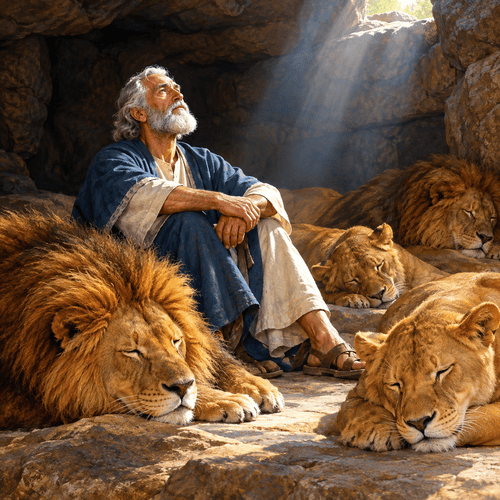
| 6 | The lions’ den | A faultless servant, a sealed stone, alive at dawn | Picture |
| 7 | Four beasts and the Son of Man | The Son of Man who comes with the clouds and receives an everlasting kingdom | Jesus claims it |
| 8 | The ram and the goat | A proud king rises against “the Prince of princes” (8:25) | Possible appearance |
| 9 | Daniel’s prayer and the seventy weeks | “An anointed one shall be cut off”—the Messiah’s death | Clear prophecy |
| 10 | The man clothed in linen | A shining heavenly man who looks like the risen Jesus | Possible appearance |
| 11 | Wars between kings | God rules every step of history on the road to the Messiah | Picture |
| 12 | The time of the end | The resurrection of the dead, which Jesus applies to Himself | Clear prophecy |
Level 1: Jesus Claims It—The Son of Man (Daniel 7)
This is the strongest link, because Jesus Himself pointed here. Daniel sees four terrifying beasts—four human empires. Then the scene moves to heaven:
“I saw in the night visions, and behold, with the clouds of heaven there came one like a son of man, and he came to the Ancient of Days and was presented before him. And to him was given dominion and glory and a kingdom, that all peoples, nations, and languages should serve him” (Daniel 7:13–14, ESV)
Jesus’ Favourite Name for Himself
Jesus calls Himself “the Son of Man” around eighty times in the Gospels. Many think it simply means “I am human.” But the Dutch-American scholar Geerhardus Vos argued it was not a humble title at all. Drawn from Daniel 7, it spoke of a heavenly King coming in glory.
The Words That Led to the Cross
Now go back to that trial:
“Again the high priest asked him, “Are you the Christ, the Son of the Blessed?” And Jesus said, “I am, and you will see the Son of Man seated at the right hand of Power, and coming with the clouds of heaven.”” (Mark 14:61–62, ESV)
The high priest tore his clothes and cried, “You have heard his blasphemy” (Mark 14:64). Why? In the Old Testament, riding on the clouds is something only God does (Psalm 104:3; Isaiah 19:1). Jesus was claiming to be Daniel’s heavenly figure who shares God’s throne. The high priest understood perfectly. He simply refused to believe.
A Man Who Receives Worship
In Daniel 7:14 all peoples “serve” Him. The Aramaic word, pelach, always describes worship elsewhere in Daniel—it is the word used when Daniel’s friends refused to “serve” the king’s gods (3:12).
So here is someone truly human who receives worship that belongs only to God. The only answer is God the Son, who became man. No wonder the risen Jesus said, “All authority in heaven and on earth has been given to me” (Matthew 28:18).
Jesus Shares the Glory of the Ancient of Days
The “Ancient of Days” is God on His throne, with hair “like pure wool” (7:9). Yet in Revelation 1:14, the risen Jesus has hair “like white wool”. The Son carries the Father’s glory, because they’re one God.
NOT JUST A CHRISTIAN IDEA
The Talmud (a large collection of Jewish teaching) reads Daniel 7:13 as the Messiah in Sanhedrin 98a: if Israel is worthy, he comes “with the clouds of heaven”; if not, riding humbly on a donkey. Jewish writings like 1 Enoch and 4 Ezra agree. Jesus fulfilled a hope that was already there.
Level 2: Clear Prophecies Fulfilled in Jesus
The Stone That Fills the Earth (Daniel 2)
Nebuchadnezzar dreams of a statue of gold, silver, bronze, iron and clay—most likely Babylon, Medo-Persia, Greece and Rome. Then “a stone was cut out by no human hand” and smashed it (2:34). It became a mountain filling the earth: “a kingdom that shall never be destroyed” (2:44). This happens in the days of the fourth kingdom. Jesus was born under Rome and began preaching, “The time is fulfilled, and the kingdom of God is at hand” (Mark 1:15).
Jesus used the stone picture about Himself: “when it falls on anyone, it will crush him” (Luke 20:18). A stone cut by no human hand fits a King born of a virgin, whose kingdom grows by the gospel, not armies.
The 70 Weeks (Daniel 9)
Daniel prays, and the angel Gabriel answers. “Weeks” here means “7s” of years, so 70 weeks means 490 years. Daniel 9:24 lists 6 goals for this period:
| GOAL IN DANIEL 9:24 | WHAT IT MEANS | HOW JESUS FULFILLED IT |
|---|---|---|
| Finish transgression and end sin | Deal with sin once for all | He came “to put away sin by the sacrifice of himself” (Hebrews 9:26) |
| Atone for iniquity | Pay for wrongdoing and make peace with God | His blood is the atoning sacrifice (Romans 3:25) |
| Bring in everlasting righteousness | Give people a right standing with God that lasts forever | We become “the righteousness of God” in Him (2 Corinthians 5:21) |
| Seal vision and prophet | Complete and confirm what the prophets said | Everything written about Him “must be fulfilled” (Luke 24:44) |
| Anoint a most holy place | Set apart God’s true dwelling place | Jesus was anointed by the Spirit (Acts 10:38) and is the true temple (John 2:19–21) |
Then comes the striking line: “an anointed one shall be cut off” (9:26). “Cut off” means killed. The Messiah would die.
Timeline: Counting the Seventy Weeks
- 457 BC: Artaxerxes sends Ezra to restore Jerusalem (Ezra 7). The count begins.
- AD 27 (after 69 weeks, or 483 years): Jesus is baptised and anointed by the Spirit.
- AD 30–31 (mid-70th week): Jesus is “cut off” at the cross, putting “an end to sacrifice” (9:27; Hebrews 10:18).
- AD 70: Rome destroys “the city and the sanctuary” (9:26).
Start dates vary slightly, but the natural counts land in Jesus’ lifetime. Edward J. Young defended this reading at length. Meredith G. Kline added that the “strong covenant” of 9:27 is not a future villain’s deal but the new covenant, confirmed by the Messiah’s death. (See our post on Daniel’s 70 Weeks.)
The Resurrection of the Dead (Daniel 12)
“And many of those who sleep in the dust of the earth shall awake, some to everlasting life, and some to shame and everlasting contempt.” (Daniel 12:2, ESV)
Jesus took these words and applied them to Himself: “all who are in the tombs will hear his voice and come out” (John 5:28). Daniel promised the dead would rise. Jesus says, “Mine is the voice that will wake them.”
Level 3: Pictures of Jesus in Daniel’s Life
Daniel is not Jesus, but God shaped his life as a preview—most clearly in the lions’ den.
| DANIEL IN THE LIONS’ DEN (DANIEL 6) | JESUS AT THE CROSS AND THE TOMB |
|---|---|
| Enemies look for a fault but find none (6:4) | Pilate says, “I find no guilt in this man” (Luke 23:4) |
| Accused because he stays faithful to God (6:5) | Accused of blasphemy for telling the truth (Mark 14:64) |
| The king wants to save him but gives in (6:14–16) | Pilate wants to release Him but gives in (Luke 23:20–24) |
| A stone is placed and sealed (6:17) | The tomb is sealed with a stone and a guard (Matthew 27:66) |
| At dawn, Daniel is found alive (6:19–22) | Early on the first day, the tomb is empty (Mark 16:2–6) |
WHERE THE PICTURE FALLS SHORT
Daniel was saved from death; Jesus went through it. Daniel confessed, “we have sinned” (9:5); Jesus was sinless. Daniel’s accusers were thrown to the lions; Jesus took the punishment so His enemies could be forgiven.
In Chapter 9, Daniel prays for his sinful people, picturing Jesus, who “always lives to make intercession” (Hebrews 7:25). Iain M. Duguid warns against turning Daniel into “be brave like Daniel” lessons. The hero is God, and the hope is the King who’s faithful where we fail.
Level 4: Possible Appearances of Jesus
Here faithful Christians disagree, so we hold these loosely.
- The fourth man in the fire (3:25): The king saw one “like a son of the gods”. But he was a pagan, and later called the figure an “angel” (3:28). It may be an angel or the Angel of the LORD, who speaks as God (Exodus 3). Either way, God was in the fire with His people (Isaiah 43:2).
- The man clothed in linen (10:5–6): He looks like the risen Jesus of Revelation 1 (table below). Yet in 10:13 he needs Michael’s help, so many think he is a high angel.
- Michael (10:13; 12:1): John Calvin was open to seeing Michael as Christ. But Jude 9 calls Michael an “archangel”, and Hebrews 1 puts the Son far above angels. Some groups use this link to deny Jesus is fully God, so we never build on it.
| DANIEL 10:5–6 | REVELATION 1:13–15 (THE RISEN JESUS) |
|---|---|
| Clothed in linen | Clothed with a long robe |
| A belt of fine gold around his waist | A golden sash around his chest |
| Eyes like flaming torches | Eyes like a flame of fire |
| Arms and legs like burnished bronze | Feet like burnished bronze |
| Words like the sound of a multitude | A voice like the roar of many waters |
OUR RULE OF THUMB
Build on what the New Testament clearly says. Enjoy the possible links, but never rest your case on them. Jesus in Daniel stands firm on Chapters 7, 9 and 12.
But Wasn’t Daniel Written After the Events?
Critical scholars often date Daniel to 165 BC, making its “predictions” history in disguise. The view does not hold:
- Jesus called him a prophet: “the prophet Daniel” (Matthew 24:15).
- Early copies: The Dead Sea Scrolls hold pieces of eight copies, and one (4Q174) cites “Daniel the prophet”. A new book would not spread so fast.
- History checks out: Critics doubted Belshazzar existed until the Nabonidus Cylinder named him as the king’s son. That’s why he could only offer the post of “third ruler” (5:29)—he was second. Robert Dick Wilson defended Daniel’s history for years.
- A late date does not help: Rome, the Messiah’s death and the temple’s fall in AD 70 all came after 165 BC.
The late date usually assumes prediction is impossible. If God knows the future, the objection falls.
How to Find Jesus in Daniel the Right Way
Jesus said the Scriptures “bear witness about me” (John 5:39). Commenting on that verse, Calvin wrote:
“We ought to read the Scriptures with the express design of finding Christ in them.” (John Calvin, commentary on John 5:39)
Benjamin B Warfield put it well:
“The Old Testament may be likened to a chamber richly furnished but dimly lighted; the introduction of light brings into it nothing which was not in it before; but it brings out into clearer view much of what is in it” (The Biblical Doctrine of the Trinity)
Christ switches on the light. Some guardrails help:
- Start with the New Testament: Let Jesus and the apostles show you where to look.
- Respect the first meaning: Ask what the passage meant to Daniel’s readers before you jump to Jesus.
- Separate proofs from pictures: Prophecy proves; types illustrate.
- Let Jesus be the hero: Daniel is faithful, but only Christ saves.
Why Jesus in Daniel Matters Today
Peter calls Christians “exiles” (1 Peter 1:1). Like Daniel, we’re pressed to bow to this world’s gods—money, power, the crowd. But its kingdoms are loud and temporary. The Son of Man’s kingdom “shall not be destroyed” (7:14). If you belong to Jesus, we can be faithful in Babylon without fear.
Conclusion: The Verse That Will Bring Him Back
The verse that led to Jesus’ death also promises His return: “you will see the Son of Man … coming with the clouds of heaven.” The court thought it had silenced Him. 3 days later the tomb was empty.
Jesus isn’t hidden in Daniel. He’s the stone that fills the earth, the Messiah who was cut off for sinners, the voice that will raise the dead and the Son of Man who rules forever. Let’s bow to Him now—before we see Him coming on the clouds.
Tough Questions, Honest Answers
Why did Jesus call Himself “Son of Man” more than “Son of God”?
Many Jews in Jesus’ day expected a warrior Messiah who’d drive out Rome. Titles like “Messiah” could stir up the wrong hopes, so Jesus often kept them quiet (Mark 8:29–30). “Son of Man” was different. To most listeners it sounded ordinary, but to those who knew Daniel 7 it carried the highest possible claim. It allowed Jesus to reveal Himself step by step, joining suffering (Mark 10:45) with future glory. By the time of His trial, no one could mistake what He meant.
Did Daniel understand he was writing about Jesus?
Only in part. Daniel himself says, “I heard, but I didn’t understand” (Daniel 12:8). Peter explains the prophets “searched and inquired carefully” about the person and time the Spirit of Christ was pointing to (1 Peter 1:10–11). Daniel knew God would send an anointed King and an everlasting kingdom. He didn’t know the name of Jesus or the details of Bethlehem and the cross. God, the true Author of Scripture, had bigger plans than any human writer could see at the time.
Does Daniel predict the Antichrist?
Daniel describes a proud “little horn” that speaks against God and attacks His people (7:8, 25), and a king who “shall exalt himself and magnify himself above every god” (11:36). Many of these words first fit Antiochus IV, a Greek king who defiled the temple in 167 BC. But Paul uses Daniel’s language for “the man of lawlessness” who is still to come (2 Thessalonians 2:3–4). So Daniel gives us a pattern: again and again, proud rulers rise against God. Each one points to a final enemy, and each one falls before the Son of Man.
Is the 70th week of Daniel still in the future?
Some teachers place a gap of 2000 years or more between the 69th and 70th weeks, so that the last 7 years become a future time of tribulation. But the text gives no hint of a gap. 70 weeks most naturally means seventy weeks in a row, just as the first 69 followed one after another. The best reading sees the 70th week fulfilled in Jesus’ ministry, His death and the new covenant He confirmed. This keeps the focus where Gabriel put it—on the Messiah and His finished work.
Why is Daniel not listed among the Prophets in the Hebrew Bible?
The Hebrew Bible has 3 sections: the Law, the Prophets and the Writings. Daniel sits in the Writings, probably because he served as a government official rather than preaching to Israel like Isaiah or Jeremiah. This doesn’t mean ancient Jews doubted his prophetic credentials. Jesus called him “the prophet Daniel” (Matthew 24:15), a Dead Sea Scroll calls him “Daniel the prophet”, and Josephus counted him among the greatest prophets. The ancient Greek translation of the Old Testament, like our English Bibles, placed Daniel among the prophets.
Is the “Daniel Fast” biblical?
The popular “Daniel Fast” is a plant-based diet built on Daniel 1:12 and 10:3. Daniel did choose vegetables and water, but his aim wasn’t health or weight loss. He refused the king’s food so he wouldn’t “defile himself” (1:8) or be shaped by Babylon. Christians are free to fast this way, but the Bible doesn’t command it. The deeper lesson is Daniel’s loyalty to God, which points to Jesus, who said, “My food is to do the will of Him who sent me” (John 4:34).
Why is part of Daniel written in Aramaic?
Daniel 2:4 to 7:28 is written in Aramaic, the international language of the Babylonian and Persian empires. The rest of the book is in Hebrew. Many scholars note the Aramaic chapters speak about God’s rule over all the nations, so they’re written in the language the nations spoke. The Hebrew chapters focus more on Israel’s future. Either way, the switch shows God’s message was for the whole world—and the Son of Man’s kingdom includes “all peoples, nations, and languages” (7:14).
Related Reads
- Jesus in the Old Testament: Where He Appears In All 39 Books
- Jesus in Ezekiel: 8 Pointers to Christ
- Jesus in Hosea: The Husband Who Buys Back His Bride
- The Fourth Man in the Fire: Was It Really Christ?
- Daniel and Friends: What Their Babylonian Names Mean
- Additions to Daniel: Why Are Chapters 13 and 14 Not in the Bible?