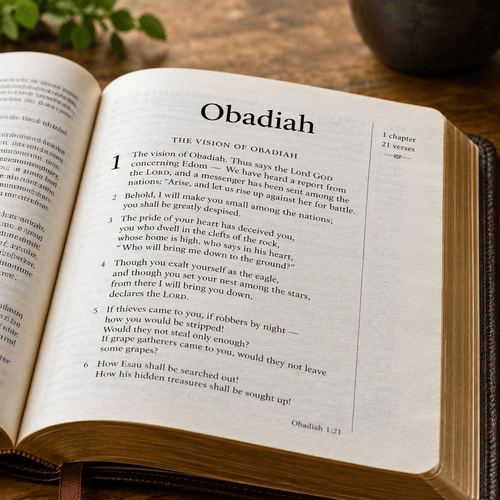
Here’s a strange fact. Obadiah is the shortest book in the Old Testament—all of 21 verses. It doesn’t mention the Messiah. And the New Testament doesn’t quote the book even once.
Yet, hundreds of years after Obadiah wrote, a king from Edom tried to kill the baby Jesus. About 30 years later, that king’s son laughed at Jesus on the day He died.
Was that an accident? Or was this tiny book telling part of a much bigger story—a story that ends with Jesus on the throne?
Obadiah isn’t just an angry poem about an old enemy. It’s a window into the whole Bible story. And at its centre stands Jesus Christ, the Saviour who conquers Edom.
Jesus in the Old Testament — Book 31 of 39
This post is the 31st instalment in our series tracing Christ through every book of the Old Testament. See the full series index.
Can We Really Find Jesus in Obadiah?
Let’s be honest. Obadiah has no clear promise that says, “The Messiah will come.” So should we look for Jesus here at all?
After He rose from the dead, Jesus taught His friends on the road to Emmaus to read the whole Old Testament with Him in view:
And beginning with Moses and all the Prophets, he interpreted to them in all the Scriptures the things concerning himself. (Luke 24:27, ESV)
“All the Scriptures” includes Obadiah. So let’s follow Obadiah’s storyline and let the New Testament show us where it ends.
KEY WORDS EXPLAINED
Type: a real person, place or event in the Old Testament that God designed to point forward to something greater in Christ. The Passover lamb was a real lamb, but it pointed to Jesus, “the Lamb of God” (John 1:29).
Allegory: finding secret meanings in small details (for example, “the eagle stands for the devil”). We avoid this. We only make connections the Bible itself confirms.
Sidney Greidanus, a respected teacher of preaching, argued the safest road from the Old Testament to Christ is the Bible’s own storyline—from promise to fulfilment. That’s the road we shall stick to.
Table 1: Obadiah at a glance—the basic facts before we start
| QUESTION | ANSWER |
|---|---|
| Who wrote it? | Obadiah, whose name means “servant of the LORD.” |
| How long is it? | One chapter, 21 verses—the shortest book in the Old Testament. |
| Who is it about? | Edom, a nation that came from Esau, the twin brother of Jacob (Israel). |
| What happened? | When enemies attacked Jerusalem, Edom cheered, stole and helped the enemy. |
| Main message | God will bring proud Edom down, rescue His people and set up His own kingdom. |
1. Two Brothers, Two Nations
Obadiah’s story begins with Rebekah, whose twin boys fought inside her womb. God explained why:
2 nations are in your womb, and 2 peoples from within you shall be divided; the one shall be stronger than the other, the older shall serve the younger. (Genesis 25:23, ESV)
The older twin, Esau, became the nation of Edom. The younger, Jacob, became the nation of Israel. Their fight lasted more than a 1,000 years.
Timeline: the long fight between Jacob and Esau
- As young men—Esau sells his birthright (his rights as the firstborn son) for one bowl of stew (Genesis 25:29–34).
- The wilderness years—Edom refuses to let Israel pass through its land on the way to Canaan (Numbers 20:14–21).
- The time of the kings—Edom rebels against Judah (2 Kings 8:20–22).
- 586 BC—Babylon destroys Jerusalem. Edom cheers and helps the attackers (Psalm 137:7; Obadiah 11–14).
This is more than a family quarrel. After Adam sinned, God promised a child of the woman who would crush the serpent (Genesis 3:15). From then on, the Bible shows a war between the family carrying that promise and those who hate it. Esau despised the promise (Hebrews 12:16), and his nation kept attacking the family through whom the Saviour would come.
Paul uses these brothers to show salvation depends on God’s free choice:
As it is written, “Jacob I loved, but Esau I hated.” (Romans 9:13, ESV)
This is election—God choosing, by grace alone, to save undeserving people. In Obadiah, Esau’s line finally meets God’s justice.
2. When Edom Met Jesus
Here’s the surprise. Edom didn’t disappear after Obadiah. It moved into southern Judah, an area later called Idumea—simply the Greek form of “Edom.”
Timeline: from Edom to the Herods
- About 400s BC—Arab tribes (the Nabataeans) push the Edomites into southern Judah.
- About 125 BC—Jewish ruler John Hyrcanus forces the Idumeans to follow Jewish law (recorded by the historian Flavius Josephus).
- 37 BC—Herod the Great, whose father Antipater was an Idumean, begins to rule as king of the Jews under Rome.
- About 5 BC—Wise men ask, “Where is he who has been born king of the Jews?” (Matthew 2:2). Herod kills the baby boys of Bethlehem to destroy the child (Matthew 2:16).
- About AD 30—Herod’s son, Herod Antipas, meets Jesus on the day of His death: “Herod with his soldiers treated him with contempt and mocked him” (Luke 23:11).
- AD 70 and after—Rome destroys Jerusalem. After this, the Idumeans vanish from history as a separate people.
THINK ABOUT IT: THE ANCIENT FIGHT COMES HOME
At Christmas, the man sitting on the throne of Israel was a son of Esau. The true King, lying in a manger, was a son of Jacob and of David.
The Edomite king tried to kill Him. The Edomite prince mocked Him. But Jesus rose—and Edom disappeared.
Obadiah had said it long before: “there shall be no survivor for the house of Esau, for the LORD has spoken” (Obadiah 18).
3. The Cup and the Returning Deeds
Next, Obadiah turns to the whole world and “the day of the LORD”—the time when God steps in to judge evil.
For the day of the LORD is near upon all the nations. As you have done, it shall be done to you; your deeds shall return on your own head. (Obadiah 15, ESV)
This is simple justice: the evil you throw at others lands back on you. Obadiah then says the nations “shall drink” (verse 16). In the Bible, “the cup” is a picture of God’s anger against sin.
Now listen to Jesus the night before the cross: “shall I not drink the cup that the Father has given me?” (John 18:11). Old Testament scholar Paige Patterson notes Jesus was taking up Obadiah’s very image.
THE GREAT EXCHANGE: HOW OBADIAH 15 IS TURNED UPSIDE DOWN AT THE CROSS
What we deserved: our evil deeds should “return on our own head” (Obadiah 15).
What Jesus did: He let our deeds land on His head instead. “He himself bore our sins in his body on the tree” (1 Peter 2:24).
What we receive: escape and holiness on Mount Zion (Obadiah 17)—the next point in our story.
4. Escape on Mount Zion
Then comes hope:
But in Mount Zion there shall be those who escape, and it shall be holy, and the house of Jacob shall possess their own possessions. (Obadiah 17, ESV)
Zion was the hill in Jerusalem where God’s temple stood—the place where God lives with His people. Obadiah is repeating Joel:
Everyone who calls on the name of the LORD shall be saved. For in Mount Zion and in Jerusalem there shall be those who escape. (Joel 2:32, ESV)
Peter quoted this verse at Pentecost (Acts 2:21), and Paul applied “the name of the LORD” to Jesus (Romans 10:9–13). So escape on Zion is found by calling on Jesus. Hebrews even tells Christians where they now stand:
But you have come to Mount Zion and to the city of the living God, the heavenly Jerusalem. (Hebrews 12:22, ESV)
Every believer, anywhere in the world, already stands on the true Mount Zion.
5. Saviours Go Up, and the Kingdom Is the LORD’s
Obadiah ends with this great verse:
Saviours shall go up to Mount Zion to rule Mount Esau, and the kingdom shall be the LORD’s. (Obadiah 21, ESV)
Who are these “saviours”? The Hebrew word is used in Judges for leaders like Othniel, “who saved them” (Judges 3:9). Such men rescued Israel for a while, then died, and trouble returned. They were small saviours pointing to one final Saviour. And notice: the kingdom is not “Israel’s” but “the LORD’s.” The New Testament shows it belongs to Jesus:
The kingdom of the world has become the kingdom of our Lord and of his Christ, and he shall reign forever and ever. (Revelation 11:15, ESV)
Why “saviours,” plural? Because Jesus shares His rule with His people (Matthew 19:28; Revelation 3:21).
WHAT SCHOLARS SAY ABOUT OBADIAH 21
John Calvin (1509–1564) read this verse as a promise about the kingdom of Christ. He saw the “saviours” as those God raises up to serve that kingdom—Christ above all, and after Him the preachers of the gospel.
Matthew Henry (1662–1714), the Puritan commentator, saw it fulfilled when the apostles went out from Jerusalem and brought God’s enemies under Christ’s gentle rule through the gospel.
The Greek Old Testament (the Septuagint) reads “men who have been saved.” Every human “saviour” is a saved sinner. Only Jesus saves without needing to be saved.
6. The Apostles’ Key: How the New Testament Reads Edom
This is the strongest evidence, because it comes from the apostles. In the Hebrew Bible, the 12 short prophets form one scroll, the Book of the Twelve. There, Obadiah comes straight after Amos—whose last promise is about Edom:
In that day I will raise up the booth of David that is fallen … that they may possess the remnant of Edom and all the nations who are called by my name. (Amos 9:11–12, ESV)
Then Obadiah picks up the same idea: God’s people “shall possess Mount Esau” (Obadiah 19). The 2 books are linked on purpose.
In Acts 15, the church met to decide whether non-Jewish believers (Gentiles) must become Jews. James settled it by quoting Amos 9 from the Greek Old Testament:
After this I will return, and I will rebuild the tent of David that has fallen … that the remnant of mankind may seek the Lord, and all the Gentiles who are called by my name. (Acts 15:16–17, ESV)
Why “mankind”? In Hebrew, Edom and adam (“mankind”) are written with almost the same letters. Guided by the Holy Spirit, James used the Greek reading to show what God always meant.
Table 2: Amos 9:12 in Hebrew compared with James’s quotation in Acts 15
| QUESTION | AMOS 9:12 (HEBREW TEXT) | ACTS 15:17 (JAMES, QUOTING THE GREEK) |
|---|---|---|
| Who is in view? | The remnant of Edom | The remnant of mankind |
| What happens to them? | God’s people “possess” them | They “seek the Lord” |
| What does it mean in Christ? | God’s enemies come under His rule | Gentiles are saved and join God’s people |
So “possessing Edom” is fulfilled when people from every nation believe in Jesus. Mount Esau is conquered not with swords but with the gospel. O. Palmer Robertson, in The Israel of God, argues that the New Testament regularly applies Israel’s kingdom promises to Christ and His people from every nation, just as James does here.
7. The Warrior Who Comes from Edom
Isaiah pictures God returning from battle in Edom:
Who is this who comes from Edom, in crimsoned garments from Bozrah … “It is I, speaking in righteousness, mighty to save.” (Isaiah 63:1, ESV)
Bozrah was Edom’s capital. “Crimsoned” means dark red. Now see Jesus riding out to judge the world:
He is clothed in a robe dipped in blood, and the name by which he is called is The Word of God. (Revelation 19:13, ESV)
Same picture. Edom became a symbol of every proud enemy of God, and Obadiah’s “day of the LORD” ends when Jesus returns to defeat all evil. Teachers differ on whose blood is on His robe, but either way, the One who saves is also the One who judges.
8. The Brother Who Didn’t Stand Aloof
The saddest words in Obadiah describe how Edom treated his own brother:
On the day that you stood aloof, on the day that strangers carried off his wealth and foreigners entered his gates and cast lots for Jerusalem, you were like one of them. (Obadiah 11, ESV)
To “stand aloof” means to stand at a distance and refuse to help. Compare Edom with Jesus, our true Brother:
Table 3: Edom, the false brother, compared with Jesus, the true Brother
| WHAT EDOM DID | WHERE IN OBADIAH | WHAT JESUS DID |
|---|---|---|
| Stood far away | Verse 11 | Came near to us and “is not ashamed to call them brothers” (Hebrews 2:11) |
| Was proud: “Who will bring me down?” | Verse 3 | “Humbled himself by becoming obedient to the point of death” (Philippians 2:8) |
| Laughed at his brother’s pain | Verse 12 | Wept over Jerusalem (Luke 19:41) |
| Stole from his brother | Verse 13 | Became poor so that we might become rich (2 Corinthians 8:9) |
| Handed survivors over to the enemy | Verse 14 | Was handed over Himself to rescue sinners (Romans 4:25) |
God told Edom, “from there I will bring you down” (Obadiah 4). Mary sang the same truth about Jesus’ coming (Luke 1:52). Pride is Edom’s way; humility is Christ’s.
9. What About the Land?
Obadiah 19–20 lists places God’s people will possess. Some Christians expect this to happen in the modern land of Israel.
But in the New Testament the promise grows. Abraham is “heir of the world” (Romans 4:13), and the meek “shall inherit the earth” (Matthew 5:5). In Christ, God’s people receive not a strip of land but the whole renewed creation.
Why Obadiah Still Matters Today
- Justice and mercy side by side: in the very next book, Jonah, God spares Nineveh, capital of cruel Assyria. Both truths meet at the cross.
- A warning against gloating: Christians must never enjoy the fall of others (Obadiah 12).
- Comfort for suffering believers: if you are attacked for your faith, God sees and will act.
Table 4: Summary—where we see Jesus in Obadiah
| WHAT OBADIAH SAYS | HOW IT IS FULFILLED IN JESUS | KEY NEW TESTAMENT TEXT |
|---|---|---|
| Esau’s line fights Jacob’s line (v. 10) | An Edomite king tries to kill the Son of Jacob and David | Matthew 2:16 |
| Deeds return on the head (v. 15) | Jesus takes our deeds on His own head | 1 Peter 2:24 |
| Escape on Mount Zion (v. 17) | All who call on Jesus are saved | Romans 10:13 |
| Possess Mount Esau (v. 19) | Gentiles are brought to God through the gospel | Acts 15:16–17 |
| The kingdom shall be the LORD’s (v. 21) | The kingdom belongs to Christ forever | Revelation 11:15 |
Conclusion: The Last Word Belongs to the King
Obadiah begins with a proud nation in its rocky nest and ends with a Saviour on Mount Zion. The Edomite king had a palace; Jesus had a manger. But the palace is now dust, and Edom is gone. Jesus is risen, and His kingdom is growing in every nation.
So which side of the story are we on? Are we trusting in our own “high rock” like Edom? Or have we called on the Lord Jesus and found safety on Mount Zion? In the end, just as Obadiah promised, the kingdom shall be the LORD’s.
Tough Questions, Honest Answers
Is the prophet Obadiah the same man as the Obadiah in 1 Kings 18?
Probably not. The Obadiah in 1 Kings 18 was a servant in King Ahab’s palace who hid 100 prophets from Queen Jezebel. The name Obadiah was very common in Israel—at least a dozen different men carry it in the Old Testament. The book tells us nothing about the prophet’s family, home or job. This silence is helpful: it keeps our eyes on the message, not the messenger. His name, “servant of the LORD,” is all we need to know.
When was the book of Obadiah written?
Bible scholars hold two main views. Some date it around 845 BC, when Edom rebelled against King Jehoram of Judah (2 Kings 8:20–22). Most date it soon after 586 BC, when Babylon destroyed Jerusalem and Edom joined in (Psalm 137:7). The details in verses 11–14—foreigners casting lots for Jerusalem, survivors handed over—fit the Babylonian attack very well. Either way, the message does not change: God sees how people treat His people, and He will act.
Where was Edom, and can we visit it today?
Edom lay south and east of the Dead Sea, in what is now southern Jordan. It was a land of red sandstone mountains and deep valleys, which made it very hard to attack. The famous rock city of Petra is in this region, though the buildings we see today were carved later by the Nabataeans. Archaeologists have also dug at Bozrah (modern Busayra), Edom’s old capital. Visitors can still see why Edom felt so safe “in the clefts of the rock” (Obadiah 3)—and how empty those rocks are today.
Why are Obadiah and Jeremiah 49 so similar?
Many lines in Obadiah 1–9 also appear in Jeremiah 49:7–22, which is another prophecy against Edom. Scholars debate who used whom: one prophet may have borrowed from the other, or both may have used an older prophecy. This is not a problem for the Bible’s trustworthiness. The Holy Spirit often repeats important warnings through more than one prophet. Two witnesses saying the same thing make the message stronger, not weaker.
What is “Sepharad” in Obadiah 20?
Obadiah 20 says “the exiles of Jerusalem who are in Sepharad” will return and possess the land. Nobody knows for certain where Sepharad was. Many scholars think it was Sardis, a city in what is now western Turkey. Later Jewish tradition linked the name to Spain, which is why Jews from Spain are still called Sephardic Jews. The point is clear, though: however far God’s people are scattered, He will gather them home.
Did God really “hate” Esau?
When Malachi and Paul say “Esau I hated” (Malachi 1:3; Romans 9:13), they are using a Hebrew way of speaking about choice. To “love” one and “hate” the other means to choose one and not the other for a special purpose. Jesus used the same kind of language when He said we must “hate” our parents to follow Him (Luke 14:26)—meaning we love Him far more. God chose Jacob’s line to bring the Saviour, and He did it by free grace, not because Jacob was better. At the same time, Esau and Edom were fully responsible for their own pride and cruelty.
Was it fair for God to punish Edom when Judah also sinned?
Yes. God did punish Judah first—that’s exactly why Babylon was allowed to destroy Jerusalem. But being God’s tool of judgement did not give Edom the right to enjoy it, steal from it or add to the cruelty. Edom acted out of hatred, not out of love for justice. God holds every nation responsible for its own sins (Obadiah 15). And the good news is that at the cross, both Jews and Gentiles can find the same mercy in the same Saviour.