Imagine asking Jesus for proof—one clear sign that He really is who He claims to be.
He’d already healed the sick, opened blind eyes and fed thousands. Yet when the religious leaders asked for a sign, He didn’t point to any of these miracles. He pointed to a runaway prophet, a violent storm and a man swallowed by a fish.
We’ve all heard people laugh at the story of Jonah and call it a fairy tale. But Jesus placed His own death and resurrection right next to it. In simple words, He was saying, “If you want to understand Me, understand Jonah.”
So let’s walk through Jonah’s 4 short chapters—the storm, the fish, the city and the angry prophet. At every step we’ll find Someone greater than Jonah.
Jesus in the Old Testament — Book 32 of 39
This post is the 32nd instalment in our series tracing Christ through every book of the Old Testament. See the full series index.
The Only Sign Jesus Would Give
Here’s how Jesus answered the demand for proof:
“An evil and adulterous generation seeks for a sign, but no sign will be given to it except the sign of the prophet Jonah. For just as Jonah was 3 days and 3 nights in the belly of the great fish, so will the Son of Man be 3 days and 3 nights in the heart of the earth. The men of Nineveh will rise up at the judgement with this generation and condemn it, for they repented at the preaching of Jonah, and behold, something greater than Jonah is here.” (Matthew 12:39–41)
Notice 3 things:
- Jonah is a sign: A road sign is not the city, but it points you to the city. Jonah points to Jesus.
- The 3 days matter: Jonah’s time inside the fish pictures Jesus’ time in the grave.
- Jesus is greater: Jonah was only the picture. Jesus is the real thing.
After His resurrection, Jesus taught His disciples to read the whole Old Testament this way: “beginning with Moses and all the Prophets, he interpreted to them in all the Scriptures the things concerning himself” (Luke 24:27). So when we look for Jesus in Jonah, we’re not inventing clever ideas. We’re reading the Bible the way Jesus taught us to.
KEY TERM: WHAT IS A “TYPE”?
A type is a real person, event or object in the Old Testament that God designed to point forward to Christ. Think of a shadow: it’s real, but it only shows the outline of something bigger coming behind it. Old Testament patterns “are a shadow of the things to come, but the substance belongs to Christ” (Colossians 2:17).
How to Read Jonah Without Getting Carried Away
Some writers seem to find Jesus in every rope and wave in the book of Jonah. That only helps sceptics say we’re making things up. So we follow two rules:
- Real likeness: The link must be in the Bible text, not just in our imagination.
- Greater fulfilment: Christ is always greater than the picture. This means the differences between Jonah and Jesus matter as much as the likenesses.
Table 1: How sure can we be about each link between Jonah and Jesus?
| HOW SURE? | WHAT THIS MEANS | EXAMPLES FROM JONAH |
|---|---|---|
| Certain | The New Testament says it directly | The sign of Jonah; the three days and nights; “greater than Jonah” |
| Strong | Clear word links and patterns in the text | The storm; one man thrown into the sea to save others; Jonah “going down”; “Salvation belongs to the LORD” |
| Possible | Interesting, but not proof | Jonah means “dove”; his father Amittai’s name means “truth” |
We build our case only on the first 2 rows.
THOUGHT TO PONDER
Edmund Clowney, who trained a generation of pastors to preach Christ from the Old Testament, warned against 2 opposite mistakes: ignoring Christ there, and forcing Him into every tiny detail. The safe path, he taught, is to follow the big story line God Himself shaped—because it leads to His Son.
The Storm: A Sleeping Man and a Sinking Ship
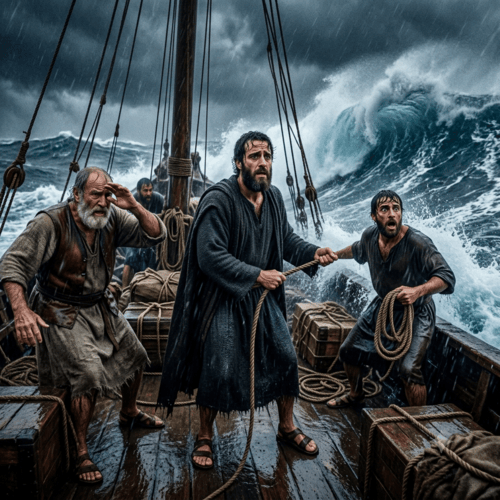
God sent Jonah east to Nineveh, a great city of Assyria, Israel’s cruel enemy. Jonah ran the other way. He “went down to Joppa and found a ship going to Tarshish” (Jonah 1:3), a far-away port in the west.
But no one outruns God. “The LORD hurled a great wind upon the sea” (Jonah 1:4). While the sailors cried to their gods, Jonah was “fast asleep” (Jonah 1:5). Centuries later, Jesus also slept in a boat during a great storm. The comparison is striking:
Table 2: Two storms, two sleepers—how Jonah and Jesus compare
| QUESTION | JONAH IN THE STORM (JONAH 1) | JESUS IN THE STORM (MARK 4) |
|---|---|---|
| Why was he asleep? | He was running away from God | He was resting in His Father’s care |
| What did people say to him? | “What do you mean, you sleeper?” | “Teacher, do you not care that we are perishing?” |
| What stopped the storm? | Jonah was thrown into the sea | Jesus spoke: “Peace! Be still!” |
| How did people respond? | “The men feared the LORD exceedingly” | “They were filled with great fear” |
Now look at the most amazing moment. Jonah said: “Pick me up and hurl me into the sea; then the sea will quiet down for you” (Jonah 1:12). They did, and “the sea ceased from its raging” (Jonah 1:15). One man went down into the deep, and everyone else was saved. Then those pagan sailors “offered a sacrifice to the LORD and made vows” (Jonah 1:16). Outsiders came to worship the true God because one man was thrown into the waters of judgement.
That’s the gospel in picture form. But notice the difference. Jonah admitted, “it is because of me that this great tempest has come upon you” (Jonah 1:12). Jonah deserved the storm. Jesus didn’t. Jonah suffered for his own sin. Jesus suffered for ours: “while we were still sinners, Christ died for us” (Romans 5:8).
KEY TERM: SUBSTITUTE
A substitute takes another person’s place. Jesus died as our substitute, taking the punishment we deserved: “Christ also suffered once for sins, the righteous for the unrighteous, that he might bring us to God” (1 Peter 3:18).
The Fish: Down, Down, Down—and Up Again
“And the LORD appointed a great fish to swallow up Jonah. And Jonah was in the belly of the fish three days and three nights” (Jonah 1:17). Notice the word “appointed”. Later God also appoints a plant, a worm and an east wind (Jonah 4:6–8). In Jonah, nothing happens by chance.
KEY TERM: PROVIDENCE
Providence means God’s constant care and control over everything He has made. Nothing is outside His plan—not storms, not fish and not even the cross, which happened “according to the definite plan and foreknowledge of God” (Acts 2:23).
Timeline: Jonah’s Journey Down
- Jonah 1:3: He “went down to Joppa”.
- Jonah 1:3: He “went down into” the ship.
- Jonah 1:5: He “had gone down into the inner part of the ship”.
- Jonah 2:6: He “went down to the land whose bars closed upon me forever”.
The Hebrew word yarad (“go down”) keeps showing up. Each step took Jonah further from God and closer to death. Jesus also went down—from heaven, to a manger, to a cross, to a grave. He “humbled himself by becoming obedient to the point of death” (Philippians 2:8). But Jonah went down running from God. Jesus went down obeying Him.
Inside the fish, Jonah prayed: “out of the belly of Sheol I cried, and you heard my voice” (Jonah 2:2). Sheol is the Hebrew word for the place of the dead. Jonah was as good as dead. Then he says, “yet you brought up my life from the pit” (Jonah 2:6). This is resurrection language.
Scholar Michael W Andrews suggests Jesus’ descent “into the heart of the earth” began even before He died—in Gethsemane, where He said, “My soul is very sorrowful, even to death” (Matthew 26:38).
Jonah’s prayer ends with one of the greatest lines in the Bible: “Salvation belongs to the LORD!” (Jonah 2:9). Then the fish “vomited Jonah out upon the dry land” (Jonah 2:10). Jonah came up alive, just as Jesus came out of the grave alive. Yet Jonah would die again one day, while “Christ, being raised from the dead, will never die again” (Romans 6:9).
THOUGHT TO PONDER
In 1858 Charles Spurgeon preached a whole sermon on Jonah 2:9. He called this short verse the sum and substance of true theology. Salvation is God’s work from beginning to end: God plans it, God achieves it through Christ and God applies it to us. Fittingly, the name Jesus means “the LORD saves” (see Matthew 1:21).
“3 Days and 3 Nights”—Does the Maths Work?
Some object that Jesus died on Friday afternoon and rose early on Sunday—far less than 72 hours. Was He wrong? No:
- Part of a day counted as a whole day: The Jerusalem Talmud records Rabbi Eleazar ben Azariah (around AD 100) teaching exactly this.
- The Bible counts this way: Esther asked for a fast “for three days, night or day” (Esther 4:16), yet went to the king “on the third day” (Esther 5:1).
- Jesus used the phrases as the same thing: “on the third day” (Matthew 16:21), “after three days” (Mark 8:31) and “three days and three nights” (Matthew 12:40).
- His enemies understood it this way: Remembering “After three days I will rise,” they guarded the tomb “until the third day” (Matthew 27:63–64).
Table 3: How the Jews of Jesus’ day counted the three days
| DAY | WHAT HAPPENED | COUNTED AS |
|---|---|---|
| Friday | Jesus died and was buried before sunset | Day 1 |
| Saturday | Jesus’ body lay in the tomb | Day 2 |
| Sunday | Jesus rose early in the morning | Day 3 |
There is no need to move the crucifixion to a Wednesday. Friday to Sunday fits Jesus’ words perfectly.
The City: When Enemies Repent
God gave Jonah a second chance, and this time he went. His sermon was only five words in Hebrew: “Yet forty days, and Nineveh shall be overthrown!” (Jonah 3:4). Shockingly, “the people of Nineveh believed God” (Jonah 3:5). From king to beggar, they fasted and wore sackcloth, rough clothing that showed sorrow for sin. And God spared them.
This is Jesus’ point in Matthew 12:41. The Ninevites repented after a runaway prophet preached a five-word sermon with no miracles. Jesus’ hearers had the Son of God Himself before them—and still refused. So the Ninevites will condemn them at the judgement. The same warning stands for us.
There is a sharp irony too. The leaders said, “no prophet arises from Galilee” (John 7:52). Yet Jonah came from Gath-hepher in Galilee (2 Kings 14:25), a few kilometres from Nazareth. Galilee had given Israel a prophet—and now One greater than Jonah.
DID YOU KNOW? FROM JOPPA TO THE NATIONS
Jonah sailed from Joppa to avoid the Gentiles (non-Jewish people). About eight hundred years later, in the same town, the apostle Peter received a vision sending him to the Gentiles (Acts 10). What Jonah refused, Christ’s apostle did gladly.
The Angry Prophet and the Weeping Saviour
The book does not end happily. When Nineveh was spared, Jonah “was angry” (Jonah 4:1), and he told God why he had run: “I knew that you are a gracious God and merciful, slow to anger and abounding in steadfast love” (Jonah 4:2). Jonah knew God well. He just did not like God’s mercy towards his enemies. So he sat outside the city, hoping to watch judgement fall (Jonah 4:5).
Table 4: Jonah and Jesus at the city—the great contrast
| POINT OF COMPARISON | JONAH | JESUS |
|---|---|---|
| Feelings towards the city | Angry that it was spared | Wept over Jerusalem (Luke 19:41) |
| Place outside the city | Sat outside, waiting for judgement to fall on others (Jonah 4:5) | Suffered “outside the gate”, taking judgement on Himself (Hebrews 13:12) |
| Attitude to enemies | Wanted them destroyed | Prayed, “Father, forgive them” (Luke 23:34) |
| Attitude to God’s mission | Ran away from it | “Not my will, but yours, be done” (Luke 22:42) |
Tim Keller, in his book The Prodigal Prophet, showed that Jonah behaves like the older brother in Jesus’ parable of the prodigal son (Luke 15). Both are proud of their obedience. Both are angry at grace for “bad” people. And both stories end with an unanswered question, left for us to answer.
God’s final question is: “should not I pity Nineveh, that great city?” (Jonah 4:11). Jesus is God’s full answer. His pity for sinners was so great that He sent His own Son into the storm.
Did It Really Happen?
Some say Jonah is only a parable, a made-up story with a lesson. But this view runs straight into Jesus. He said the men of Nineveh “will rise up at the judgement” (Matthew 12:41). Made-up people cannot condemn real people at a real judgement. And if Jonah’s rescue is fiction, the sign of Jonah points to nothing solid. The Bible also places Jonah in real history, in the reign of King Jeroboam II of Israel, around 793–753 BC (2 Kings 14:25).
WHAT HISTORY TELLS US
Under King Ashur-dan III (about 772–755 BC), Assyria faced revolts, disease and a total eclipse of the sun on 15 June 763 BC—which Assyrians read as a sign of divine anger. The British scholar Donald Wiseman suggested such events may explain why Nineveh listened to a foreign prophet. This does not prove the story, but it fits it well. (See our post on the archaeology of Nineveh.)
Around AD 409, Augustine answered pagans who mocked the fish story. If you reject Jonah because it is a miracle, he argued, you must also reject Christ’s resurrection. The real question is not “Could a fish swallow a man?” but “Is there a God who does miracles?” If Jesus rose, a fish is a small thing.
What Jonah Teaches Us Today
- God is in control: Storm, fish, plant and worm were all “appointed”. So is your life.
- Salvation is God’s work: We cannot earn it. We can only receive it.
- No one is too far gone: Pagan sailors, a cruel city and a runaway prophet all found mercy.
- We are more like Jonah than we think: We love grace for ourselves but resent it for our enemies.
- Jesus is the greater Jonah: He went willingly into the storm of God’s judgement so that we could be safe.
The leaders asked Jesus for a sign, and He gave them one. Three days after the cross, His tomb was empty. That same sign is given to our generation. Will we respond like the Ninevites, who believed and repented—or like the leaders who kept demanding more proof?
Something greater than Jonah is here.
Tough Questions, Honest Answers
Was it indeed a whale or just a big fish?
The Hebrew text of Jonah simply says “a great fish”. When Jesus spoke about Jonah, Matthew used the Greek word kētos, which means a large sea creature or sea monster. Older English Bibles like the King James Version translated this as “whale”, and the name stuck. The Bible doesn’t tell us the exact species. It doesn’t need to. The key point is “the LORD appointed” it (Jonah 1:17). This was God’s chosen creature, doing God’s chosen work at exactly the right time.
Can a person really survive inside a fish?
You may have heard the story of James Bartley, a sailor said to have survived inside a whale in 1891. Careful research shows this story can’t be confirmed, so we mustn’t use it as evidence. The Bible never claims Jonah survived by natural means. It presents his rescue as a miracle from start to finish. The God who made the sea (Jonah 1:9) can keep a man alive anywhere He chooses. And the God who raised Jesus from the dead isn’t limited by biology. Or in His options.
Did Jonah actually die inside the fish?
Bible teachers answer in 2 ways. Some say Jonah truly died and God raised him, because he speaks of “Sheol” and “the pit” (Jonah 2:2, 6). Most, however, see this as poetic language for being at death’s door, since Jonah prays from inside the fish. Either way, the picture still points to Christ. Jonah went down to the edge of death and came back up. Jesus went all the way into death and rose again, which is why He is greater.
Did God change His mind about destroying Nineveh?
Jonah 3:10 says God “relented of the disaster” He had spoken of. Yet the Bible also teaches that God does not change (Malachi 3:6) and is not like a man who changes his mind (Numbers 23:19). The answer is that God’s warnings often carry an unspoken “unless you repent”. God explains this in Jeremiah 18:7–8. God did not change His plan. His plan always included both the warning and the repentance He would give Nineveh through that warning.
Where’s Jonah’s tomb today?
A long tradition places Jonah’s tomb at Nebi Yunus (“Prophet Jonah”) in Mosul, Iraq, near the ruins of ancient Nineveh. In 2014 the terrorist group ISIS blew up the shrine. Afterwards, tunnels they had dug revealed an Assyrian royal palace hidden underneath, which archaeologists have since studied. We can’t be sure Jonah is really buried there, as many burial traditions are uncertain. Our faith doesn’t rest on finding Jonah’s grave. It rests on the empty tomb of Jesus.
What happened to Nineveh after Jonah?
Sadly, Nineveh’s repentance didn’t last. Over time Assyria returned to cruelty and even destroyed the northern kingdom of Israel in 722 BC. About a century after Jonah, prophet Nahum announced Nineveh’s final judgement. In 612 BC the city fell to the Babylonians and Medes, and it lay in ruins for centuries. This reminds us every generation must turn to God for itself. Past revival doesn’t save present hearts.
Who wrote the book of Jonah, and when?
The book doesn’t name the author. Jewish and Christian tradition has often linked it to Jonah himself, or to someone who knew his story well. Jonah lived in the 8th century BC under King Jeroboam II (2 Kings 14:25). Some critics date the book much later, after the exile, but their reasons aren’t convincing. The Hebrew style and the details about Nineveh fit an early date well. Most importantly, Jesus treated Jonah as a real prophet and the events as real history.
Related Reads
- Jesus in the Old Testament: Where He Appears In All 39 Books
- Jesus in Obadiah: The Saviour Who Conquers Edom
- Jesus in the Book of Micah: 7 Pointers to Christ
- Matthew 12:39-40: What Did Jesus Mean by the Sign of Jonah?
- Three Days and Three Nights: Did Jesus Get His Math Wrong?
- Nineveh Archaeology and the Bible: What the 2026 Digs Found