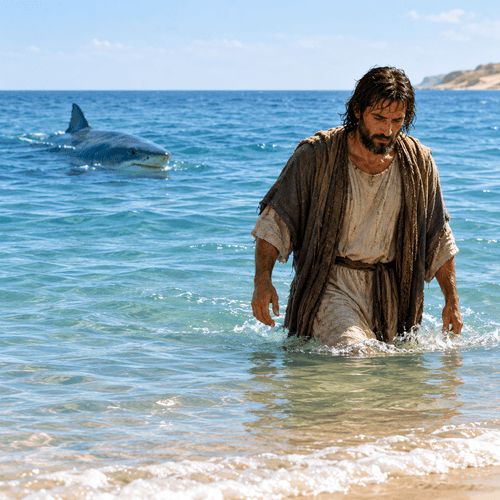
Here’s something that may surprise you. A man cannot live for 3 days inside a whale. Science says so. And so does the Bible.
Yes, you read that correctly. The Bible agrees nobody could survive what Jonah went through—not by ordinary means. That’s the whole point of the story. And once you see why, ‘Jonah and the whale’ stops being a joke. It becomes one of the clearest signposts to Jesus in the Bible.
In June 2021, a lobster diver named Michael Packard was working about 14 metres under the sea off Cape Cod, in the United States. Suddenly, everything went dark. He was inside the mouth of a humpback whale. He stayed there for about 30 seconds, still breathing through his diving equipment. Then the whale rose to the surface and spat him out. He went home with bruised legs.
Reporters around the world compared it to Jonah, and millions asked an old question again: could Jonah really survive in a whale? Let’s look honestly at what science says, what the Bible says, and why the 2 aren’t at war.
THE SHORT ANSWER
No human could survive 3 days inside a whale or a fish by natural means. There’s no air to breathe, and the stomach is built to digest flesh.
But the Bible never says Jonah survived naturally. It says God appointed the fish and kept Jonah alive. That’s a miracle—an act that only God can do. Science can tell us what nature normally does. It cannot tell us God is unable to act.
What Does the Bible Actually Say?
Many people only know the children’s version of the story. The real text is short and simple:
And the LORD appointed a great fish to swallow up Jonah. And Jonah was in the belly of the fish 3 days and 3 nights.
Jonah 1:17
3 things in this verse are worth noticing:
- It was a ‘great fish’, not necessarily a whale. The Hebrew words are dag gadol. Dag means a fish or sea creature, and gadol means big. The Bible doesn’t tell us the species.
- The Greek word is even wider. The early Greek translation of the Old Testament (called the Septuagint) used the word ketos, and so does Matthew 12:40. Ketos meant any huge sea creature—a whale, a large shark, or a ‘sea monster’. The word ‘whale’ came into English Bibles through the King James Version of 1611.
- God ‘appointed’ it. The Hebrew verb is manah. It means to assign, arrange or provide. The same verb returns when God appoints a plant (4:6), a worm (4:7) and a scorching east wind (4:8). Sea, plants, insects and weather all obey their Maker. The fish wasn’t a freak accident. It was a servant on duty.
John Calvin (1509–1564), the French Reformer, asked whether God created a brand-new fish just for Jonah. Perhaps not, he answered, but God certainly prepared it for this task. Then he made a striking admission: ‘it wasn’t according to the course of nature that the fish swallowed Jonah’.
John Owen (the 19th-century clergyman who translated Calvin’s commentary—not the famous Puritan) added it was a miracle either way: ‘To provide it, by bringing it to the spot, was as much a miracle as to provide it by a new act of creation.’
Could Any Sea Creature Swallow a Man?
First, a simpler question: could any sea creature swallow a grown man whole? Yes—but not every big one. The size of the mouth doesn’t matter. What matters is the width of the throat.
Which sea creatures could swallow a human whole?
| SEA CREATURE | COULD IT SWALLOW A MAN WHOLE? | WHY OR WHY NOT |
|---|---|---|
| Humpback whale | No | It has a huge mouth but a narrow throat. Michael Packard’s story shows a person can end up in its mouth—but not down its throat. |
| Blue whale | No | The largest animal ever, but a baleen whale. (Baleen whales have comb-like plates instead of teeth, used to sieve tiny krill from the water.) Its throat is far too narrow for a person. |
| Whale shark | No | It’s the largest living fish. But it feeds on plankton and small fish, and its throat is very narrow. |
| Sperm whale | Yes | It’s a toothed whale that hunts large prey and swallows giant squid whole. Its gullet (food pipe) is wide enough for a human body. |
| Great white shark | Possibly | Large adults can grow to about 6 metres. Older writers recorded human bodies found whole inside very large sharks. |
Surprisingly, Calvin studied the marine science of his own day. He quoted French naturalist William Rondelet, who thought Jonah’s fish was probably a ‘Lamia’, a large shark, inside which a man in armour had once been found.
Calvin concluded a whale, a large shark, ‘or a fish unknown to us’ could swallow a man whole. So the first half of Jonah’s story is no problem for science at all.
Could Jonah Survive in a Whale? What Science Says
Now the hard part. Suppose a sperm whale did swallow a man. Scientists point to five dangers he would face.
What would happen to a human inside a sperm whale?
| DANGER | WHAT IT WOULD DO TO A PERSON |
|---|---|
| No air | A whale’s stomach is not an air pocket. It holds fluid, half-digested food and gas, but almost no oxygen. A person would pass out within minutes. |
| Stomach acid | A sperm whale’s stomach has several chambers. The first is filled with strong acid and digestive juices that break down squid and fish. Human skin would soon begin to be damaged. |
| Crushing muscles | The walls of the throat and stomach squeeze food along. A human body would be pressed hard from every side. |
| Harmful gases | Bacteria in the whale’s gut produce gases such as methane. These would make breathing even harder. |
| Time | Experts agree that a person would die within minutes. Jonah was inside for three days and three nights. |
Some Christians feel nervous at this point. They shouldn’t. The Bible’s great teachers said exactly the same thing. Matthew Henry (1662–1714), whose Bible commentary is still loved by millions, put it in one beautiful line: ‘to nature this was impossible, but to the God of nature all things are possible.’
NOTICE WHAT’S HAPPENING HERE
The church’s Bible teachers didn’t wait for modern science to tell them Jonah’s survival was naturally impossible. They said it first—centuries ago.
They never claimed the fish was a comfortable submarine. They claimed God did something nature cannot do. Science has simply confirmed what they already admitted.
The ‘Modern Jonah’ Story We Should Stop Telling
You may have heard this in a sermon. In 1891, a sailor named James Bartley was swallowed by a sperm whale near the Falkland Islands. His shipmates later cut open the whale and found him inside—blinded and bleached white by stomach acid, but alive.
It’s a wonderful story. But it’s not true.
WHY THE JAMES BARTLEY STORY FAILS
- No whaling ship of that name. Historian Edward B. Davis investigated the story in 1991. He found no whaling ship called the Star of the East, the ship named in the story.
- Wrong place. There was a British ship with that name. But it was nowhere near the Falkland Islands at the time.
- No James Bartley on board. His name wasn’t on the ship’s crew list.
- The details keep changing. Different versions say he was inside the whale for 15 hours, 36 hours or two days.
Davis also traced how this tall tale found its way into Christian books and even into some respected Bible commentaries.
Why does this matter? Because we must never defend God’s Word with false stories. A sceptic who finds out Bartley is a myth may decide Jonah is a myth too.
Our case is stronger without Bartley. Jonah’s survival wasn’t a lucky accident that might happen again to some sailor. It was a one-off act of God, for a purpose.
Is ‘It Was a Miracle’ Just a Cop-Out?
Some people say, ‘Christians just shout “Miracle!” whenever science disagrees with them.’ That’s a fair challenge. So what exactly is a miracle?
Charles Hodge (1797–1878), who taught theology at Princeton for more than fifty years, gave a clear definition. A miracle, he wrote, is ‘an event, in the external world, brought about by the immediate efficiency, or simple volition of God.’ In plain English, a miracle is a real event that God does directly, without using the normal causes of nature.
KEY TERM: PROVIDENCE
Providence means God’s constant care and control over everything he has made. The Westminster Confession of Faith (1646), one of the great Protestant statements of belief, puts it like this:
‘God, in His ordinary providence, maketh use of means, yet is free to work without, above, and against them, at His pleasure.’
In simple words: God normally works through the ordinary laws of nature. But he is free to work without them, above them or even against them, whenever he chooses.
With that in mind, here are 4 reasons why ‘miracle’ is not a cop-out:
- Science describes; it doesn’t forbid. Science tells us what normally happens. It cannot prove that God never acts in an unusual way—that is a belief held before looking at any evidence. The Scottish philosopher David Hume (1711–1776) said miracles break the ‘laws of nature’. But if God made those laws, he is not trapped by them.
- The laws of nature are God’s faithful habits. Hebrews 1:3 says that Christ ‘upholds the universe by the word of his power’. Nature runs regularly because God is faithful. A miracle is the same God, always at work, choosing to act differently for a special purpose.
- The Bible itself calls it a miracle. The book of Jonah never pretends that the fish was normal. Jesus called it a ‘sign’. A sign that anyone could explain away would not be a sign at all.
- It fits a pattern. God parted the Red Sea. He kept Moses alive on Mount Sinai for forty days. As John Owen noted, Jonah’s rescue was ‘no greater reversion of nature’ than these.
Calvin wrote that Jonah ‘was received into the inside of the fish as though it were into an hospital’. In Calvin’s day, a hospital was a place of shelter for travellers. Calvin added that Jonah ‘was as safe as to his body, as though he were walking on land.’ The place built to destroy him became, by God’s command, his shelter.
Did Jonah Die Inside the Fish?
Some readers believe Jonah died inside the fish and God raised him to life. They point to his prayer:
I called out to the LORD, out of my distress, and he answered me; out of the belly of Sheol I cried, and you heard my voice.
Jonah 2:2
Sheol is a Hebrew word for the grave, or the place of the dead. Later Jonah also says, ‘yet you brought up my life from the pit, O LORD my God’ (Jonah 2:6). This view isn’t a heresy. But most Bible teachers through history have believed God kept Jonah alive, for 2 reasons:
- The narrator never says Jonah died. Something as huge as a resurrection would surely be stated plainly.
- Jonah’s prayer is poetry. The Psalms often use this kind of language for being rescued from near death. David sang, ‘O LORD, you have brought up my soul from Sheol; you restored me to life from among those who go down to the pit’ (Psalm 30:3). David had not literally died.
Calvin read it this way. He said Jonah ‘was not slain but languished in continual torments’. Jonah was alive, and painfully aware that he had run from God.
Either way, notice this: both views need a miracle. Whether God kept Jonah alive or raised him from death, only God could bring him out.
Jesus Staked His Resurrection on It
Here’s the strongest evidence of all. When religious leaders demanded a sign, Jesus answered:
An evil and adulterous generation seeks for a sign, but no sign will be given to it except the sign of the prophet Jonah. For just as Jonah was three days and three nights in the belly of the great fish, so will the Son of Man be three days and three nights in the heart of the earth. The men of Nineveh will rise up at the judgement with this generation and condemn it, for they repented at the preaching of Jonah, and behold, something greater than Jonah is here.
Matthew 12:39–41
In these few words, Jesus did 3 things:
- He treated Jonah’s 3 days as a real event, not as ‘the old story goes’.
- He made Jonah a picture of his own death and resurrection. As Jonah came out of the ‘grave’ of the fish, Jesus would rise from the tomb. Theologians call this a type—a real person or event in the Old Testament that God designed to point forward to Christ.
- He said the men of Nineveh will stand at the final judgement. Made-up characters don’t rise at the judgement. Jesus treated Nineveh’s repentance as history.
The Bible also places Jonah firmly in real history. Second Kings 14:25 names ‘Jonah the son of Amittai, the prophet, who was from Gath-hepher’. He prophesied during the reign of King Jeroboam II of Israel. John Gill (1697–1771), the English Baptist pastor and Bible scholar, drew the obvious lesson: ‘after this instance of divine power, why should it be thought a thing incredible that God should raise the dead?’
Timeline: How the Jonah Story Has Been Read Through History
- 8th century BC: Jonah son of Amittai prophesies in Israel during the reign of Jeroboam II (2 Kings 14:25).
- 1st century BC: The Jewish book of 3 Maccabees remembers how God watched over Jonah inside the sea creature and returned him unharmed.
- c. AD 30: Jesus calls Jonah’s three days in the fish the ‘sign’ of his own death and resurrection (Matthew 12:40).
- c. AD 93: The Jewish historian Josephus retells the event as history, saying Jonah came out ‘alive, and without any hurt upon his body’.
- 1550s: Calvin lectures on Jonah and calls the rescue a work done ‘contrary to the order of nature’.
What This Means for You
So, could Jonah have survived in a whale’s belly? Not by nature—on that, science and the Bible agree. But the Bible was never telling a story about a lucky man and a gentle fish. It was telling us about a God who rules the sea, chases runaway prophets and brings people up from the pit.
Jonah’s prayer ends with one of the greatest lines in the Bible: ‘Salvation belongs to the LORD!’ (Jonah 2:9). Jonah could not save himself. Neither can we. And the same God who brought Jonah out of the fish brought Jesus out of the tomb on the third day.
If Jesus truly rose from the dead, then Jonah’s fish is a small thing for God. The real question is not, ‘Could Jonah survive?’ It is this: ‘Will you trust the One who is greater than Jonah?’
Tough Questions, Honest Answers
What does ‘3 days and 3 nights’ mean if Jesus died on Friday and rose on Sunday?
In Bible times, Jewish people counted any part of a day as a whole day. Later Jewish teachers put it simply: part of a day counts as the whole day. We see this in Esther. She asked the Jews to fast ‘for 3 days, night or day’ (Esther 4:16), yet she went to the king ‘on the third day’ (Esther 5:1). Even Jesus’ enemies understood it this way. They remembered him saying, ‘After 3 days I will rise’, and so they asked for the tomb to be guarded ‘until the third day’ (Matthew 27:63–64). Friday, Saturday and Sunday fit the phrase perfectly.
Is the book of Jonah history or a parable?
Some modern scholars call Jonah a parable or a piece of satire. But the Bible gives us strong reasons to read it as history. Second Kings 14:25 names Jonah as a real prophet, from a real village, in the reign of a real king. His home town, Gath-hepher, was in Galilee, only a short walk from Nazareth, where Jesus grew up. Parables do not usually name real prophets and real kings. Most importantly, Jesus spoke of Jonah and the people of Nineveh as real people who will stand at the final judgement (Matthew 12:41). If we trust Jesus, we can trust his reading of Jonah.
Where did the fish spit Jonah out?
The Bible simply says ‘upon the dry land’ (Jonah 2:10). The Jewish historian Josephus thought it was the shore of the Black Sea, but that is a very long way from the Mediterranean. John Gill thought the coast of Syria or the land of Israel was much more likely. Many readers believe it was near Joppa, the port where Jonah’s journey began. The truth is that we do not know, and the Bible did not think it important to tell us. What matters is that God spoke to the fish, and it obeyed.
Where is Jonah’s tomb?
One old tradition places Jonah’s tomb on the hill of Nebi Yunus in Mosul, Iraq, opposite the ruins of ancient Nineveh. A mosque and shrine stood there for centuries. In July 2014 the terrorist group ISIS blew it up. After the city was freed in 2017, archaeologists found that ISIS tunnels under the hill had exposed parts of an ancient Assyrian royal palace. Another tradition places Jonah’s tomb near his home town of Gath-hepher in Galilee. We cannot be sure which is right. For Christians, the tomb that really matters is the empty one in Jerusalem, which Jonah’s story points to.
Is there any evidence that Nineveh really repented?
No Assyrian record mentions Jonah by name. This is not surprising, because Assyrian kings rarely recorded moments of weakness or shame. But historians have noticed that during the reign of King Ashur-dan III (773–755 BC), Assyria suffered plagues, revolts and a total eclipse of the sun on 15 June 763 BC. The British scholar Donald Wiseman suggested that events like these may have filled the people with fear and made them ready to listen to a prophet’s warning. This cannot be proved, but it fits the story well. Sadly, Nineveh’s repentance did not last. About 150 years later the prophet Nahum announced its fall, and the city was destroyed in 612 BC.
Why did Jonah run away from God?
It was not because he was afraid. Jonah tells us the real reason himself: ‘for I knew that you are a gracious God and merciful, slow to anger and abounding in steadfast love, and relenting from disaster’ (Jonah 4:2). Nineveh was the capital of Assyria, Israel’s cruel enemy. Jonah wanted God to judge it, not save it. The book ends with God’s gentle question: ‘And should not I pity Nineveh, that great city?’ (Jonah 4:11). Jonah’s story shows us that God’s grace reaches people we might think do not deserve it—and that includes us.
Is Jonah in the Quran, and does it tell the same story?
Yes. Jonah appears in the Quran as Yunus, and a whole chapter (Surah 10) is named after him. Surah 37:139–148 tells how he ran away, was swallowed by a great fish, and was later released. But the Quran does not link Jonah to the death and resurrection of the Messiah. In fact, it denies that Jesus was crucified at all (Surah 4:157). Jesus himself said that the sign of Jonah was the one great sign of who he is (Matthew 12:39–40). That sign only makes sense if Jesus truly died and truly rose again.
Related Reads
- How Did Jesus Die? What Doctors Say About the Cross
- Jesus in Jonah: The Storm, the Fish and the Saviour
- Matthew 12:39-40: What Did Jesus Mean by the Sign of Jonah?
- Nineveh Archaeology and the Bible: What the 2026 Digs Found
- Blue Whales: Mammoth Icons of Intelligent Design
- Miracles In the Bible: What Purposes Do They Serve?
- Faith Vs. Scepticism: Tackling Hard Questions About Bible Miracles
- What Is Scientism? Why It Fails Its Own Test
- Bible Verses About Science: 15 Claims That Stood the Test of Time