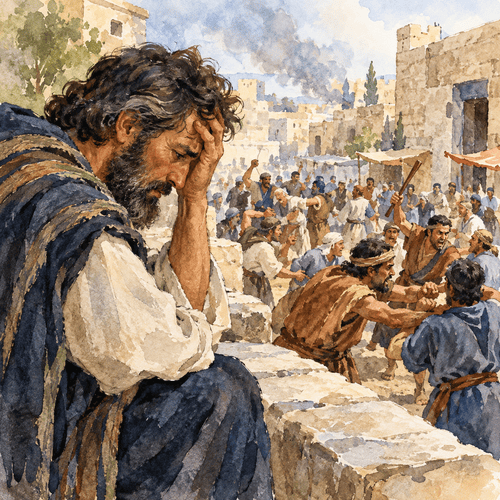
What if one of the most important verses in history came from a man who was angry with God?
About 600 years before Jesus, a prophet called Habakkuk saw violence and injustice everywhere in his nation. So he cried out to God: ‘How long?’ Part of God’s answer was one short line: ‘The righteous shall live by his faith’ (Habakkuk 2:4). In simple words, people are made right with God by trusting Him.
Around 2,000 years later, in the 1500s, a German monk called Martin Luther read that verse, quoted by the apostle Paul in Romans 1:17. It set him free from his fear of God. It also sparked the Reformation—a movement that called the church back to the Bible’s teaching that salvation is God’s free gift, received by faith alone. Europe was never the same again.
But Habakkuk holds an even bigger surprise. It isn’t only about faith. It’s about the Person we trust. This little book points to Jesus again and again—and the New Testament writers saw it clearly.
Jesus in the Old Testament — Book 35 of 39
This post is the 35th instalment in our series tracing Christ through every book of the Old Testament. See the full series index.
Is It Fair to Look for Jesus in Habakkuk?
Some people worry that Christians ‘read Jesus into’ books where He doesn’t belong. That’s a fair worry.
But Jesus Himself told us where to look. After He rose, He walked with two followers on the road to Emmaus:
And beginning with Moses and all the Prophets, He interpreted to them in all the Scriptures the things concerning Himself. (Luke 24:27, ESV)
Habakkuk is one of ‘the Prophets’, so Jesus is in its pages. Peter adds the prophets searched to know what ‘the Spirit of Christ in them was indicating when He predicted the sufferings of Christ’ (1 Peter 1:11). They were looking forward to Christ, even when they couldn’t see Him clearly.
French Reformer John Calvin said it simply: ‘We ought to read the Scriptures with the express design of finding Christ in them.’
4 RULES FOR FINDING JESUS IN HABAKKUK
Rule 1: Start with the New Testament. If an apostle quotes Habakkuk about Jesus, that is the strongest proof.
Rule 2: Look for clear word links. Some key words in Habakkuk come back in the story of Jesus.
Rule 3: Follow the Bible’s big story. Some patterns in Habakkuk find their full meaning at the cross.
Rule 4: Handle old traditions with care. They can be interesting, but they are not proof.
Habakkuk in a Nutshell
Most prophets represent God before people. Habakkuk speaks to God for the people. His whole book is a conversation.
How Habakkuk moves from hard questions to joyful worship
| PASSAGE | WHAT HAPPENS | KEY VERSE |
|---|---|---|
| Habakkuk 1:1–11 | Habakkuk: Why does evil win in Judah? God: I am sending Babylon. | Habakkuk 1:5 |
| Habakkuk 1:12–2:1 | Habakkuk: How can a holy God use people who are even worse? | Habakkuk 1:13 |
| Habakkuk 2:2–20 | God: Wait for the vision. The proud will fall; the righteous will live by faith. | Habakkuk 2:4 |
| Habakkuk 3:1–19 | Habakkuk sings: God will save. I will rejoice in Him, whatever happens. | Habakkuk 3:18 |
Timeline: From Habakkuk to Jesus
- Around 609–605 BC: Habakkuk prophesies in Judah while Babylon grows into the world’s strongest nation.
- 586 BC: Babylon destroys Jerusalem and its temple, just as God warned.
- Around 250–150 BC: Jewish scholars translate the Old Testament into Greek (the Septuagint).
- Around AD 30: Jesus dies on the cross and rises from the dead.
- Around AD 47: Paul quotes Habakkuk 1:5 in a synagogue in Pisidian Antioch (Acts 13).
- Still to come: ‘The coming one will come’ (Hebrews 10:37). Jesus will return.
The 7 Ways at a Glance
Here are the 7 ways, from strongest proof to gentlest picture.
Seven places where Habakkuk points to Jesus
| # | In Habakkuk | What it shows about Jesus | How we know |
|---|---|---|---|
| 1 | The vision that will surely come (2:3) | He is the Coming One who will return | Quoted in Hebrews 10:37 |
| 2 | The righteous shall live by faith (2:4) | He is the Righteous One we trust | Quoted in Romans, Galatians and Hebrews |
| 3 | A work you would not believe (1:5) | His resurrection is God’s great surprise | Quoted in Acts 13:41 |
| 4 | Your anointed; you crushed the head (3:13) | He is the Messiah who crushes evil | Word links: ‘anointed’, Genesis 3:15 |
| 5 | The cup; in wrath remember mercy (2:16; 3:2) | He drank God’s anger so we receive mercy | Word link: Matthew 26:39 |
| 6 | Glory filling the earth (2:14) | God’s glory shines in His face | Isaiah 11:9; 2 Corinthians 4:6 |
| 7 | The God of my salvation (3:18) | His very name means ‘salvation’ | Hebrew word link |
1. Jesus Is the Coming One Who Will Not Delay (Habakkuk 2:3)
Habakkuk climbs his watchtower and waits for God to answer (2:1). God tells him to write down a vision. Then God says:
For still the vision awaits its appointed time; it hastens to the end—it will not lie. If it seems slow, wait for it; it will surely come; it will not delay. (Habakkuk 2:3)
Notice something small but important. The Hebrew for ‘wait for it’ can also mean ‘wait for him’. The Septuagint read it that way. Its Greek says, in effect, ‘Coming, he will come.’ Now look at how Hebrews quotes it:
For, ‘Yet a little while, and the coming one will come and will not delay.’ (Hebrews 10:37)
Hebrews adds one tiny word: ‘the coming one’. That tiny word is huge, because ‘the coming one’ was a title for the Messiah. John the Baptist used it when he asked Jesus, ‘Are you the one who is to come?’ (Matthew 11:3).
So the final answer to ‘How long?’ is a Person: Jesus. He came once to die for sin. He will come again to judge evil and put the world right. It may seem slow, but He will surely come.
2. Jesus Is the Righteous One We Trust (Habakkuk 2:4)
Behold, his soul is puffed up; it is not upright within him, but the righteous shall live by his faith. (Habakkuk 2:4)
God sets two people side by side. One is ‘puffed up’—proud and self-trusting, like Babylon. The other is ‘righteous’, which means right with God. And he lives by faith.
One verse, three New Testament uses
| WHERE | WHAT THE WRITER IS TEACHING | THE MAIN IDEA |
|---|---|---|
| Romans 1:17 | How God makes sinners right with Him | We are saved by faith, not by good works |
| Galatians 3:11 | Why keeping the law cannot save anyone | No one is made right with God by the law |
| Hebrews 10:38 | How to keep going while we wait for Jesus | Do not give up; keep trusting |
Martin Luther once hated the phrase ‘the righteousness of God’, thinking it meant only God’s anger. Then Romans 1:17 showed him it is a gift to all who trust Christ. Luther later wrote: ‘Here I felt that I was altogether born again and had entered paradise itself through open gates.’
So where is Jesus in this verse? In two places:
- He is the One we trust. Faith is only as strong as what it rests on. Faith in a rotten bridge will not save you. Faith in Jesus will.
- He is the Righteous One. Peter calls Jesus ‘the Holy and Righteous One’ (Acts 3:14). He alone lived by perfect faith. When we trust Him, His perfect life is counted as ours.
A HARD QUESTION: ‘FAITH’ OR ‘FAITHFULNESS’?
The Hebrew word in 2:4 is emunah. It can mean ‘faith’ (trusting) or ‘faithfulness’ (staying loyal). Some critics say Paul chose the wrong meaning. But in Hebrew these are two sides of one coin. The same family of words is used when Abraham ‘believed the LORD’ (Genesis 15:6).
O. Palmer Robertson, in his respected commentary on Habakkuk, stresses that this faith is not a single moment but a trust that lasts. So Paul did not twist Habakkuk. He drew out its full meaning.
Richard Hays thinks Paul means Jesus’ own faithfulness. Jesus was indeed perfectly faithful. But Douglas Moo and Thomas Schreiner show that Paul’s main point is our faith in Christ. Both truths stand: He was faithful, and we are saved by trusting Him.
3. Jesus Is God’s Unbelievable Work (Habakkuk 1:5)
Look among the nations, and see; wonder and be astounded. For I am doing a work in your days that you would not believe if told. (Habakkuk 1:5)
In Habakkuk’s day the ‘work’ was shocking. God would use Babylon, a cruel, idol-worshipping nation, to punish His own people. No one believed it. But it happened.
Six centuries later, Paul preached the risen Jesus in a synagogue in Pisidian Antioch, in modern Turkey. He ended with Habakkuk:
Look, you scoffers, be astounded and perish; for I am doing a work in your days, a work that you will not believe, even if one tells it to you. (Acts 13:41)
Why use a verse about Babylon? Because God works in patterns. Once again He was doing something nobody expected—not an army this time, but a crucified Messiah who walked out of His grave. And once again, proud people refused to believe it.
4. Jesus Is the Anointed One Who Crushes Evil (Habakkuk 3:13)
Chapter 3 is a prayer-song recalling the Exodus:
You went out for the salvation of your people, for the salvation of your anointed. You crushed the head of the house of the wicked. (Habakkuk 3:13)
- ’Your anointed.’ The Hebrew word is mashiach, or Messiah. The Septuagint uses christos. ‘The anointed’ usually means David’s royal son, and God promised a greater one (2 Samuel 7:12–13). Habakkuk prays for God to save His anointed. God answered amazingly: the anointed King became the Saviour.
- ’You crushed the head.’ This recalls the Bible’s first promise, that the woman’s child ‘shall bruise your head’ (Genesis 3:15). Habakkuk sees God crushing the head of evil. At the cross and empty tomb, Jesus did exactly that (Hebrews 2:14).
5. Jesus Drinks the Cup So Mercy Can Win (Habakkuk 2:16; 3:2)
Habakkuk’s biggest problem is in 1:13: ‘You who are of purer eyes than to see evil… why do you idly look at traitors?’ In simple words: ‘God, You are holy. Why do You let evil win?’
God answers with five ‘woes’ (warnings of judgement) in chapter 2. One says: ‘The cup in the LORD’s right hand will come around to you’ (2:16). In the Bible, ‘the cup’ pictures God’s anger against sin. The wicked must drink it.
Now the gospel twist. The night before He died, Jesus prayed: ‘My Father, if it be possible, let this cup pass from me’ (Matthew 26:39). Then He drank it—not for His own sin, for He had none, but for ours.
That answers Habakkuk’s prayer: ‘in wrath remember mercy’ (3:2). At the cross, God’s anger and mercy met. God did not ignore evil. He punished it fully in Jesus. So He is ‘just and the justifier of the one who has faith in Jesus’ (Romans 3:26).
WISE WORDS FROM A GREAT PREACHER
D Martyn Lloyd-Jones, the Welsh preacher, taught Habakkuk in a series published as From Fear to Faith. His key lesson: when events confuse you, don’t start with the events. Start with God—who He is and what He has promised. Then look at the events in that light.
Habakkuk did this in 1:12: ‘Are you not from everlasting, O LORD my God, my Holy One?’
6. Jesus Shows the Glory That Will Fill the Earth (Habakkuk 2:14)
In the middle of the woes there is a shining promise:
For the earth will be filled with the knowledge of the glory of the LORD as the waters cover the sea. (Habakkuk 2:14)
Habakkuk is borrowing from Isaiah 11:9, which follows a prophecy about ‘a shoot from the stump of Jesse’ (Isaiah 11:1)—a King from David’s family. So this worldwide glory is tied to the Messiah’s rule.
Where do we see God’s glory most clearly? Paul answers: ‘in the face of Jesus Christ’ (2 Corinthians 4:6). Every time the gospel reaches a new nation, Habakkuk 2:14 comes a little more true.
A smaller link sits nearby:
- ’The stone will cry out’ (2:11). Jesus said that if His disciples were silent, ‘the very stones would cry out’ (Luke 19:40). Many readers hear Habakkuk here. His stones accuse the wicked; Jesus’ stones would praise the King.
7. Jesus Is the God of My Salvation (Habakkuk 3:17–18)
The book ends with one of the most beautiful songs in the Bible:
Though the fig tree should not blossom, nor fruit be on the vines, the produce of the olive fail and the fields yield no food, the flock be cut off from the fold and there be no herd in the stalls, yet I will rejoice in the LORD; I will take joy in the God of my salvation. (Habakkuk 3:17–18)
For a farmer, this meant no food and no future. Yet he sings.
Look at the last words: ‘the God of my salvation’. The Hebrew for ‘my salvation’ is yish’i. It comes from the same root (family of words) as Yeshua, the Hebrew form of ‘Jesus’. The angel said, ‘you shall call his name Jesus, for he will save his people from their sins’ (Matthew 1:21). ‘Salvation’ appears four times in Habakkuk 3. Habakkuk did not know the Saviour’s name, but he sang about what that name means. We should not push this too far, but the link is real.
Habakkuk began crying ‘How long?’ (1:2). He ends rejoicing, though nothing around him has changed. What changed? He saw God. We see even more: God’s salvation in a face and a name.
A TRADITION TO HANDLE WITH CARE: ANIMALS AT THE MANGER?
The Septuagint translates Habakkuk 3:2 as ‘in the midst of two living creatures you will be known’. Early Christians linked this with Isaiah 1:3 and pictured an ox and a donkey beside baby Jesus.
But the Gospels never mention these animals, and the Hebrew actually says ‘in the midst of the years’. It is a lovely tradition, not a proof.
But Aren’t Christians Just Reading Jesus into Habakkuk?
Two common objections deserve a short answer:
- ’Habakkuk never mentions a Messiah.’ He does. Habakkuk 3:13 speaks of God’s ‘anointed’, the Hebrew word mashiach.
- ’The New Testament changes Habakkuk’s words.’ The apostles often quoted the Septuagint, their readers’ Bible. The small differences draw out what was already there.
Our strongest links are not our ideas but the apostles’ teaching. As Augustine of Hippo, loved by the Reformers, put it, the New Testament lies hidden in the Old, and the Old is made plain in the New.
What Habakkuk Teaches Us About Jesus Today
Habakkuk opens with ‘How long?’ and closes with ‘Yet I will rejoice.’ Between them stands a Person who ‘will surely come’.
If you are not yet a Christian, do not be like the proud man whose ‘soul is puffed up’. Trust the Righteous One who drank the cup for sinners. Live by faith in Him.
If you follow Jesus, Habakkuk gives you a song for hard days. When the fields are empty, keep waiting, trusting and singing. The Coming One will not delay.
Tough Questions, Honest Answers
Who was Habakkuk, and what does his name mean?
We know very little about Habakkuk as a person. The book only calls him ‘the prophet’ (1:1), and the music note at the end of chapter 3 suggests he may have had links with temple worship. His name probably comes from a Hebrew word meaning ‘to embrace’ or ‘to cling’. Martin Luther loved this meaning. He said Habakkuk embraces his people and holds them close, like someone comforting a crying child. Whatever the exact meaning, his message fits: he clings to God, and he helps us cling to God too.
Is it wrong to question God like Habakkuk did?
Not in itself. Habakkuk asked hard questions, and God answered him instead of rebuking him. The difference is in the heart. Habakkuk questioned God as a believer who still trusted Him—he called God ‘my Holy One’ (1:12)—and then he waited humbly for an answer (2:1). Proud questioning demands that God explain Himself on our terms. Faithful questioning brings our pain to God and waits. So bring your questions to God, but bring them as a child to a Father, not as a judge to a prisoner.
Does Habakkuk 1:13 mean God cannot look at sin?
Some people use this verse to say that the Father turned His eyes away from Jesus on the cross. But the verse cannot mean God is unable to see evil, because the very same verse says God does ‘look at traitors’. It means God cannot approve of evil or treat it as acceptable. The Bible says, ‘The eyes of the LORD are in every place, keeping watch on the evil and the good’ (Proverbs 15:3). At the cross the Father did not stop seeing His Son. He poured out His judgement on the sin Jesus carried, while the love between Father and Son was never broken.
What does ‘Write the vision; make it plain’ mean?
Habakkuk 2:2 is popular on posters and ‘vision boards’ for personal goals. But the ‘vision’ here is not our dream for our own future. It is God’s message about His judgement on Babylon and His salvation for those who trust Him. God told Habakkuk to write it clearly on tablets ‘so he may run who reads it’. That means it should be easy to read and quick to pass on. The lesson for us is to make God’s promises plain and share them, not to write down our wishes and expect God to fulfil them.
Why would a good God use wicked Babylon to punish His people?
This question troubled Habakkuk too (1:12–13). The Bible teaches that God rules over every nation, even wicked ones. He can use their evil plans for His good purposes without approving of their sin. Babylon acted from pride and cruelty, and God held Babylon responsible, which is why chapter 2 announces five woes against it. Isaiah says the same about Assyria, which God called ‘the rod of my anger’ before judging it too (Isaiah 10:5). The greatest example is the cross: wicked men killed Jesus, yet it happened ‘according to the definite plan and foreknowledge of God’ (Acts 2:23).
Why is Habakkuk 3 written like a song?
Chapter 3 begins, ‘A prayer of Habakkuk the prophet, according to Shigionoth’, and ends, ‘To the choirmaster: with stringed instruments.’ Shigionoth is a music word whose exact meaning is uncertain. It may describe a strong, emotional style of song, and a similar word appears at the start of Psalm 7. The word Selah (3:3, 9, 13) also appears in the Psalms and probably marks a pause. These details show that Habakkuk’s prayer was meant to be sung by God’s people together. One man’s private struggle became the whole community’s song of faith.
Is Habakkuk in the Dead Sea Scrolls?
Yes. One of the best-known Dead Sea Scrolls is the Habakkuk Commentary, often called the Pesher Habakkuk (1QpHab), found near Qumran in 1947. It explains Habakkuk chapters 1 and 2 line by line and applies them to its own community and its leader, the ‘Teacher of Righteousness’. It even reads Habakkuk 2:4 as a promise for those who keep the law and trust that teacher. This shows that some Jewish readers before Jesus already read Habakkuk as pointing to the last days. It also shows that Habakkuk was carefully copied long before Christ, which supports the reliability of our Bible.