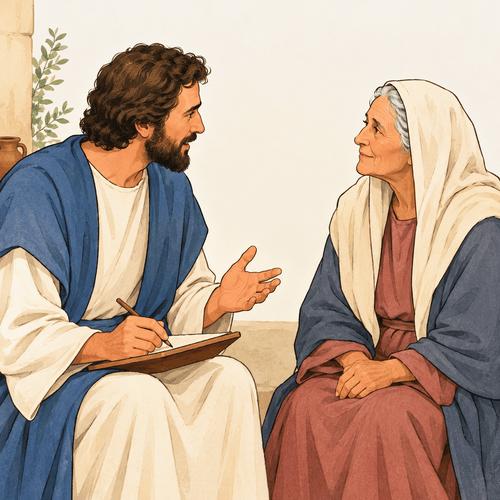
No one else was in the room. A young woman in the small village of Nazareth is suddenly visited by an angel. He tells her she’ll have a baby, even though she’s a virgin. She asks a question. He answers. Then he leaves. There were no cameras, no reporters and no other people. So where did Luke get his Gospel details about this very private moment?
That’s a question sceptics (people who doubt the Bible) love to ask. Luke wasn’t there. He wrote many years later. How could he know what was said in that room?
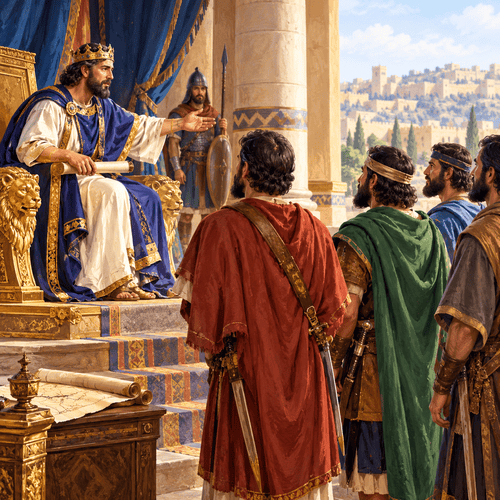
There are only 2 answers. Either Luke invented it, or someone who was there told him. The evidence points clearly to the second—and to Mary herself.
THE SHORT ANSWER
Luke tells us plainly he collected his facts from eyewitnesses—people who saw events with their own eyes (Luke 1:2). For the stories of Jesus’ birth and childhood in Luke Chapters 1–2, the clues point strongly to Mary, the mother of Jesus. She told it either directly to Luke or through her family in Jerusalem. And this careful research makes Luke’s Gospel no less the Word of God.
First, Who Was Luke?
Luke was a doctor—“Luke the beloved physician” (Colossians 4:14)—and one of Paul’s travel partners. He wrote the Gospel of Luke and the book of Acts (Acts 1:1), about a quarter of the New Testament. But he wasn’t one of the 12 apostles, and he never says he saw Jesus himself. That’s why his sources (the places he got his information from) matter so much.
Luke Tells Us His Method
Luke tells us exactly how he worked. Read his opening words slowly:
“Inasmuch as many have undertaken to compile a narrative of the things that have been accomplished among us, just as those who from the beginning were eyewitnesses and ministers of the word have delivered them to us, it seemed good to me also, having followed all things closely for some time past, to write an orderly account for you, most excellent Theophilus, that you may have certainty concerning the things you have been taught.”
Luke 1:1–4, ESV
4 key words show his method:
- Eyewitnesses: The Greek word is autoptai. It means people who saw something for themselves (our word “autopsy” shares the root).
- Delivered: The Greek word paradidōmi means handing on teaching carefully, like a precious package. Paul uses it for the gospel he passed on (1 Corinthians 15:3).
- Followed all things closely: Luke did his homework, checking facts over a long time.
- Certainty: Luke wanted his reader to be sure—the language of facts, not fairy tales.
British scholar, Loveday Alexander, in The Preface to Luke’s Gospel (1993), showed these lines sound like the openings of serious historical and technical books of Luke’s time. Luke is telling us: “This is history. I checked it.”
Dutch New Testament scholar, Herman Ridderbos made a related point. He argued this “handing on” wasn’t loose storytelling but authorised witness, guarded by the people Christ himself had sent.
Luke Had the Chance to Meet Mary’s Circle
In parts of Acts, Luke changes from writing “they” to writing “we”. These “we passages” show where Luke himself travelled with Paul—including about 2 years in the Holy Land.
Timeline: Luke in the Holy Land
- About AD 57: Luke arrives in Caesarea with Paul. They stay “many days” in the home of Philip the evangelist, one of the earliest church leaders (Acts 21:8–10).
- About AD 57: In Jerusalem, Luke lodges with Mnason, “an early disciple” (Acts 21:16). The next day he meets James, the brother of Jesus, together with all the church elders (Acts 21:17–18).
- AD 57–59: Paul is held as a prisoner in Caesarea for two years (Acts 24:27). Luke is nearby, free to travel and ask questions.
- AD 59: Luke sails with Paul from Caesarea towards Rome (Acts 27:1).
- About AD 60–62: Luke writes his Gospel, before Acts, which ends with Paul still alive in Rome (Acts 28:30–31).
Notice who Luke met: James, Mary’s own son. Even if Luke never sat down with Mary, he certainly sat down with her family.
But was Mary herself still alive? Very possibly. If she was a teenager when Jesus was born (around 6–4 BC), she’d have been in her early 70s around AD 57. Old, but far from impossible. And it is Luke who tells us that Mary stayed with the believers in Jerusalem after Jesus rose from the dead:
“All these with one accord were devoting themselves to prayer, together with the women and Mary the mother of Jesus, and his brothers.”
Acts 1:14, ESV
This is the Bible’s last mention of Mary by name—and Luke recorded it.
5 Fingerprints of Mary in Luke 1–2
A fingerprint shows who touched something. Luke 1–2 carries five clear “fingerprints” that point back to Mary.
1. Luke “Signs” His Source—Twice
At the end of 2 key stories, Luke stops to tell us about Mary’s memory:
“But Mary treasured up all these things, pondering them in her heart.”
Luke 2:19, ESV
“And his mother treasured up all these things in her heart.”
Luke 2:51, ESV
To “treasure up” means to keep something carefully, like a valuable jewel. Luke says this about no one else. These lines work like a footnote: “Mary remembered all this. That is how we know it.”
JOHN CALVIN ON LUKE 2:19
“Mary’s diligence in contemplating the works of God is laid before us for two reasons; first, to inform us, that this treasure was laid up in her heart, for the purpose of being published to others at the proper time; and, secondly, to afford to all the godly an example for imitation.”
—John Calvin, Commentary on a Harmony of the Evangelists
What this means: Nearly 500 years ago, Calvin saw it: Mary kept these memories so they could one day be shared with the church.
2. Events Only Mary Saw
Some scenes had only one human witness. The clearest is the annunciation (meaning “announcement”)—the moment the angel Gabriel told Mary she would bear the Son of God (Luke 1:26–38). Only Mary was there. The same is true of Simeon’s private warning to her: “a sword will pierce through your own soul also” (Luke 2:35). Who else could report words spoken to Mary’s own soul?
3. The Story Is Told from Mary’s Side
Matthew tells the birth story from Joseph’s side—his worries, dreams and decisions. Luke tells it from Mary’s side. We hear her question (“How will this be, since I am a virgin?” Luke 1:34), her song of praise (Luke 1:46–55), her visit to her relative Elizabeth, and her fear when twelve-year-old Jesus went missing. This is exactly what we would expect if Mary was the source.
4. Honest, Uncomfortable Details
When Mary and Joseph finally find Jesus in the temple, Mary says: “Son, why have you treated us so? Behold, your father and I have been searching for you in great distress” (Luke 2:48). Then Luke adds: “they did not understand the saying that he spoke to them” (Luke 2:50).
Someone inventing stories to honour Mary would never show her confused and upset. But a mother telling the truth would remember exactly these moments.
5. A Jewish “Accent” and Very Early Hopes
Luke’s first four verses are in polished Greek. From Luke 1:5 to the end of chapter 2, the Greek suddenly sounds very Hebrew, like the Old Testament—as if Luke is passing on material from Jewish believers in the Holy Land.
The hopes in these chapters also sound very early. The angel promises Jesus “the throne of his father David” (Luke 1:32). Zechariah praises God “that we should be saved from our enemies” (Luke 1:71). These are the hopes of faithful Jews before the cross, not the words of a later Gentile writer inventing stories.
Princeton scholar John Gresham Machen argued this point at length in The Virgin Birth of Christ (1930). He showed Luke’s birth stories are thoroughly Jewish and Palestinian (from the land of Israel). They’re not pagan myths borrowed from the Greek world, but memories of the earliest Jewish believers.
Mary Wasn’t Luke’s Only Witness
Luke used many other witnesses too. British scholar Richard Bauckham, in Jesus and the Eyewitnesses (2006), noticed the Gospels often name minor people. Why? Because readers knew them—they were living witnesses who could still be asked.
Luke names one Emmaus disciple, “Cleopas” (Luke 24:18), though the story doesn’t need his name—unless Cleopas was a known source.
Luke’s Likely Eyewitness Sources and What Each Could Tell Him
| WITNESS | BIBLE EVIDENCE | WHAT THEY COULD TELL LUKE |
|---|---|---|
| Mary, mother of Jesus | Luke 2:19, 51; Acts 1:14 | The birth and childhood of Jesus |
| James and Jesus’ family | Acts 21:18; Galatians 1:19 | Family memories of Jesus in Nazareth |
| Joanna | Luke 8:3; 24:10 (named only by Luke) | Events at Herod’s court and the empty tomb |
| Manaen | Acts 13:1 (“a lifelong friend of Herod the tetrarch”) | Inside stories about Herod Antipas |
| Cleopas | Luke 24:18 | The Emmaus road meeting with the risen Jesus |
| Philip the evangelist | Acts 21:8–10 | The early days of the Jerusalem church |
| Mark | Colossians 4:10, 14; Philemon 24 | Peter’s preaching, written down in Mark’s Gospel |
Two Witnesses, One Story
Sceptics say Matthew and Luke tell different birth stories. But different is not contradictory. If Matthew’s information came from Joseph’s side and Luke’s from Mary’s, we would expect different details but the same core facts. That is exactly what we find.
Where Matthew and Luke Agree on Jesus’ Birth (chapter and verse)
| CORE FACT | MATTHEW | LUKE |
|---|---|---|
| Mary was a virgin when she conceived | 1:18 | 1:34–35 |
| Joseph was from King David’s family | 1:20 | 1:27 |
| An angel gave the name “Jesus” | 1:21 | 1:31 |
| Jesus was born in Bethlehem | 2:1 | 2:4–7 |
| It happened while Herod was king | 2:1 | 1:5 |
| The family settled in Nazareth | 2:23 | 2:39 |
In court, two witnesses telling the same main story from different angles are more believable. Word-for-word matches would suggest copying.
Answering Objections
A strong case must face the hard questions.
“Luke Just Made It All Up”
Luke’s accuracy can be tested where we can check him. The Scottish archaeologist William Mitchell Ramsay began by doubting Luke, but years of work in modern-day Turkey led him to rank Luke among the best historians. Colin Hemer, in The Book of Acts in the Setting of Hellenistic History (1989), listed dozens of local details—officials’ titles, place names, travel routes—that Luke got exactly right. A writer this careful does not suddenly become a storyteller about Jesus’ birth.
Raymond Brown, in The Birth of the Messiah (1977), doubted much of Luke 1–2. But sceptics cannot explain away Luke’s stated method, his access to Mary’s family, or the fingerprints above. (The question of the census under Quirinius in Luke 2:2 deserves its own article.)
“Mary Was Probably Dead by Then”
We do not know when Mary died. But even if she had, her memories lived on in her family—James, Jude and Jesus’ wider relatives in Jerusalem. The second-century writer Hegesippus (quoted by Eusebius) says Clopas was Joseph’s brother, and Clopas’s son Simeon led the Jerusalem church after James. That is a short chain of named people, not a line of strangers passing on rumours.
“If Luke Did Research, His Gospel Isn’t Inspired”
Inspiration does not mean God dictated while the writer took notes. It means God guided the human writers so that they wrote exactly what he wanted—without error. Scripture says that “men spoke from God as they were carried along by the Holy Spirit” (2 Peter 1:21). God carried Luke along through his research, not around it.
KEY TERM: ORGANIC INSPIRATION
Dutch theologian Herman Bavinck called this “organic” inspiration. God didn’t switch off the writers’ minds. He used their personalities, their memories, their research and even their writing styles.
BB Warfield, the Princeton theologian, put it memorably when speaking of Paul: “If God wished to give His people a series of letters like Paul’s, He prepared a Paul to write them, and the Paul He brought to the task was a Paul who spontaneously would write just such letters.”
Applied to Luke: God prepared a careful doctor-historian, led him to the right witnesses, and breathed out a Gospel through him.
Luke’s Gospel was recognised as Scripture very early. In 1 Timothy 5:18, Paul quotes Deuteronomy 25:4 and then “The labourer deserves his wages”—the exact words of Luke 10:7—and calls both “Scripture”.
“Doesn’t This Make Mary Too Important?”
Many online articles on this topic come from Roman Catholic writers who use it to raise Mary higher. But being a witness does not make Mary a mediator (someone who stands between us and God). Mary herself sang, “my spirit rejoices in God my Saviour” (Luke 1:47). Only sinners need a Saviour.
Luke even records Jesus gently redirecting praise of Mary:
“As he said these things, a woman in the crowd raised her voice and said to him, ‘Blessed is the womb that bore you, and the breasts at which you nursed!’ But he said, ‘Blessed rather are those who hear the word of God and keep it!’”
Luke 11:27–28, ESV
Notice the word “keep”—exactly what Mary did. She is not someone to be worshipped, but a model believer and faithful witness who pointed to her Son.
WHAT WE ARE CLAIMING—AND WHAT WE AREN’T
- Not claimed: That Luke and Mary certainly met face to face. The Bible does not say.
- Not claimed: That Mary was Luke’s source for the whole Gospel—only for the birth and childhood stories.
- Claimed: Mary is the human source behind Luke 1–2, directly or through her family. Every piece of evidence points that way, and no better explanation exists.
Why This Matters for You
Luke wrote “that you may have certainty” (Luke 1:4). That’s still his goal for you.
The Christmas story isn’t a sweet legend. It rests on the memory of a real woman who carried the Son of God, raised Him and watched Him die. She didn’t understand everything, but she remembered—and God made sure her memories reached us through a careful writer.
Our faith rests on real events, told by real witnesses and written down under the Spirit’s guidance. Yet evidence alone does not create faith. As the Westminster Confession of Faith (1646) puts it, our “full persuasion and assurance” of the Bible’s truth comes “from the inward work of the Holy Spirit bearing witness by and with the Word in our hearts” (1.5). The evidence opens the door; the Spirit leads us through it.
Back in That Quiet Room
No one else was in the room when the angel spoke. But Mary was there. She heard every word. She treasured it up. She pondered it for years. And when the time was right, she shared it.
So where did Luke get his Gospel details? From eyewitnesses—just as he told us. And for the most precious story of all, the evidence points to the one person who was there from the very beginning: Mary, the mother of our Lord.
Tough Questions, Honest Answers
Was Luke the unnamed disciple on the road to Emmaus?
Some later church writers, especially in the Eastern church, suggested that Luke was the unnamed companion of Cleopas in Luke 24. It is a lovely idea, but the Bible does not support it. In Luke 1:2, Luke says he received his information from eyewitnesses, which strongly suggests he was not one himself. This tradition appeared many centuries after Luke wrote. We should hold firmly to what Scripture says and lightly to what later traditions guess.
Was Luke a Gentile?
Most likely, yes. In Colossians 4:10–11, Paul lists his fellow workers who are “of the circumcision” (Jewish believers), and only afterwards mentions Luke (Colossians 4:14). An early tradition says Luke came from Antioch in Syria. If so, Luke is the only Gentile (non-Jewish) writer in the New Testament. This is a beautiful picture of the gospel itself: God brought the nations into his family, and he even used a Gentile to write part of his Word.
Who was Theophilus?
Theophilus is the man Luke wrote both his Gospel and Acts for (Luke 1:3; Acts 1:1). His name means “friend of God” or “loved by God”, so some think it is a symbolic name for every Christian reader. But Luke calls him “most excellent”, a title used for high Roman officials such as Felix and Festus (Acts 23:26; 26:25). So he was probably a real, important person who had already been taught about Jesus and needed certainty. Either way, God intended Luke’s words for every believer who wants to be sure of the faith.
Was Luke really a doctor, and does it show in his writing?
Yes. Paul calls him “the beloved physician” (Colossians 4:14). In 1882, William Kirk Hobart argued that Luke’s Greek is full of medical terms. Later, Henry Cadbury showed that educated non-doctors used many of the same words, so that argument is weaker than people once thought. Still, Luke takes a special interest in sickness and healing, and in the poor and the outsider. Most importantly, a doctor’s careful habits of observation fit well with the careful research he describes in Luke 1:1–4.
Did Luke paint the first portrait of Mary?
There is a popular legend that Luke painted Mary, and some churches still display so-called “Luke icons”. But the story first appears in writings linked to Theodorus Lector, a sixth-century historian—about 500 years after Luke lived. There is no early evidence for it at all. More importantly, Luke never shows any interest in what Mary looked like. The portrait he gave the church is a written one: a humble, believing woman who pointed to her Son.
Is Luke’s family tree of Jesus actually Mary’s family line?
Luke 3:23 says Jesus was “the son (as was supposed) of Joseph, the son of Heli”, while Matthew names Joseph’s father as Jacob. Many careful interpreters believe Luke gives Mary’s line, with Heli as Mary’s father and Joseph counted as his son by marriage. Others follow the early Christian writer Julius Africanus, who explained it through an Old Testament custom: a man could marry his dead brother’s widow, so a son might have both a “legal” and a “natural” father. Both explanations are reasonable, and neither damages the Bible’s reliability. Either way, Jesus is truly the Son of David.
When and where did Mary die?
The Bible does not tell us. One tradition says she died in Jerusalem, where a “Tomb of Mary” is shown today; another says she died in Ephesus. Around AD 375, the church writer Epiphanius admitted that no one knew how her life ended. The Roman Catholic teaching that Mary was taken bodily into heaven (called the Assumption) was only made official in 1950, and it has no support in Scripture. The Bible’s silence is itself telling: Mary’s story matters because it points to Jesus, not to herself.
Related Reads
- If 500 People Saw Jesus Alive, Where Is Their Testimony?
- Are the Gospels Eyewitness Accounts? The Mounting Evidence
- Unsung Witnesses: How Minor Characters Validate Gospel Accounts
- Historical Accuracy of the Book of Acts: A Treasure Trove of Evidence
- Was Luke Wrong About the Census? New Evidence Says No
- Solving the Mystery: Why Does Jesus Have Two Genealogies?
- Why Must We Affirm the Virgin Birth?
- Did Mary Remain a Virgin? A Biblical Case Against Perpetual Virginity
- Verbal Plenary Inspiration: Why We Affirm Every Word of Scripture
- When Were the Gospels Written? The Evidence for Early Dates