To many modern ears, a virgin conceiving and bearing a child sounds like exactly the kind of ancient myth a scientific age has outgrown. Yet the virgin birth isn’t a decorative detail Christians could quietly drop without loss. Pull on this one thread and the whole garment of orthodox Christology comes with it—who Jesus is, why He came, and how His death could actually save anyone.
So why affirm it? Not out of nostalgia for a pre-scientific worldview, but because the virgin birth is both well-attested in the text and load-bearing for the doctrines built on top of it.
The short answer
The virgin birth is affirmed because it’s recorded by two independent Gospel witnesses, fulfils specific Old Testament prophecy, and is theologically necessary: only a miraculous conception could make Jesus fully human and yet free from inherited sin, qualifying Him as humanity’s sinless substitute.
First Things First: Does a Miracle-Working God Exist?
Objections to the virgin birth often start from an assumption smuggled in before the evidence is even weighed: that miracles are impossible by definition. But that’s not a historical argument—it’s a philosophical one, and it only works if there’s no God capable of acting outside the ordinary course of nature. If God exists and created the universe, an event like a virgin conceiving isn’t a violation of the system so much as the Author briefly writing an exception into His own story. The real question isn’t “can a virgin give birth?” It’s “is there a God who could make this happen?” We make that broader case in Does God Exist? 10 Compelling Evidences. Settle that question first, and the virgin birth stops looking impossible and starts looking like exactly the kind of thing you’d expect at the hinge-point of redemptive history.
Prophetic Fulfilment
The virgin birth doesn’t appear out of nowhere in the Gospels—it was foretold centuries in advance. Isaiah 7:14 declares: “Therefore the Lord himself will give you a sign: The virgin will conceive and give birth to a son, and will call him Immanuel.” Written roughly 700 years before Christ, in the middle of a political crisis threatening the Davidic line, Isaiah’s sign pointed forward to an event genuinely unprecedented—not simply a young woman having a child, but a virgin doing so. Matthew explicitly quotes this text as fulfilled in Jesus (Matthew 1:22–23).
The precision doesn’t stop there. Micah 5:2, written centuries earlier still, named the specific town: Bethlehem—at the time an insignificant village with no reason to expect a king would come from it. Two separate prophets, centuries apart, converging on details neither Mary nor Joseph could have engineered. We explore this specific prophecy at length in Isaiah 7:14 and the Virgin Birth: How the Prophecy Points to Jesus.
Eyewitness Testimony: Two Independent Accounts
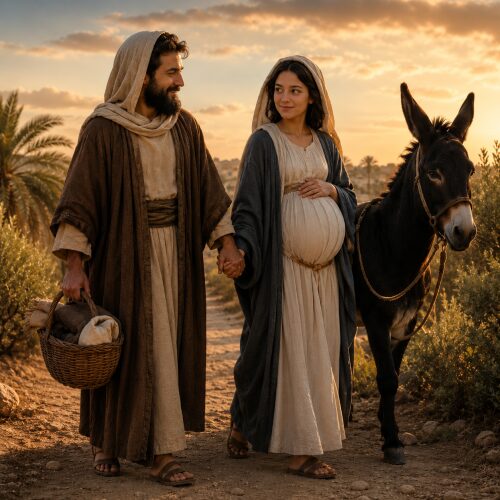
The virgin birth rests on two Gospel accounts—Matthew’s and Luke’s—that are strikingly independent of one another. Matthew tells the story primarily from Joseph’s perspective and traces Jesus’ genealogy through Joseph’s line; Luke tells it from Mary’s perspective, with his own distinct genealogy. The two accounts differ in emphasis and detail exactly as you’d expect from separate sources drawing on separate testimony, yet they agree completely on the central, extraordinary claim: Mary conceived while a virgin, by the Holy Spirit. Two independent witnesses converging on the same unlikely core fact, while diverging on peripheral detail, is precisely the pattern historians treat as evidence of authentic, uncoordinated testimony rather than a single invented story copied twice.
Theological Necessity: Why the Incarnation Requires It
Paul never narrates the virgin birth directly, but his theology depends on it. He describes Christ’s pre-existence and self-emptying (Philippians 2:5–8) and His entry into humanity “born of woman, born under the law” (Galatians 4:4)—language that assumes a genuinely human birth without describing an ordinary human father. For Jesus to be what the gospel requires Him to be—fully God and fully man, in one person, without contradiction—He needed an entry into the world that was fully human (born of a woman, growing in Mary’s womb like any child) yet also directly, supernaturally divine in its origin (conceived by the Holy Spirit, not by human agency). We unpack this dual nature more fully in Why Do We Affirm Jesus Is Truly God and Truly Man? The virgin birth is the mechanism by which both truths hold at once.
A Sinless Sacrifice
This is where the doctrine stops being a historical curiosity and becomes soteriologically essential. Scripture treats sin as something inherited through the ordinary line of human generation, traced back to Adam (Romans 5:12). Had Jesus been conceived through the usual course of human fatherhood, He would have entered the world under the same inherited condition every other descendant of Adam bears—disqualifying Him from being the spotless, sinless sacrifice the gospel requires. Conceived instead by the Holy Spirit, Jesus entered humanity as a genuine descendant of Mary, yet without a human father transmitting Adam’s guilt and corruption. Only this way could He be, in the language of the Gospels, the truly unblemished “Lamb of God” (John 1:29)—fully human, and yet untouched by the inherited condition every other human being carries.
Affirmation of Jesus’ Own Claims
There’s a further, more personal stake in the doctrine. Jesus repeatedly claimed a unique, divine identity—eternal Son, one with the Father, worthy of worship. If His entry into the world were entirely ordinary, that claim would need to rest on His words alone, unsupported by anything about His origin. The virgin birth is part of the total pattern of evidence—prophecy, testimony, and the shape of His own life—that coheres with, rather than contradicts, the extraordinary identity He claimed for Himself. Deny the virgin birth, and you’re not simply editing a footnote; you’re removing one load-bearing piece of the case for who He said He was.
Answering the Alternative Theories
Sceptical alternatives to the virgin birth tend to fall into a few recurring categories, and each faces real difficulties of its own.
- The illegitimacy theory. Some propose Jesus was conceived out of wedlock and the virgin birth was invented to cover the scandal. This requires believing Mary and Joseph—and the Gospel writers—constructed and maintained a lie the New Testament itself doesn’t shy away from complicating: both Matthew and Luke openly record Joseph’s initial doubt and near-decision to quietly divorce Mary (Matthew 1:19), hardly the smooth cover story a fabrication would produce.
- The borrowed-pagan-myth theory. Ancient mythology does contain stories of gods fathering children with human women, but these typically involve physical union between a deity and a mortal. The Gospel accounts describe something categorically different: a non-physical, Spirit-wrought conception, recorded in the sober, genealogically precise style of Jewish historical narrative rather than the ornate style of Greco-Roman myth.
- The “too conveniently undocumented” objection. Critics sometimes argue the event is suspiciously private. But by its nature, only Mary (and, indirectly, Joseph) could have known how the conception occurred—and the Gospels don’t hide the difficulty this posed. Joseph’s doubt and the risk Mary faced under Jewish law for an unexplained pregnancy are recorded candidly, not smoothed over, which is exactly what we’d expect from an account reporting an awkward true event rather than inventing a tidy one.
Why Discretion Made Sense at the Time
It’s fair to ask why, if true, Mary and Joseph didn’t publicise the miracle more widely. The answer fits the culture precisely: in first-century Jewish society, an unexplained pregnancy carried severe social and even legal risk. Claiming a virgin conception without proof would have invited scorn rather than belief. Quiet discretion, followed by public testimony only once the Gospels were written—decades later, while eyewitnesses including Mary herself were plausibly still alive to confirm or deny the account—is exactly the pattern a true, extraordinary, hard-to-believe event would produce.
More Than a Historical Detail
The virgin birth isn’t a devotional flourish added to make the Christmas story more magical. It’s the doctrine that lets every other claim about Jesus hold together: that He is genuinely human and yet genuinely, uniquely divine; that He could be born under the law and yet untouched by its curse; that His sacrifice could actually count for sinners because He wasn’t one of them. Pull the thread, and the rest of the garment doesn’t stay neatly in place.
Tough Questions, Honest Answers
Why would God choose such an unusual method for Jesus’ birth?
The virgin birth marked Jesus as unique from the moment of conception—fulfilling Isaiah 7:14 and demonstrating God’s supernatural power, while establishing Him as both fully human (born of Mary) and uniquely divine (conceived by the Holy Spirit) from the very start, rather than divinity being added on later.
Weren’t virgin birth stories common in ancient mythology—isn’t this just another myth?
Ancient myths of divine parentage typically describe physical union between a god and a human. The Gospel accounts describe something different: a non-physical, Spirit-wrought conception, told in the restrained, genealogically careful style of Jewish narrative rather than the embellished style of Greco-Roman mythology.
Why do only two Gospels—Matthew and Luke—mention the virgin birth?
Each Gospel writer selected material serving his specific purpose and audience; Mark begins with Jesus’ adult ministry and John opens with a theological statement about His eternal existence, neither needing to retell the birth narrative. That two independent sources record the virgin birth, with complementary but distinct details, actually strengthens rather than weakens its credibility.
If the virgin birth is true, why was it so poorly documented at the time?
By its nature, the event was known firsthand only to Mary and, indirectly, Joseph. Given the private nature of the claim and the scepticism it would have faced, limited initial documentation makes sense—and the Gospels’ candid record of Joseph’s doubt suggests an account reporting a difficult true event, not one smoothed over for easy belief.
Wouldn’t Mary and Joseph have told more people if this really happened?
Their discretion fits first-century Jewish culture precisely: claiming a virgin conception without proof risked serious social and legal consequences, as Joseph’s initial plan to “divorce her quietly” shows (Matthew 1:19). That the account became public only later, through the Gospels, while eyewitnesses were plausibly still alive to confirm or deny it, adds to rather than undermines its credibility.
Does the virgin birth mean Jesus wasn’t really human?
No—Scripture insists on the opposite. Jesus was genuinely born of Mary, grew, and experienced real human life. The virgin birth doesn’t make His humanity less real; it explains how that fully real humanity could also be free from the inherited sin nature every other human being carries.
Related Reads
- Isaiah 7:14 and the Virgin Birth: How the Prophecy Points to Jesus
- Why Do We Affirm Jesus Is Truly God and Truly Man?
- Why God Became Man: Could He Have Saved Us Another Way?
- The Mystery of Christmas: Why God HAD to Become Man
- Is Jesus the Jewish Messiah? Seven Arguments You Can’t Ignore
- Did Jesus Really Exist? The Historical Evidence Sceptics Can’t Ignore
- Did the Disciples Die for a Lie?
- Types of Christ and His Cross in the Old Testament
- The Curse of Jeconiah: Why His Name Is in Jesus’ Genealogy
- Where Did Luke Get His Gospel Details? The Case for Mary
- What Does It Mean for Me that Christ Is Immanuel?