Satan once took Jesus to the top of a very high mountain. He showed Him “all the kingdoms of the world and their glory” and said, “All these I will give you, if you will fall down and worship me” (Matthew 4:8–9). Jesus said no.
A few years later, Jesus stood on another mountain in Galilee. This time He said, “All authority in heaven and on earth has been given to me” (Matthew 28:18).
Same Jesus. Two mountains. On the first, Satan offered Him the world without a cross. On the second, Jesus held the world because of the cross.
That is no accident. In the Bible, mountains are where the big moments happen. The Bible’s story begins on a mountain and ends on a mountain, and many of its great turning points in between happen on one too. In this guide, we will see why mountains matter so much in Scripture, walk through the key mountains of the Old Testament, and discover the one story they tell together—a story that leads straight to Jesus.
ABOUT THIS SERIES: MOUNTAINS OF SCRIPTURE
This post is the starting point for our Mountains of Scripture series on the great mountains of the Bible. Read it first for the big picture. Then follow the “Go deeper” links to read the full post on each mountain. Every post explains what happened on that mountain in the Old Testament, and how the New Testament shows its fulfilment in Christ.
Why Does God Meet People on Mountains?
In the ancient world, people believed the gods lived on mountains. The Canaanites said their god Baal ruled from a mountain in the north. The Greeks said their gods lived on Mount Olympus. A mountaintop felt like the place where heaven touched earth.
The Bible uses this picture, but it also corrects it. A mountain is not holy in itself. It becomes holy only because God chooses to meet people there. When God spoke to Moses from the burning bush on Mount Horeb, He said, “the place on which you are standing is holy ground” (Exodus 3:5). The ground was holy because God was there—not the other way around.
Israel’s enemies got this badly wrong. After losing a battle in the hills, the Syrians decided that Israel’s God was only a mountain god. They would fight on the flat plains instead. God’s answer was sharp:
“Because the Syrians have said, ‘The LORD is a god of the hills but he is not a god of the valleys,’ therefore I will give all this great multitude into your hand, and you shall know that I am the LORD.”
1 Kings 20:28
KEY TERM: HIGH PLACES
In the Old Testament, “high places” were hilltop shrines where people worshipped—often idols, sometimes the LORD in ways He had not commanded. Israel’s kings were judged by whether they tore these places down (2 Kings 23:8). The problem was never the hills. The problem was people choosing their own way to reach God instead of the way He gave.
The Question Behind Every Mountain
One verse in the Psalms sums up why mountains matter in the Bible:
“Who shall ascend the hill of the LORD? And who shall stand in his holy place? He who has clean hands and a pure heart, who does not lift up his soul to what is false and does not swear deceitfully.”
Psalm 24:3–4
L. Michael Morales, the Old Testament scholar, wrote a whole book named after this question: Who Shall Ascend the Mountain of the Lord? (2015). He argues that it is the big question running through the first five books of the Bible. How can sinful people climb back into the presence of a holy God? Every mountain in this series gives part of the answer.
Eden: The First Mountain of God
The first mountain in the Bible is not named a mountain at first. But look closely at the Garden of Eden: “A river flowed out of Eden to water the garden, and there it divided and became four rivers” (Genesis 2:10). Rivers flow downhill. So Eden was high ground, with water running down from it to the world below.
Later, the prophet Ezekiel makes this clear. Speaking of the proud king of Tyre, he uses the language of Eden: “You were in Eden, the garden of God… you were on the holy mountain of God” (Ezekiel 28:13–14). Eden was God’s mountain.
KEY TERM: SANCTUARY
A sanctuary is a holy place where God lives among His people. Later in the Bible, the tabernacle (God’s tent) and the temple were Israel’s sanctuaries.
Meredith G. Kline, the Old Testament scholar, taught that Eden was the first sanctuary: a garden on a holy mountain, where God walked with Adam “in the cool of the day” (Genesis 3:8). Gregory K. Beale, in The Temple and the Church’s Mission (2004), points out the clues. Eden had an entrance on the east, and cherubim guarded it (Genesis 3:24). Israel’s tabernacle and temple also faced east, and cherubim were woven into their curtains and carved on their walls (Exodus 26:31; 1 Kings 6:29). The temple was built to look like Eden.
Then Adam sinned, and God drove him out. Humanity went down the mountain, away from God. The rest of the Bible is the story of how God brings His people back up.
The Mountains at a Glance
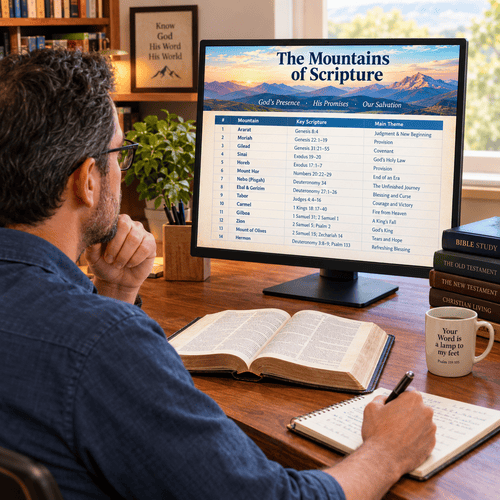
Mountains in the Bible: What Happened There and How Each Points to Christ (in Bible order)
| MOUNTAIN | WHAT HAPPENED (OLD TESTAMENT) | HOW IT POINTS TO CHRIST (NEW TESTAMENT) |
|---|---|---|
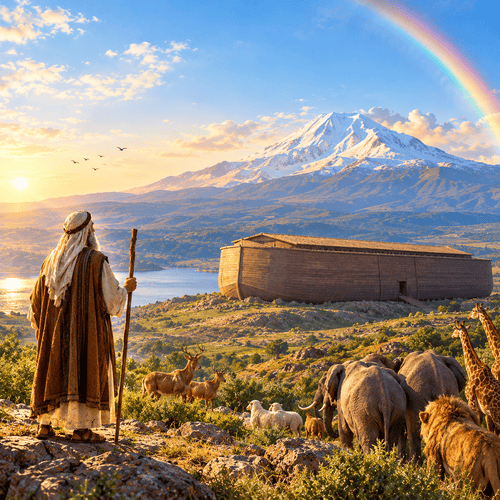
| Ararat | Noah’s ark comes to rest after the flood (Genesis 8:4) | Jesus compares His return to “the days of Noah” (Matthew 24:37); the flood pictures baptism (1 Peter 3:20–21) |
| Moriah | Abraham offers Isaac and God provides a ram (Genesis 22); David’s altar stops a plague (2 Samuel 24) | God “did not spare his own Son” (Romans 8:32) |
| Sinai (Horeb) | God gives His law in fire and thunder (Exodus 19–20) | Jesus fulfils the law (Matthew 5:17) and brings a new covenant (Hebrews 12:24) |
| Pisgah (Nebo) | Moses sees the Promised Land but cannot enter (Deuteronomy 34) | Moses stands in the land with Jesus at the Transfiguration (Matthew 17:3) |
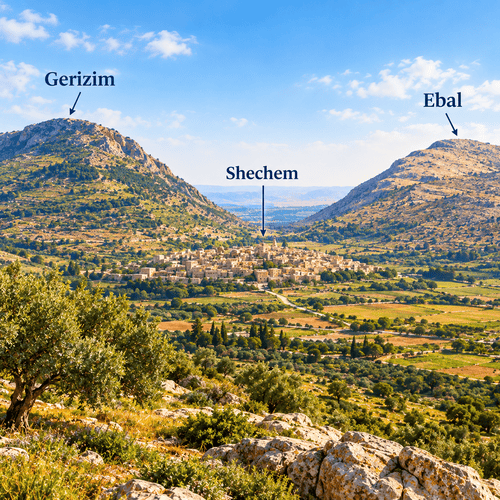
| Gerizim and Ebal | Israel hears the blessings and curses of the law (Deuteronomy 27; Joshua 8) | Christ became “a curse for us” (Galatians 3:13) |
| Zion | David makes Jerusalem God’s city; God sets His King there (2 Samuel 5:7; Psalm 2:6) | Believers “have come to Mount Zion” (Hebrews 12:22) |
| Carmel | Elijah calls down fire and Baal’s prophets fail (1 Kings 18) | John the Baptist comes “in the spirit and power of Elijah” (Luke 1:17) |
| Mount of Olives | David climbs it weeping (2 Samuel 15:30); the LORD will one day stand on it (Zechariah 14:4) | Jesus weeps, prays in Gethsemane, and ascends to heaven from it (Luke 19:41; 22:39; Acts 1:12) |
| Hermon | The great mountain of Israel’s northern border; its dew pictures God’s blessing (Psalm 133:3) | At its foot, Jesus says the gates of hell will not win against His church (Matthew 16:18) |
The Story the Mountains Tell
These mountains are not a random list. Read them together, and they tell one story in four stages.
1. Mountains of Judgement and Rescue: Ararat and Moriah
On both of these mountains, death came very close. At Ararat, the whole world had just been judged by the flood, yet God kept Noah and his family safe inside the ark. At Moriah, Abraham’s knife was raised over Isaac, until God provided a ram to die in his place. Here we learn the first great lesson of the mountains: God judges sin, but He also provides a way of rescue. Both stories point to the cross, where judgement fell on Jesus so that His people could be saved.
Go deeper: Read our posts on Mount Ararat and Mount Moriah.
2. Mountains of Law and Covenant: Sinai, Gerizim and Ebal, Pisgah
A covenant is a binding promise between God and His people. At Sinai, God made His covenant with Israel and gave them His law. At Gerizim and Ebal, Israel stood between two mountains and heard what obeying would bring (blessing) and what disobeying would bring (curse). At Pisgah, Moses—the man who brought the law—looked into the Promised Land but was not allowed to enter.
Put these three together, and the lesson is clear. The law is good, but it cannot bring sinners home. It shows us God’s holiness and our failure. Only Christ, who kept the law perfectly and took its curse on Himself, can bring us into God’s rest (Galatians 3:13; Hebrews 4:9–10).
Go deeper: Read our posts on Mount Sinai, Mounts Gerizim and Ebal, and Mount Pisgah.
3. Mountains of the King and His Worship: Zion and Carmel
Zion was the small hill in Jerusalem that God chose for His throne on earth. “As for me, I have set my King on Zion, my holy hill” (Psalm 2:6). Carmel was where Elijah showed who the true God was. While Baal’s prophets cried out all day with no answer, the LORD answered Elijah with fire (1 Kings 18:38). Elijah asked the people, “How long will you go limping between two different opinions?” (1 Kings 18:21). Together, these mountains teach that God alone is King, and He alone must be worshipped.
Go deeper: Read our posts on Mount Zion and Mount Carmel.
4. Mountains of the Coming King: Olives and Hermon
These two mountains belong mostly to the Gospels. On the Mount of Olives, Jesus wept over Jerusalem, prayed in deep sorrow in Gethsemane, and later rose to heaven before His disciples’ eyes (Acts 1:9–12). Near Mount Hermon, at Caesarea Philippi, Peter said, “You are the Christ, the Son of the living God,” and Jesus promised to build His church (Matthew 16:16–18). Many scholars believe the Transfiguration, which came a week later, happened on Hermon’s slopes. The King has come—and His kingdom cannot be stopped.
Go deeper: Read our posts on the Mount of Olives and Mount Hermon.
Two Mountains That Sum Up the Bible: Sinai and Zion
If you want to understand what the mountains of the Bible are all about, read Hebrews 12:18–24. The writer puts two mountains side by side. One is Sinai, where the old covenant was given. The other is Zion—not the hill in Jerusalem, but the heavenly city it pictured.
Sinai and Zion Compared (Hebrews 12:18–24): What Each Mountain Shows Us
| QUESTION | MOUNT SINAI (THE OLD COVENANT) | MOUNT ZION (THE NEW COVENANT) |
|---|---|---|
| What do you see? | “A blazing fire and darkness and gloom and a tempest” (v. 18) | “The city of the living God, the heavenly Jerusalem” and “innumerable angels in festal gathering” (v. 22) |
| What do you hear? | A voice so frightening that the people begged to hear no more (v. 19) | “The sprinkled blood that speaks a better word than the blood of Abel” (v. 24) |
| Who may come near? | No one—“If even a beast touches the mountain, it shall be stoned” (v. 20) | “The assembly of the firstborn who are enrolled in heaven” (v. 23) |
| Who stands between God and the people? | Moses, who said, “I tremble with fear” (v. 21) | “Jesus, the mediator of a new covenant” (v. 24) |
Notice the words “you have come” (Hebrews 12:22). The writer does not say “you will come one day”. If you trust in Jesus, you have already arrived at Mount Zion. When the church gathers to worship, it joins the angels and the saints in heaven. Sinai said, “Stay back.” Zion says, “Come near”—because Jesus has opened the way by His blood (Hebrews 10:19–22).
Jesus and the Mountains
The Gospel of Matthew is full of mountains. Each one shows us something about who Jesus is:
- The mountain of temptation. Satan offers Jesus the world’s kingdoms without suffering. Jesus refuses (Matthew 4:8–10).
- The mountain of teaching. “He went up on the mountain” and taught (Matthew 5:1). Moses received the law on a mountain. Jesus speaks with His own authority: “You have heard that it was said… But I say to you” (Matthew 5:21–22).
- The mountain of glory. At the Transfiguration, Jesus shines like the sun. Moses and Elijah—who both met God on Mount Sinai—now meet Him in Jesus. The Father says, “This is my beloved Son… listen to him” (Matthew 17:5).
- The mountain of sorrow. On the Mount of Olives, Jesus prays, “My Father, if it be possible, let this cup pass from me; nevertheless, not as I will, but as you will” (Matthew 26:39).
- The mountain of authority. After the cross and the empty tomb, Jesus sends His followers to “make disciples of all nations” (Matthew 28:16–20).
Here is the point. Jesus is the new and better Moses, who does not just receive God’s word—He is God’s Word. He is also the answer to Psalm 24. He is the only one with truly “clean hands and a pure heart”. He climbed the hill of the LORD, not into an earthly temple, but “into heaven itself, now to appear in the presence of God on our behalf” (Hebrews 9:24).
The Mountain That Fills the Earth
The Old Testament prophets looked ahead to a day when God’s mountain would grow beyond anything Israel had seen:
“It shall come to pass in the latter days that the mountain of the house of the LORD shall be established as the highest of the mountains, and shall be lifted up above the hills; and all the nations shall flow to it.”
Isaiah 2:2
When did this begin? The New Testament says the “last days” started when Christ came (Acts 2:17; Hebrews 1:2). Isaiah continues, “out of Zion shall go the law, and the word of the LORD from Jerusalem” (Isaiah 2:3). That is exactly what happened when the gospel went out from Jerusalem to the nations (Luke 24:47; Acts 1:8). John Calvin, the reformer, pointed out that Isaiah was not promising a taller hill. The mountain would be lifted up in honour, not in height, as Christ’s kingdom spread through the preaching of the gospel.
Daniel saw the same thing in a dream about a great statue. A stone “cut out by no human hand” struck the statue and smashed it. Then “the stone that struck the image became a great mountain and filled the whole earth” (Daniel 2:34–35). Daniel explains that God would set up a kingdom “in the days of those kings” that would never be destroyed (Daniel 2:44). Christ came in the days of Rome, the last of those kingdoms. His kingdom began small, like a stone. Today it is growing to fill the earth.
Back to the Mountain of God
The Bible’s last mountain brings us full circle. In Revelation, John says, “he carried me away in the Spirit to a great, high mountain, and showed me the holy city Jerusalem coming down out of heaven from God” (Revelation 21:10). The city is a perfect cube: “its length and width and height are equal” (Revelation 21:16). The only other perfect cube in the Bible is the Most Holy Place in Solomon’s temple, where God’s presence lived (1 Kings 6:20).
Do you see what this means? In the end, the whole new creation becomes God’s holy place. As Gregory Beale puts it, God’s plan from Eden onward was for His presence to fill the whole earth. What Adam lost on the first mountain, Christ wins back on the last. A river flows from God’s throne once again (Revelation 22:1), and God’s people see His face (Revelation 22:4).
What the Mountains Mean for Us Today
- You do not need a holy mountain. Jesus said worship would be “neither on this mountain nor in Jerusalem”, but “in spirit and truth” (John 4:21–23). You can meet God anywhere through Jesus.
- You can come near without fear. Sinai’s fire kept people back. Christ’s blood invites you in (Hebrews 12:22–24).
- Jesus climbed every mountain for you. He kept the law given at Sinai, gave Himself as the Lamb that Moriah pointed to, and now reigns as King from the true Zion.
- God’s kingdom is still growing. The stone is becoming a mountain. Every person who comes to Christ is part of Isaiah’s promise that “all the nations shall flow to it”.
- God is greater than the mountains. “Before the mountains were brought forth… from everlasting to everlasting you are God” (Psalm 90:2). The mountains point to Him; they never replace Him.
Satan offered Jesus a mountaintop kingdom without a cross. Jesus chose the cross instead. Because He did, He now stands on the mountain of all authority—and He calls you to come up with Him.
So, who shall ascend the hill of the LORD? Only the One with clean hands and a pure heart. And, by His grace, everyone who trusts in Him.
Tough Questions, Honest Answers
How many mountains are mentioned in the Bible?
The Bible names dozens of different mountains and hills, and the words “mountain” and “hill” appear hundreds of times. Some are mentioned only once, often as border markers in the books of Numbers and Joshua. Others, like Sinai and Zion, appear again and again because of what God did there. The exact count depends on how you treat places with two names, such as Sinai and Horeb, or Pisgah and Nebo. What matters is not the number, but the handful of mountains where God made Himself known in a special way.
What’s the highest mountain in the Bible?
The modern Mount Ararat in Turkey rises over 5,000 metres, but Genesis says the ark rested on “the mountains of Ararat” (Genesis 8:4). That means a mountain range in a region, not one exact peak. Within Israel’s own lands, Mount Hermon is the highest, at about 2,800 metres. Zion, by contrast, is a small hill. Psalm 68:16 even pictures the high peaks looking at Zion with jealousy, because it is “the mount that God desired for his abode”. God often chooses what is small to show that the glory is His.
Why did Jesus often go up a mountain to pray?
The Gospels tell us that Jesus “went out to the mountain to pray, and all night he continued in prayer to God” before choosing His twelve apostles (Luke 6:12). After feeding the five thousand, He again “went up on the mountain to pray” (Mark 6:46). The hills around Galilee gave Him quiet, away from the crowds. This does not mean God is closer on a mountain. Jesus also taught us to pray in a private room (Matthew 6:6). His example shows that even the Son of God made time to be alone with His Father—and so should we.
What does “faith to move mountains” mean?
Jesus said, “if you have faith like a grain of mustard seed, you will say to this mountain, ‘Move from here to there,’ and it will move” (Matthew 17:20). A mountain was a common picture for a problem that seemed impossible (Zechariah 4:7). Jesus’ point is that even small faith is powerful, because it trusts a great God. The power is in God, not in the size of our faith. This is not a promise that we will get whatever we want. True faith asks “according to his will” (1 John 5:14) and trusts Him with the answer.
What does Psalm 121 mean by “I lift up my eyes to the hills”?
Psalm 121 is a “Song of Ascents”, sung by pilgrims as they climbed up to Jerusalem for the feasts. It begins, “I lift up my eyes to the hills. From where does my help come? My help comes from the LORD, who made heaven and earth” (Psalm 121:1–2). The hills may stand for dangers on the road, such as robbers hiding in the rocks. Or they may stand for the hilltop shrines of false gods. Either way, the answer is the same: our help does not come from the hills, but from the One who made them.
Was Jesus crucified on a hill called Mount Calvary?
The Bible never calls the place of the cross a mountain or a hill. The Gospels call it “Golgotha (which means Place of a Skull)” (Matthew 27:33). The name “Calvary” comes from the Latin word for skull. We know the place was “near the city” (John 19:20) and could be seen “from a distance” (Mark 15:40), so it may have been raised ground beside a road. The idea of “Mount Calvary” comes from later tradition and hymns. What matters most is not the height of the place, but the Saviour who died there.
What’s the “7 Mountain Mandate”, and is it biblical?
The 7 Mountain Mandate is the idea that Christians must take control of 7 “mountains” of society: religion, family, education, government, media, arts and entertainment, and business. It is popular in parts of the New Apostolic Reformation movement and was spread by teachers such as Lance Wallnau. Supporters sometimes point to Isaiah 2:2, but that verse is about the gospel drawing the nations to God, not Christians gaining power. Christians should be salt and light in every part of life (Matthew 5:13–16). But Jesus said, “My kingdom is not of this world” (John 18:36). His kingdom grows through the gospel and the Holy Spirit, not by taking over society’s institutions.
Related Reads
- Mount Ararat in the Bible: Where Judgement Ended and Rescue Began
- Mount Moriah in the Bible: Araunah’s Threshing Floor and Why It Matters
- Mount Sinai in Arabia: What Paul Meant in Galatians 4:25
- Mount Nebo (Pisgah): The Law, the Promise and Rest Christ Gives
- Mounts Gerizim and Ebal: Blessing, Curse and the Cross
- Mount Zion Meaning: From David’s Hill to the People of God
- Mount Carmel in the Bible: Elijah’s Fire and the Cross of Christ
- Mount of Olives in the Bible: Where the King Wept and the Glory Returns
- Mount Hermon in the Bible: Dew, Watchers and the Gates of Hell
- Where Was the Garden of Eden? What the Four Rivers Reveal
- Mountaintop Moments: The Transfiguration’s Timeless Truths
- Old Covenant Vs New: The Shadow Becomes Substance, and How!
- Mountains or Molehills? How Hyperbole Reveals Bible Truth
- What’s Wrong With Dominion Theology? A Biblical Critique