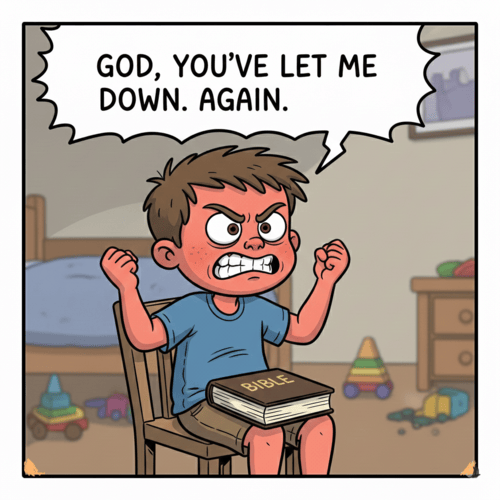
Here’s a thought that may upset us: our failure didn’t catch God by surprise. Not the exam we failed. Not the business that collapsed. Not the relationship that broke. Not even the sin we promised we’d never ever commit again.
Before you close this page, stay with us. That sentence isn’t bad news. It’s the best news a failing person can hear. Because, come to think of it: if God wasn’t in charge when you fell, nobody is in charge of picking you up.
Failure’s hurt is special. Most pain comes from outside us. Failure points a finger at us and whispers, “You did this. You’re the problem.” Christians often feel it twice: the loss itself, and the fear that God is now disappointed in us.
So how do we go about coping with failure as a Christian? The Bible doesn’t hand us a list of tips. It gives us a God who rules over everything—our failures included—and who uses even our worst moments to draw us closer to Himself.
In this article we shall walk through the stories of 2 men who failed badly: King David and the apostle Peter. One fell into adultery and murder. The other denied Jesus three times on the night Jesus needed him most. Both were brought back. And in both stories we shall see the same thing. God was at work the whole time.
Our Failure Doesn’t Surprise God
The Bible teaches God is sovereign. This word means God is the supreme ruler over everything. Nothing happens by accident. Nothing happens outside His plan. That includes the good things in our lives. It also includes the painful ones.
Think about Joseph in the book of Genesis. His own brothers sold him as a slave. That was a terrible sin. Years later, Joseph told them:
“As for you, you meant evil against me, but God meant it for good, to bring it about that many people should be kept alive, as they are today.”
Genesis 50:20
Notice what Joseph says. His brothers did something evil, and they were guilty for it. But God wasn’t standing to one side, watching helplessly. God meant it. He had a good purpose hidden inside their bad act.
The clearest example of all is the cross. The worst crime in history was the killing of the Son of God. Yet Peter preached that Jesus was “delivered up according to the definite plan and foreknowledge of God” (Acts 2:23). If God ruled over the cross, He surely rules over your failure.
TWO TRUTHS THAT STAND TOGETHER
The Bible holds two truths side by side. We do not need to choose between them.
- God rules over all things. He “works all things according to the counsel of his will” (Ephesians 1:11). Nothing, not even sin, is outside His plan.
- People are responsible for what they do. God never forces anyone to sin, and He “tempts no one” (James 1:13).
- Both are true at the same time. Joseph’s brothers “meant evil” and God “meant it for good”—in the very same event.
Why This Truth Matters So Much
Many Christians love this promise: “And we know that for those who love God all things work together for good, for those who are called according to his purpose” (Romans 8:28).
Think carefully about it. God can only work all things for good if He controls all things. Some say God does not control our failures; He only reacts afterwards and repairs the damage. That sounds kind, but it takes away our comfort. A God who only reacts can hope to bring good out of your mess. He cannot promise it. Only a God who rules over everything can make the promise of Romans 8:28 and keep it.
John Calvin understood this well. He wrote that “ignorance of providence is the ultimate of all miseries; the highest blessedness lies in the knowledge of it” (Institutes 1.17.11). Providence simply means God’s loving care and control over everything that happens. For Calvin, it was a pillow for a tired head.
Why Would a Good God Let Us Fail?
If God rules over our failures, the next question is obvious. Why does He allow them? The Westminster Confession of Faith, written in 1646, gives a remarkably honest answer. It says that God sometimes leaves His own children, “for a season,” to temptation and to the weakness of their own hearts. Then it explains why.
WHY GOD SOMETIMES LETS HIS CHILDREN FALL
These are the reasons given in the Westminster Confession of Faith, chapter 5, section 5, put into plain English.
- To correct us. God may use a failure to deal with sin we have not taken seriously.
- To show us our own hearts. We find out how weak and deceitful our hearts really are.
- To humble us. Our pride breaks, and we stop trusting in ourselves.
- To bring us closer. God does this “to raise them to a more close and constant dependence for their support upon Himself.”
- To make us watchful. We become more careful about the dangers ahead.
Look again at the fourth reason. In God’s hands, the goal of failure is not to push us away. It is to pull us closer. The apostle Paul learned this during a time of terrible trouble. He felt he had received a death sentence, yet he wrote, “But that was to make us rely not on ourselves but on God who raises the dead” (2 Corinthians 1:9).
Failure breaks our confidence in ourselves. That hurts, but self-confidence was never a safe place to stand. When it breaks, we are free to stand on God instead. The Puritan preacher Thomas Watson put it in six words: “Till sin be bitter, Christ will not be sweet.”
Charles Spurgeon, the great London preacher, said it even more beautifully: “I have learned to kiss the wave that throws me against the Rock of Ages.” The wave still hurts. But it throws us somewhere better than where we were.
Is God Punishing Me?
Many people who fail believe God is now angry with them and punishing them. For the Christian, this is not true. Jesus already took the punishment for our sins on the cross. “There is therefore now no condemnation for those who are in Christ Jesus” (Romans 8:1).
What God gives His children instead is discipline. This is the loving correction of a father, not the anger of a judge. “For the Lord disciplines the one he loves” (Hebrews 12:6). The table below shows the difference.
Punishment or Discipline? What a Christian’s Failure Really Means
| QUESTION | PUNISHMENT | FATHERLY DISCIPLINE |
|---|---|---|
| Who gives it? | A judge | A loving Father |
| What is it for? | To pay for a crime | To train and heal a child |
| What drives it? | Anger against the guilty | Love for the child |
| Where does it lead? | It shuts the door | It opens the door to a closer walk with God |
| Does a Christian receive it? | No. Jesus already paid it on the cross | Yes, and always for our good (Hebrews 12:11) |
David: When a King Falls Hard
The Bible calls David “a man after his own heart” (1 Samuel 13:14). Yet David committed some of the worst sins in the Bible. He slept with Bathsheba, another man’s wife. When she became pregnant, he arranged for her husband Uriah to be killed in battle (2 Samuel 11).
Now notice who moved first. David did not come to God. God came to David. The Lord sent the prophet Nathan, who told David a story and then said four words that broke him: “You are the man!” (2 Samuel 12:7). This is God’s sovereign grace at work. Grace means God’s kindness to people who do not deserve it.
David’s reply was simple: “I have sinned against the LORD.” And Nathan answered, “The LORD also has put away your sin; you shall not die” (2 Samuel 12:13).
What David Teaches Us About Coming Back to God
- Stop hiding. David said that when he kept silent, “my bones wasted away through my groaning all day long” (Psalm 32:3). Hidden failure eats us from the inside.
- Call it what it is. “Against you, you only, have I sinned” (Psalm 51:4). David made no excuses.
- Ask for a new heart, not just relief. “Create in me a clean heart, O God, and renew a right spirit within me” (Psalm 51:10).
- Ask for joy to return. “Restore to me the joy of your salvation” (Psalm 51:12). Forgiven people are allowed to be happy again.
But there is a hard truth here too. Forgiveness did not remove every consequence. The child died, and violence troubled David’s family for years (2 Samuel 12:10–14). God forgives completely, but He does not always undo the results of our choices. Even so, those results now come to us as a Father’s discipline, not a Judge’s rejection.
When Failure Is Not Sin: David at Ziklag
Not every failure is a sin. Sometimes we simply lose. Earlier in his life, David came home to the town of Ziklag and found it burned to the ground. Every family had been taken captive, including his own. His men were so bitter that they talked of stoning him (1 Samuel 30:1–6). As their leader, it all felt like his fault.
What did David do? “But David strengthened himself in the LORD his God” (1 Samuel 30:6).
Martyn Lloyd-Jones, the Welsh doctor who became a preacher, once asked: “Have you realised that most of your unhappiness in life is due to the fact that you are listening to yourself instead of talking to yourself?” At Ziklag, David stopped listening to his fear and started telling his own heart about God’s faithfulness.
Peter: The Man Jesus Prayed For
If David shows us God chasing a fallen man, Peter shows us something even more amazing. God planned the rescue before the fall.
Peter was very sure of himself. He told Jesus, “If I must die with you, I will not deny you” (Mark 14:31). But Jesus knew what was coming. Read slowly what He said to Peter that night:
“Simon, Simon, behold, Satan demanded to have you, that he might sift you like wheat, but I have prayed for you that your faith may not fail. And when you have turned again, strengthen your brothers.”
Luke 22:31–32
FOUR THINGS TO NOTICE IN LUKE 22:31–32
These two verses hold the whole gospel of failure in miniature.
- Satan had to ask. Even the devil could not touch Peter without God’s permission. God was in control.
- Jesus prayed first. Before Peter fell, Jesus was already praying for him. This is called intercession, which means praying to God on someone else’s behalf.
- “When,” not “if.” Jesus said “when you have turned again.” Peter’s return was certain before his fall even happened.
- The failure had a future use. “Strengthen your brothers.” Peter’s worst night would become a tool for his future ministry.
John Calvin pointed out that Jesus did not pray that Peter would never stumble. He prayed that Peter’s faith would not die out completely. Peter’s faith was shaken, but it was never snuffed out, because Christ was holding on to it.
Timeline: Peter’s Fall and Restoration
- The boast (Mark 14:31): Peter promises he will never deny Jesus.
- The prayer (Luke 22:32): Jesus prays that Peter’s faith will not fail.
- The fire (John 18:18): Peter warms himself at a charcoal fire in the high priest’s courtyard.
- The fall (Luke 22:54–60): Three times Peter says he does not know Jesus.
- The look (Luke 22:61–62): “The Lord turned and looked at Peter.” Peter goes out and weeps bitterly.
- The message (Mark 16:7): The angel says, “Go, tell his disciples and Peter.” Jesus names the man who failed.
- The second fire (John 21:9): The risen Jesus cooks breakfast on a charcoal fire by the lake.
- The three questions (John 21:15–17): Three times Jesus asks, “Do you love me?”—one question for each denial.
- The new task (John 21:17): “Feed my sheep.” Peter is sent back into service.
Did you notice the two charcoal fires? The Greek word John uses for “charcoal fire” appears only in these two places in the whole New Testament. Jesus brought Peter back to the same kind of scene where he had failed. He healed the wound where it was made.
Jesus never asked, “Will you try harder?” He asked, “Do you love me?” Restoration rests on Christ’s love and Christ’s prayer, not on our promises.
Years later, Peter wrote to suffering Christians: “The God of all grace … will himself restore, confirm, strengthen, and establish you” (1 Peter 5:10). The man who was restored became a teacher of restoration.
Peter and Judas: Different Ending
Peter was not the only disciple who turned on Jesus that night. Judas did too. Both felt terrible. Why did one end in restoration and the other in death? Paul explains: “For godly grief produces a repentance that leads to salvation without regret, whereas worldly grief produces death” (2 Corinthians 7:10). Repentance means turning away from sin and back to God.
Peter and Judas Compared: Two Kinds of Sorrow
| Question | PETER | JUDAS |
|---|---|---|
| What he did | Denied Jesus three times | Betrayed Jesus for money |
| How he felt | Wept bitterly (Luke 22:62) | Felt remorse and “changed his mind” (Matthew 27:3) |
| Where he turned | Back towards Jesus | To the priests, and then inward to himself |
| Kind of grief | Godly grief, which leads to God | Worldly grief, which leads to despair |
| What made the difference | Jesus had prayed for him (Luke 22:32) | No such prayer or promise is recorded |
| How it ended | Restored and sent to feed Christ’s sheep | Died in despair (Matthew 27:5) |
The size of the sin was not the difference. The difference was grace. Peter’s faith held because Christ held Peter. That should give hope to anyone who fears they have fallen too far.
Guilt, Shame and the Voice in Your Head
After failure, two feelings often arrive together. They sound similar, but they are different.
- Guilt says, “I did something wrong.” Guilt can be healthy. It leads us to confess.
- Shame says, “I am something wrong. I am worthless.” Shame makes us hide.
The gospel answers both. To our guilt, God says: “If we confess our sins, he is faithful and just to forgive us our sins and to cleanse us from all unrighteousness” (1 John 1:9). To our shame, He says that we now belong to Christ, and Christ “is not ashamed to call them brothers” (Hebrews 2:11). Edward T. Welch, a Christian counsellor who has written widely on shame, shows that the cure for shame is not learning to feel better about ourselves. It is being welcomed and covered by Christ.
The Puritan pastor Richard Sibbes wrote a small book called The Bruised Reed. It is based on Isaiah 42:3: “a bruised reed he will not break, and a faintly burning wick he will not quench.” A bruised reed is a damaged plant stem, close to snapping. That is how many of us feel after failure. Sibbes reminds us that Christ is gentle with damaged people, and he gives us one of the most comforting lines ever written: “There is more mercy in Christ than sin in us.”
Dane Ortlund makes a similar point in his book Gentle and Lowly. He notes that the only time Jesus describes His own heart, He says, “I am gentle and lowly in heart” (Matthew 11:29). That is the heart that meets you in your failure.
WHEN THE PAIN WILL NOT LIFT
Sometimes the sadness after failure becomes very heavy.
- Talk to your pastor, a trusted friend or a doctor today. You do not have to carry this alone.
- If you are having thoughts of harming yourself, please reach out for help right away. In India you can call the Tele-MANAS mental health helpline on 14416.
- Asking for help is not a lack of faith. God often brings comfort through other people.
Answering the Hard Objections
Here are the most common objections, and how the Bible answers each one.
Common Objections About God and Failure, Answered From Scripture
| THE OBJECTION | WHAT THE BIBLE SAYS |
|---|---|
| “If God planned it, my failure is not my fault.” | God’s plan and human guilt stand together. Joseph’s brothers were guilty even though God meant it for good (Genesis 50:20; Acts 4:27–28). |
| “If God uses my sin for good, sin does not matter.” | “Are we to continue in sin that grace may abound? By no means!” (Romans 6:1–2). David’s sin still cost him dearly. |
| “Real Christians do not fail like this.” | David and Peter were true believers who fell badly. “The righteous falls seven times and rises again” (Proverbs 24:16). |
| “Failure means my faith is too weak.” | Paul’s weakness stayed so that Christ’s power could be seen: “My grace is sufficient for you” (2 Corinthians 12:9). |
| “God does not control things. He just makes the best of them.” | Then Romans 8:28 is only a wish. Only a God who works “all things according to the counsel of his will” can promise good (Ephesians 1:11). |
How to Walk Through Failure: Six Steps
So what does coping with failure as a Christian look like from day to day? Here are six steps drawn from the lives of David and Peter.
- Bring it into the light. Tell God honestly what happened. If it is sin, confess it plainly, as David did.
- Separate guilt from shame. Take real guilt to the cross. Refuse shame’s lie that you are worthless.
- Talk to yourself with Scripture. Like David at Ziklag, preach God’s promises to your own heart. “Hope in God; for I shall again praise him” (Psalm 42:5).
- Accept consequences without despair. Forgiveness is full even when some results remain.
- Let others help you. God sent Nathan to David and friends to Peter. “If anyone is caught in any transgression, you who are spiritual should restore him in a spirit of gentleness” (Galatians 6:1).
- Watch for your “strengthen your brothers” moment. One day God may use your failure to comfort someone else.
Your Failure Is Not the Last Word
David fell into adultery and murder. Peter denied his Lord with oaths and curses. Human writers would have ended their stories there. But God was the Author.
David went on to write Psalm 51, a prayer that has helped millions of broken people find their way home. Peter went on to preach at Pentecost, where about three thousand people believed (Acts 2:41). Their failures were real. But they were not the end.
The same God who sent Nathan to David, and who prayed for Peter before he fell, is ruling over your life today. He saw your failure coming, and He has not let go of you. “When I fall, I shall rise” (Micah 7:8), because “he who began a good work in you will bring it to completion at the day of Jesus Christ” (Philippians 1:6).
Your failure is a chapter. It is not the whole story. And the Author is good.
Tough Questions, Honest Answers
Is failure always a sin?
No. Failure simply means falling short of a goal. Some failures are sin, such as lying or adultery. Others are not, such as failing a driving test, losing a job when a company shrinks, or starting a project that did not work out. On the cross, Jesus looked like a failure to many people, yet He never sinned. The real question is not “Did I fail?” but “Did I disobey God?” Confess sin, grieve loss, and do not label every disappointment a sin.
How do I forgive myself after a big failure?
Interestingly, the Bible never tells us to forgive ourselves. Forgiveness is something God gives to us, and something we give to others. When we say, “I can’t forgive myself,” we often mean, “I can’t believe God has really forgiven me,” or, “I am still upset that I was not as good as I thought.” The answer is to trust God’s verdict over your own feelings. Paul wrote, “I do not even judge myself … It is the Lord who judges me” (1 Corinthians 4:3–4). If the Judge of all the earth says “forgiven,” you have no right to overrule Him.
Why does God let me fail when I prayed for success?
God hears every prayer of His children, but sometimes His answer is “no” or “not this way.” He sees what we cannot see. Success might have made us proud, or drawn our hearts away from Him. James teaches us to plan humbly and say, “If the Lord wills, we will live and do this or that” (James 4:15). A “no” from God is not a sign that He was not listening. It is a sign that He loves you too much to give you everything you ask for.
If I keep failing in the same sin, am I really saved?
An ongoing fight against sin is actually a mark of true faith, not proof that it is missing. People with no spiritual life do not fight their sin—they simply enjoy it. Paul himself cried, “Wretched man that I am!” and then answered, “Thanks be to God through Jesus Christ our Lord!” (Romans 7:24–25). The real warning sign is not struggle but peace with sin. Keep confessing, keep fighting, and ask mature believers to help you. God’s grip on you is stronger than your grip on Him (John 10:28).
Can a pastor or leader be restored after moral failure?
Any Christian who truly repents can be fully restored to God and to the fellowship of the church. Returning to leadership, however, is a separate question. The Bible says an elder must be “above reproach” (1 Timothy 3:2), which means having a reputation others can trust. Serious public sin can damage that trust for a long time, even after real repentance. Wise churches usually move slowly, looking for time, accountability and clear evidence of change before giving leadership back.
Is it wrong to feel depressed after failing?
No. Deep sadness after failure is a normal human response, and the Bible is honest about it. Soon after his great victory on Mount Carmel, the prophet Elijah sat under a tree and asked God to take his life (1 Kings 19:4). God did not scold him. He sent an angel with food and let him sleep before He spoke to him (1 Kings 19:5–8). Sometimes our bodies and minds need care before our hearts can hear God again. If the sadness does not lift, please speak with a pastor and a doctor—seeking help is wise, not faithless.
What does the Bible say about failing exams or a career?
Your marks and your job title do not decide your worth. In many cultures, failing an exam or losing a job can feel like bringing shame on the whole family. But God measures us by faithfulness, not results. Paul wrote, “Whatever you do, work heartily, as for the Lord and not for men” (Colossians 3:23). Work hard, then leave the outcome with God. A failed exam may close one door, but the God who rules over every detail can open another you never expected.
Related Reads
- Providence Is Peace: How God’s Will Prevails Through Our Mistakes
- Does Everything Happen for a Reason? What Does the Bible Say?
- Would Judas Have Been Forgiven If He Repented?
- When Courage Fails: Will I Be Forgiven If I Deny Christ in Persecution?
- How Many Times Did the Rooster Crow at Peter’s Denial?
- Why Does God Call David a Man After His Own Heart?
- When Guilt Won’t Go Away: Overcoming Satan’s Lies
- Can Repentance be Real If We Struggle With Habitual Sin?
- Is Taking Antidepressants a Failure of Faith?