
We prayed. We trusted. We held on through the long nights and the hard seasons, believing God was good and that He’d heard us. And then life goes in a direction we never asked for and never wanted. The diagnosis comes back wrong. The marriage that was supposed to heal quietly falls apart. The child we’d raised in the faith walks away from it. The door we believed God was opening, closes. And stays closed.
When the gap between what we expected from God and what we’re experiencing in life grows wide, our love for Him often begins to fray. We feel a quiet resentment, a sense of betrayal. How do we love a God who has the power to change our circumstances, yet chooses not to?
First: Our Disappointment Isn’t A Failure Of Faith
One of the cruellest things the church sometimes does to hurting people is imply that disappointment with life means something has gone wrong with their faith. It hasn’t. Disappointment isn’t the opposite of faith—it’s the experience of nearly every serious believer in the entire Bible.
Nearly a third of the Psalms—the Bible’s own prayer book—are laments. That’s the word scholars use for prayers of raw, honest grief addressed directly to God. Psalm 13 opens with the blunt accusation: “How long, O Lord? Will you forget me forever?” Psalm 88—perhaps the darkest psalm in the entire Psalter—ends not in resolution but in darkness, with the words “darkness is my closest friend.” And yet, it’s still addressed to God. That’s the key: the psalmist doesn’t run from God in his pain. He runs to God with it.
Even Jeremiah, the great prophet, cried out in anguish: “You deceived me, Lord, and I was deceived” (Jeremiah 20:7). These aren’t the words of someone whose faith has collapsed. They’re the words of someone whose faith is honest enough to bring its full weight of grief into the presence of God.
“The lament psalms are acts of bold faith—they insist that the relationship with God is real enough to bear our full weight of grief.”
— Walter Brueggemann, The Psalms and the Life of Faith
Bringing our disappointment to God isn’t a sign our love for Him is failing. It’s in itself an act of love. It means we still believe He’s worth the argument.
The Problem Beneath The Pain: What Has God Actually Promised?
Much of our disappointment with God—if we’re honest—flows from a gap between what we expected Him to do and what He has actually promised to do. And those two things aren’t always the same.
A version of Christianity that has become widely popular in many parts of the world teaches that genuine faith produces health, wealth, and a smooth path through life. It sounds wonderful. The problem is that it isn’t the Christianity of the New Testament. Jesus told His disciples plainly: “In this world you will have trouble” (John 16:33). Not might. Not possibly. Will.
What God has promised isn’t a pain-free life but His presence through pain. “When you pass through the waters, I will be with you,” Isaiah 43:2 says. Notice the word when, not if. Paul writes in Romans 8:17 we share in Christ’s sufferings in order that we may also share in His glory. The path to glory, in Scripture, runs through the valley—not around it. And the goal God is pursuing in our lives isn’t, ultimately, our comfort. It’s something far more lasting.
“God’s goal for your life is not your comfort but your conformity to Christ — and the two are often in direct tension.”
—DA Carson, How Long, O Lord?
When we understand this, disappointment doesn’t disappear—but it begins to make a different kind of sense.
Three Anchors For Loving God Through Disappointment
Anchor One: Return to Who God Is, Not What He Has or Hasn’t Given
Job lost his children, his health, and his livelihood in a single devastating season. His three friends offered polished theological explanations. God offered none. What God offered instead was Himself—a breathtaking encounter in the whirlwind that left Job saying not “Now I understand” but “My ears had heard of you but now my eyes have seen you” (Job 42:5). Suffering had brought him to a deeper knowledge of God than ease ever had.
This is the first anchor: love for God must be rooted in who He is—holy, sovereign, wise, and unfailingly faithful—not in what He has delivered or withheld. Romans 8:28 doesn’t promise all things will feel good. It promises that all things work together for good for those who love God. That’s a promise about direction and destination, not about the comfort of the journey.
Anchor Two: Practise the Discipline of Remembrance
When the Israelites lost heart in the wilderness, God’s repeated instruction wasn’t “look forward” but “look back”—to remember what He had already done (Deuteronomy 8:2). Psalm 77 is a masterclass in this discipline. The psalmist begins in despair—”Has God forgotten to be gracious?” (v 9)—a question many of us have whispered in the dark. But he doesn’t stay there. He deliberately shifts his gaze: “I will remember the deeds of the Lord; yes, I will remember your wonders of old” (v 11). By the end of the psalm, he is in doxology—not because his circumstances have changed, but because his perspective has.
“The way to love God in the dark is to preach to yourself what you know to be true when the feelings have gone cold.”
—Timothy Keller, Walking with God through Pain and Suffering
Keep a record of God’s faithfulness—prayers answered, moments of grace, times He carried you through what you thought would break you. In the seasons of darkness, that record becomes an anchor.
Anchor Three: Fix Your Eyes on the Cross—and the Glory Ahead
The cross is God’s definitive answer to the accusation that He doesn’t care. When suffering feels like abandonment, the cross says otherwise. God didn’t observe human suffering from a safe distance and send a memo of sympathy. He entered it—took on flesh, wept at a graveside, sweat blood in a garden, and was crushed under the weight of divine wrath on a Roman cross. Whatever you’re carrying, you’re not carrying it alone, and you’re not carrying it with a God who is indifferent to your pain.
And there is more. Paul writes in Romans 8:18 that “the sufferings of this present time are not worth comparing with the glory that is to be revealed to us.” The Christian’s deepest hope isn’t that this life will eventually improve. Instead, it is that this life isn’t the end. Every loss here is temporary. Every grief here has an expiry date. The glory ahead doesn’t erase the pain of now, but it refuses to let the pain of now have the final word.
“The cross is God’s answer to the question, ‘Do you care?’ He does not explain our suffering from a distance—He absorbs it.”
—John Piper, Desiring God
We Weren’t Meant To Do This Alone
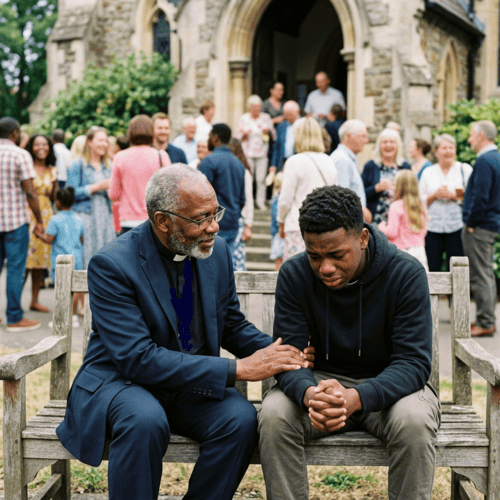
Loving God through disappointment isn’t a private, solitary achievement. Scripture places us in a community precisely because we need each other in the hard seasons. Hebrews 10:24–25 urges believers to “stir up one another to love and good works, not neglecting to meet together”—and the context makes clear this gathering matters most when faith is under pressure.
The local church—imperfect as it always is—is God’s designed context for sustaining faith over the long haul. When our own faith is running low, we borrow from the faith of those around us. When the Scriptures feel distant, we hear them read and preached by someone else, and they re-enter us through a different door. Regular, unhurried time in God’s Word also does something that nothing else can: it re-narrates our story. It places our particular pain inside God’s much larger story of redemption—and in that larger story, no suffering is wasted. And no chapter is the last.
But Remember: Some Things Will Not Be Explained This Side Of Eternity
Not every wound comes with a clear explanation. Nor does patient, faithful Christianity always produce visible answers to our hardest questions. It doesn’t. Some prayers remain unanswered in ways we can understand. Some losses remain raw for years. Some chapters of life close without resolution.
Deuteronomy 29:29 puts it with quiet honesty: “The secret things belong to the Lord our God.” There are things God is doing that He hasn’t chosen to show us. This isn’t cruelty. It’s the natural gap between an infinite God and finite creatures—a gap that faith doesn’t close but chooses to trust across. What Scripture promises isn’t that we will always understand what God is doing, but that He is always doing something. And that something is good, even when we cannot see it.
DA Carson, one of the most careful biblical scholars writing today, puts it plainly: unanswered prayer does not point to an absent God. It points to a God whose wisdom exceeds our vision.
Where Love Is Born
On the night before His crucifixion, in a garden called Gethsemane, Jesus knelt under the weight of what was coming and prayed: “Father, if you are willing, take this cup from me; yet not my will, but yours be done” (Luke 22:42). That single sentence is the most profound act of love for the Father in the history of the world—and it was spoken in the darkest, most frightening moment of the Son’s earthly life. Love for God, at its deepest, isn’t a feeling that flourishes in easy times. It’s a choice—made in the hard place, in the dark, with tears—to say: You are still good. I still trust You. Not my will, but Yours.
Our disappointment doesn’t disqualify us from loving God. It doesn’t mean our faith is broken or our prayers have gone unheard. It may be the very thing He is using, slowly and painfully and with great care, to bring us to the place where we know Him—not just about Him—in a way that easy seasons never could.
As the late author Elisabeth Elliot, who faced the tragic loss of two husbands, famously noted: “God is God. Because He is God, He is worthy of my trust and obedience. I will find rest nowhere but in His holy will, a will that is unspeakably beyond my largest notions of what He is up to.”
Hard Questions, Honest Answers
If God is truly good, why does He allow suffering that seems completely pointless and random—not just hard, but senseless?
The assumption buried in the question is that we’re in a position to identify which suffering is truly pointless. Scripture, however, consistently challenges that assumption. Joseph’s brothers meant their cruelty for evil; God meant it for the salvation of nations (Genesis 50:20), and no observer at the time could have seen that. DA Carson, in How Long, O Lord?, argues carefully that the absence of an explanation is not the same as the absence of a purpose. God’s purposes routinely exceed our capacity to trace them in real time. The cross itself looked, from every human vantage point on Good Friday, like the most senseless and wasteful death in history—and turned out to be the hinge of all redemption. We’re simply not equipped to adjudicate which suffering is truly without purpose and which is the very means by which God is doing His most profound work.
I have prayed faithfully for years about the same thing and nothing has changed. How is that compatible with a God who hears and answers prayer?
Unanswered prayer is one of the most personally destabilising experiences a Christian can face, and it deserves more than a formulaic response. Timothy Keller, in Prayer, observes that God always answers prayer—but that His answers take three forms: yes, not yet, and I have something better in mind—and that our pain almost always comes from assuming the first is the only legitimate one. Paul himself prayed three times for his “thorn in the flesh” to be removed, and God’s answer was not removal but sufficiency: “My grace is sufficient for you, for my power is made perfect in weakness” (2 Corinthians 12:8–9). The harder and more mature question is not “Why hasn’t God answered?” but “Am I willing to receive the answer He is actually giving?”
Doesn’t loving God despite disappointment just mean training ourselves to accept abuse from a God who could help but chooses not to?
This objection has real emotional force and should not be dismissed lightly—it comes from a place of genuine pain. But it rests on a fundamental mischaracterisation of what God has actually promised: He has never promised to prevent all suffering in this life, so withholding that which He never promised is not a breach of covenant faithfulness. John Piper, in Desiring God, draws the crucial distinction between a God who is indifferent to suffering and a God who sovereignly ordains suffering as the path to a greater good. The cross is the definitive proof that God is the latter, not the former. A God who entered human suffering, absorbed divine wrath in human flesh, and rose from the dead on our behalf is categorically different from an abusive authority who watches passively from comfort. The call to trust God through pain isn’t a call to accept cruelty. Rather, it’s a call to trust a proven character.