Here’s a truth we’ll never see on a motivational poster: life doesn’t always go according to plan. Not just for other people. For us too.
The job we prayed for may go to someone else. The marriage we hoped for may never happen. A doctor may say a word we never wanted to hear. The business, the exam, the visa, the house—some of our plans will break.
So here’s the real question. When our plan breaks, has God’s plan broken too?
Many Christians quietly fear the answer is yes. They imagine God had a perfect plan for them, and somewhere along the way they—or someone else—ruined it. Others decide God was never really in control at all. Things just happen.
The Bible gives a far better answer. Our plans can fail. God’s plan cannot. And if we belong to Jesus Christ, God’s plan isn’t against us. It’s for us—even on the days it hurts.
This post is part of our series What Do We Do When…?, which takes the hard moments of the Christian life to Scripture and asks how God would have us respond. Other posts in the series ask what we do when God seems distant and silent, when God closes a door we prayed would open, when we don’t know what step to take next and when we fall into the same sin again…
THE SHORT ANSWER
When life doesn’t go according to our plan, it’s still going according to God’s plan. His plan is wise, it’s good. What’s more, nothing can stop it.
So we don’t panic, and we don’t pretend. We tell God honestly how we feel. We keep obeying what He has clearly said. And we trust Him with what He hasn’t explained.
Our Plans Changed. Did God’s?
Here’s a surprise: the Bible doesn’t tell us to stop making plans. Planning is wise. But the Bible puts our plans in their proper place:
The heart of man plans his way, but the LORD establishes his steps.
Proverbs 16:9
Notice the two halves. You make the plan. God decides which steps actually happen. “Establishes” means makes firm or settles. You draw the map; God decides the road.
Many are the plans in the mind of a man, but it is the purpose of the LORD that will stand.
Proverbs 19:21
Our plans are many. God’s purpose is one, and it “will stand”—it will not fall over. James doesn’t tell planners to stop planning. He tells them to stop forgetting God: “Instead you ought to say, ‘If the Lord wills, we will live and do this or that’” (James 4:15).
KEY TERM: PROVIDENCE
Providence is the Bible’s teaching about how God cares for and controls everything He made.
God didn’t create the world and then walk away. Or go to sleep. He is still holding it together and guiding every part of it—big events and small details—towards the goal He has chosen.
The Westminster Confession of Faith (1646), a famous summary of Christian belief, puts it like this:
God the great Creator of all things doth uphold, direct, dispose, and govern all creatures, actions, and things, from the greatest even to the least, by his most wise and holy providence.
Westminster Confession of Faith 5.1
In simple English: God holds up, guides, arranges and rules everything—from the biggest thing to the smallest. Nothing is outside His hand.
What the Bible Says About God’s Control
This isn’t taught in just 1 or 2 verses. The whole Bible teaches it.
Five Bible passages on God’s control over our lives
| BIBLE PASSAGE | WHAT IT SAYS (ESV) | WHAT IT MEANS FOR YOU |
|---|---|---|
| Ephesians 1:11 | God “works all things according to the counsel of his will” | “All things” includes what went wrong this year. |
| Proverbs 16:33 | “The lot is cast into the lap, but its every decision is from the LORD.” | Even what looks like chance is in God’s hand. (Casting a lot was like rolling dice.) |
| Matthew 10:29 | “Not one of them will fall to the ground apart from your Father.” | If God cares about a sparrow’s fall, He cares about yours. |
| Psalm 139:16 | “In your book were written, every one of them, the days that were formed for me” | God knew all your days before you lived one. |
| Isaiah 46:10 | “My counsel shall stand, and I will accomplish all my purpose” | Nothing surprises God into changing His plan. |
John Calvin said that not knowing God’s providence is the worst of all miseries, while knowing it brings the highest happiness (Institutes 1.17.11). Why? Because the person who believes it knows that nothing in his life is random, wasted or out of control.
The Case in 3 Steps
- Step 1—God controls all things. Nothing happens outside His plan (Ephesians 1:11).
- Step 2—God is perfectly wise and good. “The LORD is righteous in all his ways and kind in all his works” (Psalm 145:17).
- Step 3—God has made a promise to His people. “And we know that for those who love God all things work together for good, for those who are called according to his purpose” (Romans 8:28).
- Conclusion—For the Christian, a broken plan is never a wasted plan. It’s a redirected one.
But what does “good” mean here? The very next verse tells us: God has planned for His people “to be conformed to the image of his Son” (Romans 8:29). “Conformed” means shaped like. So the “good” God promises is not always a better job or a healthier body. It’s something greater: becoming more like Jesus.
Thomas Watson, a 17th-century English pastor, wrote a whole book on this one verse, All Things for Good (1663). He showed God uses even the worst things in a believer’s life—pain, loss, even temptation—for that believer’s lasting good.
Jerry Bridges, the American author of Trusting God, built his book on 3 truths: God is completely sovereign (He has full authority, like a king no one can overrule), infinite in wisdom and perfect in love. Without power, God could not help us. Without wisdom, He might make mistakes. Without love, He might not care. Our God has all three.
The Greatest Plan That “Went Wrong”
Want to see how God’s plan works when human plans fail? Look at the cross.
Jesus’ disciples had a plan. Jesus would become king and throw out the Romans. Then came Friday. Jesus was arrested, beaten and nailed to a cross. Their plan died with Him. It looked like the greatest failure in history.
But listen to how the early church later prayed about that day:
For truly in this city there were gathered together against your holy servant Jesus, whom you anointed, both Herod and Pontius Pilate, along with the Gentiles and the peoples of Israel, to do whatever your hand and your plan had predestined to take place.
Acts 4:27–28
Wicked men did a wicked thing, and they were guilty. Yet it was God’s plan all along—the very plan by which He saved the world. (“Predestined” means decided beforehand.) The darkest day in history was the day God defeated sin and death.
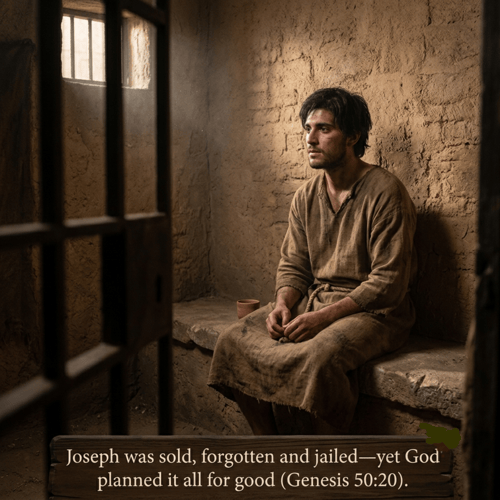
Joseph’s story follows the same pattern. His brothers sold him as a slave. Years later he told them, “As for you, you meant evil against me, but God meant it for good” (Genesis 50:20). One event. Two plans. The brothers’ plan was evil. God’s plan was good. God’s plan won.
THINK ABOUT IT
If God could turn the worst day in history into the best news in history, we can trust Him with our worst days too.
Two Kinds of “God’s Will”
Many Christians carry a hidden fear: “What if I missed God’s plan for my life?” To answer it, we need to see that the Bible speaks of God’s will in 2 ways.
The secret things belong to the LORD our God, but the things that are revealed belong to us and to our children forever, that we may do all the words of this law.
Deuteronomy 29:29
The 2 ways the Bible speaks of God’s will
| QUESTION | GOD’S SECRET WILL | GOD’S REVEALED WILL |
|---|---|---|
| What is it? | What God has decided will happen | What God has told us to do |
| Where do we find it? | Usually only after it happens | In the Bible |
| An example | Whether you get the job | Work honestly in whatever job you have (Colossians 3:23) |
| Can anyone stop it? | No—it always comes to pass (Isaiah 46:10) | We can disobey it, and that is sin |
| Our job | Trust it | Obey it |
God never asks us to discover His secret plan before we act. He asks us to obey what He has already said. Kevin DeYoung, an American pastor, makes this point in Just Do Something: many of us wait for a sign from heaven when God has already given us His Word. Obey Him, ask wise people for advice—then decide.
So, can we ruin God’s secret plan? No. Our sins are real and have real results, but they never take God by surprise. He works even our failures into His purpose.
When Plans Broke: A Timeline of Bible Detours
- Age of the patriarchs—Joseph: He dreamed of greatness but was sold as a slave and jailed for a crime he didn’t commit. God used it to save nations from famine (Genesis 37–50).
- Time of the judges—Naomi: She lost her husband and both sons, and said, “the Almighty has dealt very bitterly with me” (Ruth 1:20). Yet through Ruth came King David—and, much later, Jesus.
- Before the kingdom—David: Anointed king as a boy, he then spent years hiding in caves from Saul (1 Samuel 16–24). God was training a shepherd to rule.
- The night before the cross—Jesus: He prayed, “not as I will, but as you will” (Matthew 26:39). The cross came—and then the empty tomb.
- About AD 49—Paul’s mission: The Holy Spirit stopped Paul preaching in Asia and Bithynia (Acts 16:6–7). So the good news crossed into Europe instead.
- About AD 60—Paul in Rome: Paul planned to visit Rome as a free man (Romans 15:23–24) but arrived in chains. Yet he wrote, “what has happened to me has really served to advance the gospel” (Philippians 1:12).
John Flavel, a 17th-century English pastor, wrote in The Mystery of Providence: “Some providences, like Hebrew letters, must be read backward.” Hebrew is read from right to left. We often understand what God was doing only when we look back. Joseph could not see it in prison. He saw it years later.
What Providence Is Not
Because this truth is so powerful, people often bend it out of shape. Here are five wrong ideas.
5 wrong ideas about God’s plan—and the Bible’s answer
| Wrong idea | What people say | What the Bible says |
|---|---|---|
| Fate or karma | “It was written in my fate.” “I am paying for my past.” | God is not a blind force or a reward-and-punishment machine. He is a Father. All things come “not by chance, but by his fatherly hand” (Heidelberg Catechism, 1563, Q27). |
| “God only allowed it” | “God did not want this, but could not stop it.” | God rules over hard events too (Genesis 50:20; Job 1:21; Lamentations 3:38). |
| “God is learning as He goes” | “God does not know the future.” (This view is called open theism.) | God declares “the end from the beginning” (Isaiah 46:10). |
| “God’s plan means success” | “With enough faith, your plans will always work.” | Paul had great faith, yet his plans were blocked and his “thorn” stayed (2 Corinthians 12:7–9). |
| “Everything happens for a reason” | “The universe has a reason.” | True but vague. The reason is a Person—God—with a clear purpose: making His people like Christ (Romans 8:29). |
One more point. God’s control does not make Him guilty of evil. God has planned whatever comes to pass, “yet so, as thereby neither is God the author of sin” (Westminster Confession 3.1). People make real choices and are responsible for them. Joseph’s brothers were guilty. Pilate was guilty. God’s hand works through human choices without cancelling them. It is a deep mystery, but the Bible teaches both truths side by side.
So What Do We Do When Life Doesn’t Go According to Plan?
- Plan humbly. Keep making plans, but hold them with an open hand. Say “if the Lord wills”—and mean it (James 4:15).
- Lament honestly. “How long, O LORD? Will you forget me forever?” (Psalm 13:1). To lament is to bring your sadness and complaints to God in prayer. Mark Vroegop, an American pastor, calls lament “a prayer in pain that leads to trust.” God wants honest hearts, not fake smiles. (If God also feels far away, read What Do We Do When God Seems Distant and Silent?)
- Pray the Gethsemane prayer. Jesus told the Father exactly what He wanted, then said, “not as I will, but as you will” (Matthew 26:39). Ask boldly. Then submit.
- Do the next right thing. You may not know what next year holds, but you know what God asks of you today: love Him, love your neighbour, work honestly and stay close to His people.
- Remember God’s past faithfulness. “I will remember the deeds of the LORD” (Psalm 77:11). Write down how God has helped you before.
- Learn contentment. “I have learned in whatever situation I am to be content” (Philippians 4:11). Notice “learned”. Contentment is a skill God teaches, not a feeling we wait for.
- Lean on His grace. When God did not remove Paul’s thorn, He said, “My grace is sufficient for you” (2 Corinthians 12:9). He may not change your situation, but He will carry you through it.
A DEFINITION WORTH MEMORISING
Jeremiah Burroughs, an English pastor of the 1600s, wrote The Rare Jewel of Christian Contentment (1648). He described contentment as “that sweet, inward, quiet, gracious frame of spirit, which freely submits to and delights in God’s wise and fatherly disposal in every condition.”
In simple words: a calm heart that gladly accepts God’s wise and loving plan—whatever happens.
The Plan That Cannot Fail
Your plans may fail. Your health may fail. Even your own heart may fail (Psalm 73:26). But one plan has never failed and never will.
And those whom he predestined he also called, and those whom he called he also justified, and those whom he justified he also glorified.
Romans 8:30
Every link in that chain holds. Nobody falls out between “called” and “glorified”. (Justified means declared right with God because of Jesus. Glorified means made perfect in the life to come.) Paul even writes “glorified” as if it has already happened. That is how certain God’s plan is.
But remember: Romans 8:28 is a promise “for those who love God”. If you are not yet a Christian, it is not yet yours—but it can be. Jesus died for sinners and rose again. Turn from your sin and trust Him, and you will be welcomed into the one plan that can never fail.
Your life will not go according to your plan. But if you belong to Christ, it will go exactly according to His. And His plan alwaysends in glory.
Tough Questions, Honest Answers
Does Jeremiah 29:11 promise me the future I planned?
Jeremiah 29:11 is one of the most loved verses in the Bible: “For I know the plans I have for you, declares the LORD, plans for welfare and not for evil, to give you a future and a hope.” But look at who first received it. God spoke these words to Jewish exiles in Babylon, and in the verse just before He told them they would stay there for seventy years (Jeremiah 29:10). Many who first heard this promise died in Babylon before it came true. So the verse is not a promise that your personal plans will succeed. It is a promise that God’s good purpose for His people will stand through long, hard seasons—a promise that finds its final “Yes” in Jesus Christ (2 Corinthians 1:20).
If God has already planned everything, does prayer change anything?
Yes, it does. God has planned not only the results but also the means that lead to them, and prayer is one of His chosen means. James says, “You do not have, because you do not ask” (James 4:2). God planned to send rain in Elijah’s day, and He also planned for Elijah to pray for it (1 Kings 18:41–45; James 5:17–18). So prayer is not trying to change God’s mind; it is taking part in how God carries out His plan. And even when God says “no”, prayer changes us and draws us closer to Him.
What if my plans failed because of my own sin or foolish choices?
Then be honest about it, but do not lose hope. Sometimes God lets us feel the results of our choices, because “whatever one sows, that will he also reap” (Galatians 6:7). Sometimes He disciplines us as a loving Father does, so that we grow (Hebrews 12:6–11). Confess your sin to God, and where you have hurt others, put things right. Then hold on to His promise: “If we confess our sins, he is faithful and just to forgive us our sins” (1 John 1:9). Your failure did not surprise God, and it cannot cancel His purpose for you—just think of Peter, who denied Jesus three times and was then restored to serve Him (John 21:15–19).
Is it wrong to be angry with God?
Bringing hard feelings to God is not wrong, and hiding them from Him is not better. Job, David, Jeremiah and Habakkuk all spoke to God with raw honesty, and God placed their words in the Bible. But there is a difference between taking our anger to God and holding our anger against God. The first is faith that is hurting; the second accuses God of doing wrong, which He never does, for “all his ways are justice” (Deuteronomy 32:4). So pour out your heart, and then let His Word correct your view of Him, just as Asaph did in Psalm 73.
Does trusting God mean I should just accept things and not try to change them?
No. Trusting God’s providence is not the same as giving up. The Bible tells us to use wise means. Paul told Christian slaves, “if you can gain your freedom, avail yourself of the opportunity” (1 Corinthians 7:21), and he used his own legal rights as a Roman citizen when he was treated unfairly (Acts 22:25; 25:11). So see the doctor, apply for the next job, ask for advice and fix what you can. Work hard and pray hard, and then leave the results with God.
Will God always give me something better to replace what I lost?
Not always in this life. God did restore Job’s family and wealth (Job 42:10–17), but many faithful believers “died in faith, not having received the things promised” (Hebrews 11:13). Some teachers promise that every lost job or relationship will soon be replaced with something better, but God never makes that promise. What He does promise is even better: Himself now, and a coming glory so great that “the sufferings of this present time are not worth comparing” with it (Romans 8:18). The “better” God gives may be a new door—or it may be more of Christ in the middle of the loss.
How can I help a friend whose plans have fallen apart?
Start by being present, not by giving speeches. Job’s friends did their best work in the first seven days, when they sat with him in silence (Job 2:13); they did their worst when they started explaining why it happened. Avoid quick lines like “Everything happens for a reason” or “God has something better for you.” Instead, “weep with those who weep” (Romans 12:15), pray with your friend and help in practical ways—a meal, a ride, a phone call. Later, when the moment is right, gently point them to the God who holds their story.
Related Reads
- What Do We Do When God Seems Distant and Silent?
- What Do We Do When God Closes a Door We Prayed Would Open?
- What Do We Do When We Don’t Know What Step to Take Next?
- What Do We Do When We Fall Into the Same Sin Again?
- Purpose in Pain: Why Trust Providence When His Plan Is Hidden?
- Providence Is Peace: How God’s Will Prevails Through Our Mistakes
- The Doctrine of Providence: Does God Really Govern All Things?
- Fate vs Chance vs God’s Providence: Which Really Rules Our Lives?
- Christian Contentment: Discover True Joy in a ‘Never Enough’ World
- Godliness with Contentment: Why Does Paul Call it ‘Great Gain’?
- The Paradox of Prayer: Why Ask When God Already Knows?