God once told a man to stop praying.
Moses had led Israel for 40 years. He’d stood before Pharaoh. He’d watched the sea split in 2. Now he wanted just one thing: to walk into the Promised Land. So he prayed. And God answered: “Enough from you; do not speak to me of this matter again” (Deuteronomy 3:26).
That’s not a verse people put on a fridge magnet.
Maybe you know how Moses felt. You prayed for a job, a marriage, a child, a visa, a place in ministry, a healing. You prayed for months, maybe years. You believed God could open the door. And then the door closed—sometimes quietly, sometimes with a loud bang.
Kind friends say, “When God closes a door, He opens a window.” But is it true? And what do we do with the ache inside when our hope never comes?
In this post we shall see God really does close doors, that He’s good when He does it, and that He gives us something better than a window. We shall also learn how to grieve—honestly, and with hope.
This post is part of our series What Do We Do When…?, which takes the hard moments of the Christian life to Scripture and asks how God would have us respond. Other posts in the series ask what we do when God seems distant and silent, when we don’t know what step to take next, when we fall into the same sin again and when life doesn’t go according to plan…
What Does the Bible Mean by a “Door”?
The Bible often uses a door as a picture word. A picture word (or metaphor) describes one thing by using another, so we can understand it better. In the Bible, a door usually means an opportunity—a chance to do something, especially to share the good news about Jesus.
Doors in the Bible: what each one teaches us
| BIBLE VERSE (ESV) | WHAT HAPPENED | WHAT IT TEACHES US |
|---|---|---|
| Genesis 7:16 | God closed the door of Noah’s ark: “And the LORD shut him in.” | A shut door can be God’s protection. |
| Acts 14:27 | God “had opened a door of faith to the Gentiles.” | God opens the way for the gospel to spread. |
| 1 Corinthians 16:9 | Paul says “a wide door for effective work has opened to me, and there are many adversaries.” | An open door can still be hard. Trouble does not mean the door is shut. |
| Colossians 4:3 | Paul asks the church to pray “that God may open to us a door for the word.” | We may pray and ask God to open doors. |
| Matthew 25:10 | In Jesus’ story of the ten young women, “the door was shut.” | A shut door can also be God’s judgement. |
| Revelation 3:7 | Jesus is the one “who opens and no one will shut, who shuts and no one opens.” | Jesus holds the key to every door. |
Notice in the Bible, open doors are mostly about God’s mission, not our comfort. God cares about our jobs and plans. But every door in our life is part of a much bigger story—His story.
Who Really Closed the Door?
When a door closes, we want to know who closed it. Bad luck? An unfair boss? The devil? Or God?
The Bible answers with one big word: providence. Providence means God’s constant care and control over everything He has made. The Westminster Shorter Catechism (a question-and-answer teaching book written in the 1640s) says God’s works of providence are “His most holy, wise, and powerful preserving and governing all His creatures, and all their actions.”
In plain words: nothing happens by accident. Not one sparrow falls to the ground “apart from your Father” (Matthew 10:29). “The heart of man plans his way, but the LORD establishes his steps” (Proverbs 16:9).
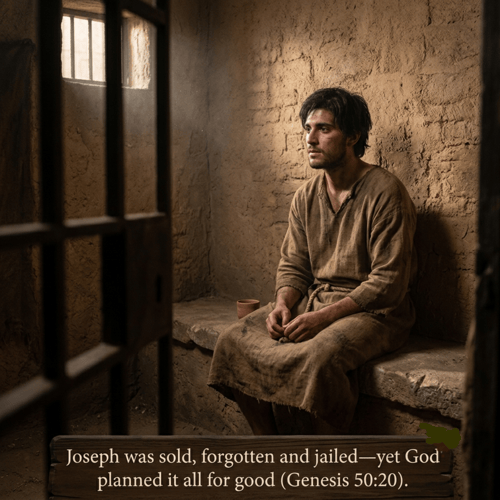
But what if a person closed the door unfairly? Think of Joseph. His brothers sold him as a slave. Years later Joseph told them, “you meant evil against me, but God meant it for good” (Genesis 50:20). The brothers were guilty, yet God was still in control. God never does evil, but He rules over it and turns it for good.
WHY THIS TRUTH COMFORTS US
The Heidelberg Catechism (1563) asks what good it does us to know that God rules all things. Its answer: “That we may be patient in adversity; thankful in prosperity; and that in all things which may hereafter befall us, we place our firm trust in our faithful God and Father.”
Think about it. If chance closed our door, our pain has no meaning. If God closed it, our pain is held in the hands of a loving Father.
Thomas Watson, an English pastor of the 1600s, said: “Where reason cannot wade, there faith may swim.” We won’t always understand why. But we can always trust who.
A Closed Door Isn’t a Secret Code
Here’s where many Christians go wrong. They treat open and closed doors like coded messages from heaven: “The door opened, so God wants me to go.” But the Bible warns us not to read our circumstances this way.
Deuteronomy 29:29 says: “The secret things belong to the LORD our God, but the things that are revealed belong to us and to our children forever, that we may do all the words of this law.” This verse shows us two sides of God’s will:
- God’s secret will: His plan for everything that will happen. We usually see it only after it happens.
- God’s revealed will: what He has told us in the Bible—what to believe, how to live, what is right and wrong. This is our guide for decisions.
So a closed door shows us God’s secret will after the event. It tells us what God has decided. It does not tell us what to do next. For that, we go to His Word.
Can we read God’s will from our circumstances? Four Bible examples
| BIBLE EXAMPLE | WHAT IT LOOKED LIKE | WHAT WAS REALLY HAPPENING |
|---|---|---|
| Jonah (Jonah 1:3) | An open door: a ship to Tarshish was ready to sail. | Jonah was running away from God. |
| Paul at Troas (2 Corinthians 2:12–13) | An open door to preach the gospel. | Paul left anyway—and God did not rebuke him. |
| Paul in Asia (Acts 16:6–7) | A closed door: Paul could not go where he planned. | The Holy Spirit stopped him. |
| Paul and Thessalonica (1 Thessalonians 2:18) | A closed door: Paul could not go where he planned. | “Satan hindered us.” |
Look at the last 2 rows. They looked the same from outside, but one door was closed by the Holy Spirit and the other by Satan. If even the apostle Paul couldn’t judge by the circumstance alone, neither can we.
John Flavel, a 17th-century English pastor who wrote a whole book on providence, gave wise advice: “Some providences, like Hebrew letters, must be read backward.” Hebrew is read from right to left. We often understand God’s ways only when we look back on our lives.
Kevin DeYoung, an American pastor, makes a similar point in his book Just Do Something: obey the Bible, use wisdom, listen to wise friends, pray—and then decide. Bruce Waltke, an Old Testament scholar, warns trying to decode God’s secret plan from signs is closer to pagan fortune-telling than to biblical faith.
Does God Always Open a Window?
“When God closes a door, He opens a window.” That saying isn’t in the Bible. It became popular through the 1965 film The Sound of Music. And it promises something God never promised: that every loss will be replaced with something like it.
Timeline: 4 great “Nos” in the Bible
- Moses (about 1400 BC): He begged to enter Canaan. God said no and told him to stop asking (Deuteronomy 3:23–27).
- David (about 1000 BC): He longed to build a temple for God. God said no (1 Chronicles 28:2–3). Instead, God promised David a different “house”—a royal family line that would lead to Jesus (2 Samuel 7:11–16).
- Jesus (about AD 30): In the garden of Gethsemane He prayed, “let this cup pass from me” (Matthew 26:39). The Father said no. That “no” became our salvation.
- Paul (about AD 55): 3 times he asked God to take away his “thorn in the flesh.” God answered: “My grace is sufficient for you, for my power is made perfect in weakness” (2 Corinthians 12:9).
Hebrews 11:13 says of the great heroes of faith: “These all died in faith, not having received the things promised.” No window. Just faith.
What about Romans 8:28? “For those who love God all things work together for good.” But verse 29 tells us what that “good” is: to be “conformed to the image of his Son.” Conformed means shaped to look like. God’s good plan is not mainly to give us what we wanted. It is to make us like Jesus.
BETTER THAN A WINDOW: WISDOM FROM THE PAST
John Newton, the former slave trader who wrote “Amazing Grace,” wrote: “Everything is needful that He sends; nothing can be needful that He withholds.”
Augustine tells us his mother, Monica, wept and prayed he’d not sail to Rome. God let him sail. In Italy, Augustine came to faith in Christ. He later wrote God didn’t give her what she asked for that night, so He could give her what she’d always asked for—a son who loved God (Confessions, Book 5).
Tim Keller, the New York pastor, taught that God gives us either what we ask for, or what we would have asked for if we knew everything He knows.
So God may not give you a window. But He’ll give you Himself. And He’ll use even this closed door to shape us into the likeness of His Son.
When the Heart Breaks: Grieving a Door That Stayed Shut
Now for the hardest part: what do we do with the pain?
The Bible doesn’t pretend this is easy. “Hope deferred makes the heart sick, but a desire fulfilled is a tree of life” (Proverbs 13:12). Deferred means delayed or put off. God Himself says that when a hope keeps not coming, it makes us sick inside. Your pain is not a sign of weak faith.
Grief isn’t unbelief. Jesus stood at the grave of His friend Lazarus. He knew He was about to raise him from the dead. Still, “Jesus wept” (John 11:35). The Bible does not tell us not to grieve. It tells us not to grieve “as others do who have no hope” (1 Thessalonians 4:13).
God gave us words for our pain. About a third of the Psalms are laments. A lament is a prayer that pours out sorrow and complaint to God. Psalm 13 begins, “How long, O LORD? Will you forget me forever?” God gave us these prayers so that we would pray them too.
How to pray a lament: the 4 steps of Psalm 13
| STEP | WHAT IT MEANS | PSALM 13 (ESV) | YOUR PRAYER (AN EXAMPLE) |
|---|---|---|---|
| 1. Turn to God | Talk to God, not just about Him. | “How long, O LORD?” (v. 1) | “Lord, I am bringing this to You.” |
| 2. Complain | Tell Him honestly what hurts. | “How long must I… have sorrow in my heart all the day?” (v. 2) | “I prayed for years, and the answer was no. It hurts.” |
| 3. Ask | Ask Him boldly for help. | “Consider and answer me, O LORD my God” (v. 3) | “Please heal my heart and show me how to go on.” |
| 4. Trust | Choose to rest in His love. | “But I have trusted in your steadfast love” (v. 5) | “I do not understand, but I trust You.” |
God is not cold towards you. Lamentations 3:32–33 says: “though he cause grief, he will have compassion according to the abundance of his steadfast love; for he does not afflict from his heart or grieve the children of men.” God may close the door. But He takes no pleasure in your tears.
3 LIES TO REFUSE WHEN A DOOR CLOSES
- Lie 1: “God is against me.” The truth: “If God is for us, who can be against us?” (Romans 8:31). A closed door does not mean God has rejected you.
- Lie 2: “I missed my only chance.” The truth: no one can spoil God’s plan. “I know that you can do all things, and that no purpose of yours can be thwarted” (Job 42:2).
- Lie 3: “This is all my fault.” The truth: many closed doors have nothing to do with our sin (John 9:3). And for those in Christ, there is “no condemnation” (Romans 8:1).
Look gently at your heart. John Calvin, the French pastor of the 1500s, warned that “the human mind is, so to speak, a perpetual forge of idols.” A forge is a workshop where metal is shaped. An idol is anything we love more than God. Sometimes a closed door shows us that a good wish had quietly become a “must have.” This is not a call to shame, but an invitation to lean on God again.
Don’t grieve alone. The Bible tells the church to “weep with those who weep” (Romans 12:15). Talk to a pastor or a trusted friend. If deep sadness stops you eating, sleeping or working for a long time, please also see a doctor.
William Cowper (say “Cooper”) struggled with deep sadness all his life. Yet he wrote the hymn “God Moves in a Mysterious Way,” which says:
Judge not the Lord by feeble sense,
But trust Him for His grace;
Behind a frowning providence
He hides a smiling face.William Cowper, “God Moves in a Mysterious Way”
So What Do We Do Next?
Grief and faithfulness can walk together. Before we move on, let’s ask one honest question: is this door really closed?
Is the door really closed? 3 kinds of doors
| KIND OF DOOR | EXAMPLE | WHAT TO DO |
|---|---|---|
| Closed by God’s Word | The opportunity would mean sin—for example, marrying someone who doesn’t follow Christ (1 Corinthians 7:39). | Do not go through. This door is shut. |
| Closed by events | The job went to someone else, or the person you hoped to marry married another. | Accept it. Grieve, then move forward. |
| Hard, but still open | The road is difficult, or people oppose you. | You may keep praying and keep trying (Luke 18:1). |
Then take these simple steps:
- Pray and lament: bring your sorrow to God first, not last.
- Seek wise counsel: “in an abundance of counsellors there is safety” (Proverbs 11:14).
- Take the next faithful step: when God’s people were taken as captives to Babylon, they didn’t get the life they wanted. God told them, “Build houses and live in them; plant gardens and eat their produce” (Jeremiah 29:5). This is the setting of the famous Jeremiah 29:11. Those good plans were for people facing seventy years in a place they never chose.
The Door That Will Never Be Shut
Every door in this life will one day close. But Jesus said, “I am the door. If anyone enters by me, he will be saved” (John 10:9). That door is open to everyone who trusts in Him.
At the end of the Bible, John sees the city of God, the new Jerusalem. He writes: “its gates will never be shut by day—and there will be no night there” (Revelation 21:25).
So when God closes a door we prayed would open, let’s weep if we must. But let’s also pray honestly. And take the next faithful step. And lift our eyes to the open gates ahead. The God who shut this door has already opened the only door that truly matters—and He will never close it.
Tough Questions, Honest Answers
Have I missed God’s will for my life?
Many Christians fear that one wrong choice has pushed them off “Plan A” for ever. But the Bible teaches that God’s secret plan cannot be missed or ruined: “My counsel shall stand, and I will accomplish all my purpose” (Isaiah 46:10). Even your past mistakes are woven into His purpose. What God asks of you is to obey His revealed will—what He has told us in Scripture—today. If you are trusting Christ and seeking to obey Him, you are walking in God’s will right now.
Should I keep praying after a door has closed?
It depends on whether the door is truly shut. If it is still open but hard, keep praying, because Jesus taught that we “ought always to pray and not lose heart” (Luke 18:1). But when events have made the answer final, there is a time to stop asking. When King David’s baby son was ill, David fasted and prayed. When the child died, David got up, washed and ate, saying, “Why should I fast?” (2 Samuel 12:23). Stopping your request is not giving up on God; it is resting in His answer. Keep praying—but now for comfort, wisdom and a trusting heart.
Is a closed door God’s punishment for my sin?
Not necessarily. When the disciples asked whether a man was born blind because of sin, Jesus said it was “that the works of God might be displayed in him” (John 9:3). Job lost almost everything, yet God called him blameless. If you belong to Christ, the punishment for your sin was fully paid at the cross. God may still discipline His children, but He does it as a loving Father: “the Lord disciplines the one he loves” (Hebrews 12:6). His discipline is for your growth, never for revenge.
What if I closed the door myself through a bad decision?
Sometimes we do close doors through our own foolishness or sin. The first step is repentance—honestly turning from sin back to God. Then remember that God’s providence is bigger than your failures. Peter denied Jesus three times, yet Jesus restored him and gave him a great work to do (John 21:15–19). There are no “Plan B Christians.” God can use even your regrets to humble you and draw you closer to Himself.
Is it right to ask God for a sign, like Gideon’s fleece?
Gideon put out a piece of wool and asked God to make it wet or dry as a sign (Judges 6:36–40). But Gideon already had God’s clear word, so his fleece showed weak faith—and God was patient with him. The Bible never tells us to copy Gideon. Today God has given us something far better than a fleece: His complete Word, which makes us “complete, equipped for every good work” (2 Timothy 3:17). Instead of asking for signs, study Scripture, ask God for wisdom (James 1:5) and seek wise counsel.
Can God reopen a door He has closed?
Yes, He can. Paul wanted to visit Rome for years but was “prevented” again and again (Romans 1:13), yet God finally brought him there. But God never promises to reopen every closed door—Moses never entered Canaan. So we hold our hopes with open hands. If God opens the door again, we thank Him. If He does not, we still trust Him.
How can I help a friend whose door has just closed?
Start by simply being there. Job’s friends did well for the first seven days, when they sat with him in silence (Job 2:13). Their trouble began when they started explaining his pain. Avoid quick sayings like “Everything happens for a reason” or “God will open a window.” Instead, listen, “weep with those who weep” (Romans 12:15), pray with your friend and offer practical help. Later, when they are ready, gently remind them of God’s goodness.
Related Reads
- What Do We Do When God Seems Distant and Silent?
- What Do We Do When We Don’t Know What Step to Take Next?
- What Do We Do When We Fall Into the Same Sin Again?
- What Do We Do When Life Doesn’t Go According to Plan?
- Kinds of God’s Will: Secret, Revealed, and How to Discern Them
- The Doctrine of Providence: Does God Really Govern All Things?
- Purpose in Pain: Why Trust Providence When His Plan Is Hidden?
- Providence Is Peace: How God’s Will Prevails Through Our Mistakes
- Lamentations 3:24: What Does ‘The Lord Is My Portion’ Mean?
- Does Grief Cancel Christian Joy? Or Can the Two Coexist?
- How May a Believer Discern God’s Will in Decision-Making?