
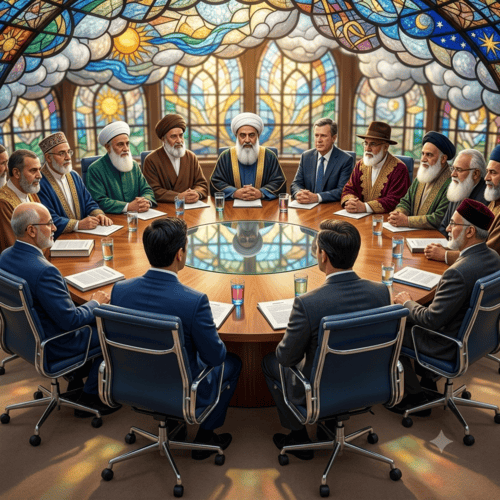
For over two centuries now, major world religions, philosophical traditions, and secular worldviews have raised serious objections to core Christian beliefs and tenets. From the Islamic world to Eastern faiths, Enlightenment rationality to modern atheism—Christianity has faced criticisms and countering viewpoints that appear to fundamentally contradict or call into question its theology and doctrinal stances.
However, Christian apologists and theologians have robust, adequate defences to each of these objections. Over the coming weeks, we shall examine the most substantial objections raised against Christianity one by one, and see how we may, with intellectual coherence and validity, and yet, with love and respect, uphold our faith’s traditions. Join us as we explore a critique of Christianity by other faiths, and consider how we might respond to each objection:
| Tradition | Era / Origin | Core Objection |
|---|---|---|
| Islam | Since the 7th century | The Trinity and Christ’s divinity amount to polytheism and a corruption of pure monotheism |
| Dharmic Faiths (Hinduism, Buddhism) | Traditions predating Christianity | Christianity’s exclusive claim to salvation clashes with pluralistic, karmic spiritual traditions |
| Atheism / Rationalism | Since the 18th-century Enlightenment | Christian belief lacks empirical evidence and rests on unverifiable supernatural claims |
| Enlightenment Philosophy | Since the 18th century | Church doctrinal authority is seen as a hindrance to reason, inquiry and individual liberty |
| Non-Christian Faiths generally | Historical, ongoing | Christianity’s claim of supremacy over all other belief systems is seen as arrogant given global religious diversity |
| Judaism | Since the 1st century CE | Jesus did not fulfil messianic prophecy, and claiming his divinity violates Jewish monotheism |
Objection from Islam: “Polytheistic” Undertones
From the viewpoint of Islam, a major contention against Christianity is its concept of the Trinity and the designation of Jesus as the Son of God. This theological stance has been seen by Muslims, since the advent of Islam in the 7th century, as a form of polytheism and a corruption of pure monotheistic doctrine. The Christian notion of Jesus’s divinity fundamentally contradicts Islam’s portrayal of Jesus as simply a powerful prophet and messenger of God. Some Muslims also argue the Bible has been corrupted and cannot be relied upon regarding tenets such as the Trinity and divinity of Christ.
Objection from Dharmic Faiths: The Exclusivity of Salvation
Dharmic faiths like Hinduism and Buddhism, with traditions predating Christianity, take issue with Christianity’s exclusivist claims about being the sole path to salvation. The doctrine that only those who accept Jesus can attain heaven does not align with the pluralistic spiritual traditions of the East. Karmic religions have historically viewed this as an arrogantly narrow perspective incompatible with concepts like reincarnation and spiritual enlightenment.
Objection from Atheists and Rationalists: Lack of Empirical Evidence
Atheists and secular humanist thinkers, notably since the 18th century Enlightenment, perceive Christianity as an outdated set of dogmatic beliefs lacking empirical evidence. They view the Bible as an historically compiled work of mythology and fiction rather than of divine truth. The rational, scientific worldview is contradicted by beliefs in supernatural miracles, creationism and biblical literalism.
Objection from Enlightenment Philosophy: A Hindrance to Reason and Liberty
Within the realm of philosophy, Enlightenment thinkers of the 18th century criticized Christianity’s perceived interference with human reason, rational inquiry and individual liberty. They saw the Church’s doctrinal authority and coercive enforcement as an impediment to social progress and freedom of thought.
Objection to “Claims” of Supremacy
Generally speaking, non-Christian faiths across the world have viewed the core Christian beliefs surrounding the deification of Jesus, His miracles and resurrection, the concept of original sin, and humanity’s need for a divine Saviour as misguided and fundamentally flawed theology not substantiated by evidence. The supremacy claimed by Christianity over all other belief systems is seen by ancient and modern faiths alike as an arrogant view incompatible with humanity’s global religious diversity.
Objection from Judaism: Rejection of Jesus as Messiah
While Christianity emerged from Jewish traditions and shares the Old Testament, Jews have seriously objected to Christian beliefs and theology from the very beginning in the 1st century CE. Fundamentally, Judaism rejects the Christian view of Jesus as the Messiah and Son of God. From the Jewish perspective, Jesus did not fulfil the messianic prophecies of the Old Testament and claiming his divinity is seen as idolatry that violates the Jewish concept of one true God.
Jews critique the Christian idea that the New Covenant superseded—in other words, replaced and made obsolete—the Old Covenant and Jewish religious law. Orthodox Jews argue that Christianity’s negation of codes like kosher dietary laws and requirements like circumcision undermine Jewish precepts laid out in the Torah (first five books of the Hebrew Bible).
Additionally, Jews contend there is no basis in medieval rabbinic literature from the formative years of Judaism for a Trinitarian theology. The whole notion of God comprising three distinct persons is viewed as an illegitimate, un-Jewish appropriation.
So while Christianity incorporates the Hebrew Bible, Jewish thinkers across centuries have repudiated Christian theology as a digression from Jewish monotheism, values and beliefs committed to writings like the Torah and Talmud. This Jewish opposition has represented a serious contention against Christian theology since its origins.
Conclusion
While some of these criticisms arise from differing metaphysical beliefs originating in pre-modern times, others underscore philosophical objections from more recent Enlightenment rationality. In the coming weeks, we shall engage with these varying perspectives across epochs and allow Christianity to engage with dismissive viewpoints evaluating its orthodox traditions.
Tough Questions, Honest Answers
Are these six objections listed in order of severity or importance?
No—they’re arranged roughly by the tradition raising them, not by how serious or difficult apologists consider each one. Some, like the Jewish objection over messianic prophecy, engage directly with shared Scripture. Others, like the atheist objection, reject the framework of revelation altogether. Each requires a different kind of response.
Which of these objections do Christian apologists consider hardest to answer?
Most apologists would point to the problem of religious diversity itself—the sheer fact that sincere, thoughtful people across cultures and centuries have reached such different conclusions about ultimate reality. It’s less a single argument to rebut than a persistent, uncomfortable question about why God would allow so much confusion, and it resists a quick answer more than a specific doctrinal dispute like the Trinity or messianic prophecy does.
Do all these traditions object to Christianity for the same underlying reason?
No. Islam and Judaism object on largely doctrinal grounds—they affirm a Creator God but reject Christian claims about who Jesus is. The Dharmic faiths object on the different grounds of exclusivity itself, since their own frameworks are generally pluralistic. Atheism and Enlightenment rationalism reject the entire category of supernatural revelation. Lumping them together as “religious objections” actually understates how different the underlying disagreements are.
How should a Christian respond when confronted with one of these objections in conversation?
Listen first, and resist the urge to answer a caricature of the objection rather than the real one. Most of these critiques, taken seriously, deserve a substantive response rather than a slogan—which is exactly why we’re treating each one in its own dedicated article rather than trying to compress a full answer into a paragraph here.
Has Christianity seriously engaged with these critiques, or mostly just dismissed them?
Serious engagement has a long history on all five fronts—medieval Jewish-Christian disputations, centuries of Christian-Muslim theological exchange, the Christian response to Enlightenment rationalism from figures like Blaise Pascal and Joseph Butler, and ongoing interfaith dialogue with Hindu and Buddhist scholars. The caricature of Christianity simply ignoring its critics doesn’t hold up historically, even though individual Christians certainly have dismissed objections without engaging them.
Are there objections to Christian doctrine that come from within professed Christianity itself, rather than from outside faiths?
Yes, though that’s a different category from what this post covers. Groups like Mormonism, Christian Science, Jehovah’s Witnesses, and the Unification Church all claim a Christian identity while departing from historic Christian doctrine on essentials like the Trinity or the nature of Christ. We address those separately, since the apologetic issues involved (a shared vocabulary with redefined meanings) differ from the objections raised by entirely separate world religions and philosophies.
Where can I find a detailed response to each of these six objections?
Each has its own dedicated article, linked below—covering the Islamic challenge, the Dharmic and Jewish objections, Enlightenment rationalism, and atheist/sceptic objections in full.
Related Reads
- Christian Answers to Islamic Challenges: Clarifying Monotheism
- Christianity’s Exclusive Claims: Addressing Hindu Objections
- Jewish Objections to Christianity: Addressing Messianic Challenges
- Christian Answers to Atheist Objections: A Defence of Faith
- Christianity’s Rational Foundations: Challenging Critiques of Faith