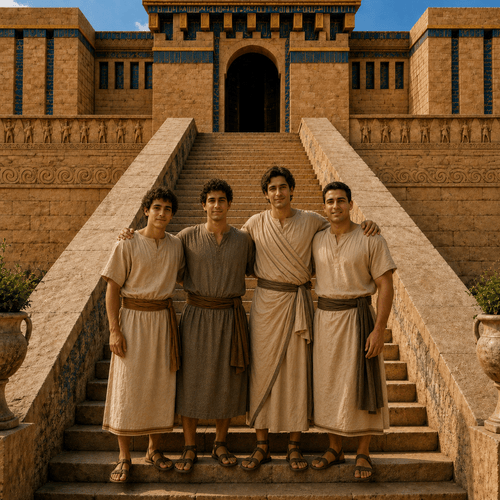
When Nebuchadnezzar’s forces carried off the brightest young men of Judah around 605 BC, they took more than gold from the temple. They took the future leaders of a nation. And almost the first thing Babylon did to four of those teenagers—Daniel, Hananiah, Mishael and Azariah—was give them new names.
It sounds like a small administrative detail. It wasn’t. In the ancient world a name was a statement of identity and allegiance, and these four boys had names that publicly honoured the God of Israel. Babylon set out to overwrite that. What’s striking, centuries later, is how much those replacement names quietly tell us—not only about Babylon’s strategy, but about whether the book that records them is real history.
The Short Answer
Each Hebrew name pointed to the living God; each Babylonian replacement pointed to a Babylonian god—Bel, Nabu or the moon-god Aku. The aim was to reshape the young men’s loyalty. The deeper point for readers today is that these names fit sixth-century BC Babylon with uncanny precision, which is exactly what we’d expect if the account is a genuine record rather than a much later invention.
The Four Names At A Glance
Here are the four pairs side by side. We’ll unpack each one below.
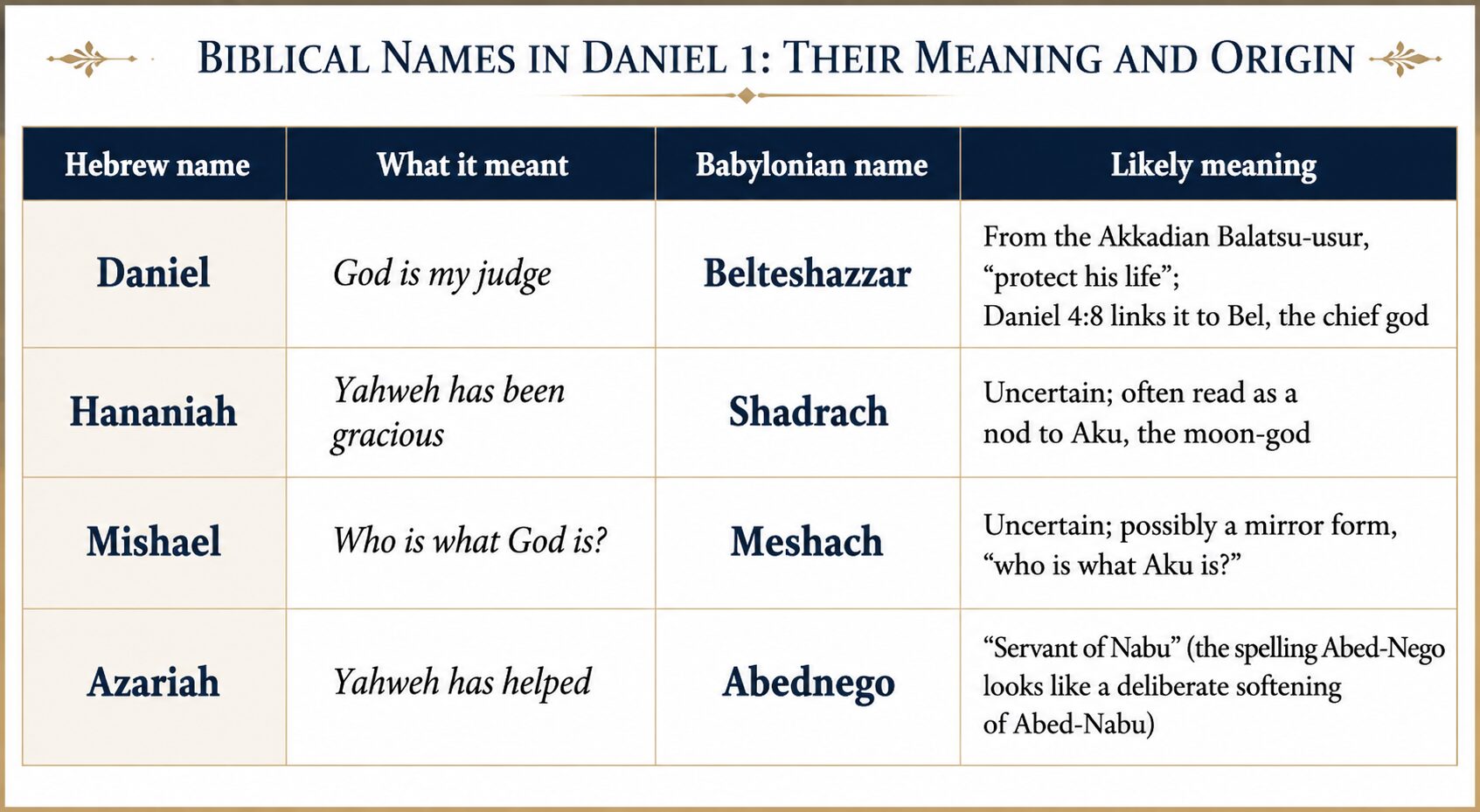
A note on the spellings: Akkadian was the language of Babylon, written in cuneiform (wedge-shaped marks pressed into clay). Where the Babylonian meanings are marked “uncertain”, scholars can see the shape of the name clearly but still debate its precise sense—more on why that matters later.
Why the Hebrew Names All Carried God
All four original names are what scholars call theophoric—literally “god-bearing” (from the Greek theos, “god”, and pherein, “to carry”). A theophoric name builds a god’s name into a person’s own. Hebrew parents did this constantly as a kind of walking confession of faith:
Daniel: Dāniyyēl means “God (El) is my judge”.
Hananiah: ends in -iah, a shortened form of Yahweh, the covenant name of God; the name means “Yahweh has been gracious”.
Mishael: asks a loaded question—“Who is what God is?”—the implied answer being: no one.
Azariah: also carries Yahweh, meaning “Yahweh has helped”.
So every time these boys were addressed at home, the God of Israel was named aloud. Babylon understood the power of that, and moved to break it.
What the Babylonian Names Were Really Doing
The chief official renamed each young man after a Babylonian deity. Two of the four are well understood; two remain debated.
- Belteshazzar (Daniel): This comes from the Akkadian Balatsu-usur, “protect his life”. The book itself tells us whose protection is meant: Nebuchadnezzar says Daniel was named after the name of my god (Daniel 4:8), and that god is Bel—a title (“lord”) for Marduk, the chief god of Babylon. The prophets knew him: Bel bows down, Nebo stoops (Isaiah 46:1). Daniel’s very name became a daily prayer to a pagan lord.
- Abednego (Azariah): This means “servant of Nabu”—Nabu (the Nebo of Isaiah 46:1) being the god of wisdom and writing, and Marduk’s son. Interestingly, the form we have, Abed-Nego, swaps the expected b of Abed-Nabu for a g. Many scholars read this as a deliberate Hebrew tweak—just enough alteration to avoid writing a pagan god’s name cleanly into Scripture. A quiet act of resistance hidden in the spelling.
- Shadrach and Meshach (Hananiah and Mishael): These two are harder. The most common suggestion links them to Aku, a moon-god—Shadrach as something like “command of Aku” and Meshach as a mirror of Mishael’s question, “who is what Aku is?”. But honesty matters here: no single etymology has won universal agreement. We can read the names; we cannot yet pin their exact sense. As we’ll see, that uncertainty does not weaken the historical case—if anything it sharpens it.
Why Rename a Captive At All?
Renaming conquered people was standard practice across the ancient Near East. Strip away a person’s name and you begin to strip away their history, their culture and their loyalties—then rebuild them around your own gods and your own king. The Bible records the same tactic more than once: Pharaoh Necho renamed Judah’s king Eliakim as Jehoiakim (2 Kings 23:34). And Nebuchadnezzar renamed Mattaniah as Zedekiah (2 Kings 24:17).
Against that backdrop, the renaming of four trainee officials in Babylon is not a colourful flourish a storyteller might invent. It is precisely how empires actually behaved—which brings us to the heart of the matter.
Names that Fit the Right Time and Place
There’s a field of study that asks a simple question of any ancient document: do its names match the naming habits of the time and place it claims to describe? (The technical label is onomastics—the study of names; we explore it in depth in our companion piece, The Study of Names.) Names are like fingerprints. They’re hard to fake, because naming fashions shift from century to century and from one culture to the next.
This matters for Daniel because the book’s date is disputed. Two views compete:
Now put the names back into that picture. A writer in the second century BC, generations after Babylon had fallen, would have had to reconstruct authentic Babylonian court names from memory and legend. Yet the names in Daniel slot neatly into genuine sixth-century patterns:
- The right gods: Bel/Marduk and Nabu were precisely the deities dominant in Nebuchadnezzar’s Babylon—not a later guess.
- The right grammar: “Protect his life” (Balatsu-usur) matches a real Akkadian name-formula, the same shape as attested officials of the period.
- The telling difficulty: The very names we cannot fully translate, Shadrach and Meshach, are unlikely to be later inventions—an inventor tends to coin names he can explain, not awkward ones that puzzle scholars for centuries.
Old Testament scholar Kenneth Kitchen put the verdict bluntly: “The personal names in Daniel are impeccable for the Neo-Babylonian and early Persian periods.” Assyriologist Paul-Richard Berger went so far as to say he wouldn’t be surprised if the four names turned up one day in actual Babylonian tablets. Alan Millard and Edwin Yamauchi, surveying the wider historical detail, reach the same conclusion: the texture of the account belongs to the sixth century, not the second.
None of this “proves” the whole book by itself. But it removes a favourite argument against it and adds a small, stubborn piece of evidence on the other side—the author writes like someone who was actually there.
What the Renaming Teaches Us
Step back from the linguistics and the story turns pastoral. Four teenagers lose their homeland, their freedom and even their names—and God isn’t absent from any of it.
- God rules over empires: Nebuchadnezzar could rewrite their names, their diet and their education, but he could not touch the One their old names confessed. The king arranges the curriculum; God governs the outcome.
- Faithfulness chooses its battles: The young men accept the new names—an unavoidable circumstance—yet draw a clear line at the king’s food and, later, at worshipping his image (Daniel 1:8; Daniel 3). Wisdom knows the difference between what’s imposed and what would be compromise.
- Identity rests in God, not in a label: A pagan official could call Azariah “servant of Nabu”, but it didn’t make him one. Those whom God knows aren’t defined by the names others assign them: I have called you by name, you are mine (Isaiah 43:1).
That’s why the book keeps calling its hero “Daniel” in its own narrative, even while Babylon insists on “Belteshazzar”. The name that honours God has the last word—and so, in the end, does the God it honours (Daniel 2:47).
Digging Deeper: Related FAQs
Why does God Himself rename people in Scripture—Abraham, Jacob—and what does He want them, and us, to take from it?
God’s renamings run in the opposite direction to Babylon’s: where Babylon renamed to possess and erase, God renames to bless and commission. Abram (“exalted father”) becomes Abraham (“father of a multitude”) as God pledges him descendants beyond counting (Genesis 17:5). Jacob (“he grasps the heel”, a byword for a schemer) becomes Israel (“he struggles with God”) after a night of wrestling that leaves him limping (Genesis 32:28). It’s a name that announces his destiny rather than his past. The lesson is that a God-given name is a promise about who we will become, sometimes handed over through struggle and not without a wound. And the truest name any believer bears is the one God speaks over them—so much so that He promises the faithful a “new name” known fully only to them (Revelation 2:17).
Aren’t Belteshazzar and Belshazzar simply the same name?
They look almost identical in English, but they belong to two different men with two different Babylonian names. Belteshazzar (Akkadian Balatsu-usur) was Daniel; Belshazzar (Akkadian Bel-shar-usur, “Bel, protect the king”) was the ruler who saw the writing on the wall in Daniel 5. The king’s name also invokes Bel, which is exactly why the two are so easily confused. It’s worth knowing the difference, because Belshazzar’s very existence was once dismissed by critics—until Babylonian tablets confirmed him as the son and co-regent of King Nabonidus.
Did Nebuchadnezzar’s own name follow the same pattern as the names he handed out?
It did. “Nebuchadnezzar” is the Akkadian Nabu-kudurri-usur—a prayer asking the god Nabu to protect the king. So the same “[god], protect…” formula runs through the king’s own name, through Belshazzar, and through the name Abednego (“servant of Nabu”). That web of internal consistency isn’t what we’d expect from a late storyteller guessing at Babylonian names; it’s what we’d expect from a writer who knew the real naming habits of the court from the inside.
Were Daniel and his three friends made eunuchs?
We cannot be certain, and scholars are genuinely divided. The official placed over them, Ashpenaz, is called the “chief of the eunuchs” (Daniel 1:3), yet the Hebrew word for eunuch (saris) could also mean simply a court official, so his title alone settles nothing. What gives the question weight is Isaiah’s earlier warning to King Hezekiah that some of his royal line would be taken to serve in the palace of Babylon’s king (Isaiah 39:7)—wording often read to imply castration. Whether or not it was literally fulfilled in these four young men, the text leaves the door open, and the possibility only deepens the cost of their faithfulness.
Who were the “Chaldeans” whose language and learning they were forced to study?
The Chaldeans (Hebrew Kasdim) were the people who founded and ruled the Neo-Babylonian empire—Nebuchadnezzar’s own dynasty. Daniel and his friends were enrolled in a three-year course in “the language and literature of the Chaldeans” (Daniel 1:4), which meant mastering Akkadian, cuneiform writing, and the astronomy, omen-reading and ritual texts that shaped Babylonian thought. Intriguingly, later in the book the same word “Chaldean” carries a second sense—a class of astrologers and wise men at court (Daniel 2:2). That double usage is itself a quiet mark of authenticity: the writer knows the term both as an ethnic label and as a professional one, precisely as a sixth-century insider would.
Why did the Babylonians reach for these particular gods — Bel, Nabu and the moon-god?
Because they were aiming the young men at the very summit of Babylon’s pantheon. Bel (a title for Marduk) was the city’s chief god, and Nabu, god of wisdom and writing, was his powerful son—the two deities paraded together through Babylon at the great New Year festival. The moon-god lurking behind Shadrach and Meshach matters too: moon worship stood so high in this era that Babylon’s last king, Nabonidus, would controversially try to elevate the moon-god above Marduk himself. Renaming the captives after these gods was therefore no random insult. It was an attempt to bind them to the most prestigious powers Babylon could offer.
Do new names still carry this kind of weight today?
They can. Down the centuries, conquerors and slave-owners renamed those they controlled for the very reason Babylon did—to assert ownership and reshape identity—while countless immigrants have quietly anglicised their names simply to belong. Scripture points to a redeemed version of the same instinct: converts in the early church sometimes took new names, and God promises His people a new name that no earthly power can revoke. A name can be given to diminish a person or to dignify them—and the believer’s deepest identity is the one God assigns.
Related Reads
- Is the Bible Historically Reliable? Here’s What the Evidence Shows
- Babylon Archaeology: How the Ruins Confirm Bible Accounts
- Hezekiah and Assyria: 7 Archaeological Discoveries Confirm Scripture
- Why Did Saul Change His Name to Paul? What the Bible Actually Says
- What Does the Siloam Dam Discovery Reveal About Judah’s Kings?
- What Do the Dead Sea Scrolls Prove? The Case for Bible Reliability
- Jesus in the Book of Daniel: A Chapter-by-Chapter Guide