The Ketef Hinnom scrolls—two minuscule silver amulets no larger than the stub of a cigarette—have turned out to be the oldest surviving biblical text ever found, predating the Dead Sea Scrolls by roughly half a millennium. Easy to overlook, they’re nonetheless among the most important manuscript discoveries of the 20th century. This is the story of what they say, how old they are, and why they’re a critical find.
A bored 13-year-old rewrites biblical scholarship
The discovery was an accident. In 1979 Israeli archaeologist Gabriel Barkay was excavating a series of First Temple-period burial caves cut into the rocky slope above the Valley of Hinnom, the ravine on the south-western edge of the Old City. The Hebrew Bible calls the ravine Ge-Hinnom, which gives us, through Greek, the word Gehenna—a byword for judgement. The site sits on the shoulder, the ketef, of that valley, which is how the caves came to be known as Ketef Hinnom.
One chamber, catalogued as Chamber 25, looked like a dead end. Its contents seemed disturbed, and Barkay had all but written it off as a tomb grave-robbers had long since emptied. What he couldn’t see was that the ceiling of a side repository had collapsed in antiquity, burying the original deposits under rubble and hiding them from every looter who’d passed through in the centuries since.
The repository gave up its secret almost by chance. A 13-year-old brought along to help, restless with the slow work, tapped on the chamber floor—and it gave way to reveal the undisturbed deposit beneath. Under roughly 60 centimetres of fallen rock lay close to a thousand objects: pottery, arrowheads, bone, ivory, glass, and gold and silver jewellery, the burial goods of a wealthy Jerusalem family laid to rest in the final decades before the city fell to Babylon. Among them were two small, dark, tarnished cylinders of rolled silver, each no bigger than the stub of a cigarette—so unremarkable they might have been catalogued, boxed and forgotten.
Three years to unroll a scroll the size of a business card
Finding the scrolls was the easy part. Reading them took three years. The problem was the silver itself. Corroded silver no longer behaves like the supple metal it once was; it becomes brittle and flaking, closer to a burnt biscuit than to foil. The two amulets had been rolled tightly while soft and had then spent some 2,600 years oxidising in the ground. Unrolling them by hand would have shattered them into confetti, destroying the very inscriptions that made them precious.
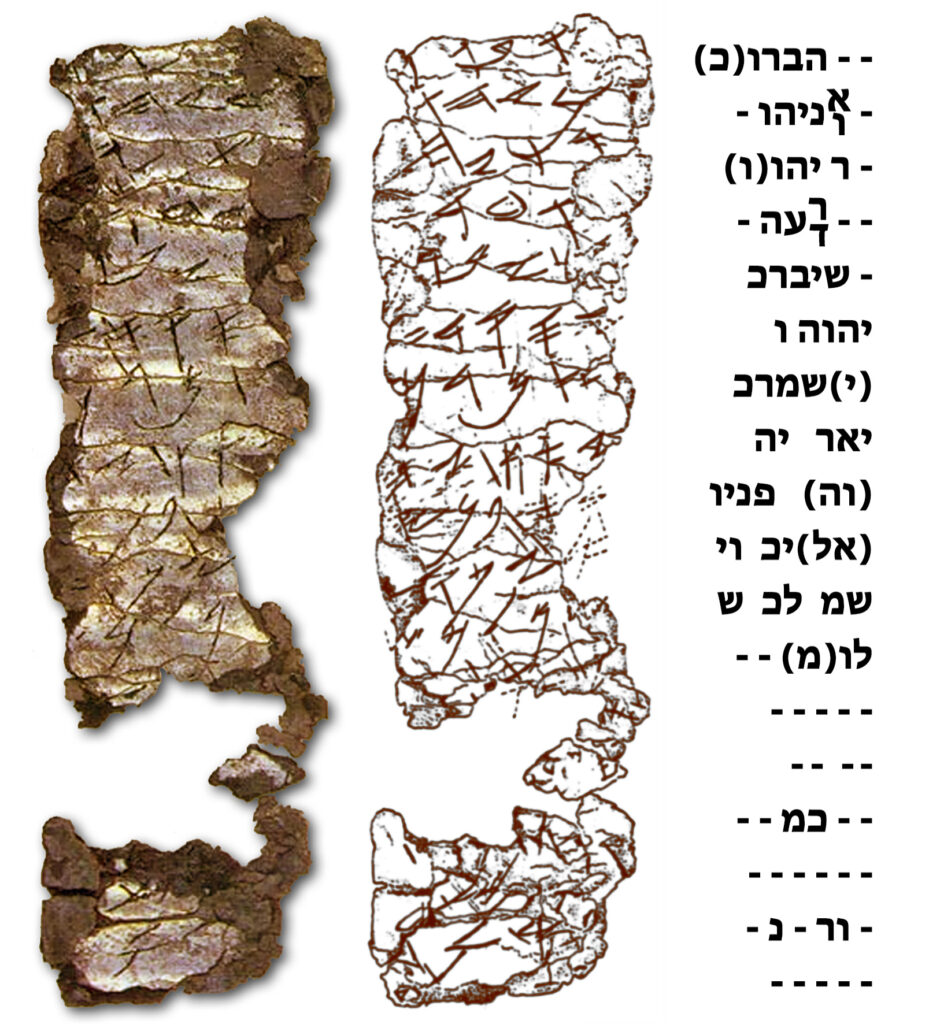
For three years they resisted every method and sat unread, their contents a matter of guesswork. The breakthrough came when Barkay’s team, working with conservation specialists, developed a new technique to stabilise the metal before unrolling—reinforcing the fragile silver so it could be coaxed open a fraction at a time without disintegrating. When the larger of the two was finally unrolled it measured 97 millimetres long by 29 wide: a strip of silver roughly the size of a business card, covered in faint, scratched lines of archaic Hebrew lettering.
And the lettering mattered as much as the words. The script was Paleo-Hebrew—the angular, archaic alphabet used in Israel before the Babylonian exile, descended from older Phoenician letters. It’s visibly different from the square Aramaic script that Jewish scribes adopted after the exile. That’s not a stylistic footnote; it’s itself a dating clue, for a text in this older alphabet belongs, on the face of it, to the older period—before the exile reshaped how Hebrew was written. When the corroded surface finally yielded a legible line and the conservators recognised the divine name and the cadence of a blessing they knew by heart, they understood they weren’t looking at decorated jewellery. They were looking at Scripture.
What the scrolls actually say: the Priestly Blessing
What the silver carries, in part, is one of the most familiar passages in the whole Hebrew Bible: the Priestly Blessing of Numbers 6. In full it reads:
The LORD bless you and keep you; the LORD make his face shine on you and be gracious to you; the LORD turn his face towards you and give you peace.
It’s worth pausing on what that blessing has meant, because the Ketef Hinnom scrolls connect a buried First Temple amulet to a living act of worship. The Priestly Blessing is, by a wide margin, the oldest continuously used liturgical text on earth. Jewish communities pronounce it over the congregation; in many traditions the priests, the kohanim, still lift their hands to speak these words on Shabbat. Christian churches close worship with the same blessing, week by week, often without realising that the benediction sending them home is the identical formula a Judahite family wore against their skin in the days of Jeremiah. That continuity is the most human detail in the whole story.
These weren’t display pieces or scholarly archives. They were amulets—worn on a cord around the neck or the wrist, close to the body, invoking the protection of God by means of his own promised blessing. The inscription does more than quote Numbers 6. Alongside the blessing, the text invokes Yahweh as the “Rebuker of Evil”—a phrase that opens a small window onto the lived theology of the late First Temple period.
How Old? 500 Years Older than the Dead Sea Scrolls
Now to the claim that makes archaeologists sit up: the age.
Before 1979, the oldest surviving manuscripts of any biblical text were the Dead Sea Scrolls, recovered from the caves at Qumran from 1947. The Ketef Hinnom scrolls sit on the far side of that frontier by half a millennium—dated, on the combined evidence of the tomb’s archaeology, the form of the pottery buried with them and above all the Paleo-Hebrew script, to the closing decades of the First Temple period. Set the principal manuscripts in sequence and the leap is plain:
The Biblical Manuscript Record, Oldest To Latest
- 650–587 BC: the Ketef Hinnom scrolls—the silver amulets from Jerusalem, and the oldest surviving biblical text, from the generation before Babylon razed the city in 586 BC.
- 250 BC – AD 70: the Dead Sea Scrolls—the Qumran library that held the previous record, itself a landmark of antiquity.
- AD 1000: the Masoretic Text—the standardised Hebrew text that underlies essentially every modern translation of the Old Testament.
In a single discovery, then, the oldest known scrap of the Bible was pushed back to around 450 years—from the 3rd century before Christ to the 7th, gone in one collapsed ceiling.
Put that date in its biblical setting and it grows more striking still. The late 7th century BC is the era of King Josiah and the prophet Jeremiah—precisely the period in which the Bible records a religious reawakening in Judah: Josiah’s reforms, the rediscovery of the Book of the Law during the Temple repairs, the recommitment to the covenant described in 2 Chronicles 34. The Ketef Hinnom scrolls come from exactly that moment of renewed devotion to Scripture. They’re physical residue from the world the text describes—a Jerusalem in which someone cared enough about the words of the LORD to have them engraved in silver and worn against the heart.
The Documentary Hypothesis and Why the Scrolls Complicate It
This is where the small silver strips reach beyond archaeology and into the longest-running debate in modern biblical studies.
For most of the last 150 years, the dominant critical account of how the first five books of the Bible came to be has been some version of the Documentary Hypothesis, often abbreviated by the four letters JEDP. Developed chiefly in 19th-century German scholarship and given its classic form by Julius Wellhausen, it holds that the Pentateuch—Genesis through Deuteronomy—wasn’t written by Moses at all, but stitched together by later editors from four originally separate source documents:
- J, the Yahwist: named for its characteristic use of the divine name Yahweh; reckoned one of the earlier strands.
- E, the Elohist: distinguished by its preference for the title Elohim for God.
- D, the Deuteronomist: the source held to lie behind the book of Deuteronomy.
- P, the Priestly source: concerned with worship, genealogy and ritual law—and, on this theory, the latest layer of the four.
On this account the Pentateuch were composed over several centuries and only woven into the text we now have by priestly redactors during and after the Babylonian exile. This would date their addition to the 6th and 5th centuries BC—a 1000 years or so after Moses’s time.
The detail that matters here concerns the P source, the Priestly material—and Numbers 6 belongs to exactly that strand. A number of scholars in this tradition argued the Priestly texts were among the latest layers of all, composed during or after the exile, as a product of the post-exilic temple establishment giving final shape to Israel’s law and liturgy. On that reading, the Priestly Blessing of Numbers 6:24–26 would be a relatively late composition, written no earlier than the sixth century BC and possibly later.
The Ketef Hinnom scrolls land directly on that claim. They’re dated to the late 7th century BC—before the exile, before the supposed post-exilic priestly redactors set to work. And what do they contain? Numbers 6:24–26, very nearly word for word. Which means the text was already in existence, already regarded as sacred, already so woven into ordinary Judahite piety that a family had it inscribed on silver and wore it as a protective amulet, a full generation or more before the date at which one influential strand of the theory says it was first written.
The silver says otherwise. The text was there, in the hands of ordinary believers, while the First Temple still stood.
That’s why the discovery so easy to overlook carries such weight. Arguing about the dating of ancient documents on internal literary grounds leaves every scholar reading the same words and reaching different conclusions. Holding a dated, physical, seventh-century object with the disputed words already inscribed on it is another matter entirely. Archaeology has a way of settling arguments that literary theory can keep open indefinitely.
Textual Stability: 2,600 Years and Almost No Change
There’s a second, quieter implication in the silver, and for the reliability of the Bible it may matter just as much.
When scholars finally read the inscriptions, they could set the wording of the blessing on the scrolls beside the wording of Numbers 6 in the Masoretic Text—the standardised Hebrew Bible fixed by the Jewish scribes known as the Masoretes around AD 1000. The amulets predate that standardisation by some 1600 years.
And across that staggering gap, the text is essentially stable. The blessing on the amulets matches the blessing in our Bibles with remarkable fidelity—the same divine name, the same threefold structure, the same petitions in the same order. There are minor differences of the kind one expects between a personal amulet and a formal scroll, but the core is unmistakably, recognisably the same text. 16 centuries of hand-copying, by generation after generation of scribes who never met and never compared notes, and the words arrive intact.
The Ketef Hinnom scrolls are valuable precisely because they stand so far back in time: they let us test the accuracy of biblical transmission across a longer span than almost any other evidence we possess.
What Modern Technology Keeps Revealing
Remarkably, the scrolls are still giving up new information nearly half a century after they came out of the ground.
The silver is so worn, and the letters so shallow, that for years several characters could not be read with confidence—and a single uncertain letter can change how a whole line is reconstructed. Advances in imaging have begun to recover what the naked eye could not:
- Multispectral imaging: photographs the surface across many wavelengths beyond the visible range, making faint scratches leap into legibility.
- Reflectance transformation imaging (RTI): combines dozens of photographs lit from different angles, letting researchers relight the surface on a screen and tease out shapes invisible in any single shot.
- Three-dimensional scanning: maps the metal’s contours at microscopic resolution, recording detail too fine for the eye.
The result is that letters once marked illegible have become readable and earlier transcriptions have been refined. A discovery from 1979 continues to yield fresh data in the 2020s, not because the object changed but because our ability to interrogate it keeps improving. Here’s fresh evidence the antiquity of the biblical text isn’t static but is, if anything, growing sharper with time.
The scrolls themselves are now held in the Israel Museum in Jerusalem, where the larger of the two is displayed: a strip of tarnished silver, smaller than a credit card, carrying the oldest words of the Bible that survive anywhere on earth.
Tough Questions, Honest Answers
Could the scrolls be forgeries?
No, and the reasons are unusually strong. Forgery is a live concern mainly when an object surfaces on the antiquities market with no documented history. The Ketef Hinnom scrolls are the opposite case. They were recovered in a controlled excavation by Gabriel Barkay’s team, lifted from a sealed repository in Chamber 25 that had lain under 60 centimetres of collapsed ceiling for some two and a half millennia. Their findspot, stratigraphy and the thousand-odd associated objects are all documented. The silver shows exactly the corrosion and mineralisation that genuine ancient metal develops over millennia, and the inscriptions are in authentic Paleo-Hebrew script. No serious scholar regards them as anything but genuine; the debate has only ever concerned their precise dating and the reading of individual letters, never their authenticity.
Why were these particular verses chosen for protective amulets?
Because of what they say. The Priestly Blessing is not a narrative or a law but a direct invocation of God’s protection—he will bless, keep, be gracious, give peace. For someone seeking divine favour and safety, no words in the tradition could be more fitting to carry against the body. The choice of Numbers 6 tells us the blessing was already understood, in the late First Temple period, as a word of personal protection worth inscribing in silver.
What does JEDP theory actually claim, and how directly do these scrolls challenge it?
JEDP—the Documentary Hypothesis—claims the first five books of the Bible weren’t written by Moses but compiled much later from four separate source documents, with the final editing done by priestly hands during or after the Babylonian exile. Several scholars in that tradition specifically dated the Priestly material, which includes Numbers 6, to that late stage. The scrolls challenge that dating head-on: they carry Numbers 6:24–26 and date to before the exile, showing the text existed and was treated as sacred while the First Temple still stood. They don’t single-handedly dismantle the whole theory, which is broad and much-modified, but they do refute the once-confident claim that this passage was a late invention.
How do the scrolls compare to other ancient amulets from the region?
Inscribed amulets aren’t unusual in the ancient Near East; many survive, bearing incantations, divine names, or appeals for protection. What sets the Ketef Hinnom scrolls apart is that their text isn’t pagan incantation but a passage of Scripture—a quotation from what would become the Hebrew Bible—invoking the covenant God of Israel by name. They show the biblical text already at work in the everyday devotional life of ordinary Judahites, not merely preserved in official temple scrolls but worn on the body.
Where can I see the Ketef Hinnom scrolls today?
Both scrolls are held by the Israel Museum in Jerusalem. The larger and better-preserved of the two is usually on display. Seen in person it’s almost anticlimactic—a small, dark curl of silver—until we remember we’re looking at the oldest surviving words of the Bible found anywhere on earth.
Related Reads
- Is the Bible Historically Reliable? Here’s What the Evidence Shows
- What Do the Dead Sea Scrolls Prove? The Case for Bible Reliability
- Babylon Archaeology: How the Ruins Confirm Bible Accounts
- Hezekiah and Assyria: 7 Archaeological Discoveries Confirm Scripture
- The Destruction of Tyre: How Ezekiel’s Prophecy Was Fulfilled, Stone by Stone
- Rylands Papyrus P52: Why This Tiny Fragment Still Matters
- Where Is Mount Sinai? Weighing the Candidates
- Caiaphas Ossuary: How the Finds Back Bible Reliability
- Sodom and Gomorrah: New Evidence That Backs the Bible