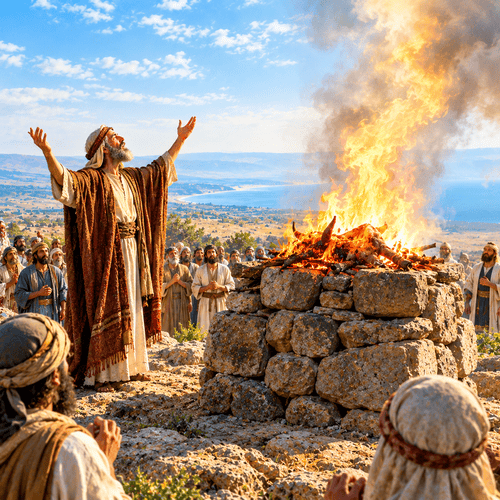
Some mountains in the Bible are remembered for a view. Mount Carmel is remembered for a question. Nearly 900 years before Christ, Elijah stood on this green ridge by the Mediterranean and told all Israel to stop sitting on the fence:
“How long will you go limping between two different opinions? If the LORD is God, follow him; but if Baal, then follow him.”
1 Kings 18:21
In our Mountains of Scripture series on Old Testament mountains with New Testament meaning, we have climbed Mount Moriah, the place of sacrifice, Mount Sinai, the place of the law, and Mount Zion, the city of God. Mount Carmel is the place of decision.
The New Testament returns to Carmel more often than many readers notice—in James, Luke, Romans and Revelation. Its lesson is the one Jesus taught on another mountain: “No one can serve two masters” (Matthew 6:24).
Mount Carmel at a Glance
| EVENT ON CARMEL | OLD TESTAMENT | NEW TESTAMENT | WHAT IT TEACHES |
|---|---|---|---|
| Elijah’s challenge to choose | 1 Kings 18:21 | Matthew 6:24 | One heart can have only one Master |
| Fire falls on the sacrifice | 1 Kings 18:38 | Luke 9:54–55 | God’s judgement falls on a substitute |
| “You have turned their hearts back” | 1 Kings 18:37 | Luke 1:17 | Only God turns hearts |
| Elijah prays for rain | 1 Kings 18:42–45 | James 5:17–18 | God works through prayer |
| Seven thousand who did not bow | 1 Kings 19:18 | Romans 11:2–5 | A remnant chosen by grace |
| Fire and a shut sky | 1 Kings 17:1; 18:38 | Revelation 11:5–6 | The church witnesses by the word |
The Setting: A Nation Trying to Keep Two Gods
King Ahab ruled Israel’s northern kingdom in the ninth century BC. The Bible says he married Jezebel, a princess from Sidon in Phoenicia, and then “went and served Baal and worshipped him” (1 Kings 16:31). Jezebel fed Baal’s prophets at the royal table and hunted down the LORD’s prophets (1 Kings 18:4, 19).
Baal was the Canaanite god of storms, rain and harvests. Tablets from ancient Ugarit in Syria call him the “rider of the clouds”, and a famous carving shows him holding a spear of lightning. To farmers in a dry land, he was the god who sent rain.
So when Elijah announced, “there shall be neither dew nor rain these years, except by my word” (1 Kings 17:1), he was attacking Baal’s very job description. This was no random punishment. Moses had warned:
“Take care lest your heart be deceived, and you turn aside and serve other gods and worship them; then the anger of the LORD will be kindled against you, and he will shut up the heavens, so that there will be no rain.”
Deuteronomy 11:16–17
For three and a half years the sky stayed shut (James 5:17). Every cloudless day asked the same question: Where is your storm god now? On green Carmel, near Jezebel’s homeland, Elijah chose Baal’s home field for the answer.
WHAT DOES “BAAL” MEAN?
In Hebrew, ba’al is an ordinary word for “lord”, “master”, “owner” or even “husband”. So Baal was, quite literally, “the Master”. That is why God says through Hosea, “you will call me ‘My Husband,’ and no longer will you call me ‘My Baal’” (Hosea 2:16). Every false god is a would-be master.
Timeline: The Day on Carmel
- Morning—the challenge (18:19–24). Elijah faces 450 prophets of Baal: two bulls, no fire. “The God who answers by fire, he is God.”
- Morning to noon—the frenzy (18:26). Baal’s prophets cry, “O Baal, answer us!” and limp around their altar.
- Noon—the mockery (18:27). Elijah teases them: perhaps Baal is busy, on a journey or asleep.
- Afternoon—the blood (18:28–29). They cut themselves until blood flows. “No one answered; no one paid attention.”
- Evening offering—the prayer (18:30–37). Elijah repairs the LORD’s altar with twelve stones, soaks it and prays briefly.
- Moments later—the fire (18:38–39). Fire consumes sacrifice, wood, stones, dust and water. The people fall on their faces.
- Before nightfall—the rain (18:41–45). Elijah prays seven times until a small cloud rises and heavy rain follows.
“How Long Will You Limp?”—The Heart of Carmel
Elijah did not say, “Stop believing in the LORD.” Most Israelites still did. Their sin was not dropping God but adding Baal. They wanted the God of their fathers for history and the god of the storm for the harvest.
Elijah’s word for “limping” is a clever choice. The same Hebrew verb appears a few verses later for Baal’s prophets: “they limped around the altar that they had made” (1 Kings 18:26). Israel’s hesitation was no safe middle ground. To limp between two opinions was already to join Baal’s dance.
And how did the people respond? “The people did not answer him a word” (18:21). Silence. Jesus speaks straight into that silence:
“No one can serve two masters, for either he will hate the one and love the other, or he will be devoted to the one and despise the other. You cannot serve God and money.”
Matthew 6:24
Jesus names the Baal of His day and ours: money. Like Baal, it promises security and provision—and asks for the heart.
Why Two Masters Can Never Share One Heart
- A slave cannot have two owners. The word Jesus uses for “serve” is the word for a slave’s service. A worker may have two employers; a slave belongs wholly to one owner.
- God claims the whole heart. “You shall love the LORD your God with all your heart and with all your soul and with all your might” (Deuteronomy 6:5). Love shared with a rival is not the love He commands.
- God’s jealousy is a husband’s love. The LORD calls Himself “a jealous God” (Exodus 20:5). This is faithful love that refuses to share His bride.
- Not choosing is choosing. Jesus said, “Whoever is not with me is against me” (Matthew 12:30). The silent crowd on Carmel had already sided with Baal by refusing to decide.
The Fire Fell on the Sacrifice, Not on the People
Here is a detail many readers miss. Who deserved the fire on Carmel? Israel did—they had broken the covenant. Yet the fire did not fall on the crowd. It fell on the bull.
“Then the fire of the LORD fell and consumed the burnt offering and the wood and the stones and the dust, and licked up the water that was in the trench.”
1 Kings 18:38
Judgement landed on a substitute, and the guilty lived to confess, “The LORD, he is God” (18:39). Elijah even timed his prayer to “the time of the offering of the oblation” (18:36)—the hour of the evening sacrifice at God’s temple in Jerusalem. His twelve stones declared one people and one way to approach God.
All of this points ahead to Calvary. At the cross, the fire of God’s judgement against sin fell on Jesus. The sky went dark and the Son was forsaken (Mark 15:33–34). As Peter puts it, “Christ also suffered once for sins, the righteous for the unrighteous, that he might bring us to God” (1 Peter 3:18). The fire that should have fallen on us fell on Him.
Two Altars, Two Religions
| QUESTION | BAAL’S ALTAR | THE LORD’S ALTAR |
|---|---|---|
| Who does the work? | The worshippers—shouting, dancing, cutting themselves | God—answering from heaven |
| What is it based on? | Effort and emotion | God’s word: “I have done all these things at your word” (18:36) |
| How long is the prayer? | From morning until evening | A few short sentences |
| Whose blood is shed? | The worshippers’ own | The sacrifice’s |
| The result | “No one answered” (18:29) | Fire, then confession, then rain |
Every religion in the world falls into one of these two columns. Either we work to make God answer, or God answers through a sacrifice He accepts. Baal’s prophets bled for their god; God’s Son bled for His people.
“You Have Turned Their Hearts Back”—God Changes Hearts
Elijah’s prayer ends with a line that is easy to read past:
“Answer me, O LORD, answer me, that this people may know that you, O LORD, are God, and that you have turned their hearts back.”
1 Kings 18:37
Elijah did not ask God to help the people make up their own minds. He asked God to show that He was turning their hearts. Conversion is God’s work from start to finish. God would later promise, “I will give you a new heart” (Ezekiel 36:26), and Jesus would say, “No one can come to me unless the Father who sent me draws him” (John 6:44).
This is exactly the language the angel used of John the Baptist:
“And he will go before him in the spirit and power of Elijah, to turn the hearts of the fathers to the children…”
Luke 1:17
John was Malachi’s promised “Elijah” (Matthew 11:14), yet he never called down fire. His “power of Elijah” was a word that turned hearts, pointing to the Lamb who would take the fire for sinners (John 1:29). He promised that the One coming after him would baptise “with the Holy Spirit and fire” (Luke 3:16)—a promise fulfilled at Pentecost, when tongues of fire rested not on a dead bull but on living believers (Acts 2:3).
Elijah’s Prayer and the Rain (James 5:17–18)
“Elijah was a man with a nature like ours, and he prayed fervently that it might not rain, and for three years and six months it did not rain on the earth. Then he prayed again, and heaven gave rain, and the earth bore its fruit.”
James 5:17–18
- Elijah was ordinary. James stresses that he had “a nature like ours”. The power belonged to God.
- God’s promise and our prayer work together. God had already said, “I will send rain upon the earth” (1 Kings 18:1). Yet Elijah still climbed to the summit, bowed with his face between his knees, and prayed seven times (18:42–44). Knowing God’s plan made him bold, not lazy. As the Westminster Confession of Faith (5.3) puts it, God “in His ordinary providence, maketh use of means”—and prayer is one of His chosen means.
“Lord, Do You Want Us to Tell Fire to Come Down?” (Luke 9:54–55)
Luke tells us that Jesus “set his face to go to Jerusalem” (Luke 9:51). On the way, a Samaritan village refused to welcome Him. James and John remembered that Elijah had called down fire from heaven on soldiers sent by the king of Samaria (2 Kings 1:10–12). And they had just seen Elijah himself with Jesus on the mountain of transfiguration (Luke 9:30–31).
“And when his disciples James and John saw it, they said, ‘Lord, do you want us to tell fire to come down from heaven and consume them?’ But he turned and rebuked them.”
Luke 9:54–55
Elijah had not been wrong. The hour had changed.
- Jesus was going to Jerusalem to receive the fire, not to send it. Moses and Elijah had spoken of “his departure, which he was about to accomplish at Jerusalem” (Luke 9:31).
- This is the day of salvation. Later manuscripts add, “the Son of Man came not to destroy people’s lives but to save them.” The earliest lack it, but Luke 19:10 agrees: “the Son of Man came to seek and to save the lost.”
- The church does not fight with fire from heaven. “The weapons of our warfare are not of the flesh” (2 Corinthians 10:4). Christians who want to “burn” their opponents hear the same rebuke.
- Judgement is delayed, not cancelled. Christ will return “in flaming fire” (2 Thessalonians 1:7–8). Today’s mercy makes today’s decision urgent.
Later, when the gospel reached Samaria, the apostles sent Peter and John there. The John who once wanted fire on Samaritans now prayed for them to receive the Holy Spirit (Acts 8:14–17). That is what grace does to a disciple.
The Remnant Chosen by Grace (Romans 11:2–5)
After Carmel, Elijah fled to Mount Horeb, convinced he was the last faithful man in Israel (1 Kings 19:10). God corrected him: there were seven thousand who had not bowed to Baal (19:18). Paul uses this moment to explain how God saves in every age:
“But what is God’s reply to him? ‘I have kept for myself seven thousand men who have not bowed the knee to Baal.’ So too at the present time there is a remnant, chosen by grace.”
Romans 11:4–5
Look closely at God’s words: “I have kept for myself.” The seven thousand were not chosen because they stood firm; they stood firm because God chose and kept them. Paul adds: “if it is by grace, it is no longer on the basis of works; otherwise grace would no longer be grace” (Romans 11:6). The faithfulness of God’s people is the fruit of His choosing, not the cause of it.
When the church looks small, God’s people are never as alone as they feel.
Fire from Their Mouths: The Two Witnesses (Revelation 11:3–6)
“And if anyone would harm them, fire pours from their mouth and consumes their foes… They have the power to shut the sky, that no rain may fall…”
Revelation 11:5–6
Elijah fills this picture. The witnesses prophesy for 1,260 days (11:3)—three and a half years, the length of Elijah’s drought (Luke 4:25). Fire consumes enemies (2 Kings 1); the sky is shut (1 Kings 17).
Several clues show the two witnesses picture the whole witnessing church:
- They are “the two lampstands” (11:4). In Revelation, lampstands are churches: “the seven lampstands are the seven churches” (1:20).
- The fire comes from their mouth, not from the sky. God told Jeremiah, “I am making my words in your mouth a fire” (Jeremiah 5:14). Christ Himself conquers with a sword from His mouth (Revelation 19:15). Their weapon is the word.
- Their witness is worldwide. Every nation sees them (11:9).
Gregory K. Beale and William Hendriksen both read the witnesses as the church in its prophetic role between Christ’s two comings. Whatever one’s wider view of the last days, Carmel’s fire has not gone out. Jesus forbade His disciples to call fire down from heaven; instead He put fire in their mouths—the gospel that convicts, divides and turns hearts. Every faithful sermon is a small Carmel.
Conclusion: Carmel’s Question Is Still Open
Few readers will bow to a carved Baal. But the Baals have only changed their names. Money, career, comfort, sexual freedom, approval—anything we trust to “send the rain” can become a rival master. And, like Israel, we rarely drop God. We simply add one more lord, just in case.
Carmel shows that this cannot work. A divided heart is not half-faithful; it is unfaithful. Yet Carmel also shows the way out. Israel was rescued not by trying harder but when God sent fire on a sacrifice and turned their hearts back. He has now answered once for all at the cross of His Son.
So the question Elijah asked still stands, and Joshua’s call before him still applies: “choose this day whom you will serve” (Joshua 24:15). If the LORD is God, follow Him. Do not answer with silence. Answer with the confession of Carmel: “The LORD, he is God; the LORD, he is God.”
Tough Questions, Honest Answers
Where is Mount Carmel today, and can you visit the place where Elijah faced Baal’s prophets?
Mount Carmel is a ridge in northern Israel that runs inland from the Mediterranean coast at the city of Haifa. The traditional site of Elijah’s contest is called El-Muhraqa, an Arabic name meaning “the place of burning”, near the south-eastern end of the ridge. A Carmelite monastery stands there today, with a rooftop view over the Jezreel Valley and the Kishon stream below—the valley where the story of 1 Kings 18 ends (18:40). We cannot be certain it is the exact spot, but its view of both the sea and the valley fits the Bible’s details well, and many pilgrims visit it.
What does the name “Carmel” mean?
The Hebrew word karmel means “fruitful land”, “garden land” or “orchard”. It is sometimes used as an ordinary word for a plentiful field (Isaiah 32:15). Because the mountain caught rain and dew from the sea, it was known for its greenness and beauty. Isaiah speaks of “the majesty of Carmel” (Isaiah 35:2), and the Song of Solomon compares the bride’s head to Carmel (Song of Solomon 7:5). When Amos warns that “the top of Carmel withers” (Amos 1:2), he means that even Israel’s most fruitful places cannot escape God’s judgement.
Was Elijah right to kill the prophets of Baal?
Yes, within his situation. Israel was then a nation under God’s direct covenant rule, and the law of Moses commanded that a prophet who led the people to other gods must be put to death (Deuteronomy 13:1–5). Baal’s prophets had led the whole nation into idolatry and ate at Jezebel’s table while she killed the LORD’s prophets. Elijah acted as a prophet carrying out God’s own law, not as a private man taking revenge. That law belonged to Israel’s unique role as a nation set apart. The church today is not a nation with a sword, and Christians answer false teaching with truth, never with force.
Where did Elijah get so much water during a drought?
Elijah had four large jars of water poured over the altar, three times over (1 Kings 18:33–35). This puzzles readers who remember there had been no rain for years. There are two simple answers. First, Mount Carmel lies right beside the Mediterranean Sea, so seawater was close at hand. Second, springs on the mountain may still have flowed, and the Kishon stream at its foot may not have dried up fully. Either way, the water was not a trick. Elijah wanted everyone to see that no hidden flame and no human effort could explain what happened next.
Did the drought last three years or three and a half?
1 Kings 18:1 says God’s word came to Elijah “in the third year”, while Jesus and James both speak of three years and six months (Luke 4:25; James 5:17). These fit together. The “third year” in 1 Kings is most likely counted from Elijah’s move to the widow of Zarephath (1 Kings 17:8–9), after he had already spent time hiding by the brook Cherith. The rains may also have failed for a season before Elijah’s public announcement. Interestingly, the historian Josephus, quoting Menander of Ephesus, records a year-long drought in the reign of Ethbaal of Tyre—Jezebel’s father.
Why did Elijah run away from Jezebel straight after such a great victory?
After Carmel, Jezebel threatened Elijah’s life, and he fled south to Beersheba and on to Mount Horeb, even asking God to end his life (1 Kings 19:1–4). Spiritual highs are often followed by deep lows. Elijah was physically exhausted, emotionally drained and disappointed that the nation had not fully turned back. God’s response was gentle: food, sleep, His presence in a low whisper and a fresh task (1 Kings 19:5–18). This is why James calls Elijah “a man with a nature like ours”. God uses weak servants and cares for them when they are worn out.
Will Elijah come back before Jesus returns?
Malachi promised, “I will send you Elijah the prophet before the great and awesome day of the LORD comes” (Malachi 4:5). Jesus did say that “Elijah does come, and he will restore all things” (Matthew 17:11), but in the next breath He added, “Elijah has already come”, and the disciples understood He meant John the Baptist (Matthew 17:12–13; see also 11:14). John denied being Elijah in person (John 1:21), but he came in Elijah’s “spirit and power” (Luke 1:17). So the New Testament does not lead us to expect Elijah himself to return before Christ’s second coming. The church now carries on Elijah’s ministry by calling the world to repentance.
Related Reads
- Mountains in the Bible: From Eden to the New Jerusalem
- Mount Moriah in the Bible: Araunah’s Threshing Floor and Why It Matters
- Mount Sinai in Arabia: What Paul Meant in Galatians 4:25
- Mount Zion Meaning: From David’s Hill to the People of God
- Mount of Olives in the Bible: Where the King Wept and the Glory Returns
- Mount Nebo (Pisgah): The Law, the Promise and Rest Christ Gives
- Mount Ararat in the Bible: Where Judgement Ended and Rescue Began
- Mount Hermon in the Bible: Dew, Watchers and the Gates of Hell
- Mounts Gerizim and Ebal: Blessing, Curse and the Cross
- Malachi’s Closing Prophecy: Who Is the Promised Elijah?
- Is Jehovah a Copy of Other Ancient Gods?
- The First Commandment: Why Does God Demand Exclusive Worship?
- The Desire for Wealth: What Does the Bible Truly Teach?
- When God Manifests in Fire: What Does the Symbolism Mean?