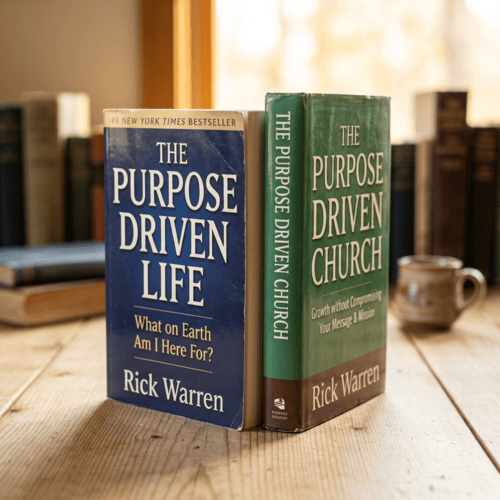
Few Christian books have travelled as far. Rick Warren published The Purpose Driven Life in 2002, and by 2020 it had sold more than 50 million copies. Its older sibling, The Purpose Driven Church (1995), quietly reshaped how thousands of pastors think about their work, and tens of thousands of congregations have run “40 Days of Purpose” campaigns. If you’ve belonged to an evangelical church over the last two decades, you’ve almost certainly met this material.
So the question matters. But notice which question we’re asking. We’re not asking if the book is popular; the sales figures have settled that. We’re not asking if readers find it helpful; many will tell you they do. We’re asking something harder: is it biblical? Does it teach what Scripture teaches, in the proportions Scripture teaches it?
Warren affirms Scripture is God’s Word without error, and that Christ died in the place of sinners. The difficulty is subtler: it lies in what the material leaves out, what it quietly demotes, and the order in which it arranges things. It’s truth blown out of proportion—and spread over 40 days and 50 million readers, truth out of proportion does real harm.
What the purpose driven model actually says
Fairness first. Warren’s system is simple, and meant to be. He argues God has 5 purposes for every believer and every congregation, drawn from the Great Commandment (Matthew 22:37–40) and the Great Commission (Matthew 28:19–20).
| Purpose | The claim to the reader | The activity |
|---|---|---|
| Worship | You were planned for God’s pleasure | Loving and praising God |
| Fellowship | You were formed for God’s family | Belonging to a local church |
| Discipleship | You were created to become like Christ | Growing in Christian character |
| Ministry | You were shaped for serving God | Serving within the church |
| Mission | You were made for a mission | Evangelism and world missions |
The Purpose Driven Church applies the same five purposes to congregational life. Warren pictures the church as a set of circles: the surrounding community, then the crowd who attend, then the congregation who join, then the committed who grow, then the core who serve. And Warren insists growth isn’t the goal—health is. A healthy church, he says, grows naturally, the way a healthy body does.
None of this is silly, and the five activities are all genuinely commanded in Scripture. That’s what makes the book hard to assess: it isn’t a list of errors with a little truth mixed in, but a list of truths with something essential missing.
What the book gets right
Any assessment that can’t say this part honestly isn’t worth reading.
- The first sentence. The book opens by telling the reader it isn’t about him. In a culture of religious self-help, that’s a bracing correction.
- God-centred purpose. We exist for God’s glory and pleasure, not the reverse. Warren says this plainly. And repeatedly.
- Serious membership. Saddleback asks new members to complete classes and sign a covenant—more demanding than most churches manage.
- Every member serves. Warren attacks the idea that ministry belongs to professionals—a Reformation conviction, the priesthood of all believers, that many churches affirm on paper and ignore in practice.
15 Bibles, 1 argument
The Purpose Driven Life quotes roughly 15 different English versions, and many of its quotations come from paraphrases rather than translations. The distinction matters. A translation tries to carry the words of the original into English. A paraphrase retells the sense in free modern language—they may be refreshing to read, but tend to be unreliable as proof. Warren explains in his preface he chose paraphrases deliberately, so familiar verses would strike the reader newly.
The trouble is a writer free to choose among 15 renderings will nearly always find one saying what he already wished to say. That’s not letting the Bible speak; it’s selecting the witness who agrees. Scholars call reading a meaning into the text, rather than drawing it out, eisegesis—the opposite of exegesis.
CASE STUDY: EPHESIANS 1:11
As the paraphrase has it: the reader is told that in Christ we find out who we are and what we’re living for.
As the ESV has it: In him we have obtained an inheritance, having been predestined according to the purpose of him who works all things according to the counsel of his will.
What changed: the Greek verb means we were allotted—we became God’s portion. Paul is describing God’s eternal decree, his settled plan formed before creation and carried out without fail. In the loose rendering, a sentence about God’s sovereign choosing becomes a sentence about our self-discovery.
The irony is hard to miss. The verse that most plainly teaches our purpose was fixed by God before we existed is used to send us off to find our purpose.
The same pattern appears with Jeremiah 29:11—For I know the plans I have for you, declares the Lord, plans for welfare and not for evil, to give you a future and a hope. That’s a letter to Jewish exiles in Babylon, promising a nation under judgement God will restore it after 70 years. The promise is magnificent, and it does belong to Christ’s people—but it reaches us through the covenant and the cross, not by a straight line from Babylon to our career decisions.
The doctrines that go missing
Now the deeper problem. Read the book looking for certain words, and you’ll search a long time.
- Sin as guilt before a holy God. Sin appears mainly as something that spoils our potential, rather than as rebellion that condemns.
- The wrath of God. Warren doesn’t deny it. He simply almost never mentions it.
- Propitiation. The word means the turning aside of God’s righteous anger by a sacrifice. It’s the heart of what the cross achieved (Romans 3:25).
- Justification by faith alone. God declaring the sinner righteous on the basis of Christ’s work received by faith—not on the basis of anything found in us.
Instead, God appears mostly as a warm friend who smiles at our efforts; one chapter asks what makes God smile. The question isn’t wrong, but as a governing image it shifts the ground of our standing from Christ’s finished work to our daily performance.
David Wells has spent decades arguing God has become “weightless” in modern church life. He’s named constantly. He’s mentioned everywhere. And feared nowhere. Michael Horton makes the parallel case that much evangelical preaching has slid into moralistic therapeutic deism: a distant, agreeable God who mainly wants us to be nice and happy. When God loses His weight, the cross stops being a rescue and becomes a gesture.
THE PRAYER ON DAY SEVEN
Early in the book the reader is invited to pray a short prayer—believing in Jesus and receiving him—and is then congratulated and welcomed into the family of God.
What’s absent: sin named, repentance required, the cross explained, the cost counted, the church mentioned.
What Scripture says: Repent and be baptised every one of you in the name of Jesus Christ for the forgiveness of your sins (Acts 2:38). God commands all people everywhere to repent (Acts 17:30).
Why it matters: assurance is anchored to a sentence the reader once said, rather than to Christ and the fruit the Spirit produces. Churches worldwide are full of people holding the memory of a prayer instead of a living faith.
Underneath this lies a question about how anyone becomes a Christian at all. Scripture teaches the new birth is God’s work, not ours: we were dead in our trespasses and God made us alive together with Christ (Ephesians 2:5). If that’s true, the obstacle to conversion isn’t that the message sounds unattractive. The obstacle is a dead heart—and only God raises the dead, ordinarily through the preached Word (Romans 10:17). A strategy built on making the message maximally agreeable has misdiagnosed the patient.
Why purposes aren’t marks
This is the structural problem, and the most important point in this article.
Warren defines a church by what it does. The historic Protestant confessions define a church by what is true of it. The Belgic Confession of 1561, in Article 29, lists the marks: the pure preaching of the gospel, the right administration of the sacraments, and the faithful exercise of church discipline.
| Five purposes (functions) | Three marks (identity) |
|---|---|
| Worship, fellowship, discipleship, ministry, mission | Word, sacraments, discipline |
| Describe what a church does | Describe what makes a church a church |
| Measured by counting activity | Assessed only by doctrine |
| Shared with many religious groups | Belong to Christ’s church alone |
The difference isn’t academic. A religious body can worship enthusiastically, build warm fellowship, teach its members, organise service and recruit vigorously—and preach a false gospel while doing all five. Mormon wards do all five. Functions describe activity; marks describe identity, and only identity tells you whether you’ve found Christ’s church.
Mark Dever’s well-known nine marks of a healthy church begin where Warren doesn’t: with expositional preaching and sound biblical theology, on the conviction that what a church believes governs everything it does.
Notice, too, what shrinks when purposes take over.
- The Lord’s Supper barely features
- Baptism appears mostly as a step in the membership process.
- Preaching becomes topical and need-driven rather than working steadily through books of the Bible—which is how a congregation actually hears the whole counsel of God (Acts 20:27)—including the parts nobody would have requested.
Methods are never neutral
Everything in the purpose driven system rests on one sentence: the message is sacred, the methods aren’t. It sounds modest. It’s the load-bearing beam of the whole structure, and it will not hold.
The model’s family history explains why. It grows out of the Church Growth Movement associated with Donald McGavran and Fuller Theological Seminary, which studied why some churches grow. Saddleback surveyed the unchurched people of its area and built a composite profile—”Saddleback Sam”—of the man it wanted to reach, then shaped the service around his stated preferences.
Scripture isn’t silent about who decides the shape of worship. Nadab and Abihu offered unauthorised fire before the Lord, which he had not commanded them (Leviticus 10:1), and died for it. Israel was warned to add nothing to what God commanded and to take nothing away (Deuteronomy 12:32). Paul warns against self-made religion—worship we invent for ourselves (Colossians 2:23). The historic Protestant instinct follows: in worship, God tells us what He wants. We don’t survey the neighbourhood.
But there’s a plainer reason. Methods teach. If we gather people by making the meeting comfortable, we must keep them by keeping it comfortable; the medium disciples the congregation as surely as the sermon does. Gather consumers with consumer methods, and we’ll have a room of people who’ve learned, week by week, that the church exists to meet their preferences.
Carl Trueman has traced how modern people came to believe identity is found by looking inward and expressing what’s found. A book that answers “what on earth am I here for?” by mapping our gifts, personality and experiences speaks that language fluently—even while telling us it isn’t about us.
The movement’s own audit
The most damaging criticism of the seeker-shaped church didn’t come from outside it. In 2007 Willow Creek Community Church near Chicago—the pioneer of the seeker service—published REVEAL, a large survey of its own people, asking whether taking part in the church’s programmes was actually producing love for God and neighbour. The finding was uncomfortable: more activity didn’t track with more spiritual growth, and the most mature believers were the likeliest to say they were underfed. Bill Hybels, the founding pastor, publicly called it a mistake he’d made.
That’s not a hostile outsider scoring a point. It’s the movement’s flagship checking its own instruments and reporting the reading honestly. Activity had been mistaken for maturity.
A better answer to a real question
“What on earth am I here for?” is a genuine question, and Warren deserves credit for taking it seriously. Scripture answers it—but differently.
TWO OLDER ANSWERS TO THE PURPOSE QUESTION
Westminster Shorter Catechism (1647), Question 1: What is the chief end of man? Man’s chief end is to glorify God, and to enjoy Him for ever.
Heidelberg Catechism (1563), Question 1: What is your only comfort in life and in death? That I am not my own, but belong—body and soul, in life and in death—to my faithful Saviour Jesus Christ.
Look at what the Heidelberg does. Asked about purpose, it answers with a person: we belong to Christ. It hands us no programme; it tells us whose we are. John Piper’s much-quoted line captures the same instinct: “God is most glorified in us when we are most satisfied in him.” Purpose isn’t a task list but a relationship that produces a life.
That also changes how we think about calling. Purpose is mostly given, not discovered. Only let each person lead the life that the Lord has assigned to him (1 Corinthians 7:17). Our callings are visible already, without a personality inventory: son or daughter, perhaps husband, wife or parent, neighbour, worker, church member. Kevin DeYoung has argued God’s will isn’t a hidden message to be decoded but a holy life to be lived. Os Guinness puts it the other way round: God calls us first to Himself, and everything else is a response to that call.
And the means are ordinary. God grows His people through the preached Word, the sacraments and prayer, week after unglamorous week. There’s no 40-day version of that.
If your church is using it
- Don’t storm out. Warren isn’t preaching another gospel, and a congregation that reads him isn’t a cult.
- Check every verse. Look up each quoted text in a standard translation and ask whether the point still stands. Often it will. Sometimes it won’t.
- Ask what’s missing. At the end of each chapter, ask where sin, the cross, repentance and the church appeared.
- Add a catechism. Work through the Heidelberg or the Westminster Shorter alongside it. Six weeks of that will supply what 40 days cannot.
- Speak to your elders quietly. Raise concerns privately and gently, with specifics rather than suspicion.
The Purpose Driven Life asks the right question and gives an answer that’s half true and half missing—and the missing half is the half that saves. Read it, if you wish, with your Bible open beside it, and let the Bible have the last word.
Tough Questions, Honest Answers
Is Rick Warren a false teacher?
No—and the accusation deserves more care than it usually gets. A false teacher, in the New Testament’s sense, denies the gospel itself: the deity of Christ, His atoning death, salvation by grace (2 Peter 2:1; Galatians 1:8–9). Warren has publicly affirmed the inerrancy of Scripture, the Trinity, the substitutionary death of Christ and His bodily resurrection. The criticisms in this article concern emphasis, method and omission, which are serious enough without inflation. Some discernment ministries flatten every disagreement into apostasy, and the habit blunts the word “heresy” until it can no longer warn anyone. Criticise the book sharply if you must; describe the man accurately.
What is SHAPE, and is it biblical?
SHAPE is Warren’s acronym for what supposedly reveals your ministry: Spiritual gifts, Heart, Abilities, Personality and Experiences. Two of those are genuine biblical categories. Scripture does teach that the Spirit distributes gifts for the good of the body (1 Corinthians 12:7–11), and God certainly uses our history, as Joseph learned (Genesis 50:20). The problem is the framing. Scripture presents gifts as given for others and recognised by the church, not as a private code to be cracked through self-assessment. Personality inventories are a 20th-century tool, not a biblical one—useful for self-knowledge, but unable to tell you what God wants. Ask your elders where you’re needed before you ask a questionnaire who you are.
Why was Saddleback Church removed from the Southern Baptist Convention?
In February 2023 the SBC’s Executive Committee ruled Saddleback was no longer in friendly cooperation with the denomination because it had women serving as pastors; it was one of five churches removed that month. Warren appealed, and the messengers at the annual meeting upheld the decision by an overwhelming margin. He has since said publicly that four passages changed his long-held view on the question. Scripture reserves the teaching and ruling office for qualified men (1 Timothy 2:12; 1 Timothy 3:2; Titus 1:6), and the SBC’s own confession says the same. The episode illustrates this article’s argument: when a church’s identity is defined by what works rather than by what’s written, the order God has given becomes negotiable.
Is The Purpose Driven Life linked to New Age teaching or mysticism?
The strongest versions of that claim aren’t fair. Warren doesn’t teach that God is in everything, does not blur the distinction between the Creator and His creatures, and doesn’t promote occult practice; the internet claims he does usually from quotations cut away from their context. There’s, however, a real and smaller concern. The book commends “breath prayers”—repeating a short phrase through the day—and recommends devotional writers such as Brother Lawrence and Frank Laubach without much sifting. Scripture is sufficient, and the means God has appointed are the Word, the sacraments and prayer offered with understanding (John 4:24; 2 Timothy 3:16–17). Borrowing devotional techniques from traditions with a different doctrine of God is unwise, even when the borrower’s own doctrine is sound.
Does God have a specific plan for my individual life?
Yes and no, depending on which “will of God” you mean. God’s secret decree covers everything that happens, down to the sparrow and the hair (Matthew 10:29–30; Ephesians 1:11)—but it stays secret until it unfolds, and we’re not responsible to guess it. God’s revealed will is what we’re answerable to, and it isn’t hidden at all: For this is the will of God, your sanctification (1 Thessalonians 4:3). So there is no coded message to decipher about which job to take or whom to marry. Pursue holiness, take wise counsel, weigh your duties and circumstances, and then choose freely—trusting that the secret will was never yours to manage.
Is the purpose driven church the same as the seeker-sensitive church?
They’re close relatives rather than twins. The seeker-sensitive model, associated above all with Willow Creek, redesigns the Sunday service around the non-Christian visitor. Warren’s model is broader: it keeps the five purposes as an organising system for the whole church and moves people through stages of commitment, so his Sunday service aims at seekers while his structure aims past them. Both grow from the same root—the Church Growth Movement’s confidence that what attracts people can be studied and then applied to the church. Both therefore inherit the same weakness: they treat the gathering as something to be designed around the audience rather than prescribed by God.
What should I read instead?
For the purpose question itself, start with a catechism—the Heidelberg Catechism or the Westminster Shorter Catechism, with a modern guide alongside. For the cross, John Stott’s The Cross of Christ and Jerry Bridges’ The Gospel for Real Life. For the church, Mark Dever’s Nine Marks of a Healthy Church and Michael Horton’s Christless Christianity. For guidance and calling, Kevin DeYoung’s Just Do Something. And read one book of the Bible slowly with a good commentary.
Related Reads
- The Gospel of Self-Improvement: Is It Just a Pack of Lies?
- Do Altar Calls Help or Hurt Evangelism?
- What the ‘Woke’ Church Gets Wrong: A Call to Gospel-Centred Faithfulness
- What’s Wrong With Dominion Theology? A Biblical Critique
- Ancient Heresies, New Disguises: Identify the Modern Variants
- What Are the Marks of a True Church?
- Exegesis vs Eisegesis: What Do the Two Terms Really Mean?