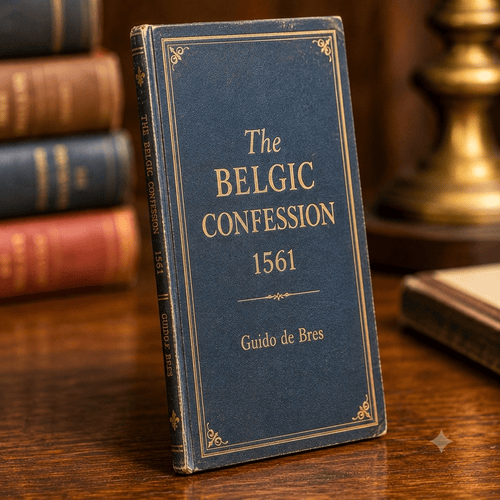
On the night of November 1, 1561, a small parcel flew over the wall of a castle at Tournai, a town in what’s now Belgium. Inside was a printed book of 37 short chapters. Wrapped around it was a letter addressed to the most powerful ruler in Europe: King Philip II of Spain.
The man who threw it was pastor, Guido de Brès. He wasn’t sending a threat. He was handing the government a complete, signed description of everything he and his people believed—at a time when holding those beliefs was a crime punishable by death. In effect he was saying: here’s what we think. Read it. If you still want to kill us, you now know why.
To read the Belgic Confession online, see the Reformed Church in America’s English version
6 years later the king’s soldiers hanged de Brès. The little book survived. Today it’s still read, still taught and still binding on churches from the Netherlands to Nigeria, from Canada to Korea. This is the story of how it came to be written, and why a hunted man thought it was well worth the risk to draft it.
The man who wrote it
Guido de Brès—sometimes written Guy de Bray—was born around 1522 in Mons, in the province of Hainaut. His family painted glass for a living. He grew up in a workshop.
Sometime in his mid-20s he began reading the Bible for himself, and what he read changed him permanently. From that point, his life follows a pattern that repeats again and again: preach, be hunted, flee, come back.
A life on the run: the key dates
- c. 1522—Born in Mons, into a family of glass painters.
- c. 1547—Comes to settled evangelical convictions through private Bible reading.
- 1548—Flees to England to escape the heresy laws. Joins the refugee congregations in London gathered under the Polish pastor Jan Łaski.
- 1552—Returns home and pastors a secret congregation in Lille.
- 1555—Publishes his first book, Le baston de la foy chrestienne (The Staff of the Christian Faith).
- 1556—Flees again. Studies at Lausanne and Geneva under John Calvin and Theodore Beza.
- 1559—Returns to the Low Countries and takes up the most dangerous pastorate in Europe: an underground church at Tournai.
That 1555 book matters more than its title suggests. It was a collection of quotations from the early church fathers, arranged to prove one point: what we believe isn’t new. His opponents said he’d invented a religion. He answered with 500 years of receipts. 6 years before the Confession, de Brès was already an apologist.
The Confession: Why Write it?
People often assume confessions are written in a quiet study by comfortable committees. This one wasn’t. Four separate pressures prompted the draft.
1. The law had made his church a crime
In 1550 Emperor Charles V issued a placard so severe that historians nicknamed it the Edict of Blood. It made it a capital offence to own a banned book, to attend a secret service, or even to discuss the Bible privately with a neighbour. His son Philip II renewed and tightened it. By the 1550s the Low Countries had executed more people for their faith than anywhere else in Europe.
Understand what that meant. There was no legal category under which his congregation could exist. Not a tolerated minority, not a registered sect. Nothing. They were criminals who met at night.
2. Everyone believed they were terrorists
This is the piece most short summaries leave out.
In 1534 and 1535, a violent Anabaptist group led by Jan van Leiden seized the German city of Münster by force. They expelled or killed opponents, abolished private property, introduced polygamy, and set up a self-declared kingdom. The siege that ended it was brutal. All Europe watched.
After Münster, governments across the continent stopped making fine distinctions. Anyone who rejected the official church was filed under the same heading: heretic equals rebel. The charge against de Brès’s people was therefore not really theological. It was political. They were being executed as a threat to public order.
Once we see that, the Confession snaps into focus. It isn’t simply a summary of doctrine. It’s a legal defence against a criminal accusation. Several of its articles exist mainly to say, calmly and in writing: we’re not those people. Article 34 defends infant baptism and explicitly rejects rebaptism. Article 36 insists Christians must honour, obey and pay taxes to the government God has placed over them. De Brès later devoted an entire book, published in 1565, to refuting Anabaptist teaching in detail.
3. A public protest had just exposed everyone
On 29 September 1561, crowds in Tournai poured into the streets singing psalms in French. These demonstrations are known as the Chanteries—literally, the singings. Thousands took part. It was a deliberate, open, public breaking of the placards.
Here’s the detail that makes de Brès a real person rather than a plaster saint: he opposed the Chanteries. He thought they were reckless. Philip II sent commissioners to investigate. Houses were searched. Arrests and interrogations followed. A hidden church suddenly stood in the open, and the state now knew it was there.
The Confession was written and printed in the weeks that followed. The timing is no coincidence. A protest he couldn’t control had exposed his people, so de Brès moved fast to control the one thing he still could: what the authorities believed about them.
4. Scattered congregations had no shared standard
There were no seminaries, no synods, no church buildings, no bishops. Congregations met in cellars, barns and fields. A pastor could be arrested on Tuesday and replaced by a stranger on Sunday. In those conditions, a short written standard wasn’t bureaucracy. It was the only practical way to keep scattered groups believing the same thing.
IN ONE SENTENCE
The Belgic Confession was written to prove to a hostile king the persecuted congregations of the Low Countries were orthodox, peaceable and law-abiding—and to give those scattered congregations one voice while they waited to find out whether the king would listen.
The night of the wall, and the letter to the king
De Brès had the Confession printed in French at Rouen, across the border in France, by printer Abel Clémence. The full title described it as a confession made by common agreement by the faithful in the Low Countries, who desire to live according to the purity of the gospel.
Notice the phrasing. Not “by Guido de Brès”, but by common agreement, by the faithful. Every word says: we’re a community, not a conspiracy.
The parcel thrown over the castle wall on the night of November 1 contained the printed Confession and a covering letter to Philip II. That letter is the frame through which the whole document should be read. It makes three moves.
- It promises obedience. The signatories declare themselves loyal subjects, ready to obey the government in everything that doesn’t require them to disobey God.
- It claims numbers. They’re not a handful of cranks, the letter insists, but many thousands of the king’s own people.
- It accepts the cost. And then it says the thing nobody expects a petition to say.
From the covering letter to Philip II, 1561
The petitioners tell the king plainly that rather than deny the truth, they will offer their backs to the whips, their tongues to the knives, their mouths to the gags, and their whole bodies to the fire.
This is a legal petition that ends by describing its own authors’ executions. They were not bluffing. Within six years the man who wrote it was hanged.
The gamble failed completely. Philip II granted nothing—no hearing, no tolerance, no pause—and within months de Brès was a fugitive. Again. As political lobbying, the Belgic Confession failed totally. By every other measure it’s one of the most successful documents of the century.
What’s Inside: the 37 Articles
The Confession doesn’t beat around the bush. It follows the shape of the ancient creeds: who God is, what He has said, what He has done, what the church is, and how history ends.
| ARTICLES | SUBJECT | WHY IT’S PLACED THERE |
|---|---|---|
| 1–2 | Who God is, and how He can be known | Everything else depends on whether God has spoken at all |
| 3–7 | The Bible: its origin, its books, its sufficiency | Establishes the authority the rest of the document will appeal to |
| 8–11 | The Trinity: one God, Father, Son and Holy Spirit | Answers the charge of inventing a new religion by affirming the ancient creeds |
| 12–13 | Creation, angels, and God’s government of the world | Comfort for people whose lives were visibly out of their own control |
| 14–15 | What human beings are, and what went wrong | Sets up the need for a rescuer |
| 16 | God’s eternal choice of a people | Grounds salvation in God’s decision, not human performance |
| 17–21 | Jesus Christ: his person, his work, his death | The centre of the document |
| 22–26 | How a sinner is put right with God, and lives after that | Faith alone, and what faith produces |
| 27–32 | The church: what it is, how to recognise it, how it is governed | Crucial when your church has no building and no legal existence |
| 33–35 | Baptism and the Lord’s Supper | Where the sharpest disputes of the century lay |
| 36 | Government and the Christian citizen | The direct answer to the accusation of rebellion |
| 37 | The return of Christ and the final judgement | The last word belongs to God, not to Philip II |
Article 2: the two books
If you read only one article, read the second. It’s four sentences long and it quietly sets the agenda for centuries of Christian thinking about science, nature and evidence.
De Brès says God makes Himself known to us by two means. First, by the creation, preservation and government of the whole universe, which is before our eyes like a most beautiful book, in which all created things are like letters, leading us to see the invisible things of God. Second, and much more clearly and fully, by His holy and divine Word.
Two books, then: the world and the Bible. Both are written by the same Author. Neither contradicts the other. But they don’t do the same job.
| THE BOOK OF CREATION | THE BOOK OF SCRIPTURE | |
|---|---|---|
| What it is | The universe itself—its order, beauty, scale and design | The written Word of God, the Bible |
| Who can read it | Everyone, everywhere, without a teacher | Anyone who receives it, hears it read or has it explained |
| What it shows | That God exists, and something of His power and nature | Who God is, what He has done, and how sinners are saved |
| What it cannot do | It can’t tell us about Christ, or forgive us | Nothing is lacking; Article 7 calls it sufficient |
| The effect on the reader | Leaves every person without excuse | Brings faith, and through faith, life |
Apostle Paul had already said both halves. Of the first book: “For His invisible attributes, namely, His eternal power and divine nature, have been clearly perceived, ever since the creation of the world, in the things that have been made. So they are without excuse” (Romans 1:20). And the psalmist agrees: “The heavens declare the glory of God, and the sky above proclaims His handiwork” (Psalm 19:1).
This is why Article 2 remains useful. It refuses both mistakes at once: that nature tells us nothing about God, and that nature tells us enough. A hunted man wrote the balanced sentence much later apologetics has struggled to hold on to.
Article 5: who decided which books belong in the Bible?
This is a question modern readers ask constantly: didn’t the church just pick the books it liked?
It was also the sharpest polemical question of 1561. De Brès’s opponents argued the Bible has authority because the church says so—and therefore the church, not the Bible, is the final judge.
Article 5 answers carefully. The church receives these books as holy and canonical, it says, not because the church has authorised them, but chiefly because the Holy Spirit bears witness in our hearts that they’re from God. The books also carry the evidence of it in themselves, since even the blind can see the things foretold in them come to pass.
The distinction is worth slowing down over. A jeweller doesn’t make a diamond valuable by certifying it. He recognises value that was already there. The church, on this view, is the jeweller, not the mine.
Article 7 then completes the thought: the Bible contains fully everything a person needs for salvation, so nothing may be added to it, not by councils, customs or long tradition.
What he borrowed, and what he added
Let’s be plain: de Brès didn’t start from scratch.
Two years earlier, in 1559, the French churches had adopted the Gallican Confession, drafted largely by John Calvin and Antoine de Chandieu. De Brès had studied in Geneva. He knew the document well, and he followed its order and much of its substance.
But the Belgic Confession isn’t a translation, and anyone who calls it a copy hasn’t compared them. It’s roughly a third longer. It says far more about how God is known and about which books belong in the Bible. It treats the person of Christ and the marks of the true church in much greater detail. And it’s far more deliberate in separating its authors from Anabaptist teaching—because in the Low Countries, unlike in France, that accusation was the one killing people.
Authorship has been debated. Adrien de Saravia, Herman Moded and Godfried van Wingen have all been proposed as collaborators. Nicolaas H. Gootjes, in the most thorough modern study of the document’s history and sources, concluded de Brès is best understood as its single author rather than the chairman of a committee—a conclusion that fits the speed with which it appeared after the Chanteries.
A copy went to Geneva for inspection before it circulated widely. The reaction was reportedly cool: publishing now, Calvin’s circle felt, was premature. De Brès published it anyway. He was the one living under the placards.
From smuggled pamphlet to church standard
A document thrown over a wall by a wanted man had no official status whatsoever. Within 60 years it had become one of the doctrinal standards of an entire national church.
Timeline: how it was received
- 1561—Written and printed in French at Rouen; thrown over the castle wall at Tournai on the night of 1 November.
- 1562—Translated into Dutch by Godfried van Wingen, which puts it into the hands of ordinary congregations.
- 1566—Reviewed, lightly revised and formally approved at the Synod of Antwerp. A German translation follows.
- 1568—Adopted at the Convent of Wesel, a gathering of exiles planning for a church they hoped to go home to.
- 1571—The Synod of Emden requires ministers and elders to subscribe to it. It is now a test of office, not just a statement.
- 1574–1581—Reaffirmed by the synods of Dordrecht and Middelburg.
- 1618–1619—The Synod of Dort compares the French, Dutch and Latin texts line by line and settles the definitive wording.
At Dort it took its permanent place beside the Heidelberg Catechism of 1563 and the Canons of Dort of 1619. Together these three are known as the Three Forms of Unity, and they remain the confessional basis of Dutch and continental churches—and, through four centuries of emigration, of congregations on every inhabited continent.
How the story ended
De Brès went on pastoring. Antwerp, then Tournai again, then Valenciennes.
In 1566 a wave of image-breaking swept the Low Countries. Mobs stripped and smashed church interiors. De Brès neither led nor encouraged this, and worked against its excesses. But the destruction handed the Spanish government exactly the argument it wanted: you see—they’re rebels after all.
Valenciennes was besieged and fell on 23 March 1567. De Brès escaped, was captured, and imprisoned. From his cell he wrote to his mother and to his wife, Catherine Ramon, with whom he had five children. Those letters are astonishing. There’s fear in them, and tenderness, and no self-pity at all. He writes as a husband settling the household’s affairs and as a pastor still doing his job through the bars.
He was hanged at Valenciennes on 31 May 1567. He was about 45 years old.
THE IRONY WORTH SITTING WITH
The letter was ignored. The petitioner was executed. The empire that hanged him is gone, and the Spanish crown no longer rules a square inch of the Low Countries. The book he threw over the wall is read aloud in churches this Sunday, in languages he never heard, on continents he never visited.
Why this story still matters
It’s tempting to file confessions under “history”. Three things make that a mistake.
- Every church already has a confession. Carl R. Trueman has argued the point forcefully: no congregation is confession-free. Every church has beliefs it won’t surrender and boundaries it quietly enforces. The only real question is whether those beliefs are written down where members can read them, test them against Scripture and hold their leaders to them—or left unwritten, in the pastor’s head, where nobody can check them.
- A confession is a servant, never a master. Article 7 puts the Bible above every human writing, including the Confession itself. Daniel R. Hyde, who has written a widely used popular commentary on the document, makes the same point pastorally: these articles are meant to help ordinary believers read Scripture with confidence, not to stand between them and it.
- Writing it down is a different act from privately believing it. Paul makes the two inseparable: “For with the heart one believes and is justified, and with the mouth one confesses and is saved” (Romans 10:10). Peter assumes the same, telling us to be “always being prepared to make a defence to anyone who asks you for a reason for the hope that is in you; yet do it with gentleness and respect” (1 Peter 3:15). De Brès did exactly that, with gentleness, with respect. And with a rope waiting.
Wes Bredenhof, who studied de Brès closely, draws attention to how outward-looking the man was: this was a pastor concerned that outsiders should hear and understand, not merely that insiders should be kept safe. That’s precisely what a confession thrown over a castle wall is—doctrine addressed to people outside the church, in language they couldn’t misunderstand.
Most of us will never pay what he paid. But the question his life puts to us is smaller and sharper than martyrdom. Would we write down what we believe—clearly enough that strangers who dislike us could read it and understand exactly what we’re claiming?
Guido de Brès did. It cost him his life. But his work has outlasted every man who signed his death warrant.
Tough Questions, Honest Answers
Why is it called the Belgic Confession when Belgium didn’t exist in 1561?
The name comes from the Latin word Belgica, which in the 16th century referred to the whole of the Low Countries—roughly today’s Netherlands, Belgium and Luxembourg together—not to the modern nation of Belgium, which was only founded in 1830. So the title means something closer to “the Confession of the Low Countries”. In Dutch it’s usually called the Nederlandse Geloofsbelijdenis, the Netherlands Confession of Faith, which is a more accurate description. The English name is simply an old label that stuck.
Which churches still use the Belgic Confession today?
It remains an official doctrinal standard across the Dutch and continental family of churches, which spread around the world through four centuries of emigration. Denominations in the Netherlands, Canada, the United States, South Africa, Australia, Indonesia, Korea and across Africa continue to hold to it, and in many of them it’s printed at the back of the psalm book so members can look it up. In these churches it functions in a specific way. Ministers, elders and deacons sign it when they take office, promising to teach in accordance with it and to raise any disagreement openly through church channels rather than privately from the pulpit. Presbyterian churches generally use the Westminster Standards instead, but the two families recognise one another’s confessions as teaching substantially the same faith.
What’s the difference between the Belgic Confession, the Heidelberg Catechism and the Canons of Dort?
They’re 3 documents doing 3 different jobs, which is why churches keep all 3 rather than merging them. The Belgic Confession of 1561 is a confession: a comprehensive statement of what the church believes, arranged as 37 short articles. The Heidelberg Catechism of 1563 is a catechism: 52 weekly lessons in question-and-answer form, written to teach children and new believers, and famously warm and personal in tone. The Canons of Dort of 1619 are judicial decisions: the ruling of an international assembly on one specific controversy, concerning grace and God’s choice of His people. Together they’re called the Three Forms of Unity. The order is roughly what we believe, how we teach it, and how we settled a dispute about it.
Did John Calvin write the Belgic Confession?
No. Guido de Brès wrote it, and the confusion is easy to explain. De Brès had studied in Geneva under John Calvin and Theodore Beza, and he used the Gallican Confession of 1559—drafted largely by Calvin and Antoine de Chandieu—as his model for structure and much of his content. The family resemblance is real and obvious. But the Belgic Confession is substantially longer, considerably fuller on Scripture and the church, and shaped throughout by pressures specific to the Low Countries that France didn’t face in the same way. Calvin’s circle in Geneva did review a copy, and reportedly thought publishing it in 1561 was unwise. De Brès published it anyway, which isn’t how a ghost-writer behaves.
Why was Article 36, about government, later revised?
The original article said the civil government carries duty not only to maintain public order but also to remove and prevent all idolatry and false worship. In 1561 that language was uncontroversial across Europe, Protestant and Catholic alike; almost nobody yet believed a state could be religiously neutral. The difficulty became obvious over time. Read consistently, that clause authorises a government to suppress false religion by force—which is precisely what Philip II believed he was doing to de Brès. In 1905 the churches in the Netherlands revised the wording to remove that clause, and churches in North America followed. The article’s main claims were kept: government is God’s gift, Christians must obey and pray for it, and the state isn’t the church. Several churches have since adopted further clarifications.
Was Guido de Brès involved in the smashing of church images in 1566?
No, and the evidence is clear on this. In 1566 mobs across the Low Countries broke into church buildings and destroyed statues, paintings and stained glass. The episode is remembered in Dutch as the Beeldenstorm, the image storm. De Brès neither incited it nor approved it, and he worked to restrain the violence. His whole public strategy for five years had been to demonstrate that his people were peaceable subjects; a riot destroyed that argument overnight. The Spanish authorities used the destruction as proof that the accusation had been right all along, and the crackdown that followed swept up de Brès among many others. There’s irony here: he was executed partly on the strength of an outbreak he had opposed.
If the Bible is enough, why should any church bind itself to a written confession?
Because a confession doesn’t compete with Scripture; it summarises it and makes the summary public. The Confession itself insists on the ranking. Article 7 states Scripture contains fully everything necessary for salvation, and that no writing of any person, however holy, may be treated as equal to it. A confession is therefore always answerable to the Bible and always open to correction by it—which is exactly why Article 36 could be revised. The practical case is simpler still. Every church teaches something. If what it teaches is written down, members can compare it with Scripture, spot errors and hold their leaders accountable. If it is left unwritten, the church still has a set of beliefs—it just has one nobody outside the leadership can examine. Written, testable, public doctrine is a protection for ordinary believers, not a threat to them. That is precisely what a young pastor was offering a hostile king in 1561, and it is why he printed it rather than merely thinking it.
Related Reads
- The Westminster Confession: Why This Document Still Matters
- The Synod of Dort: The Debate That Gave Us TULIP
- Is the Biblical Canon Self-Authenticating?
- The Biblical Canon: The Journey from Scrolls to Scripture
- Why Didn’t the Gnostic Gospels Make the Cut Into the Canon?
- How Did Jews Know the Old Testament Canon Before Rome Did?
- Why Isn’t the Book of Judith in the Protestant Bible?