Every few years a headline appears. A lost gospel has been found. It was hidden for centuries. The church buried it because it was dangerous. Now, at last, the truth can be told.
The story is exciting. It’s also wrong.
The question in our title contains a hidden assumption. It suggests a group of men once sat around a table with a pile of gospels in front of them. They picked four. And threw the rest away. Some books “made the cut”. Others didn’t.
That’s not what happened. There was no table, no vote, and no losing party. Matthew, Mark, Luke and John were already being read as God’s word in churches from Gaul to Egypt before the first Gnostic gospel was even written. The Gnostic texts weren’t thrown out. They arrived long after the race had finished.
This article explains what these texts actually are, when they were written, what they teach, and why the church didn’t receive them. Along the way we shall also answer the popular version of the story: that a Roman emperor decided what must go into our Bibles.
First, What Are the “Gnostic Gospels”?
In December 1945, near the village of Nag Hammadi in Upper Egypt, a farmer digging for fertiliser found a sealed jar. Inside were thirteen leather-bound books. They were written in Coptic, the late form of the Egyptian language, and they were translations of older Greek texts.
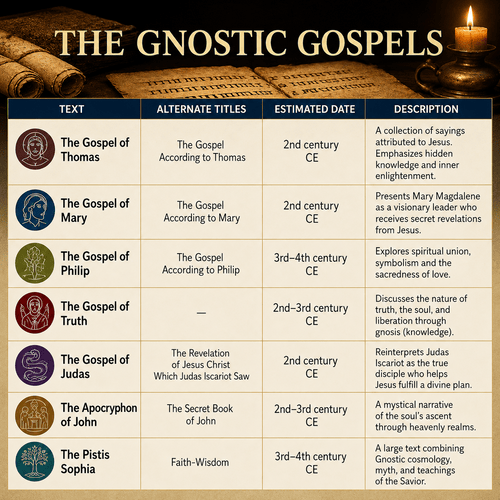
These books are usually dated to around AD 350–400 as physical objects, though the writings they contain are older. Two other important texts come from elsewhere. The Gospel of Mary survives in the Berlin Codex, bought in Cairo in 1896. The Gospel of Judas belongs to a manuscript known as Codex Tchacos, published in 2006.
The word “Gnostic” comes from the Greek word gnosis, which simply means “knowledge”. Gnosticism was a movement that promised salvation through secret knowledge—knowledge available only to a special few.
KEY TERM: GNOSTICISM
Gnosticism was not one organised religion. It was a family of teachings that shared a few core ideas: that the physical world is a mistake, that the true God did not make it, that a lower and lesser god did, and that a small number of people carry a divine spark inside them which can escape the material world through secret knowledge.
Now here’s the first surprise. Most of these “gospels” aren’t gospels at all.
- The Gospel of Thomas is a list of 114 sayings. There’s no story. No birth, no miracles, no journey to Jerusalem, no cross, no empty tomb.
- The Gospel of Philip is a collection of theological reflections, more like a notebook than a narrative.
- The Gospel of Mary and the Gospel of Judas are conversations in which a heavenly figure reveals hidden truths to a chosen disciple.
None of them tells the life of Jesus. So the popular picture—dozens of biographies of Jesus competing for a place, four winners and many losers—collapses straight away. These documents were never in the same competition. They’re a different kind of writing altogether.
The Problem Nobody Can Get Around: The Calendar
You can’t suppress in AD 90 a book that was written in AD 150. Dates decide this debate before theology even begins.
Here’s the sequence, in order:
- AD 30–35: Paul passes on a summary of the faith he himself received: that Christ died for our sins in accordance with the Scriptures, that He was buried, that He was raised on the third day (1 Corinthians 15:3-4). Scholars across the theological spectrum agree this wording is older than the letter itself. A bodily death and a bodily resurrection are fixed within a few years of the events.
- AD 60s–90s: Matthew, Mark, Luke and John are written, within living memory of eyewitnesses.
- AD 125–175: P52, a small fragment of John 18, is copied in Egypt.
- AD 140s–150s: The Gospel of Thomas takes shape. Mark Goodacre has argued in detail that Thomas knows and reworks the material in Matthew, Mark and Luke, which means it depends on them rather than competing with them.
- AD 150s: The Gospel of Judas appears. We know it existed by about AD 180, because Irenaeus of Lyons names it and rejects it.
- Third century: The Gospel of Philip is composed.
Read that list again slowly. The four gospels were in circulation, were being copied, and being read aloud in worship for 2 or 3 generations before the first Gnostic gospel was written. Nobody had to exclude these texts from an early Christian Bible. They simply were not there.
And the names on them are borrowed. Thomas didn’t write the Gospel of Thomas. Philip didn’t write the Gospel of Philip. Mary didn’t write the Gospel of Mary. These are 2nd- and 3rd-century writings wearing 1st-century clothes. In the ancient world this practice had a name: pseudepigraphy, writing under a false name.
The Real Divide: These Books Teach Another Religion
Even if the dates were different, the content would settle it. The gap between the Gnostic texts and the New Testament isn’t a gap between two versions of Christianity. It’s a gap between two rival views of God, the world, sin, salvation and Jesus.
Here’s the contrast set side by side.
| THE QUESTION | WHAT THE GNOSTIC TEXTS SAY | WHAT THE BIBLE SAYS |
|---|---|---|
| Who made the world? | A lower, ignorant being. In the Apocryphon of John he is called Yaldabaoth, and he is openly identified with the God of Genesis. | The one true God, freely and deliberately. |
| Is matter good? | No. Bodies, food, marriage and the physical world are a prison to escape. | Yes. And God saw everything that he had made, and behold, it was very good (Genesis 1:31). |
| What’s wrong with us? | Ignorance. We have forgotten who we really are. | Sin. We are guilty rebels against a holy God. |
| How are we saved? | By knowing. The spark inside us wakes up and escapes. | By grace, through faith, on the ground of Christ’s finished work. |
| Who is saved? | A spiritual class of people who are saved by what they already are. | Sinners with nothing in themselves to commend them, saved by God’s free mercy. |
| Who is Jesus? | A revealer who only appeared to have a body, and in some texts only appeared to die. | The eternal Son who truly took flesh, truly died, and truly rose. |
The point where everything breaks
Look closely at the last two rows. They’re where the whole argument lives.
Several Gnostic texts teach what scholars call docetism, from a Greek word meaning “to seem”. On this view Jesus only seemed to have a body. In the Second Treatise of the Great Seth and in the Coptic Apocalypse of Peter, someone else is nailed to the cross while the real Jesus stands above, laughing at those who think they’re killing him.
Set that beside the apostle Paul:
For in him the whole fullness of deity dwells bodily (Colossians 2:9).
Or beside John, who insists that he had physically handled the person he is writing about:
That which was from the beginning, which we have heard, which we have seen with our eyes, which we looked upon and have touched with our hands, concerning the word of life (1 John 1:1).
WHY THIS IS NO SMALL DISAGREEMENT
If matter is evil, a bodily resurrection isn’t good news. It’s a disaster. It would mean being pushed back into the prison we’d just escaped.
That’s why the Gospel of Thomas has no cross. And no resurrection. It’s not an oversight. Within the Gnostic framework, the cross and empty tomb have nothing to do. There’s no guilt to be paid for. And no body worth raising.
A message with no atonement isn’t a rival gospel. It isn’t a gospel at all.
There’s a quieter contrast worth naming, because critics often miss it. Gnosticism divides humanity into classes: the spiritual, the soulish and the fleshly. You’re saved because of the kind of person you are. That’s the exact opposite of the Bible’s teaching on God’s choosing love. Scripture says God chooses the weak, the foolish and the despised precisely so no human being may boast in His presence (1 Corinthians 1:26-29). Gnosticism flatters the elite. The gospel humbles everyone and then saves by mercy alone.
The Apostles Were Already Fighting This
One of the strongest arguments is often overlooked. We don’t need to wait for 4th-century bishops to find the line between truth and error. The apostles drew it themselves, in the New Testament, while the earliest forms of this teaching were appearing.
- 1 Timothy 6:20 Paul tells Timothy to avoid what is falsely called “knowledge”. The Greek word there is gnosis. Paul is warning against a counterfeit knowledge by name.
- 1 John 4:2-3 John gives a test: every spirit that confesses that Jesus Christ has come in the flesh is from God. Denying the real body of Jesus is not a minor error. It marks a teaching as coming from another spirit.
- Colossians 2:8 Paul warns the church not to be taken captive by philosophy and empty deceit, and then immediately affirms that the fullness of God dwells in Christ bodily.
- 2 Peter 1:16 Peter insists the apostles did not follow cleverly devised myths but were eyewitnesses.
- Galatians 1:8-9 and Jude 3 Paul and Jude both assume there’s one faith, that it was delivered once for all, and that anything else is to be rejected however impressive its source.
So the boundary wasn’t invented centuries later by men with political power. It was drawn by the apostles, in writing, in the 1st century. Everything the church did afterwards was maintenance work on a line that was already there.
So Who Actually Decides Which Books Are Scripture?
That’s the question underneath the question. Three answers are on offer.
| VIEW | WHO HAS THE FINAL SAY? | THE DIFFICULTY |
|---|---|---|
| Rome | The church gives the books their authority by recognising them. | This places the church above Scripture. But a messenger cannot outrank the one who sent him. |
| The critical view | Whoever won the power struggle. Orthodoxy is simply the version of Christianity that succeeded. | The manuscripts, the early quotations and the geography do not support it, as we will see below. |
| Confessional Protestant | God. His word carries its own authority; the church receives and acknowledges what God has given. | — |
The third answer is ours, and it’s worth stating carefully, because it’s often misunderstood.
We’re not saying Christians pick books by a private feeling. We’re saying God’s word isn’t made authoritative by a human decision, any more than a mountain becomes tall because a surveyor measures it.
John Calvin put it with great force in his Institutes. Scripture, he argued, is self-authenticated: it doesn’t beg for approval from human judges, and the Holy Spirit persuades believers inwardly that these words come from God.
The Westminster Confession of Faith says the same thing in its opening chapter. The authority of Scripture depends not on the testimony of any man or church, but wholly upon God, its author.
Two modern writers have developed this with unusual clarity.
Michael Kruger, in Canon Revisited, argues we should stop asking only historical questions and start asking what kind of book Scripture is. He describes three strands that hold together:
- The divine qualities of the books themselves,
- Their apostolic origin, and
- The fact that the churches, across a wide geographical area and without a central authority, received the same books.
When independent congregations separated by thousands of miles converge on the same writings, that’s not a conspiracy. It’s recognition.
Herman Ridderbos, the Dutch New Testament scholar, made a related point. The canon isn’t an afterthought or a later church policy. It flows out of the apostolic office itself. Christ appointed apostles as authorised witnesses; their writings carry that authority. The canon is therefore built into the structure of salvation history, not bolted on at the end.
That gives us a simple test to apply.
- Do the Gnostic gospels have apostolic origin? No—they were written long after the apostles died, under borrowed names.
- Were they received widely across the churches? No—they circulated in narrow circles, mostly in Egypt.
- Do they bear the marks of God’s own word? They deny the Creator, the incarnation, the cross and the resurrection.
They fail every test at once.
“Didn’t Constantine Choose the Books of the Bible?”
This claim is everywhere. It’s also completely false. And easy to disprove.
The Council of Nicaea met in AD 325. Its subject was whether the Son is truly and fully God, against the teaching of Arius. Not one of its decisions concerns which books belong in the New Testament. The canon wasn’t on the agenda. Anyone can read the council’s decisions and check.
More importantly, the four gospels were already settled long before Constantine was born.
| DATE | WITNESS | WHAT IT SHOWS |
|---|---|---|
| AD 150 | Justin Martyr | Describes Christian worship in Rome: the “memoirs of the apostles” are read aloud every Sunday. |
| AD 173 | Tatian | Weaves the gospels into a single continuous narrative called the Diatessaron. He uses exactly four. |
| AD 180 | Irenaeus | Argues that the fourfold gospel is as fixed and as obvious as the four winds and the four corners of the earth. He assumes his readers already agree. |
| AD 170–200 | Muratorian Fragment | An early list of accepted books. |
| AD 367 | Athanasius | His festal letter lists the twenty-seven New Testament books—confirming existing practice, not inventing it. |
| AD 393, 397 | Hippo and Carthage | Regional councils formally acknowledge what the churches had used for generations. |
Notice the shape of the evidence. Irenaeus is writing about 145 years before Nicaea, and he isn’t arguing for four gospels as if it were a new idea he had to defend. He is explaining something the churches already took for granted. That’s the tone of a settled matter, not a contested one.
THE QUESTION WORTH ASKING
If a powerful institution had chosen the four gospels for political reasons, why choose four books that disagree with each other about details, embarrass the apostles repeatedly, and record women as the first witnesses of the resurrection in a culture where a woman’s testimony carried little weight? Invented propaganda tidies things up. These accounts do not.
The Tests the Early Church Actually Used
The early churches didn’t have a rulebook, but their instincts were consistent. Four questions kept surfacing.
- Apostolicity. Does this come from an apostle, or from someone in the apostles’ immediate circle?
- Conformity to the rule of faith. Does it agree with the teaching handed down from the beginning?
- Catholicity. Is it received by churches everywhere, not just one region or one group?
- Antiquity. Does it come from the first generation, or did it appear later?
Every Gnostic gospel fails the first and the last outright. Most fail all four.
And here’s the irony that finishes the discussion. The Gospel of Thomas opens by announcing these are the secret sayings of Jesus. Secret. Hidden. For insiders.
A document that defines itself as secret cannot then complain that the public church left it out. It excluded itself by design. The apostles preached in the open, in markets and synagogues and courtrooms. Paul could stand before a Roman governor and say this has not been done in a corner (Acts 26:26).
Two completely different instincts are at work. One hides. The other publishes.
“Orthodoxy Is Just the Heresy That Won”
The most serious academic version of the argument comes from Walter Bauer, a German scholar writing in 1934, and has been popularised in our own time by Bart Ehrman. The claim is that early Christianity was wildly diverse, that no single version was original, and that one group later gained power and rewrote history as though it had always been the true faith.
It’s a striking thesis. But it hasn’t held up well.
- It argues largely from silence. Bauer looked at regions where our evidence is thin and treated the gaps as proof that heresy came first.
- It ignores the earliest layer. Larry Hurtado showed worship of Jesus as divine appears extremely early and in Jewish monotheistic circles—far too early to be a later development imposed by winners.
- It cannot explain the manuscripts. Copies of the four gospels vastly outnumber Gnostic texts in the surviving record, and they are spread across the empire. Andreas Köstenberger and Michael Kruger set out this evidence in The Heresy of Orthodoxy.
- It overstates the diversity. Darrell Bock, comparing the New Testament with the Nag Hammadi material, concluded the differences aren’t variations within one movement but the boundary between two.
Why This Still Matters Today
It would be comfortable to treat Gnosticism as a dead movement in an Egyptian jar. It’s not. Its instincts are alive and popular, especially in the modern West.
Consider how familiar these ideas sound:
- Our real self is the inner self, and our body is an inconvenient outer shell that may or may not match it.
- Salvation is a journey of self-discovery: look inward, find your truth, become who you already were.
- Religion is for the naive; enlightenment belongs to those who can see beyond it.
Philip Lee argued decades ago in Against the Protestant Gnostics that this outlook had quietly seeped into churches, turning faith into a private inner experience detached from history, creation and the body. Carl Trueman, in The Rise and Triumph of the Modern Self, traces how the modern conviction that identity is something we find within ourselves came to feel like common sense rather than a claim needing defence.
Against all of this, the four gospels are stubbornly physical. A real baby. A real carpenter’s son. Real hunger, real tears, real blood. A death under a named Roman governor. A tomb with an address. Witnesses who could be questioned, and were.
The Gnostic texts offer knowledge for the few. The gospel offers a Saviour for the guilty. One asks us to discover a spark we already had. The other tells us we were dead, and that Christ came in a body to make us alive.
The Answer, in Short
Why didn’t the Gnostic gospels make the cut?
- Because they were too late—written decades or centuries after the apostles had died.
- Because they were not apostolic—they borrowed names they had no right to use.
- Because they were never widely received—they belonged to small circles, not to the churches.
- Because they contradicted the faith at every decisive point—on creation, on sin, on the incarnation, on the cross, on the resurrection.
- Because they excluded themselves—a secret book cannot be a public gospel.
But the deepest answer isn’t a list of tests. It’s a doctrine of God’s care. The God who spoke also kept what He had spoken. He didn’t leave His people guessing, dependent on a committee to tell them which voice was His.
Jesus said something about this that’s easy to pass over: My sheep hear my voice, and I know them, and they follow me (John 10:27).
That’s finally why the four stayed and the others never entered. The gate wasn’t guarded by bishops or emperors. It was guarded by the voice the sheep already knew.
Tough Questions, Honest Answers
Does the Gospel of Philip prove Jesus was married to Mary Magdalene?
No. The passage people quote is physically damaged, with holes in the manuscript exactly where the crucial words would be, so translations have to guess. The text calls Mary a companion and says Jesus loved her more than the others—but the same document uses kissing and marriage language throughout as symbols for spiritual union, not physical relationships. Even taken at face value, it is a third-century writing with no connection to anyone who knew Jesus. A book written two hundred years after the event, in a tradition that despised the body and marriage, is the last place to look for information about a first-century marriage. And the New Testament, written by people who knew the family, mentions no wife.
Why isn’t the Book of Enoch in the Bible, when Jude seems to quote it?
Jude does refer to a prophecy associated with Enoch (Jude 14-15). But quoting something does not make it Scripture. Paul quotes pagan Greek poets in Acts 17:28 and Titus 1:12, and nobody suggests those poets belong in the canon. An inspired author can affirm that one particular statement is true without endorsing the whole book it appears in. Enoch was not written by Enoch, it comes from the centuries just before Christ, and Israel never received it as Scripture—which matters, because Paul says the Jews were entrusted with the oracles of God (Romans 3:2).
Are the Dead Sea Scrolls Gnostic gospels?
They’re almost the opposite. The Dead Sea Scrolls were found at Qumran from 1947 onwards and belong to a strict Jewish community, not a Gnostic one. They contain Old Testament manuscripts a thousand years older than what scholars previously had, along with the community’s own rules and commentaries. There is no gospel among them and no material about Jesus. Their value for Christians is enormous but quite different: they show that the Hebrew Scriptures were transmitted with remarkable care over many centuries.
Why does the Gospel of Judas turn the betrayer into a hero?
Because it is working from Gnostic assumptions. If the body is a prison, then whoever helps Jesus escape his body is doing him a favour. In that framework Judas becomes the one disciple who understood. This is not a hidden tradition about the real Judas; it is second-century theology written as a story. And notice what it requires you to believe: that the death of Christ was a release rather than a sacrifice for sin. Scripture says the opposite—Christ was delivered up according to the definite plan of God, and the men who handed him over remained fully guilty (Acts 2:23).
Did rejecting the Gnostic gospels silence women in the early church?
The evidence points the other way. The four gospels record women as the first witnesses of the empty tomb—something no first-century writer would invent, since a woman’s testimony carried little legal weight. Paul names Phoebe, Priscilla, Junia, Euodia and Syntyche as fellow workers. Meanwhile the Gospel of Thomas closes with a saying that women must become male to enter the kingdom. A movement that could produce that line is a strange champion for women. The Bible’s dignity for women is grounded far more deeply than any Gnostic text—in the image of God given to male and female alike (Genesis 1:27).
Why does the Ethiopian Orthodox Bible contain more books than mine?
Because different traditions made different judgements about a small number of writings from the period between the Testaments and just after. The Ethiopian canon is the broadest in the Christian world and includes texts such as Enoch and Jubilees. Two things are worth noting. First, the disagreement is at the edges: no historic Christian communion disputes the four gospels or Paul’s major letters. Second, breadth is not the same as authority. The test is not how many books a tradition accepted but whether a book bears the marks of God’s word and comes with prophetic or apostolic authority.
If a genuine letter of Paul were dug up tomorrow, would it be added to the Bible?
It would be a magnificent historical discovery and no addition to Scripture. Paul certainly wrote letters we do not have; he mentions one to the Corinthians that has not survived (1 Corinthians 5:9). But the canon is tied to the apostolic era, which is closed, and to the faith that Jude says was delivered once for all to the saints (Jude 3). We would also face an unanswerable problem: with no continuing apostolic voice, no one alive has the authority to declare a new document to be Scripture. God gave his church what it needs. The Bible we have is not a partial collection awaiting completion.
Related Reads
- Nag Hammadi Texts: Secret Gospels or Ancient Heresies?
- Rylands Papyrus P52: Why This Tiny Fragment Still Matters
- Is the Biblical Canon Self-Authenticating?
- The Biblical Canon: The Journey from Scrolls to Scripture
- How Did Jews Know the Old Testament Canon Before Rome Did?
- Shouldn’t the Book of Enoch Be In the Bible? Why Isn’t It?
- The Truth About Apocryphal Books: Why They’re Not in the Bible
- Who Compiled the Bible? How 66 Books Became One
- Is the Ethiopian Bible the Oldest and Most Complete Bible?
- Belgic Confession: The Story Behind the 1561 Draft
- When Were the Gospels Written? The Evidence for Early Dates
- The Jesus Seminar: Are Their Views Biblical?