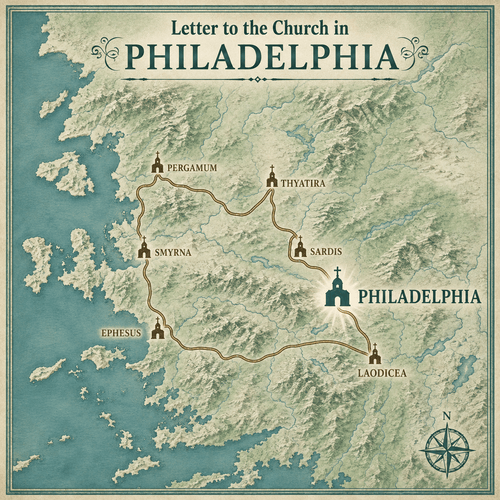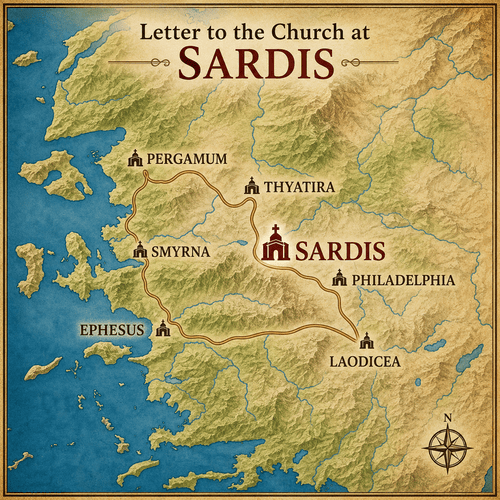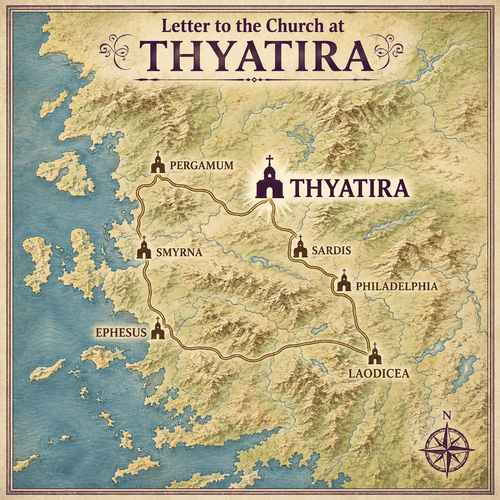
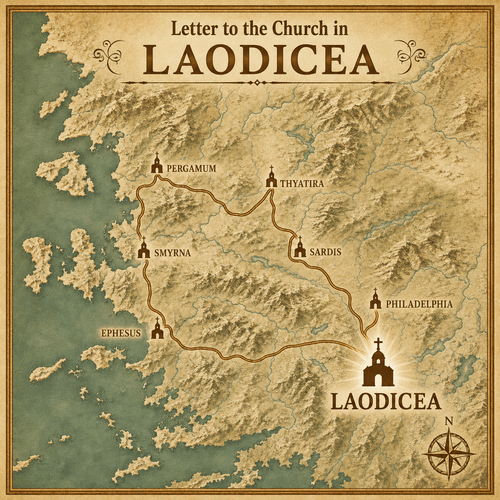
6 of the 7 churches in Revelation receive something kind. Even Sardis, a church Jesus calls dead, has a few people who’ve kept their clothes clean. Laodicea receives nothing. No praise. Not one line.
That should give us pause. The 7th and last of these letters, found in Revelation 3:14-22, is the hardest of them all. And here’s the strange part. Nobody was persecuting Laodicea. No false teacher had crept in with strange doctrine. There’s no Jezebel here, no Balaam, no Nicolaitans—the troublesome groups named in the other letters. The church had money, comfort and quiet.
That was the problem. Persecution couldn’t kill the church in Smyrna. Prosperity nearly killed the church in Laodicea.
A quick tour of a very rich city
Laodicea stood in the Lycus valley, in what’s now western Turkey. Around AD 60 a large earthquake flattened it. Rome offered disaster relief. Laodicea said no thank you and rebuilt itself out of its own pocket. Roman historian Tacitus records this almost in passing, as though it were unremarkable. For Laodicea, it was.
The city was proud of three things. Hold on to all three, because Jesus names every one of them later in the letter.
| LAODICEA WAS FAMOUS FOR | WHAT THAT MEANT IN PRACTICE | WHERE JESUS PICKS IT UP |
|---|---|---|
| Banking and gold | A financial centre wealthy enough to refuse imperial aid after the earthquake | “Buy from me gold refined by fire” (3:18) |
| Black woollen cloth | Geographer Strabo praised the soft, glossy, raven-black wool of the region | “White garments so that you may clothe yourself” (3:18) |
| Medicine | A respected medical school in the area, and an eye ointment linked to the region | “Salve to anoint your eyes, so that you may see” (3:18) |
Table 1: What Laodicea was famous for, and where each item reappears in the letter.
There was one thing Laodicea wasn’t proud of: its water. The city had no good spring of its own. Water was carried in by aqueduct—a long line of stone channels and clay pipes bringing water from several miles away. By the time it arrived it was warm, and thick with dissolved minerals. Sections of those pipes have been dug up, still furred with white limescale inside.
Six miles north lay Hierapolis, with famous hot mineral springs that people travelled to for healing. Ten miles east lay Colossae, with cold, clean mountain water. Laodicea had neither. Every single person hearing this letter read aloud knew exactly what all three tasted like.
So what does “lukewarm” actually mean?
“I know your works: you are neither cold nor hot. Would that you were either cold or hot! So, because you are lukewarm, and neither hot nor cold, I will spit you out of my mouth.” (Revelation 3:15-16)
The common explanation goes like this: hot means on fire for God, cold means spiritually dead, and lukewarm means half-hearted, somewhere in the middle. It sounds right until you read verse 15 slowly. Jesus says He wishes they were cold. Would Christ really wish a church were spiritually dead? That reading breaks on its own words.
In 1957 two scholars, Martin Rudwick and Edward Michael Bankes Green, suggested the picture isn’t about temperature at all. It’s about usefulness, and it comes straight off the map. Colin Hemer developed the argument in detail in his study of the seven cities, and Gregory Beale, in his major commentary on Revelation, adopts it.
THE THREE WATERS OF THE LYCUS VALLEY
Hot water (Hierapolis)—people bathed in it and were healed. Hot water is useful.
Cold water (Colossae)—clean and refreshing on a hot day. Cold water is useful.
Lukewarm water (Laodicea)—warm, cloudy and full of minerals. Drink it too fast and you gag. Useless.
The point isn’t how warm the church felt. The point is that nobody in the valley was helped by it.
Read that way, verse 16 makes complete sense. The word translated “spit” is a Greek word meaning to vomit. Laodicea has become the drinking water of Laodicea: it does nothing for the sick and nothing for the thirsty, and swallowing it makes you retch.
| THE OLDER READING | THE LOCAL-SETTING READING | |
|---|---|---|
| Hot means | Zealous, on fire | Healing, like the springs at Hierapolis |
| Cold means | Spiritually dead | Refreshing, like the water at Colossae |
| Lukewarm means | Half-committed | Useless to everybody |
| The problem with it | Jesus would be wishing them dead | None that is fatal; it fits the geography and the verb “vomit” |
Table 2: The two main readings of Revelation 3:15-16 compared.
Two cautions, because we want to be fair. David Aune and Grant Osborne both note ancient readers may still have heard temperature as a picture of commitment, and the evidence for exactly how the water tasted is partly reconstructed. Fair enough. But notice both readings land in the same place. Whether the charge is “you’re half-hearted” or “you’re useless”, the church is producing nothing that helps anyone. And the second reading explains verse 15 without embarrassment. That’s why we take it.
Who is speaking? Three names, and one big argument
“The words of the Amen, the faithful and true witness, the beginning of God’s creation.” (Revelation 3:14)
Every one of the 7 letters opens with a description of Christ that fits the church being addressed. This one is loaded.
- “The Amen.” Amen is a Hebrew word meaning something like “true-let it stand.” In Isaiah 65:16, God is twice called the God of Amen, the God of truth. Jesus takes that title for himself. To a city that had built its reputation on being trustworthy with money, the reply is: I am the trustworthy one.
- “The faithful and true witness.” A witness is someone who tells others what he has seen. Laodicea was a bad witness. Christ introduces Himself as the perfect one.
- “The beginning of God’s creation.” This is where the argument starts.
Does this verse mean Jesus was created?
Arius, a 4th-century church leader, argued the Son was the first thing God made. Jehovah’s Witnesses today make the same case, and Revelation 3:14 is one of their favourite verses. If Christ is “the beginning of God’s creation”, surely he is part of it?
The Greek word behind “beginning” is archē. It carries two quite different senses. It can mean first in a sequence, like the first page of a book. It can also mean source, origin or ruler—the head from which something comes. English keeps the second sense in words like “architect” and “monarch”. Grammar alone will not settle which meaning is intended. Context will.
And the context here is extraordinary, because we can name the very letter these Christians had in their hands. Paul told the Colossians to pass their letter on to Laodicea and to read the one coming the other way (Colossians 4:16). So the Laodiceans had read Colossians. And Colossians says by Christ all things were created, and that He is before all things and holds all things together. He isn’t inside the list of created things. He’s the reason the list exists.
John Calvin read archē here as source and head—Christ as the origin of creation, not a specimen of it. James White, who has debated this text with Jehovah’s Witnesses many times, makes the same point sharply: whoever created all things cannot be one of the things created. Gregory Beale adds a further layer. Given that Revelation 1:5 has already called Jesus the firstborn from the dead, “beginning of God’s creation” also announces him as the one who starts the new creation by rising from the grave.
Why this matters for a lukewarm church
Laodiceans thought they had everything and needed nothing. Verse 14 tells them who is at the other end of the letter: the God of truth, the perfect witness, and the origin of everything they own. Their bank balance was borrowed from Him. So was their next breath.
The five words that undo them
“For you say, I am rich, I have prospered, and I need nothing, not realising that you are wretched, pitiable, poor, blind, and naked.” (Revelation 3:17)
Notice the two halves. “You say” and “not realising”. This is not a church being told it has fallen short of a high standard. It is a church being told that its own self-assessment is the exact opposite of the truth.
- Wretched—in a miserable state, though it does not feel like one.
- Pitiable—the sort of person you would feel sorry for, not envy.
- Poor—in the city with the strongest bank in the valley.
- Blind—in the city known for eye medicine.
- Naked—in the city that clothed half the province.
Then set this against the second letter in the series, and the whole book starts to look deliberately arranged.
| CHURCH | WHAT THE LEDGER SAYS | WHAT CHRIST SAYS |
|---|---|---|
| Smyrna (2:9) | Poor. Persecuted. Nothing in the bank. | “But you are rich.” |
| Laodicea (3:17) | Rich. Comfortable. Needs nothing. | “You are… poor.” |
Table 3: The first and last of the seven cities, and how Christ reads their accounts.
Why could Laodicea not see it? Because that’s what sin does. Its cleverest work is hiding itself from the person it lives in. Calvin opens his Institutes by arguing we never really know ourselves until we have first looked up at God; measured against our neighbours we always seem reasonable. Robert Charles Sproul spent a career making the same point in plain speech—that we are experts at flattering ourselves, and that a low view of God always produces a high view of self.
Sinclair Ferguson presses on a related nerve: it’s entirely possible to know a great deal about grace while never having received any. Laodicea had the vocabulary. What it didn’t have was Christ.
IMPORTANT: THIS LETTER IS NOT AIMED AT THE ANXIOUS CHRISTIAN
Many sincere believers read Revelation 3 and panic. “Am I the lukewarm one?” If that is you, read verse 17 again slowly.
The Laodicean says: I need nothing. The worried believer says: I am afraid I need everything. Those are not the same person. They are opposites.
A church under God’s discipline can be brought low. A believer can be sluggish, cold, discouraged, and still be Christ’s. The mark of Laodicea isn’t weakness. It’s self-satisfaction.
“Buy from me”: the strangest shopping list in the Bible
“I counsel you to buy from me gold refined by fire, so that you may be rich, and white garments so that you may clothe yourself and the shame of your nakedness may not be seen, and salve to anoint your eyes, so that you may see.” (Revelation 3:18)
Christ now answers the city trade by trade. He doesn’t tell them to work harder. He tells them where to shop.
| WHAT LAODICEA SOLD | WHAT IT COULD NOT DO | WHAT CHRIST OFFERS | WHAT THAT MEANS |
|---|---|---|---|
| Gold | Buy anything that lasts past death | Gold refined by fire | Faith that has been tested and proved genuine (1 Peter 1:7) |
| Fine black cloth | Cover guilt or shame | White garments | The righteousness of Christ credited to us—”imputed”, meaning counted to our account though we never earned it (Revelation 19:8) |
| Eye ointment | Cure spiritual blindness | Salve for the eyes | The Holy Spirit opening blind eyes to see Christ (2 Corinthians 4:6) |
Table 4: Christ offers the same three goods Laodicea sold, only real.
And then the word that turns the whole thing on its head: buy. Told to a bankrupt church. It’s the same shock as Isaiah 55:1, where God calls those with no money to come and buy food and drink. The price isn’t cash, effort or improvement. The price is empty hands held out. That’s the only currency Christ accepts, and the one thing a self-satisfied church refuses to produce.
The tenderness hidden in the harshest letter
“Those whom I love, I reprove and discipline, so be zealous and repent.” (Revelation 3:19)
Two details are easy to miss here, and together they change the temperature of the whole letter.
- The verb for love is warm. Greek has more than one word for love. The one used here, phileō, is the affectionate, personal word—the love of close friendship. The letter with the sharpest rebuke contains the tenderest verb.
- The quotation is from Proverbs. Jesus is quoting Proverbs 3:11-12, where a father corrects the son he delights in. Hebrews 12 makes the same argument: correction is proof that you belong to the family, not proof that you’ve been thrown out of it.
- The tenses are deliberate. “Be zealous” is a continuing command—keep the fire burning. “Repent” is a decisive one—turn, now. A single sharp turn, followed by a lasting heat.
This is the hinge of the letter. The rebuke itself is the mercy. A church Christ had truly abandoned would not have received a letter at all. It would have received silence.
The knock at the door—and how it got misread
“Behold, I stand at the door and knock. If anyone hears my voice and opens the door, I will come in to him and eat with him, and he with me.” (Revelation 3:20)
This is the most quoted verse in the seven letters, and the most misused. Most of us first met it on a poster or a bookmark, usually next to William Holman Hunt’s Victorian painting The Light of the World, in which Christ holds a lamp at a door with no handle on the outside. The message taken from it is simple: Jesus is waiting outside your heart; only you can let Him in.
That reading is just not what the verse says.
THREE THINGS REVELATION 3:20 ISN’T SAYING
It isn’t addressed to an individual unbeliever. Every word of this letter is written to a church. The shocking picture is Christ standing outside His own congregation, asking to be let back into a place that’s supposedly His.
It isn’t a picture of a helpless Christ. He’s not pleading at the door of a house He cannot enter. He is the risen Judge of Chapter 1, whose voice is like a rushing waterfall. When He knocks, He is not powerless. He’s patient.
It isn’t claiming our willpower decides the outcome. The same Christ who knocks is the one who gives us ears that hear. Jesus said plainly no one comes to Him unless the Father draws them (John 6:44).
So how do the two halves fit—a genuine invitation and a work only God can do? They fit the way they always have in Scripture. The offer is real, warm and made to everyone who hears; the opening of the door is itself a gift from the one standing outside it. Nobody who ever opened that door has looked back and thought, “that was my achievement.” They’ve all said the opposite.
There’s a second layer too. Gregory Beale and others hear echoes here of Song of Songs 5:2, where the beloved knocks in the night, and of Luke 12:36, where servants wait to open the door the moment their master returns from the wedding feast. The Greek word for “eat” in verse 20 is the word for the main evening meal, not a snack. If that background is right, the knock carries the sound of Christ’s return, and the meal he offers is a foretaste of the marriage supper of the Lamb in Revelation 19.
Both are true at once. Fellowship with Christ now, at an ordinary table. The great feast later, at His.
And then He offers them a throne
“The one who conquers, I will grant him to sit with me on my throne, as I also conquered and sat down with my Father on his throne.” (Revelation 3:21)
Read that after verse 17 and it barely computes. The church told it is naked, blind and bankrupt is promised a seat on the throne of God. This is the largest promise in all seven letters, and it goes to the worst church on the list. That is how grace does arithmetic.
The promise rests on union with Christ—the truth that believers are so joined to him that what is his becomes theirs. As he conquered and sat down, so will they. Paul says the same thing in Ephesians 2:6, and dares to put it in the past tense: God has already seated us with Christ. Not “might”. Has.
There is a literary touch here as well. The church promised a throne in chapter 3 is shown the throne in chapter 4, where the vision of heaven opens. Laodicea is the doorway into the rest of Revelation.
Does Laodicea stand for the last age of church history?
You will meet this idea often, especially in older study Bibles: that the seven churches map onto seven successive periods of church history, with Ephesus as the apostolic age and Laodicea as the lukewarm, apostate church of the final days—us, in other words.
WHY WE DON’T TAKE THE “SEVEN AGES” VIEW
The letters are to real places. 7 actual congregations existed at these 7 addresses, on a real postal route, with real earthquakes and real water problems.
7 means completeness. Revelation uses the number 7 constantly-seals, trumpets, bowls, spirits-to signal fullness. 7 churches means the whole church, not 7 diary entries.
The refrain is plural. Each letter ends: “hear what the Spirit says to the churches.” Every congregation is meant to read all 7, including the 6 that aren’t about them.
The scheme is late. This way of reading the letters only became popular in the 19th century. The church didn’t read them like this for 1800 years.
William Hendriksen, Simon Kistemaker, Vern Poythress and Dennis Johnson all read the 7 letters this way—as a portrait of the whole church in every century. It makes Laodicea more urgent, not less. If Laodicea is a future age, we can relax. If Laodicea is a permanent temptation, it may be our own address.
A church that had every advantage
Here’s the detail that should sober anyone with a good church background. Laodicea wasn’t neglected. Epaphras, a faithful worker Paul praises, had laboured hard for them (Colossians 4:12-13). Paul himself wrote that he agonised over them, even though he had never met them face to face (Colossians 2:1). A church met in Nympha’s house nearby. They had an apostolic letter delivered to their door and read aloud in their assembly.
Roughly one generation later, Christ calls them useless.
Sound teaching in the past guarantees nothing in the present. A church can inherit good doctrine the way a family inherits furniture—it sits in the room, everyone is proud of it, and nobody uses it. Michael Horton has argued for years that the deeper danger in comfortable churches is not open heresy but a slow trivialising of Christ, until He is assumed rather than proclaimed. That’s precisely a Laodicean condition: nothing false is being said, and nothing living is being said either.
What does Laodicea look like now?
Not like a scandal. Scandals are loud. Laodicea is quiet, respectable and financially secure. It looks like:
- A church that measures itself by its building, budget and attendance, and therefore always has good news to report.
- Christians who’re theologically correct and personally untroubled, who can define grace precisely and haven’t needed any this month.
- A gospel of self-improvement, in which Christ tops up a life that’s basically fine already—what Timothy Keller often described as using God rather than wanting Him.
- A congregation nobody objects to, because it has stopped saying anything worth objecting to.
And the cure isn’t a strategy. Christ prescribes Himself: come and buy. In practice that means the ordinary means He has given His church—His Word read and preached, the Lord’s Table, prayer, and honest correction among believers who love each other enough to give it. Unspectacular things. Hot water usually is.
One last note. We can walk around Laodicea today. The ruins lie near Denizli in Turkey, and since 2003 large-scale excavations led by Celal Şimşek have uncovered its stadium, theatres, water pipes still furred with limescale, and one of the earliest purpose-built church buildings known anywhere. The city was hit by more earthquakes and eventually abandoned. Nobody came to shut the church down. It just went quiet, and then it went out.
“He who has an ear, let him hear what the Spirit says to the churches.”
Tough Questions, Honest Answers
What does the name “Laodicea” mean, and does it tell us anything?
The name comes from two Greek words, laos (people) and dikē (justice or right), and the city was named after Laodice, the wife of its founder Antiochus II. Some preachers translate it as “rule of the people” and treat the name itself as a prophecy about a man-centred church. That is a nice sermon point, but it is not an argument. Cities were normally named to flatter a royal family, not to describe their future religion. We should let the letter make its own case—and it does, without help from etymology.
Who founded the church at Laodicea, and who is the “angel” the letter is addressed to?
Paul had never visited the city in person (Colossians 2:1), so the most likely founder is Epaphras, whom Paul commends for hard work on behalf of Laodicea, Hierapolis and Colossae (Colossians 4:12-13). The word “angel” simply means messenger in Greek, and three views compete: a guardian angel over the congregation, the pastor or elders who would read the letter aloud, or the church itself personified. We take it as the leadership through whom the message reaches the congregation, since the content—repent, buy, open the door—is plainly addressed to human beings who can obey it. Either way, the letter was written to be read out to everybody present. Nothing in it is private.
Colossians 4:16 mentions a letter “from Laodicea”. Is it lost, and is the surviving Epistle to the Laodiceans genuine?
Paul tells the Colossians to read the letter coming from Laodicea, and three explanations are common: it was a Pauline letter that has not survived, it was Ephesians circulating around the region, or it was another short letter such as Philemon. There is a document called the Epistle to the Laodiceans that survives in Latin, but it is a patchwork of phrases lifted from Paul’s real letters, and Jerome noted that the church rejected it. So the honest answer is that we do not know which letter Paul meant. That should not worry us. God has preserved everything he intended his church to have, and a letter he did not preserve is a letter we do not need.
Where is Laodicea today, and what have archaeologists actually found there?
The site, called Laodikeia, lies just outside Denizli in western Turkey, a short drive from the white terraces of Pamukkale—ancient Hierapolis. Excavations under Celal Şimşek since 2003 have uncovered two theatres, one of the largest stadiums in Asia Minor, a monumental gateway, the aqueduct system with pipes still lined with mineral deposits, and a church building dating to the early fourth century. All of this confirms that the letter was written to a real, wealthy, water-troubled city rather than to a symbol. What archaeology cannot do is prove the message. Spades can uncover the pipes; only the Spirit uncovers the heart.
What was the Council of Laodicea, and is it connected to this letter?
It was a regional gathering of church leaders held in the same city around AD 363-364, some three centuries after Revelation was written, and it issued roughly sixty short rulings on church practice. Among other things it addressed the observance of the Lord’s Day and listed which books were to be read publicly as Scripture, which makes it a useful witness to how early the New Testament canon was settled. There is no direct link to Revelation 3 beyond the address. It does show something quietly encouraging, though: centuries after this letter, there were still Christians meeting in Laodicea. Christ’s warning was a warning, not a sentence already passed.
What is the difference between Sardis being called “dead” and Laodicea being called “lukewarm”?
Sardis had a reputation with other people—it was known as a living church while actually being dead (Revelation 3:1). Laodicea had a reputation with itself—nobody outside was fooled, but the members were. Sardis is judged on the gap between its public image and its real state; Laodicea on the gap between its self-image and its real state. There is one more difference worth noticing: Sardis still had a few faithful names, while no remnant is mentioned at Laodicea. Yet the remedy offered to both is identical, because there has only ever been one remedy.
Was there a Jewish community in Laodicea, and why is there no conflict with the synagogue in this letter?
Almost certainly there was. Cicero records a Roman governor confiscated a large quantity of gold at Laodicea that had been collected for the temple in Jerusalem, which points to a sizeable and prosperous Jewish population in the city. This makes the silence striking. In Smyrna and Philadelphia the young churches faced fierce opposition from the local synagogue; at Laodicea, apparently, nobody bothered. That may be the most damning detail in the whole letter. A church that everyone finds agreeable has usually stopped saying the one thing that makes people uncomfortable.