
Here’s an uncomfortable question. If your pastor has to drive a taxi on Monday to feed his children, whose fault is it?
Most of us would say nobody is to blame. Small church, little money—that’s life. Some would quietly add that a pastor with a second job isn’t quite a real pastor.
But what if Scripture doesn’t know two kinds of pastor at all? And what if, in some cases, the Bible blames not the pastor, but the church?
In this post we shall answer one question: is a “bi-vocational pastor” a separate category in the Bible? We will build our answer from one short passage, 1 Peter 5:1–4, and then test it against the rest of Scripture.
KEY WORDS IN PLAIN ENGLISH
- Pastor: the word means “shepherd”. A pastor feeds, leads and protects God’s people.
- Elder: a mature Christian man chosen to lead a local church. The Greek word is presbuteros.
- Overseer: one who watches over the church. The Greek word is episkopos. In the New Testament, pastor, elder and overseer are three names for the same job.
- Office: a role in the church that God Himself created, with fixed qualifications.
- Bi-vocational: “two callings”. A bi-vocational pastor leads a church and also has another paid job.
- Tentmaker: another name for a self-supporting minister, taken from the apostle Paul, who made tents for a living (Acts 18:3).
Why This Question Matters Today
This is not rare. In 2025, Lifeway Research, drawing on a national survey of US religious leaders, found that 47% of evangelical pastors work a second job, compared with 35% of all clergy. In 2001 the overall figure was 28%.
In much of the world—India, Africa, Latin America—the pastor with a second job is normal. He farms, teaches or runs a small shop, then preaches on Sunday.
So the question touches millions of pastors. If they are not second-class shepherds, we should stop talking as though they were.
Building the Case from 1 Peter 5:1–4
Peter wrote to suffering Christians scattered across what is now Turkey. Near the end, he speaks to their leaders:
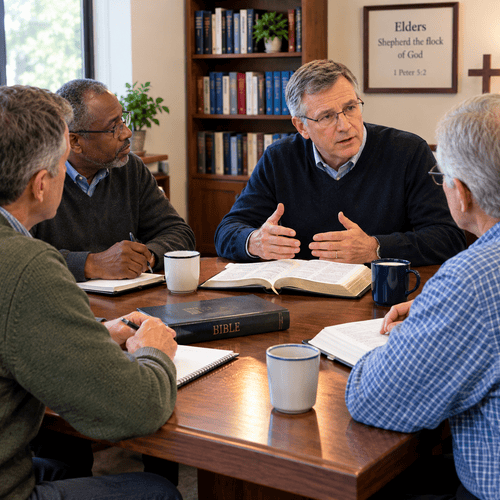
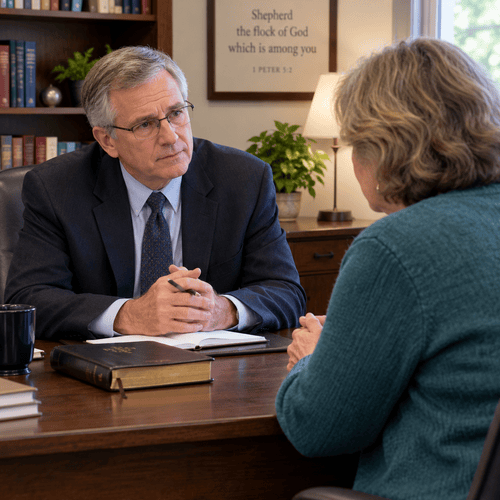
So I exhort the elders among you, as a fellow elder and a witness of the sufferings of Christ, as well as a partaker in the glory that is going to be revealed: shepherd the flock of God that is among you, exercising oversight, not under compulsion, but willingly, as God would have you; not for shameful gain, but eagerly; not domineering over those in your charge, but being examples to the flock. And when the chief Shepherd appears, you will receive the unfading crown of glory.
1 Peter 5:1–4
These four verses hold five phrases. Each one teaches us something about our question.
1. “The Elders Among You … a Fellow Elder”: One Office, Not Two Classes
Peter was an apostle who had walked with Jesus. Yet he calls himself a “fellow elder” (Greek sumpresbuteros, “an elder alongside”). He does not rank elders, least of all by who pays them.
The rest of the New Testament agrees. In Acts 20:17 and 28, Paul calls the Ephesian elders “overseers” who must “care for the church of God”. Titus 1:5–7 does the same. Wayne Grudem, a well-known modern theologian, points out that these words are simply different names for one office.
Now look at God’s qualifications in 1 Timothy 3:1–7 and Titus 1:5–9. They cover character, sound belief, teaching and family life. They say nothing about income.
Table 1: What the Bible requires of a pastor—and what it does not
| REQUIRED BY GOD (1 TIMOTHY 3; TITUS 1) | NOT ON GOD’S LIST |
|---|---|
| Above reproach (no just charge against him) | A salary from the church |
| Faithful to his wife | Working only for the church |
| Able to teach | Full-time hours |
| Holds firmly to sound doctrine | A theology degree |
| Manages his household well | A title such as “Reverend” |
| Not a lover of money | Any particular level of income |
This is our first and most important pillar. A man who meets God’s qualifications is fully a pastor, whether he is paid or not. A paid man who fails them is not a pastor at all. “Bi-vocational” describes how a pastor is supported. It does not describe a different kind of pastor.
2. “Shepherd the Flock of God”: The Job, Not the Payslip
Notice whose flock it is: “the flock of God”. The pastor feeds, leads and protects people who belong to Someone else.
That work is the same however he is paid. A shepherd who also farms a field is still a shepherd.
3. “Not for Shameful Gain”: Peter Assumes Pay Is Normal
Here is a detail many miss. Why would Peter warn elders against greed if elders never received any money? You do not warn an unpaid volunteer about loving his salary.
Peter’s Greek word (aischrokerdōs) means “greedy for dishonest profit”. The warning only makes sense if many elders were supported. Peter is not against pay, only against pay being the reason a man serves.
In fact, Peter himself lived on church support. Paul asks, “Do we not have the right to take along a believing wife, as do the other apostles and the brothers of the Lord and Cephas?” (1 Corinthians 9:5). Cephas is Peter’s Aramaic name. The man who warns against greed was himself a supported minister.
Instead of greed, Peter wants elders to serve “eagerly” (Greek prothumōs, with a ready and willing heart). Both paid and unpaid pastors can fail here: one serves for money, the other serves grudgingly because he is not paid.
4. “Being Examples to the Flock”: Why Paul Made Tents
Peter tells elders to be examples. This is exactly one of the reasons the apostle Paul gave for working with his hands:
… with toil and labour we worked night and day, that we might not be a burden to any of you. It was not because we do not have that right, but to give you in ourselves an example to imitate.
2 Thessalonians 3:8–9
Read that again: “not because we do not have that right”. Paul’s tentmaking does not prove that support is wrong. It proves that support is a real right. You cannot give up a right you never had.
5. “The Unfading Crown of Glory”: The Real Wage
Peter ends by pointing past this life. A pastor’s true reward is not paid in rupees or dollars. It is given by “the chief Shepherd”, Jesus, when He returns.
John Piper, the modern preacher best known for what he calls Christian hedonism (the view that our deepest joy and God’s glory meet in Him), puts it this way: “God is most glorified in us when we are most satisfied in him.” His book for pastors carries the striking title Brothers, We Are Not Professionals. Ministry, he insists, is a calling, not a career.
This sets a pastor free. If Christ is his treasure, he can receive a salary without loving it, or work another job without bitterness.
The Rest of the Bible Agrees
Support Is a Command, Not a Favour
When a church pays its pastor, it is not being kind. It is being obedient. Paul argues from common sense, the Law and the temple, then appeals to Jesus Himself:
In the same way, the Lord commanded that those who proclaim the gospel should get their living by the gospel.
1 Corinthians 9:14
Paul says the same thing to Timothy: “Let the elders who rule well be considered worthy of double honour, especially those who labour in preaching and teaching. For the Scripture says, ‘You shall not muzzle an ox when it treads out the grain,’ and, ‘The labourer deserves his wages’” (1 Timothy 5:17–18). See also Galatians 6:6.
What is “double honour”? The next verse about wages shows that it includes respect plus material support. George W Knight III, in his detailed commentary on the Pastoral Epistles, reads it this way, and John Calvin read it the same way nearly five hundred years ago.
A Right Can Be Set Aside
Paul set this right aside in Corinth, so that he would “put no obstacle in the way of the gospel of Christ” (1 Corinthians 9:12). He worked in Thessalonica to set an example (2 Thessalonians 3:9). In Ephesus his own hands met his needs and the needs of his team (Acts 20:34). Every reason served the gospel; none was a rule for all pastors.
But Paul Preferred Full Devotion When He Could
When Paul first arrived in Corinth, he made tents with Aquila and Priscilla (Acts 18:3). But “when Silas and Timothy arrived from Macedonia, Paul was occupied with the word” (Acts 18:5). Most likely they brought gifts from Macedonia (2 Corinthians 11:8–9; Philippians 4:15–16). When support came, Paul put down his tools. Tentmaking was a tool, not an ideal.
Table 2: Four ways a minister may be supported—and what the Bible says about each
| SITUATION | BIBLE EXAMPLE | IS IT BIBLICAL? |
|---|---|---|
| Fully supported by the church | Peter and the other apostles (1 Corinthians 9:5); Paul after Acts 18:5 | Yes. This is the normal pattern the Lord commanded (1 Corinthians 9:14). |
| Partly supported, partly working | Paul receiving gifts from Philippi while also working (Philippians 4:16) | Yes. A wise choice when a church cannot give everything. |
| Fully self-supporting by choice | Paul in Thessalonica (2 Thessalonians 3:8–9) | Yes, when chosen for the sake of the gospel. |
| Unsupported because the church will not give | The Levites in Nehemiah 13:10 | No. This is the church’s sin, not the minister’s. |
Nehemiah 13: When the Church Is to Blame
Here is the passage that answers our opening question. Nehemiah returned to Jerusalem and found a problem:
I also found out that the portions of the Levites had not been given to them, so that the Levites and the singers, who did the work, had fled each to his field.
Nehemiah 13:10
The Levites served at God’s house and lived on the people’s offerings. When the offerings stopped, they went back to farming. They became “bi-vocational” by force.
Nehemiah did not rebuke the Levites. He “confronted the officials and said, ‘Why is the house of God forsaken?’” (Nehemiah 13:11). When God’s people can support their ministers but will not, that is forsaking God’s house.
Answering the Objections
Some Christians argue that a pastor with a second job is disobeying God. Here are their main texts.
Table 3: Common objections to bi-vocational pastors—and the biblical answer
| THE OBJECTION | TEXT USED | WHAT THE TEXT REALLY SAYS |
|---|---|---|
| “A pastor must give himself only to ministry.” | Acts 6:4 | The apostles handed food distribution to others so they could focus. This sets a priority; it does not ban all trades. Paul, also an apostle, made tents. |
| “No soldier gets entangled in civilian life.” | 2 Timothy 2:4 | “Entangled” means so caught up that you forget your mission. Paul, who wrote this, worked with his own hands (1 Corinthians 4:12). |
| “A pastor must immerse himself in these things.” | 1 Timothy 4:15 | A call to devotion that fits every pastor. A paid pastor can be lazy; a working pastor can be wholehearted. |
| “Unpaid pastors save money, so they are better.” | 1 Timothy 5:18 | Holding back pay you could give is muzzling the ox. Saving money is not a biblical reason. |
A CAREFUL NOTE: WAS PAUL A “PASTOR”?
Strictly, no. Paul was an apostle and church-planting missionary, not the settled pastor of one church. But his teaching on support in 1 Corinthians 9 covers all “who proclaim the gospel” (verse 14), and he gave his example to churches to copy (2 Thessalonians 3:9). That is why his pattern still guides us today.
Tentmaking Pastors Through History
Self-supporting ministers are not a modern invention.
- AD 50s—Paul the tentmaker: Paul works with his hands in Thessalonica, Corinth and Ephesus while planting churches.
- AD 300s—Spyridon the shepherd-bishop: Spyridon, a bishop in Cyprus, was remembered for still caring for his sheep after he became a church leader.
- 1500s—Paid pastors, working elders: In John Calvin’s Geneva, pastors were paid, while the elders who helped govern the church kept their ordinary jobs.
- 1700s–1800s—Farmer-preachers: On the American frontier, many Baptist pastors farmed during the week and preached on Sunday.
- 1790s—William Carey in Bengal: The great missionary managed an indigo factory at Mudnabati while learning Bengali and translating the Bible.
- 2025—Nearly half: In the United States, almost half of evangelical pastors now hold a second job.
Mark Dever and Alexander Strauch, two modern writers on church leadership, both argue that the New Testament pattern is a team of elders, some supported by the church and others earning their living elsewhere. Both are true elders. This team, or plurality, is the Bible’s answer to a working pastor’s heavy load.
So What Should We Do?
FOR CHURCH MEMBERS
- Stop using second-class language: never call your working pastor “only part-time”. He is your shepherd.
- Give what you can: if your church can support its pastor more and does not, read Nehemiah 13:11 again.
- Share the load: Ephesians 4:11–12 says pastors “equip the saints for the work of ministry”. Do your part in the work.
- Protect his time: do not fill his only free evening with meetings that others could lead.
FOR PASTORS WITH A SECOND JOB
- Do not feel second-class: you hold the same office as any paid pastor. Serve “eagerly” (1 Peter 5:2).
- Guard the Word and prayer: set aside fixed hours each week for study, and keep them.
- Build a team of elders: you were never meant to shepherd alone.
- Work with integrity: your workplace is a pulpit too. Tim Keller often reminded Christians that ordinary work, done well, honours God and serves our neighbours.
- Keep your home first: an elder must manage his household well (1 Timothy 3:4). Do not lose your family while serving the church.
Conclusion: One Office, Many Ways of Support
So, is the “bi-vocational pastor” a biblical category? No. Scripture knows one office—elder, overseer, pastor—and many ways of supporting the men who hold it.
- The norm: churches that are able should support their pastors. The Lord commanded it.
- The freedom: a pastor may choose to support himself when the gospel or the situation calls for it.
- The sin: a church that holds back support simply to save money, or a pastor who serves for gain.
Go back to the man driving a taxi on Monday. If he meets God’s qualifications and shepherds God’s flock, he is not half a pastor. One day the chief Shepherd will give him the same unfading crown He gives every faithful shepherd.
Tough Questions, Honest Answers
Did Jesus have a job during His public ministry?
Before His public ministry, Jesus worked as a carpenter (Mark 6:3). But during His three years of preaching, there is no sign that He kept working at a trade. Luke tells us that a group of women “provided for them out of their means” (Luke 8:3). So the Lord Himself, in His ministry years, lived on the gifts of His followers. Receiving support is nothing to be ashamed of.
Is it wrong for a pastor to ask his church for a pay rise?
Not in itself. Scripture says “the labourer deserves his wages” (1 Timothy 5:18). A pastor may speak honestly about his family’s needs, especially if prices have risen. It is usually wiser to raise it through fellow elders or deacons than alone. But he must watch his heart, because an elder must not be “a lover of money” (1 Timothy 3:3).
Can a pastor own and run a business?
Yes. Nothing in Scripture forbids it, and Paul worked in Aquila and Priscilla’s tentmaking trade (Acts 18:2–3). But a pastor in business must be honest in every deal, because his name is tied to Christ’s name. He should not let the business swallow his time, and he should be careful about selling to his own church members, which can mix up his roles.
How many hours a week should a bi-vocational pastor give to his church?
The Bible gives no number. It depends on the size of the church, the number of other elders, his job and his family. A wise step is to agree, in writing, which tasks he will carry and which others will share. He should also keep a weekly day of rest. God made rest for pastors too (Exodus 20:8–11).
What is the difference between bi-vocational and co-vocational ministry?
“Co-vocational” is a newer term. Some prefer it because “bi-vocational” can sound as if the second job is a burden to escape. “Co-vocational” presents both jobs as callings that work together. Some now even say “tri-vocational” for pastors with three jobs. The Bible uses none of these words. What matters is whether the man faithfully shepherds the flock.
Do bi-vocational pastors need seminary training?
Scripture requires that an elder be “able to teach” (1 Timothy 3:2) and able to “give instruction in sound doctrine” (Titus 1:9). It does not require a degree. But it does require real knowledge of the Bible. For working pastors, part-time courses, distance learning and mentoring by older pastors (2 Timothy 2:2) are excellent paths. The goal is faithfulness, not certificates.
How do I know if I am called to bi-vocational ministry?
Start with a bigger question: are you called to be a pastor at all? Look for a godly desire (1 Timothy 3:1), the qualities God requires, and your church’s recognition of your gifts. After that, support is a practical question. What can this church give? Does your job open doors for the gospel? Talk it through with your elders. The arrangement may change over the years.
Related Reads
- Pastor-Led vs Elder-Led Churches: What’s the Difference?
- What Do We Do When We Sense Burnout in Ministry?
- Congregational, Presbyterian, Episcopal: Forms of Church Government Compared
- Reformed Church Eldership: The Role and its Qualifications
- More than Tithing: How Grace Motivates Sacrificial Giving
- Why Work Hard If God Is Sovereign and Already Knows the Outcome?
- Godliness with Contentment: Why Does Paul Call it ‘Great Gain’?
- Is God Calling Me to Missions? How to Know for Certain
- Faithful to the Pattern: Why Paul Reserves Ordination for Men
- The Priesthood of All Believers: What the Bible Really Teaches
- How Can I Serve the Church Today? The Available Options
- The Desire for Wealth: What Does the Bible Truly Teach?