Right now, even as you read these words, something strange is happening. Light is hitting your eyes. Electrical signals are racing through your brain. That part is easy to explain. But then something else happens—you understand. You see the words. You feel curious, or doubtful. Or perhaps a little bored.
Where did that come from?
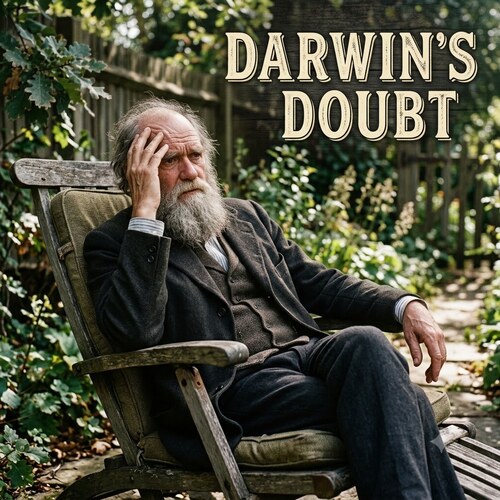
Here’s a surprise. The most famous scientist who taught that humanity came from animals was troubled by this very question. Near the end of his life, Charles Darwin admitted to a “horrid doubt”. If our minds grew out of the minds of animals, he asked, can we trust anything we think?
More than 140 years later, the doubt persists.
Can evolution explain the mind? Let’s look at what scientists and thinkers have said—many of them not Christians. We shall see why the oldest answer is still the best: our minds came from a greater Mind.
KEY WORDS IN THIS POST
- Mind: the part of you that thinks, feels, knows and chooses.
- Consciousness: being aware. It is your inner experience—seeing red, feeling pain, tasting coffee.
- Evolution: in this post, the idea that all life came from simpler life through chance changes and natural selection, with no plan and no guide.
- Natural selection: creatures that survive and have more young pass on their features. Others die out.
- Naturalism: the belief that nature is all there is. No God, no soul—only matter and energy.
What Evolution Can Do—and Cannot
Let’s be fair. Natural selection is good at one thing: keeping what helps a creature survive. A faster rabbit escapes the fox.
But selection only “sees” what a creature does—running, eating, hiding, mating. It cannot see what a creature experiences on the inside. The fox doesn’t care whether the rabbit feels afraid. It only cares whether the rabbit runs.
Everything else depends on this. Our minds are about what we experience, what we know and who we are—the very things selection cannot reach.
1. The Hard Problem: Why Does Anything Feel Like Anything?
In 1995 philosopher David Chalmers gave this puzzle a famous name: the hard problem of consciousness.
He said brain science faces 2 kinds of problems. The “easy” problems are about how the brain works—how it sees shapes, stores memories or moves your arm.
The hard problem is different. Why does all this brain activity feel like something from the inside? A camera records light, but it doesn’t see. A thermometer measures heat, but it doesn’t feel warm. So why are we different?
300 years earlier, German thinker Gottfried Wilhelm Leibniz made the same point with a picture. Imagine a thinking machine made as big as a mill, so we could walk inside it. We’d find only parts pushing other parts. We’d never find a thought.
Now here’s the problem for evolution. Imagine a creature that acts exactly like you. It runs from danger, eats when hungry and says “Ouch!” when hurt—but it feels nothing inside. Thinkers call this a “zombie”. It would survive just as well as we do. So natural selection had no reason to give anyone an inner life. If unguided evolution is the whole story, there’s no reason consciousness should exist at all.
Yet it does. We’re using it right now.
2. Even Unbelievers Admit the Problem
It isn’t just Christians who say this.
In 2012, well-known philosopher Thomas Nagel published a book called Mind and Cosmos. Nagel is an atheist. Yet the subtitle of his book says the materialist, neo-Darwinian view of nature is “almost certainly false”.
His main reason? Consciousness. Nagel argued a world of mere matter, shaped only by chance and selection, cannot explain minds that feel, reason and know right from wrong. Many scholars were angry. Few could answer him.
BE FAIR TO THE WITNESSES
Thomas Nagel and David Chalmers aren’t creationists. They don’t share our faith. That’s exactly why their words matter. When a witness from the other side admits a problem, you know the problem is real.
3. Darwin’s Doubt: Can We Trust a Mind Made by Chance?
This is the strongest argument of all, so let’s go slowly.
In July 1881, less than a year before he died, Darwin wrote a letter to his friend William Graham. He said:
“With me the horrid doubt always arises whether the convictions of man’s mind, which has been developed from the mind of the lower animals, are of any value or at all trustworthy.”
In simple words: if my mind came from an animal’s mind, why should I believe what it tells me?
Natural selection doesn’t care about truth. It cares about survival. A belief only needs to keep us alive long enough to have children. It doesn’t need to be true.
Philosopher Patricia Churchland, who does not believe in the soul, said it plainly. The brain exists to help a creature feed, flee, fight and reproduce. “Truth, whatever that is,” she wrote, “definitely takes the hindmost”—meaning truth comes last.
Scientist Donald Hoffman goes further. Using computer models, he argues creatures tuned for survival will usually beat creatures tuned for truth. In his view, our senses work like the icons on a phone screen—they’re useful, but not a true picture of reality.
THE BRANCH YOU’RE SITTING ON
If unguided evolution made our minds, our minds were built for survival, not truth. But the theory of evolution is itself a belief, produced by that same mind. So if the theory is true, we have no good reason to trust it. Philosopher Alvin Plantinga calls this the Evolutionary Argument Against Naturalism. Naturalism cuts off the very branch it’s sitting on.
Timeline: The Doubt That Will Not Go Away
- 1881—Charles Darwin: admits his “horrid doubt” in a private letter.
- 1927—JBS Haldane: the biologist writes that if his thoughts are only atoms moving, he has no reason to believe they are true—not even the thought that his brain is made of atoms.
- 1947—CS Lewis: in Miracles, argues that thinking produced by blind causes cannot be trusted.
- 1993—Alvin Plantinga: turns the doubt into a careful argument in Warrant and Proper Function.
- 2012—Thomas Nagel: an atheist agrees that materialism cannot explain reason.
Theologian Cornelius Van Til made the same point from the other side. We can trust reason, he taught, only because a rational God made both our minds and the world they study. Take God away, and reason has nothing left to stand on.
4. Thoughts Are About Things
Here’s something so normal we rarely notice it. Your thoughts are about things. You think about your mother. You worry about tomorrow. Thinkers call this “aboutness”. The formal word is intentionality, made famous by philosopher Franz Brentano.
But atoms aren’t about anything. A rock isn’t about a mountain. A cloud isn’t about rain. The chemicals in your brain aren’t by themselves, about your mother. Matter can take many shapes, but no shape makes it mean something.
Computers show the difference. In 1980, philosopher John Searle described his “Chinese Room”: a man follows a rulebook to answer Chinese messages without understanding a word of Chinese. From outside, he seems to understand. Inside, he understands nothing. Moving symbols isn’t the same as understanding them.
Our minds don’t just move symbols. They understand.
5. Who Does the Thinking?
If we’re only our brains, strange things follow. Francis Crick, who helped discover the shape of DNA, said our joys, sorrows and sense of self are “no more than the behaviour of a vast assembly of nerve cells”.
Some thinkers follow this all the way. In 2023, biologist Robert Sapolsky wrote a book called Determined. He argues free will doesn’t exist—our choices are simply the result of our genes, our brains and our past.
But if that’s true, no one is truly responsible for anything. No one deserves praise for kindness or blame for cruelty. Love becomes chemistry. Justice becomes a mistake. Hardly anyone can live this way—including the people who teach it.
Brain surgery tells a different story. Surgeon Wilder Penfield operated on more than a thousand patients while they were awake. When he touched certain spots with an electrode, a patient’s arm would move. But the patient would say, in effect, “I didn’t do that. You did.” Penfield could make the body move. He could never make a patient decide, believe or reason. He concluded in The Mystery of the Mind (1975) that the brain alone cannot explain the mind.
6. The Great Gap Between Humans and Animals
Dogs feel joy. Crows solve puzzles. But humans do things no animal comes close to. We write poems, do mathematics, compose music, pray, ask “Why am I here?” and feel guilt over secret sins. None of this helps us survive in the wild.
Alfred Russel Wallace saw this clearly. Wallace discovered natural selection at the same time as Darwin. But in 1869 he argued selection couldn’t explain the higher powers of the human mind. Darwin was upset. He wrote to Wallace: “I hope you have not murdered too completely your own and my child.” The “child” was their theory.
Language makes the gap even clearer. In 2014 a team of leading experts, including Noam Chomsky and Richard Lewontin, reviewed decades of research on how language began. Their honest conclusion: it’s still largely a mystery. We didn’t just get a slightly better grunt. We got grammar, meaning and the power to make endless new sentences.
7. What the Bible Says: Mind Comes From Mind
The Bible gives a clear answer. When God made the first man, He did more than shape a body:
“then the LORD God formed the man of dust from the ground and breathed into his nostrils the breath of life, and the man became a living creature.”
Genesis 2:7
The body came from the ground. Life and spirit came from God. Elihu says the same: “But it is the spirit in man, the breath of the Almighty, that makes him understand” (Job 32:8).
The psalmist then asks a question no materialist can answer: “He who planted the ear, does he not hear? He who formed the eye, does he not see?… He who teaches man knowledge—” (Psalm 94:9–10). If God made minds, he must be a Mind Himself.
Notice, too, that Adam did not slowly grow into thinking. On the day he was made, he named the animals (Genesis 2:19–20). He heard God’s command and understood it. He was fully human and fully rational from the very start.
Why can we trust our reason? Because we’re made in God’s image (Genesis 1:27). In a small way, our thinking copies his. Dutch theologian Herman Bavinck taught that a human being doesn’t merely have the image of God—the whole person is the image of God.
But the Bible is honest about our minds too. Since the fall, our thinking is bent. People “became futile in their thinking, and their foolish hearts were darkened” (Romans 1:21). John Calvin said human reason was “partly weakened and partly corrupted”, so that “a shapeless ruin is all that remains”. Even so, the ruin still points to its Maker. Calvin called the human conscience “an undoubted sign of an immortal spirit”.
Answering the Common Objections
Here are 5 replies you’ll often hear, and how we answer them.
| WHAT CRITICS SAY | OUR ANSWER |
|---|---|
| “This is just God of the gaps”—using God to fill holes science hasn’t filled yet. | No. We’re pointing to what matter is, not to a missing fact. Matter has size, shape and charge. It doesn’t have feelings, meaning or truth. More facts about matter will not change that. |
| “Consciousness simply emerges when the brain gets complex enough.” | “Emerges” is a label, not an explanation. Either the mind is just brain parts working (so the hard problem remains), or something truly new appears that physics cannot explain—which admits our point. |
| “Brain injuries change people. So the mind is the brain.” | In this life the mind depends on the brain—Christians agree. But depending on something is not the same as being it. A pianist cannot play well on a broken piano, yet the pianist is not the piano. |
| “True beliefs help animals survive, so evolution would favour truth.” | Only sometimes. A false belief that makes you run from danger works as well as a true one. Selection rewards what you do, not whether your reasons are true. |
| “Animals have minds too, so minds must have evolved.” | The Bible agrees that animals are living creatures (Genesis 1:24). Our point is about the human mind—reason, worship and conscience—which no animal shares. |
2 Stories About our Minds
In 1874 theologian Charles Hodge saw the heart of the debate: “The denial of design in nature is virtually the denial of God.” The table below shows how the two stories compare.
| WHAT NEEDS EXPLAINING | EVOLUTION ALONE | THE BIBLE |
|---|---|---|
| Inner experience (seeing, feeling) | No reason for it. Selection cannot see it. | God is a living Spirit who made us in his image. |
| Reason we can trust | Built for survival, not truth. | Made by a rational God to know his world. |
| Meaning (“aboutness”) | Atoms are not about anything. | God speaks, and made us to understand. |
| Free choice and responsibility | Choices are only brain chemistry. | We are real persons who will give account to God. |
| Language, worship and conscience | Still largely a mystery. | Given to Adam from the very start. |
WHY THIS MATTERS
- Our worth: we’re not an accident of chemistry. We bear the image of God.
- Our choices: our choices are real, so they matter—to others and to God.
- Our hope: Jesus said, “do not fear those who kill the body but cannot kill the soul” (Matthew 10:28). We’re more than our brains, and death isn’t the end of us.
Conclusion: A Mind That Belongs to Its Maker
So, can evolution explain the mind? It cannot explain why anything feels like anything, why we should trust our reason, why our thoughts mean something, who does the choosing, or why we stand so far above animals. Darwin felt the doubt. Atheist thinkers admit it.
The Bible’s answer is simpler and stronger. We can think because we were made by the God who thinks. Our minds are a gift—and the gift belongs to the Giver.
Abraham Kuyper, the Dutch theologian who became prime minister, once said: “There is not a square inch in the whole domain of our human existence over which Christ, who is Sovereign over all, does not cry: Mine!” That includes your mind. The best use of it is to know the One who made it, and to let him renew it through his Son (Romans 12:2).
Tough Questions, Honest Answers
Do animals have souls or consciousness?
Animals are called “living creatures” in Genesis 1:24, the same Hebrew phrase (nephesh chayyah) used for Adam in Genesis 2:7. So animals are truly alive, and they can sense, feel and remember. But only humans are made in God’s image, and only Adam received the breath of life directly from God. Animals do not pray, repent or reason about right and wrong. Scripture never says animals will face judgement or live forever as persons. Christians should treat animals kindly (Proverbs 12:10), while remembering that we’re different in kind, not just in degree.
Can artificial intelligence ever become conscious?
Today’s AI can write, talk and solve problems very well. It does this by predicting patterns in huge amounts of human writing. Doing what a mind does isn’t the same as having a mind—AI can copy human words because humans wrote them first. The Bible teaches that a living soul came when God breathed into man (Genesis 2:7), and no engineer can do that. So Christians have good reason to doubt that machines will ever become persons. We should still use AI wisely and protect human dignity as it spreads.
What’s the difference between the soul, the spirit and the mind?
Most Bible teachers believe a human being has two main parts: a body and a soul. In Scripture, “soul” and “spirit” usually describe the same inner self from different angles (see Luke 1:46–47). The mind is one power of the soul—the part that thinks, knows and judges. The will and the affections (our loves and desires) are other powers of that same soul. Some Christians teach three parts (body, soul and spirit) from 1 Thessalonians 5:23, but many see that verse as describing the whole person. Either way, the Bible is clear that you are more than your body.
When does a human being receive a soul?
The Bible treats unborn children as persons. David says to God, “you knitted me together in my mother’s womb” (Psalm 139:13). John the Baptist leapt for joy before he was born (Luke 1:41–44). Christians have long debated how each soul comes—whether God creates it directly or it is passed on from the parents. But Bible-believing Christians widely agree that a person exists from conception. This is one reason Christians protect unborn life: a whole human being, body and soul, is there from the start.
Do near-death experiences prove the soul exists?
Many people who nearly died report seeing light, meeting loved ones or watching doctors from above. Some of these reports are hard to explain by brain activity alone. But Christians should be careful, because experiences can mislead and some reports contradict the Bible. Our confidence about the soul rests on God’s Word, not on stories, however striking (Luke 16:31). At most, near-death experiences fit with what the Bible already teaches: you are more than your brain.
Could God have used evolution to create the human mind?
Some Christians believe God guided evolution and then gave humans a soul. But Genesis shows Adam formed from dust and given life directly by God, not born from animal parents (Genesis 2:7). Eve was made from Adam’s side (Genesis 2:22). Jesus and Paul both treat Adam as a real first man (Matthew 19:4; Romans 5:12). And if our minds were shaped mainly by a long struggle to survive, the trust problem in this post comes straight back. The plain reading of Scripture—a mind given whole by God at the start—fits both the Bible and the evidence best.
Does the Bible say we think with our heart or our brain?
In the Bible, the “heart” usually means the inner person—the centre of thinking, feeling and choosing. It is not a lesson about body parts. Jesus said, “out of the heart of man, come evil thoughts” (Mark 7:21). The Bible is not wrong about the brain; it is simply speaking about the whole person. Today we know the brain is the organ the mind uses in this life. But the Bible’s point still stands: what you love shapes how you think (Proverbs 4:23).
Related Reads
- Does Math Disprove Materialism? The Case from Numbers and Logic
- Our Consciousness and Rationality: Is God the Best Explanation?
- Human Uniqueness: Evidence Evolution Can’t Explain
- Nature’s Ultimate Computer: The Human Brain Defies Evolution
- Does Neuroscience Indeed Prove Free Will Is An Illusion?
- Two Parts Or Three: Are We Body + Soul Or Body + Soul + Spirit?
- Where Do Our Souls Come From? What the Bible Really Teaches
- How Sin Affects Our Mind: The Noetic Effects of the Fall