
Some people tell us believing in God isn’t just wrong—it’s a sign something’s wrong with our minds. We hear it online, in classrooms, or even from family members. Faith, they tell us, is a kind of mental illness, or at best a shared delusion.
The idea became popular through Richard Dawkins and his 2006 book The God Delusion. In it he approvingly quoted novelist Robert Pirsig, who said, in effect, that when one person believes something unreal we call it insanity, but when many people believe it we call it religion. The line is clever. But is it true?
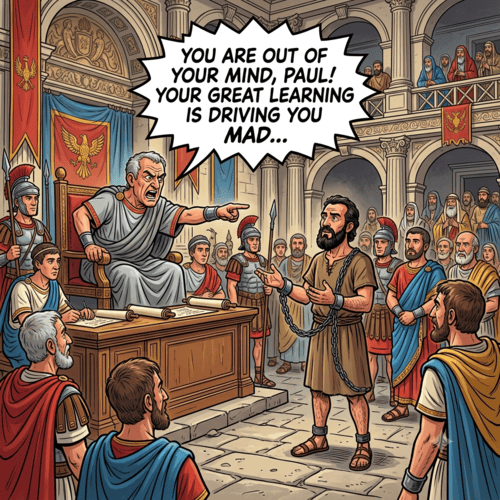
The accusation isn’t new. Nearly 2,000 years ago, a Roman governor interrupted apostle Paul in the middle of his defence:
“Paul, you are out of your mind; your great learning is driving you out of your mind.” But Paul said, “I am not out of my mind, most excellent Festus, but I am speaking true and rational words.”
Acts 26:24–25
This post asks a clinical question: does Christian faith fit what doctors actually mean by “mental illness” or “delusion”? Let’s look at the definitions, the hidden assumption behind the charge, its troubling history, the research evidence and the Bible’s own surprising answer.
What Do “Mental Illness” and “Delusion” Actually Mean?
Words matter here. In everyday speech, “delusion” can simply mean a mistaken idea. But in medicine it has a precise meaning. The Diagnostic and Statistical Manual of Mental Disorders (DSM-5), the standard handbook psychiatrists use, describes a delusion as a false belief, based on a wrong reading of outside reality, that a person holds firmly despite clear proof against it.
Notice what the same definition adds. The belief must not be one that’s normally accepted by others in the person’s culture or community—and the manual gives an article of religious faith as its own example of a belief that isn’t a delusion.
Andrew Sims, a former President of the Royal College of Psychiatrists in Britain, examined this question in his 2009 book Is Faith Delusion? He concluded sick people sometimes have delusions with religious content, but faith itself isn’t a delusion. He also noted that, in general, outcome studies link religious belief and practice with good mental health.
The differences become clear when we put the two side by side:
| Aspect | CLINICAL DELUSION | BIBLICAL FAITH |
|---|---|---|
| Where it starts | Inside one person’s mind, often alongside other symptoms such as poor sleep or hallucinations | Public events in history and a written record, received by millions across centuries |
| Relation to evidence | Held against obvious evidence; evidence does not matter to the person | Claims to rest on evidence and invites testing (Acts 17:11; 1 Thessalonians 5:21) |
| Who shares it | Usually no one; it is private and personal | A worldwide family of every nation, culture and age group |
| Openness to correction | Fixed; cannot be talked through | Corrected by Scripture, church leaders and fellow believers; doubts are faced honestly |
| Effect on daily life | Often damages work, relationships and self-care | Generally linked with stable families, steady work, service to others and lower despair |
| Centre of attention | Usually the self: I am watched, special or chosen | God and others: humility, confession of sin and love of neighbour |
One of the clearest differences is how each responds to questions. Psychiatrists describe a delusion as fixed—no conversation can reach it. Researchers who study religious delusions note a healthy believer may wrestle with doubts, while a deluded patient’s “faith” is unshakeable and proves itself. The Bible actually commands believers to test what they hear, and it praises the Bereans for checking even Paul’s preaching against Scripture (Acts 17:11).
Some critics reply the “culture clause” is just a polite exemption—that psychiatry refuses to call religion a delusion only because so many people hold it. Researchers such as Robert Ross and Ryan McKay raise this point. It’s a fair question, and it leads us to the real issue.
The Hidden Assumption Behind the Charge
Look again at the definition. A delusion is a false belief. So before anyone can call faith a delusion, they must first know that God doesn’t exist and that Jesus didn’t rise from the dead.
That means the label proves nothing. It assumes the very thing it needs to prove. In logic this is called begging the question. The diagnosis is really a conclusion—atheism is true—dressed up in a white coat.
CS Lewis spotted this trick in his 1941 essay “Bulverism”. He described people who skip the hard work of showing that someone is wrong and go straight to explaining why that person became so foolish. Lewis insisted that you must first show a person is mistaken before you explain the cause of the mistake. The same logic cuts both ways: a believer could just as easily “diagnose” unbelief. Neither side wins anything by name-calling.
THE KEY POINT: Whether Christian faith is healthy or unhealthy depends on whether it’s true. If God exists and has spoken, believing Him is the most sensible thing any human mind can do. The question of sanity cannot be separated from the question of truth.
Alvin Plantinga, a respected philosopher of religion of recent times, argued this at length in Warranted Christian Belief (2000). He showed the complaint that faith comes from a faulty mind only works if Christianity is already assumed to be false. If it’s true, belief in God is exactly what a properly working mind would produce.
Christianity is also unusual in openly naming what would disprove it. Paul wrote, “if Christ has not been raised, then our preaching is in vain and your faith is in vain” (1 Corinthians 15:14). A delusion shields itself from every test. The Christian faith does the opposite: it stakes everything on a public event that people at the time were free to check. That isn’t how a sick mind works. It’s how a confident witness speaks.
Where the Label Has Been Used Before
Calling believers “mad” has a long history. It’s worth tracing, because the pattern is revealing.
Timeline: Faith on Trial as Madness
- AD 30: Jesus’ own family went to seize Him, “for they were saying, ‘He is out of his mind’” (Mark 3:21). Later some in the crowd said, “He has a demon, and is insane; why listen to him?” (John 10:20).
- AD 59: Festus tells Paul that his learning has driven him mad (Acts 26:24).
- 1907–1939: Sigmund Freud compares religious ritual to obsessional neurosis, and late in life treats belief in one God as a kind of delusion.
- 1960s–1980s: In the Soviet Union, psychiatrists use invented diagnoses such as “sluggish schizophrenia” to lock away dissidents—among them active believers, including Baptist church members.
- 1977: The World Psychiatric Association formally criticises the Soviet abuse of psychiatry.
- 2006: Richard Dawkins publishes The God Delusion, bringing the label into popular debate.
The Soviet example is a sober warning. When a label replaces an argument, it can become a weapon. A belief is not answered by calling it a sickness; the believer is simply dismissed.
What Does the Evidence Show?
If faith were a mental illness, we’d expect believers to struggle more in daily life. Illness, by definition, damages how a person functions. The research points the other way.
In 2020 a Harvard team led by Ying Chen and Tyler VanderWeele published a large study in JAMA Psychiatry. It followed tens of thousands of nurses and other health professionals for many years. Women who attended religious services at least once a week had a 68% lower risk of “deaths of despair”—suicide, drug overdose and alcohol-related death—than those who never attended. For men, the risk was 33% lower.
We should be careful here. Studies like this measure church attendance, not the truth of the gospel, and good health doesn’t prove a belief is true. But that isn’t what we need to show. The charge was that faith is an illness—and illnesses don’t normally come with greater hope, stronger families or lower rates of despair.
Most believers hold jobs, raise children, care for neighbours and think carefully about the world. Founders of modern science such as Johannes Kepler and Robert Boyle were devout Christians who saw their work as thinking God’s thoughts after Him. Millions of ordinary believers today live the same way. That’s hardly the profile of a mental disorder.
The Bible’s Surprising Answer: Who Is Really Out of Their Mind?
Here Scripture turns the charge around. The Bible agrees that a kind of madness is real—but it locates it somewhere unexpected.
Ecclesiastes says of fallen humanity that “madness is in their hearts while they live” (Ecclesiastes 9:3). Paul explains how this happens. People know God through what He has made, yet “by their unrighteousness suppress the truth” (Romans 1:18). The result: “they became futile in their thinking, and their foolish hearts were darkened. Claiming to be wise, they became fools” (Romans 1:21–22).
Theologians call this the noetic effects of sin—“noetic” simply means “to do with the mind”. Sin does not only damage our behaviour; it bends our thinking. Unbelievers are “darkened in their understanding” (Ephesians 4:18). John Calvin taught that every person has a built-in sense of the divine (Institutes 1.3), which sin pushes down but never fully removes.
This is why the Bible so often describes conversion as a return to sanity:
- The prodigal son: “when he came to himself,” he turned for home (Luke 15:17).
- The man among the tombs: after Jesus freed him, people found him “clothed and in his right mind” (Mark 5:15).
- King Nebuchadnezzar: “I … lifted my eyes to heaven, and my reason returned to me” (Daniel 4:34).
- Every true convert: God grants repentance so that people “may come to their senses” (2 Timothy 2:25–26).
From the Bible’s point of view, turning to God is not losing your mind. It is getting it back.
Why Christ’s followers will sound mad: Paul admitted “the word of the cross is folly to those who are perishing” (1 Corinthians 1:18). Jesus warned the world would treat His followers as it had treated Him (John 15:20). The charge of madness shouldn’t surprise us; it was predicted.
How Genuine Believers Answer the Charge
When someone tells us our faith is a mental illness, Paul’s reply to Festus is a good model. He didn’t get angry, and he didn’t retreat into feelings. He pointed to public facts: “this has not been done in a corner” (Acts 26:26). Here’s how believers can follow his example:
- Ask what they mean. Is it a medical claim or an insult? If it’s medical, the definitions above apply. If it’s an insult, gently say so.
- Name the assumption. Explain that “delusion” means a false belief, so the label already assumes atheism is true. Ask for the argument, not the diagnosis.
- Separate form from content. Andrew Sims observed that in illness it’s the form of thinking that’s disordered, while the content comes from the person’s culture. A sick person may have political or religious delusions, but that doesn’t make politics or religion a sickness.
- Point to public evidence. Christianity rests on events in history—above all the death and resurrection of Jesus, seen by “more than 500 brothers at one time” (1 Corinthians 15:6). [Internal link: resurrection evidence post]
- Answer with gentleness. Peter tells us to give a reason for our hope “with gentleness and respect” (1 Peter 3:15). A calm, kind answer is itself evidence against the charge.
- Live with a sound mind. God has given us “a spirit not of fear but of power and love and self-control” (2 Timothy 1:7). A steady, loving life speaks loudly.
When Believers Do Struggle With Mental Illness
We must be honest. Christians aren’t immune to mental illness. Believers suffer from depression, anxiety, OCD, bipolar disorder and schizophrenia, like anyone else. Scripture doesn’t hide this. Elijah, worn out and afraid, asked God to end his life (1 Kings 19:4). The psalmist cried, “Why are you cast down, O my soul, and why are you in turmoil within me?” (Psalm 42:5). Preacher Charles Spurgeon battled deep depression for much of his life.
Sometimes illness also takes on religious content. A person with psychosis may believe he’s Christ or a new prophet. That’s real illness, and needs real treatment. But it no more proves faith is an illness than a patient’s delusions about the government prove that politics is a disease.
Church leaders and families should watch for signs that religious ideas may be part of an illness:
- Grand claims: believing oneself to be Christ, a new prophet or the source of revelation that overrides Scripture.
- Harmful commands: “voices” telling the person to hurt themselves or others—this needs urgent medical help.
- Sudden changes: very little sleep, racing thoughts or a fear of being watched.
- Cutting off correction: beliefs that pull someone away from church, family and the counsel of mature believers.
In such cases, the loving response is to involve both a doctor and a pastor. Medicine is a good gift of God’s common grace—Luke himself was “the beloved physician” (Colossians 4:14). Faith and treatment are not rivals. [Internal link: What Do We Do When God Seems Distant and Silent?]
Conclusion: Not Mad, but Awake
Festus thought Paul had lost his mind. Paul answered with facts, and then with an invitation: “I would to God that not only you but also all who hear me this day might become such as I am—except for these chains” (Acts 26:29).
That’s still the Christian answer. Faith isn’t a symptom to be treated. It’s trust in a God who has acted in history and spoken in His Word. The real question isn’t whether believers are sane, but whether the gospel is true. And if it is, the truly sane response is to come to our senses, lift our eyes to heaven and trust Christ.
Tough Questions, Honest Answers
Was Jesus mentally ill?
Some sceptics have suggested so, and even Jesus’ family once feared He was “out of his mind” (Mark 3:21). In 1913 Albert Schweitzer wrote his medical dissertation, The Psychiatric Study of Jesus, examining such claims and concluding that they did not stand up. Jesus’ teaching shows deep wisdom, calm under pressure and remarkable care for others—not the confusion of psychosis. CS Lewis pointed out that a man who claimed to be God must be a liar, a lunatic or the Lord. His life, and His resurrection, rule out the first two.
Is hearing God’s voice a sign of schizophrenia?
Not necessarily, but care is needed. God speaks clearly and finally in Scripture and in His Son (Hebrews 1:1–2). Most believers do not mean an audible voice; they mean that God’s Word has spoken to their hearts. Any inner impression must be tested by the Bible (1 John 4:1). Hallucinations in illness are usually distressing and persistent, and they come with other symptoms such as disturbed sleep, fear or confused thinking. Anyone hearing commanding voices, especially urging harm, should seek medical help quickly.
Can religion harm your mental health?
Unhealthy religion can. Controlling leaders, legalism and spiritual abuse do real damage, and Jesus sternly rebuked leaders who laid “heavy burdens” on people (Matthew 23:4). But that is a distortion of faith, not its nature. Christ offers rest: “Come to me, all who labour and are heavy laden, and I will give you rest” (Matthew 11:28). If a church has hurt you, the answer is not to abandon Christ, but to find a healthy, gospel-centred church—and, where needed, wise counsel.
Is religious OCD (scrupulosity) a sign of weak faith?
No. Scrupulosity is a form of obsessive-compulsive disorder in which a person is tormented by fears of having sinned, blasphemed or lost their salvation. It’s a health condition, not proof of weak or false faith. Many sincere believers have suffered this way. Treatment, often a therapy called exposure and response prevention, have been known to help. Alongside it, believers need to rest in Christ’s finished work rather than in their own feelings of certainty (Romans 8:1).
Should Christians take medication or see a psychiatrist?
Yes, when it is needed. God made us body and soul (Genesis 2:7), and the brain can become ill like any other organ. Paul told Timothy to take a little wine for his stomach (1 Timothy 5:23), which shows that physical remedies are not unspiritual. Medicine is part of God’s common grace to all people. Taking medication is no more a lack of faith than wearing glasses. Wise believers pray, stay close to their church and follow good medical advice.
Can demons cause mental illness?
Scripture shows that demons are real and can afflict people (Mark 5:1–20). But the Bible also distinguishes demonic oppression from ordinary illness. Matthew 4:24 lists people oppressed by demons separately from those with seizures and paralysis. So we should not assume that every mental illness is demonic. Doing so can cause great harm and delay real treatment. Believers are secure in Christ, for He who is in them is greater than he who is in the world (1 John 4:4). Prayer and medical care belong together.
Is mental illness a sin or a lack of faith?
No. When Jesus’ disciples asked whether a man’s blindness was caused by sin, Jesus said it was not (John 9:2–3). Illness of the mind, like illness of the body, belongs to a fallen world in which “the whole creation has been groaning” (Romans 8:22). Some struggles are linked to sinful choices, but many are not. Sufferers need compassion, not blame. “The LORD is near to the brokenhearted” (Psalm 34:18), and many of His most faithful servants have walked through dark valleys.
Related Reads
- Religious OCD (Scrupulosity): What It Is and How to Find Freedom
- Does God Exist? 10 Compelling Evidences
- Christian Answers to Atheist Objections: A Defence of Faith
- Why Does God Call Atheists Fools?
- Is Fear the Foundation of Religion?
- Is Taking Antidepressants a Failure of Faith?
- Can Evolution Explain the Mind? Why Consciousness Points to God
- Does Math Disprove Materialism? The Case from Numbers and Logic
- Mass Hallucination: Does This Explain Resurrection Appearances?
- Did Jesus Really Exist? The Historical Evidence Sceptics Can’t Ignore
- The Miracles of Jesus: Why Sceptics Can’t Dismiss the Gospel Accounts