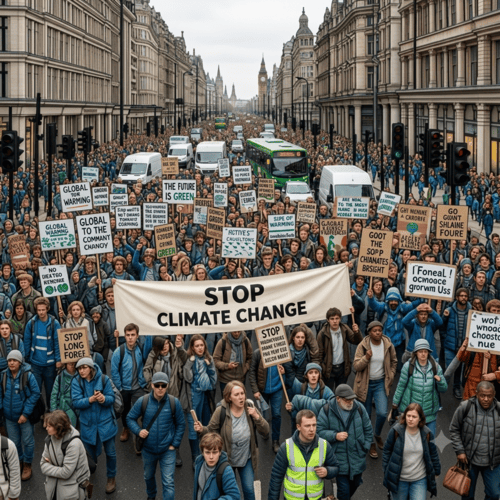
Wildfires, dying reefs, plastic in the ocean, a climate argument at every family dinner. Somewhere in the noise sits an old accusation aimed squarely at the church: that Christianity, with its command to “have dominion,” is the theological root of the ecological mess we’re in.
Is the accusation fair? And more importantly—what does the Bible actually say Christians owe the earth?
Christian Environmental Ethics: What Does the Bible Actually Teach?
Scripture, from the very first chapter, gives us a job description: “Be fruitful and multiply, fill the earth and subdue it, and have dominion over… every living thing” (Genesis 1:28). Critics stop reading right there. But the verse doesn’t end the story—it only opens it.
The Hebrew words behind “subdue” (kabash) and “have dominion” (radah) are royal words. They describe how a king is meant to govern a people, not how a conqueror is meant to plunder a resource. And Scripture is relentlessly clear about what good kingship looks like: it serves, protects, and cultivates what it rules. Ezekiel 34 spends an entire chapter condemning shepherd-kings who “rule with force and harshness” instead of tending the flock. Dominion was never a blank cheque.
“Subdue the Earth”: A Command to Exploit, or a Command to Cultivate?
Put the mandate next to its very next verse and the picture gets sharper. Genesis 2:15 places the first man in the garden “to work it and keep it”—abad and shamar in Hebrew, the same two words used elsewhere for a priest’s service in the temple and a guard’s watch over something precious. Adam wasn’t handed a quarry. He was handed a sanctuary and told to tend it like one.
| DOMINION (biblical mandate) | DOMINATION (the distortion) |
|---|---|
| Rules as a steward accountable to the true Owner (Psalm 24:1) | Rules as if the earth belongs to itself |
| Cultivates and guards (Genesis 2:15) | Extracts and discards |
| Rests the land on a sabbath cycle (Leviticus 25:1-7) | Works the land until it’s exhausted |
| Spares fruit trees even in wartime (Deuteronomy 20:19-20) | Treats nature as collateral damage |
| Cares for the needs of animals (Proverbs 12:10) | Regards animals as mere inventory |
The short answer: the Bible doesn’t grant us ownership of the earth—only management of it. “The earth is the Lord’s, and the fullness thereof” (Psalm 24:1). Every mandate to rule is a mandate to rule on God’s behalf, which is a very different thing from ruling for oneself.
Was Lynn White Right? Answering the Case Against Christianity
In 1967, historian Lynn White Jr. published a short, influential essay arguing that Christianity—specifically its doctrine of human dominion—bears “a huge burden of guilt” for the West’s ecological crisis. The essay is still assigned in university courses today, and the accusation still surfaces in comment sections whenever a Christian says anything about the environment.
It deserves a real answer. Three things are worth saying:
- The text doesn’t support the reading. As shown above, “dominion” sits inside a framework of stewardship, sabbath-rest for the land, and accountability to God—not a license for extraction. A doctrine’s abuse by people who ignored its own terms isn’t evidence against the doctrine.
- The Old Testament legal code is, by ancient standards, startlingly protective of nature. Deuteronomy 20:19-20 forbids destroying fruit trees even to build siege works against an enemy city—a wartime conservation law with no parallel in surrounding cultures. Leviticus 25 mandates a sabbath year for farmland every seventh year, so the soil itself gets to rest. These aren’t incidental footnotes; they’re law.
- Industrial-scale environmental damage tracks industrialisation, not theology. The countries and eras responsible for the worst ecological damage of the last 150 years were driven by market economics and technological capacity, not by anyone consulting Genesis 1:28 first. Correlation with a nominally Christian culture isn’t causation from a Christian doctrine.
There’s also a text White’s critics rarely quote, and it cuts the opposite direction entirely: “The time came for… destroying those who destroy the earth” (Revelation 11:18). Far from indifference, the Bible ends with God holding earth-destroyers to account.
The Earth Isn’t Ours to Wreck—It’s God’s to Reclaim
Genesis 9 records something easy to miss: after the flood, God makes His covenant not only with Noah’s family but explicitly “with every living creature” (Genesis 9:8-17). Creation itself is a covenant partner. Colossians 1:15-20 raises the stakes further—all things were created through Christ and for Christ, and “in him all things hold together.” The material world isn’t a disposable stage prop for the human drama; it belongs to Christ and finds its coherence in Him.
If Creation Will Be Renewed Anyway, Why Bother Caring for It Now?
This is the objection that quietly undermines a lot of Christian environmental apathy: the world’s going to burn eventually, so what’s the point? It rests on a misreading of the end of the story.
Romans 8:19-22 doesn’t describe creation waiting to be scrapped—it describes creation “waiting with eager longing” to be “set free from its bondage to corruption,” groaning like a woman in labour, not a building awaiting demolition. Revelation speaks of “a new heaven and a new earth” (Revelation 21:1)—renewal language, echoing the resurrection pattern of the whole Bible: God doesn’t discard what He’s made, He redeems it. Even 2 Peter 3’s fire imagery fits the pattern of purification more than annihilation—the same God who refines silver in a furnace isn’t in the business of throwing away His handiwork.
Think of it like a house you know will one day be renovated rather than demolished. You don’t trash a house you expect to see restored—you maintain it, because its future matters to its owner, and you’re currently entrusted with it.
What Faithful Stewardship Looks Like Today
- Practice household restraint. Reduce needless waste and consumption—not from earth-worship, but from the same contentment Scripture commends everywhere else (Hebrews 13:5).
- Support local, sustainable food and land practices where practical—a modern echo of the sabbath-year principle of letting land recover.
- Treat animals under your care well, in line with Proverbs 12:10—pets, livestock, and wildlife alike.
- Resist the consumerist reflex that treats creation as infinitely replaceable rather than finite and entrusted.
- Teach the doctrine accurately—dominion as stewardship, not exploitation—so the next generation doesn’t inherit a caricature of Genesis 1:28 along with the actual mandate.
- Hold environmental policy debates with humility. Christians can disagree in good faith about specific climate policy while agreeing completely on the underlying biblical mandate to steward, not exploit.
Christian Environmental Ethics—Tough Questions, Honest Answers
Doesn’t “have dominion” just mean humans can do whatever they want with the earth?
No—the word is a royal term describing rule on behalf of a sovereign, not rule instead of one. Psalm 24:1 settles ownership before Genesis 1:28 ever gets to management. A steward who trashes what he’s been entrusted with isn’t exercising dominion; he’s violating it.
Isn’t environmentalism just a form of nature-worship Christians should avoid?
Some versions of secular environmentalism do slide into treating nature itself as sacred or self-existent, and Christians rightly reject that—Romans 1:25 warns against worshipping “the creature rather than the Creator.” But rejecting nature-worship isn’t the same as rejecting nature-care. You can hold that creation isn’t divine while still holding that it belongs to Someone who is, and that you’re accountable for how you treat His property.
If the earth will be renewed or replaced eventually, why does present-day care matter at all?
Because Scripture consistently describes renewal, not replacement from nothing (Romans 8:21, Revelation 21:1-5), and because faithfulness in small, present things is itself the biblical pattern (Luke 16:10—“whoever is faithful in a very little is faithful also in much”). Present stewardship isn’t pointless busywork before an unrelated ending; it’s participation in the same story that ends in restoration.
Does the Bible tell Christians which specific environmental policies to support?
No, and that’s worth saying plainly. Scripture gives principles—stewardship, restraint, sabbath-rest for the land, care for animals, accountability to God for how creation is treated—not a position on any particular modern policy debate. Faithful Christians can and do disagree on specific climate or conservation policy while sharing full agreement on the underlying biblical mandate.
Is caring about the environment a distraction from preaching the gospel?
It doesn’t have to be either/or. Stewardship of creation was a creation-order mandate given before the fall and never rescinded—it sits alongside gospel proclamation as a facet of faithful obedience, not competition for it. A Christian who cares for creation while remaining silent about Christ has missed something essential; so has a Christian who preaches Christ while treating His creation with contempt.
Related Reads:
- How are Christians to deal with ethical issues in the workplace, such as being compelled to lie to a client?
- Gambling and Lotteries: Are They Compatible with Christian Values?
- Bribery and Corruption: What Do We Learn From the Bible?
- The Desire for Wealth: What Does the Bible Truly Teach?
- IP and Copyright: What Ethical Practices Should Christians Follow?