
Picture the last day. You stand before Jesus. Behind you is a lifetime of religious work. You’ve preached. You’ve prayed for the sick, and some were healed. You’ve even driven out evil spirits in His name. You look up with confidence and say, “Lord, Lord!”
And Jesus answers, “I never knew you; depart from me.”
Jesus said this will happen—and not to a few people, but to many.
That raises a hard question. Christians teach we’re saved by grace, not good works. But in Matthew 7:21 Jesus says only “the one who does the will of my Father” will enter His kingdom. So did Jesus teach salvation by works after all?
As we shall see, this verse doesn’t attack grace. It’s one of the Bible’s strongest warnings against trusting your own good works.
THE SHORT ANSWER
No. Matthew 7:21 does not teach good works earn a place in heaven. It teaches that real saving faith always changes a person’s life. Works don’t make us Christians; they show that we are.
And here’s the surprise: the people Jesus turns away aren’t short of good works. They’re full of them. What they lack is a real relationship with Jesus.
First, Read the Words Slowly
MATTHEW 7:21–23
“Not everyone who says to me, ‘Lord, Lord,’ will enter the kingdom of heaven, but the one who does the will of my Father who is in heaven. On that day many will say to me, ‘Lord, Lord, did we not prophesy in your name, and cast out demons in your name, and do many mighty works in your name?’ And then will I declare to them, ‘I never knew you; depart from me, you workers of lawlessness.’”
Key words in Matthew 7:21–23
| WORD OR PHRASE | WHAT IT MEANS IN SIMPLE ENGLISH |
|---|---|
| Lord | Master or owner. To call Jesus “Lord” is to say he has the right to rule your life. |
| The kingdom of heaven | God’s rule through Jesus. To “enter” it means to be saved and to belong to God for ever. |
| On that day | The Day of Judgement, when Jesus returns and judges every person. |
| Lawlessness | Living as though God’s law does not matter. |
The Hard Question: Did Jesus Contradict Grace?
Grace means God’s kindness to people who do not deserve it. The Bible says that is how we are saved: “For by grace you have been saved through faith. And this is not your own doing; it is the gift of God, not a result of works, so that no one may boast” (Ephesians 2:8–9).
So how can Jesus say that only those who “do” will enter? Some say Jesus and Paul taught different religions; others, that believers can lose salvation, or that works help us into heaven. (We look at the wider “Jesus versus Paul” question in our post Did Jesus Preach Works? [internal link].) As we will see, the answer is right here in Matthew.
Where This Verse Sits: Four Pairs That Look Alike
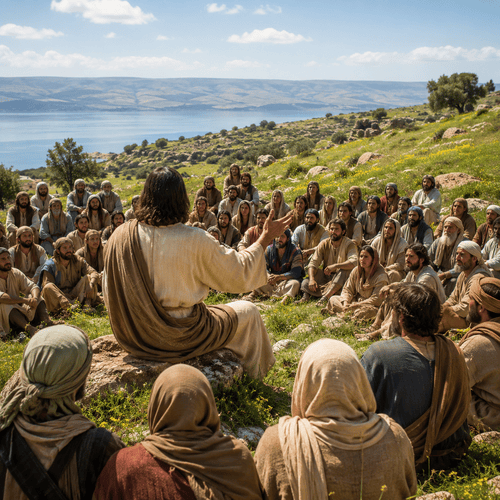
Every verse has a context—the words around it that help us understand it. Matthew 7:21 comes at the end of the Sermon on the Mount. Jesus closes it with four word-pictures. Each one shows two kinds of people who look the same on the outside.
How Jesus ends the Sermon on the Mount: four pairs that look alike
| VERSES | THE PICTURE | WHAT LOOKS THE SAME | WHAT IS REALLY DIFFERENT |
|---|---|---|---|
| Matthew 7:13–14 | Two gates and two roads | Both are roads people travel on | One leads to life; the other to destruction |
| Matthew 7:15–20 | Two trees | Both bear fruit | One is healthy; the other is diseased inside |
| Matthew 7:21–23 | Two kinds of people who say “Lord, Lord” | Both use the right words | Only one truly belongs to Jesus |
| Matthew 7:24–27 | Two builders | Both hear Jesus’ words and build a house | One builds on rock; the other on sand |
Do you see the pattern? Jesus is not setting grace against works. He is setting the real against the fake.
What Is “the Will of My Father”?
This phrase is the key to the whole verse. Many people think it means “keep God’s rules well enough”. But we do not have to guess. Matthew tells us what it means.
- It marks out Jesus’ family. “For whoever does the will of my Father in heaven is my brother and sister and mother” (Matthew 12:50). It is about belonging to Jesus.
- It begins with repentance and faith. In Matthew 21:28–32 Jesus tells of two sons. The first refuses to work for his father, but later changes his mind and goes. Jesus asks, “Which of the two did the will of his father?” Then he explains: the tax collectors and prostitutes believed John the Baptist, but the religious leaders did not (21:32).
- It means trusting the Son. “For this is the will of my Father, that everyone who looks on the Son and believes in him should have eternal life” (John 6:40).
- It goes on in obedience. “Everyone then who hears these words of mine and does them will be like a wise man who built his house on the rock” (Matthew 7:24).
Put it together. First, a person turns from sin (repentance) and trusts Jesus (faith). Then that faith shows itself in a changed life. Both are part of doing God’s will. But the order matters very much.
ROOT AND FRUIT: WHY THE ORDER MATTERS
Repentance and faith are the root. A changed life is the fruit. The fruit never creates the root. But a living root always produces fruit.
Tree First, Fruit Second
Just before our passage, Jesus says, “So, every healthy tree bears good fruit, but the diseased tree bears bad fruit” (Matthew 7:17). Tying apples onto a tree does not make it an apple tree. The tree must be right first.
So who makes the tree good? God does. He promised, “And I will give you a new heart, and a new spirit I will put within you… And I will put my Spirit within you, and cause you to walk in my statutes” (Ezekiel 36:26–27). The Bible calls this the new birth, or regeneration—God giving new life to a heart that was dead to him. Grace changes the tree. Good works grow on it.
The French Reformer John Calvin put it like this: “Christ, therefore, justifies no one whom he does not at the same time sanctify.” To justify means to declare a person right with God. To sanctify means to make a person holy, step by step. God never does the first without the second.
The Scottish theologian John Murray said it even more sharply: “Faith alone justifies but a justified person with faith alone would be a monstrosity which never exists in the kingdom of grace.” Faith alone saves—but saving faith never stays alone.
Listen to What They Say on That Day
Now look at what the “many” say: “Did we not prophesy in your name, and cast out demons in your name, and do many mighty works in your name?”
Three times they point to something they did. It is like arriving at heaven’s gate holding a list of achievements. Not one of them says, “Lord, have mercy on me, a sinner.”
Do you see the surprise? Some people use this verse to teach salvation by works. But the people Jesus sends away are the very people who trusted in their works!
Two ways to stand before Jesus on the last day
| Aspect | THE “MANY” IN MATTHEW 7 | A TRUE BELIEVER |
|---|---|---|
| What they point to | “Look what we did for you.” | “Look what you did for me.” |
| What they trust | Their religious record | Jesus’ perfect life and his death in their place |
| Jesus’ verdict | “I never knew you.” | Welcomed into his kingdom |
“I Never Knew You”—Words That Protect True Believers
Jesus does not say, “I used to know you,” or, “You were mine, but you fell away.” He says, “I never knew you.” There was never a real relationship to lose.
In the Bible, to “know” someone often means to have a close, committed relationship with them. Jesus says, “My sheep hear my voice, and I know them, and they follow me. I give them eternal life, and they will never perish” (John 10:27–28).
So this hard verse holds a hidden comfort. If Jesus truly knows you, he will never say these words to you. Those he knows, he keeps. As John wrote about people who left the church, “They went out from us, but they were not of us” (1 John 2:19). (We look at this language again in our post on the Parable of the Ten Virgins [internal link].)
And notice who gives this verdict. Not a judge appointed by God, but Jesus himself, speaking of God as “my Father”. Here a carpenter from Nazareth calmly says he will judge the whole world. If that is true, the biggest question in life is not “What have I done?” It is “Does Jesus know me?”
“Workers of Lawlessness”
Jesus’ final words are borrowed from King David: “Depart from me, all you workers of evil” (Psalm 6:8). The Greek Old Testament uses almost the same words. David spoke to his enemies; Jesus speaks as the true King.
“Workers of lawlessness” describes a way of life, not one mistake. These people were busy in ministry, but God’s law did not rule their lives. Their religion was a cover.
So Jesus condemns two things at once: trusting works to make them acceptable, and lives that never changed. Sinclair Ferguson, the Scottish pastor and theologian, shows in The Whole Christ that legalism (trying to earn God’s favour) and antinomianism (the idea that God’s law no longer matters for Christians) are like twins born to the same mother. Both cut grace off from holiness. Matthew 7 exposes both.
Can Unbelievers Really Do Miracles?
Can people really do miracles without saving faith? The Bible says yes.
- Judas Iscariot. Jesus gave the twelve disciples power over evil spirits and sickness—and Judas was one of them (Matthew 10:1–4).
- Balaam. He spoke true prophecies from God, yet he loved money (Numbers 22–24; 2 Peter 2:15).
- False christs. Jesus warned that they “will arise and perform great signs and wonders” (Matthew 24:24).
John Calvin noted in his commentary on this passage that the gift of miracles is one thing, and the Spirit who makes us God’s children is another. Jonathan Edwards, the great American pastor, made the same point in Religious Affections (1746). Being busy in religion, talking much about God, even strong religious feelings—none of these prove a person is saved.
GIFTS AREN’T THE SAME AS GRACE
Crowds, healings, powerful preaching and prophecy do not prove that someone is saved—not even when they happen “in Jesus’ name”. Matthew 7:22 is a loving warning to ministries that measure success by signs and wonders, and to the people who follow them.
Does This Clash with Paul?
Not at all. Right after saying we are saved by grace, not works, Paul adds: “For we are his workmanship, created in Christ Jesus for good works, which God prepared beforehand, that we should walk in them” (Ephesians 2:10).
Faith and works: how they fit together
| The question | What the Bible says |
|---|---|
| How are we made right with God? | By grace alone, through faith alone, because of Christ alone (Ephesians 2:8–9; Romans 3:28). |
| Can our good works pay for our sins? | Never. God “justifies the ungodly” (Romans 4:5). |
| Then why do good works matter? | They are the fruit God planned for his people (Ephesians 2:10). |
The Westminster Confession of Faith (1646) sums it up: faith “is the alone instrument of justification: yet is it not alone in the person justified, but is ever accompanied with all other saving graces, and is no dead faith, but worketh by love.”
5 Wrong Ways to Read Matthew 7:21
Five common misreadings and why the text rules them out
| THE VIEW | WHAT IT SAYS | WHY IT DOES NOT FIT THE TEXT |
|---|---|---|
| Works earn heaven (Roman Catholic teaching) | Good works add to our right standing with God. | The people turned away had many works. Entry depends on being known by Jesus. |
| You can lose your salvation (the Arminian view, after the Dutch teacher Jacobus Arminius) | These were true believers who fell away. | Jesus says “I never knew you”, not “I stopped knowing you”. |
| Works do not matter (the “Free Grace” view of Zane Hodges) | A changed life is optional. | The verses around it demand fruit (7:16–20) and obedience (7:24–27). |
| Saying the words is enough (name-only Christianity) | Calling Jesus “Lord” makes you safe. | Verse 21 says the exact opposite. |
| Jesus contradicts Paul (sceptics) | Jesus taught works; Paul taught grace. | Matthew links the Father’s will with repentance and faith (21:32). |
Am I One of the “Many”?
Two kinds of people read this passage. Some are careless. They think a prayer said long ago makes them safe, whatever their lives look like now. They need this warning. Others are fearful. They lie awake wondering, “What if this is me?” They need comfort.
The Welsh preacher Martyn Lloyd-Jones, in his sermons on this passage, urged hearers to apply it to themselves before anyone else—but always to run to Christ, not away from him. Paul says, “Examine yourselves, to see whether you are in the faith” (2 Corinthians 13:5). The Bible gives three grounds of assurance (a settled confidence that you are saved):
- God’s promises. “Whoever comes to me I will never cast out” (John 6:37). Your hope rests first on his word, not your feelings.
- The Spirit’s witness. “The Spirit himself bears witness with our spirit that we are children of God” (Romans 8:16).
- A changed life. Not perfection, but a new direction—a growing love for Jesus and a real fight against sin.
3 QUESTIONS TO ASK YOURSELF
- On the last day, will I point to what I did for Jesus, or to what Jesus did for me?
- Do I hate my sin and want to obey Jesus, even when I fail?
- Is Jesus himself precious to me—not just the things he gives?
Jesus does not turn away weak believers. He turns away proud pretenders. And “he who began a good work in you will bring it to completion at the day of Jesus Christ” (Philippians 1:6).
Conclusion: The Verse That Kills Self-Trust
So, does Matthew 7:21 teach salvation by works? No. It does the opposite. It shows us people with sermons, miracles and ministries who still had no place in the kingdom, because they never truly knew Jesus.
Doing the Father’s will begins where the tax collectors began: turning from sin and trusting God’s Son. That faith is God’s gift, and it always grows fruit. Works are the evidence, never the price.
So do not say “Lord, Lord” and stop there. Come to the Lord himself. Rest your whole weight on what he has done, and follow him. Those he knows, he will never lose.
Tough Questions, Honest Answers
Doesn’t Romans 10:13 say everyone who calls on the Lord will be saved?
Yes, it does, and both verses are true. Romans 10:13 describes real calling on the Lord—coming to Jesus in true faith, confessing him with the mouth and believing in the heart (Romans 10:9–10). Matthew 7:21 describes empty calling—words without a heart that trusts and follows him. The difference is not in the words people use but in the heart behind them. Everyone who truly calls on Jesus will be saved; not everyone who uses his name has truly called on him.
Are Luke 6:46 and Luke 13:25–27 the same teaching?
They are closely related. In Luke 6:46 Jesus asks, “Why do you call me ‘Lord, Lord,’ and not do what I tell you?” and then tells the same story of the two builders. In Luke 13:25–27 people knock on a shut door, saying they ate and drank with Jesus and heard him teach, but he says he does not know where they come from. Jesus probably gave this warning more than once, as good preachers often do. Each version adds to the picture: being near Jesus, hearing him and using his name are not the same as belonging to him.
Why does Jesus say “Lord, Lord” twice?
In the Bible, saying a name twice shows strong feeling or closeness—think of “Abraham, Abraham” (Genesis 22:11) or “Martha, Martha” (Luke 10:41). So these people are not cold or casual. They speak with real emotion and sound very sincere. That is what makes the passage so serious. Sincere feelings and warm words do not prove that a person knows Jesus.
Does “depart from me” describe hell?
Yes. To be sent away from Jesus is the very heart of what hell is. Paul describes the final punishment as being “away from the presence of the Lord and from the glory of his might” (2 Thessalonians 1:9). Jesus uses similar words in Matthew 25:41: “Depart from me, you cursed, into the eternal fire.” The greatest joy of heaven is being with Jesus; the deepest loss of hell is being shut out from him for ever. Hell is not only punishment—it is separation from the One we were made for.
Does Matthew 7:21 apply to Christians today, or only to people before the cross?
Some teachers say the Sermon on the Mount was for Jews living under the law of Moses, not for the church today. But before he returned to heaven, Jesus told his apostles to teach all nations “to observe all that I have commanded you” (Matthew 28:20). That includes the Sermon on the Mount. The warning in Matthew 7:21–23 is also about the Day of Judgement, which still lies ahead of us all. So this passage speaks directly to every church and every person who claims the name of Jesus today.
Can a backslidden Christian be one of those Jesus “never knew”?
A backslider is a true believer who drifts away from God for a time and falls into sin. Peter is a clear example: he denied Jesus three times, yet Jesus restored him (John 21:15–19). True believers can fall badly, but God disciplines his children and brings them back (Hebrews 12:6). The people in Matthew 7 are different, because Jesus never knew them at all. If someone drifts away and never returns, that shows they were never truly his (1 John 2:19). If you are worried that you have drifted, that worry is itself a good sign—turn back to Jesus today.
Is “the kingdom of heaven” the same as going to heaven when you die?
Not exactly. Matthew often says “kingdom of heaven” because many Jews avoided saying God’s name out of respect, so “heaven” stood in for “God”. The kingdom is God’s saving rule through Jesus. It has already begun—Jesus announced, “Repent, for the kingdom of heaven is at hand” (Matthew 4:17)—and it will come in full when he returns and makes all things new. Believers enter it now by faith, go to be with Christ when they die, and will enjoy it completely in the new creation. So “entering the kingdom” means sharing in God’s rule now and for ever.
Related Reads
- Is It Biblical to Tell Everyone “Christ Died for You”?
- Christ in You, the Hope of Glory: Why Paul Calls It a Mystery
- Religious OCD (Scrupulosity): What It Is and How to Find Freedom
- What Does It Mean to Be Known by God?
- Did Jesus Preach Works? Examining the Hardest Passages
- Salvation: By Faith Alone or by Works? The Biblical Answer
- Faith Vs Works: Are Paul and James at War?
- Assurance of Salvation: How Can I Know I’m Truly Saved?
- Fool’s Paradise: Is My Assurance of Salvation Real or False?
- Can Believers Lose Salvation? What Does Hebrews 6 Teach?
- Perseverance of the Saints: Why True Believers Cannot Finally Fall Away
- Sheep and Goats: Does Matthew 25 Hint at a Third Judgment?
- How Do Believers Catch Themselves Backsliding—and Get Back?
- ‘Judge Not, Lest…’: Making Sense of Jesus’ Dire Warning