
Fill a glass with water. Drop in a few strands of RNA—a key molecule of life. Then wait. Come back in about three months, and roughly half of those strands will have been broken apart by the water itself.
That simple fact is a big problem for a story most of us learnt at school. Billions of years ago, lightning struck a “primordial soup”—an early ocean full of simple chemicals—and slowly those chemicals came alive.
But here’s what many people never hear. Origin-of-life scientists openly admit water is one of their hardest problems. Life needs water, yet water destroys the very building blocks life is made from.
So did life begin in the ocean? Can life really have come from water? In this post we shall look at what the science actually shows, and why the ‘ocean origin’ story has fatal flaws.
KEY WORDS
- Abiogenesis: the idea that life came from non-living chemicals by itself, without God.
- Molecule: a tiny group of atoms joined together.
- Polymer: a long chain of small molecules linked together, like beads on a string. Proteins, DNA and RNA are all polymers.
- Hydrolysis: when water breaks the links in a chain. “Hydro” means water and “lysis” means breaking.
- RNA: a molecule that carries information in cells, like a working copy of DNA.
Where Did the “Life From Water” Idea Come From?
The idea is far older than modern science. Later scientists simply dressed an ancient Greek idea in new clothes.
Timeline: A Short History of the Idea
- Around 600 BC: Thales of Miletus, often called the first Greek philosopher, taught water was the source of all things.
- Around 550 BC: His student Anaximander taught the first human grew inside fish-like creatures before coming onto land.
- 1871: Charles Darwin wrote privately to his friend Joseph Hooker life may have started in a “warm little pond”.
- 1920s: Alexander Oparin in Russia and John BS Haldane in Britain pictured the early oceans as a chemical “soup”.
- 1952: Stanley Miller and Harold Urey sent electric sparks through gases and water in a flask, making a few amino acids—the small units that build proteins.
- 1977: Scientists discovered hydrothermal vents—hot springs on the deep sea floor. Many began to say life started there.
- 2017 to today: More researchers argue life began not in the sea but in land pools that dried out and refilled.
The story keeps changing, but one belief never does: life must have made itself. The only question is where—and each new answer creates new problems.
Fatal Flaw 1: Water Breaks Life’s Building Blocks
Life depends on very long chains of molecules. Proteins are chains of amino acids. DNA and RNA are chains of nucleotides, small units that carry the “letters” of the genetic code. Think of them as beads on a string.
Here’s the problem. To join two beads together, a tiny bit of water has to be removed. Chemists call this a condensation reaction. But in water, the opposite happens much more easily. Water attacks the links between the beads and snaps them apart. This is hydrolysis. Inside a living cell, God-designed machines protect and repair these chains. In an open ocean, nothing does.
Scientists call this the “water paradox”. A paradox is something that seems to contradict itself. Life needs water, but water destroys life’s chains. Chemist Robert Shapiro, who did not believe in creation, put it strongly. In this kind of chemistry, he wrote, “water is an enemy to be excluded as rigorously as possible”.
HERE’S THE WATER PARADOX IN 3 STEPS
- Life’s key molecules, like RNA, can only do their work in water.
- But water breaks those same molecules apart.
- So an ocean is the worst place to build them, and the best place to destroy them.
The numbers are hard to ignore. A 2025 paper by chemist James Tour and his colleagues notes one particular RNA molecule has a half-life of about 100 days in water at room temperature. A half-life is the time it takes for half of something to break down. For a protein chain, it’s about 7 years. The chains fall apart long before chance could build anything useful.
Steven Benner, one of the best-known origin-of-life chemists, admits RNA can only work in water, yet cannot be formed in water. He has even argued that life may have started on Mars, partly because early Mars had far less water. When a top scientist looks to another planet because ours is too wet, the ocean story is in serious trouble.
Fatal Flaw 2: The Experts Cannot Agree Where
If the ocean story were strong, the experts would at least agree on where life began. They don’t. Each camp’s best argument is the other camp’s biggest problem.
Table 1: The 2 leading ideas about where life began, and the main weakness each side sees in the other.
| IDEA | WHAT ITS SUPPORTERS SAY | THE PROBLEM THE OTHER SIDE POINTS OUT |
|---|---|---|
| Deep-sea hydrothermal vents (hot springs on the ocean floor) | Vents give heat, minerals and chemical energy. Tiny pores in the rock could act like the first cells. | The chains are always surrounded by seawater, so water keeps breaking them. The sea floor never dries out to help join them. |
| “Warm little ponds” on land | Pools that dry out and refill can push molecules together and help chains form. | Land pools are small, scattered and exposed to harsh sunlight. Early Earth may have had very little dry land at all. |
In 2017, Ben Pearce and Ralph Pudritz of McMaster University ruled out the vents, because making RNA needs wet-and-dry cycles and the deep sea floor never dries. Two years later, Nick Lane’s team at University College London insisted the vents cannot be ruled out. By 2026, a special collection in the journal Astrobiology described the whole field as moving away from the deep sea and towards land.
After decades of work, the experts still cannot answer the most basic question: where? That is not what we would expect if the answer were close.
Fatal Flaw 3: The Soup That Never Was
For many years, textbooks pictured an ocean full of “primordial soup”. But three problems spoil the recipe.
- Too watery: The ocean is huge. Useful chemicals would spread out and become extremely thin, like one spoon of sugar in a lake.
- No trace in the rocks: In 1984, scientists Charles Thaxton, Walter Bradley and Roger Olsen argued that there probably never was such a soup. If the oceans had been full of these chemicals for millions of years, the oldest rocks should show it. They do not.
- The famous experiment does not fit: Many scientists today doubt the gases Miller and Urey used match the early Earth. And most of what their flask produced was a sticky brown tar, not anything close to life.
And remember: a trained scientist chose the gases, built the equipment and trapped the products. Even this famous “proof” needed a mind behind it.
Fatal Flaw 4: Chemicals Aren’t a Code
Even if water were not a problem, ingredients are not enough. A pile of letters is not a book. Life needs information: the right parts in the right order.
- The order matters: A protein only works when its amino acids are in an exact order, like letters in a sentence. Chemistry does not choose meaningful orders.
- Most chains are useless or harmful: As Benner’s own research programme admits, only about one RNA molecule in a hundred trillion can speed up chemical reactions. Most of those speed up reactions that destroy other molecules.
- The “handedness” problem: Many life molecules come in left-handed and right-handed forms, like gloves. Life uses only left-handed amino acids and right-handed sugars, but unguided chemistry makes a 50–50 mix. Water even slowly turns pure forms back into a mix, a change called racemisation.
- Life only comes from life: In the 1860s, Louis Pasteur showed living things don’t appear from non-living matter. Every living thing ever observed came from another living thing—the law of biogenesis.
Where do codes ever come from? Only from minds. A message written in the sand points to a writer, not to the waves. The code in every cell points to a Designer.
Fatal Flaw 5: Climbing “Out of the Water”
Many people use the phrase “life came out of water” in a second sense. They mean that fish slowly turned into land animals. The star of this story is Tiktaalik, a fossil fish with sturdy fins described in 2006 by Neil Shubin and his team. It’s often called a “fishapod”—half fish, half four-legged animal—and is dated by evolutionists to about 375 million years ago.
But in 2010, Grzegorz Niedźwiedzki and his colleagues reported footprints of four-legged animals in Poland. On evolution’s own dates, these tracks are around 20 million years older than Tiktaalik. Animals were walking on four legs long before the “in-between” fish lived. A missing link cannot be the ancestor of animals that came before it.
There’s an even bigger problem. A fish needs far more than legs to live on land.
Table 2: What would have to change, all together, for a water animal to survive on land.
| BODY SYSTEM | LIVING IN WATER | NEEDED FOR LIVING ON LAND |
|---|---|---|
| Breathing | Gills take oxygen out of water | Lungs to take oxygen out of air |
| Support | Water holds the body up | Strong bones, hips and shoulders to carry the full body weight |
| Skin | Can stay wet all the time | Must stop the body from drying out |
| Waste | Ammonia, a toxic waste, simply washes away | Kidneys must turn waste into safer forms, such as urea |
| Senses | Eyes and ears are built to work under water | Eyes and ears must work in air |
All these changes must work together. Half a lung or half a kidney does not help an animal survive. Linked design like this is exactly what we expect from a Creator who made each kind complete.
What Does Genesis Really Say?
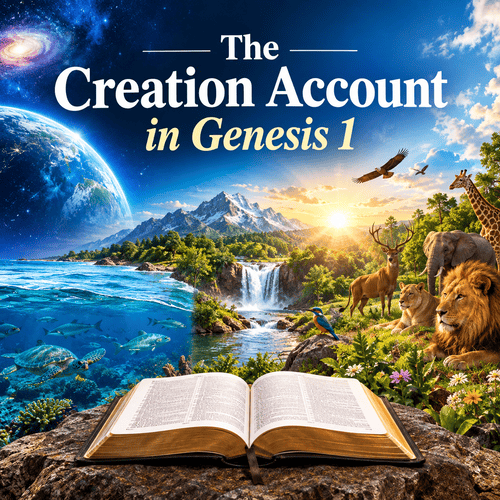
Some people say, “But the Bible itself says life came from water!” They point to Genesis 1:20:
And God said, “Let the waters swarm with swarms of living creatures, and let birds fly above the earth across the expanse of the heavens.”
Genesis 1:20
At first glance, that sounds like the ocean story. But read carefully, and three things stand out.
- God speaks first: The waters decide nothing; they swarm because God commands it. The next verse says, “So God created the great sea creatures and every living creature that moves, with which the waters swarm” (Genesis 1:21). The Hebrew word for “created” here is bara, a word the Bible uses only for God’s own creating work.
- The earth “brings forth” too: A few verses later God says, “Let the earth bring forth living creatures according to their kinds” (Genesis 1:24). If verse 20 makes water the source of life, then verse 24 makes soil the source. Clearly Moses is naming the place each creature would fill, not the power that made it.
- “According to their kinds”: Genesis repeats this phrase again and again. God made separate kinds, not one family tree growing from a single cell.
John Calvin, the great sixteenth-century Bible teacher of Geneva, saw the point clearly. On the fifth day, he said, the waters obey God’s word so quickly that “though lifeless in themselves, they suddenly teem with a living offspring”. He also warned that God, though He is the Author of nature, “by no means has followed nature as his guide in the creation of the world”. Creation was not a natural process but a mighty act of God.
JOHN CALVIN ON GENESIS 1:24
“But whence has a dead element life? Therefore, there is in this respect a miracle as great as if God had begun to create out of nothing those things which he commanded to proceed from the earth.”
In plain words: soil and water are dead. When God tells them to bring forth life, that is just as great a miracle as making something out of nothing.
The English Bible commentator Matthew Henry summed up the fifth day in two short sentences: “God commanded the fish and fowl to be produced. This command he himself executed.” And, he adds, “fruitfulness is the effect of his blessing”. The sea did not make the fish. God did, and God keeps them multiplying. The Baptist pastor John Gill said the same. The waters could bring forth creatures only “by the divine order accompanied with his power”.
The apostle Peter makes the same point about the whole earth. He warns that people “deliberately overlook” that “the earth was formed out of water and through water by the word of God” (2 Peter 3:5). Notice the last words: by the word of God. Water was the material. God’s word was the power.
Genesis does not only disagree with the ocean story about how life began. It disagrees about the order too.
Table 3: The order of creation in Genesis 1 compared with the order in the evolutionary story.
| EVENT | GENESIS 1 | THE EVOLUTIONARY STORY |
|---|---|---|
| First living things | Plants on land (Day 3) | Tiny life forms in the sea |
| Sun and stars | Made on Day 4, after the plants | Existed long before any life |
| Sea creatures | Day 5, after land plants | Long before any land plants |
| Birds | Day 5, before land animals | Much later, from reptiles |
| Whales | Day 5, before land animals | Much later, from four-legged land mammals |
| Humans | Made from dust and given God’s breath (Day 6) | Descended from ape-like ancestors |
You cannot fit the two stories together without changing one. Christians let God’s Word shape how we read science, not the other way round.
Answering the Best Objections
To be fair, origin-of-life scientists do have answers. Here are the strongest, and why they do not close the gap.
- “Wet-dry cycles solve the water problem”: Drying pools can help join short chains. But this moves life out of the ocean, which is our point, and short chains are still far from the long, ordered chains life needs.
- “Scientists are making progress”: Chemists such as Matthew Powner have found clever routes to some building blocks in water. But every step is planned and controlled by skilled scientists. That is not chance; it is intelligent design in a laboratory.
- “Probability arguments are unfair”: Critics say no one thinks a whole cell formed in one go. True—but every smaller step must still happen without a guide, and each still faces the water paradox.
- “This is just God of the gaps”: A “God of the gaps” argument says, “We don’t know, so God did it.” Our argument is different. It rests on what we do know: water breaks chains, chemistry writes no codes, and life only comes from life.
Honestly, research continues, and an unsolved problem is not the same as an impossible one. But after more than seventy years, the more we learn about the cell, the wider the gap looks.
So, Did Life Come From Water? Life’s Servant, Not Its Parent
The honest answer from both science and Scripture is no. Water is vital for life. God made it wonderfully suited to carry, protect and serve living things. But water cannot give life. It is life’s servant, not its parent.
Life comes from the living God. “In him was life, and the life was the light of men” (John 1:4). Paul told the thinkers of Athens that God “himself gives to all mankind life and breath and everything” (Acts 17:25).
And there is one more twist. Life really can come out of water—just not the way the textbooks say. Jesus told a thirsty woman at a well:
“Whoever drinks of the water that I will give him will never be thirsty again. The water that I will give him will become in him a spring of water welling up to eternal life.”
John 4:14
At the very end of the Bible, John sees “the river of the water of life, bright as crystal, flowing from the throne of God and of the Lamb” (Revelation 22:1). The sea cannot give you life. But Christ can. Come to Him and drink.
Tough Questions, Honest Answers
Why is water so important for life?
Water does jobs that no other liquid does as well. It dissolves and carries nutrients around our bodies, and it holds heat, which keeps temperatures steady. Unlike most substances, it becomes lighter when it freezes, so ice floats and protects the life underneath. As early as 1913, the scientist Lawrence Henderson wrote a whole book on how perfectly water suits living things. The Bible tells us why: God “formed it to be inhabited” (Isaiah 45:18). Water’s special gifts are not a lucky accident but a sign of His “eternal power and divine nature” (Romans 1:20).
Have scientists ever created life in a laboratory?
No. In 2010, Craig Venter’s team built a copy of a bacterium’s genetic code and placed it inside another living bacterial cell, which then ran on the new code. This was a remarkable piece of engineering, but they copied an existing code and needed a living cell to start with. Nobody has ever turned non-living chemicals into a living cell. And if scientists ever did, it would show that life needs a very clever designer working under careful control. That is exactly what Christians have always said about God.
Could life have come to Earth from space?
Some scientists think so. In 1973, Francis Crick, who helped discover the shape of DNA, and Leslie Orgel even suggested that aliens might have sent life here on purpose. This idea is called panspermia, which means “seeds everywhere”. But it does not explain how life began. It only moves the question to another planet, where the same chemical problems remain. Scripture gives a simpler and better answer: God, who is life itself, created living things directly (John 1:3–4).
Could there be life on Europa or Enceladus?
Europa, a moon of Jupiter, and Enceladus, a moon of Saturn, both have oceans of liquid water under their icy surfaces. NASA’s Europa Clipper spacecraft, launched in 2024, is on its way to study Europa. The search is driven by the belief that where there is water, there may be life. But water alone cannot make life; it actually breaks life’s building blocks apart. The Bible does not tell us whether God placed life on other worlds, so we should not make claims either way. What we can say is this: if life were ever found anywhere, it would need the same Creator.
What is LUCA, the “last universal common ancestor”?
LUCA is the name evolutionists give to the imagined single ancestor of every living thing on Earth. No fossil of LUCA has ever been found; scientists work it out by comparing the genes of living creatures. Surprisingly, a 2024 study estimated that LUCA already had around 2,600 kinds of proteins and even a simple immune system to fight viruses. In other words, the “simplest” starting point was already highly complex. That fits the biblical picture far better: living things appear fully working and well designed from the start.
How old is the earliest evidence of life on Earth?
Evolutionary scientists usually point to stromatolites, layered rock mounds built by colonies of microbes, which they date to about 3.5 billion years ago. Some claimed older examples, around 3.7 billion years, have been strongly questioned by other researchers. All these dates rest on assumptions about how rocks formed and how radioactive elements behaved in the past, and creationists challenge those assumptions. But notice what the evolutionary timeline itself admits: life appears early and already working, with no layer of “soup” beneath it. Whatever dating method one uses, the rocks show life, not life slowly making itself.
What does “born of water and the Spirit” mean in John 3:5?
Jesus told Nicodemus, “unless one is born of water and the Spirit, he cannot enter the kingdom of God” (John 3:5). He was not talking about physical birth, nor saying that baptism saves us (see What Does ‘Born of Water’ in John 3:5 Mean?). As a teacher of Israel, Nicodemus should have remembered God’s promise in Ezekiel 36:25–27 to sprinkle clean water on His people and put His Spirit within them. Water here pictures cleansing from sin, and the Spirit gives new life. John Calvin read “water and the Spirit” as one idea: the Spirit who cleanses like water. Just as physical life comes only from God, new spiritual life comes only from Him too.
Related Reads
- RNA World Hypothesis: Can Chemistry Explain Life’s Origin?
- Mystery In Every Drop: Water as Evidence of Design
- How Scientific Is Genesis 1? Science, History and Six Days
- “After Their Kind”: What Genesis Does and Doesn’t Claim
- Blueprints of Life: Why Cellular Precision Demands a Designer
- DNA Evidence for Intelligent Design: New Challenges for Evolution
- Intelligent Design: Is It A God of the Gaps Argument?
- What Does ‘Born of Water’ in John 3:5 Mean?
- Living Waters and Jesus: What’s The Connection?