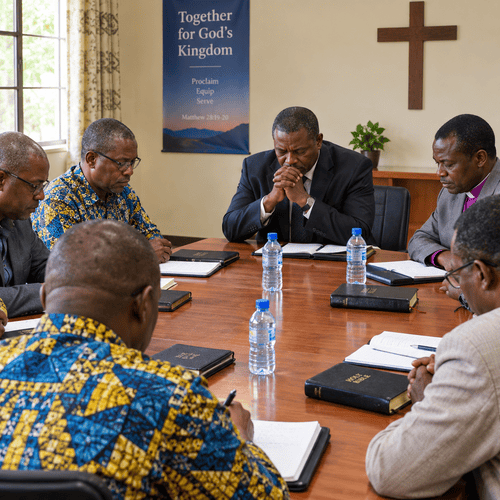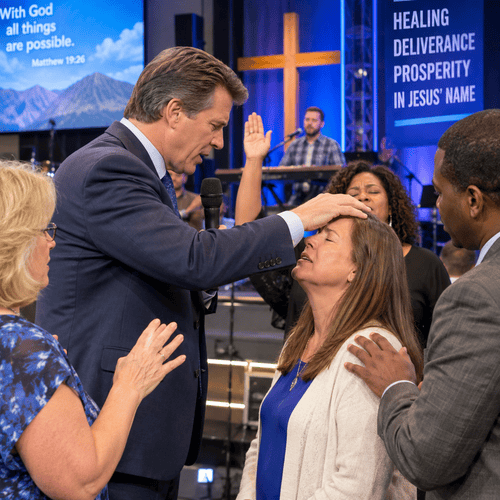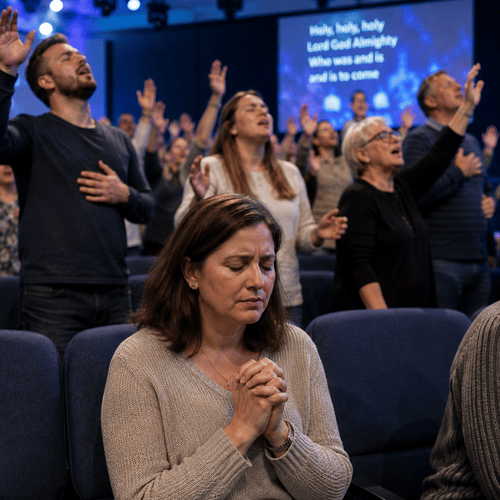

Imagine the scene: the final hymn is swelling, every head is bowed, every eye closed. The preacher’s voice drops low and urgent: “If you want to be saved tonight, don’t leave this room without Jesus. Just take that first step down the aisle. God will meet you there.” Hearts pound. A few people stand. Tears flow. The congregation sings “Just As I Am” one more time, louder, as volume and emotion do their ancient dance.
For many evangelicals, the altar call—that invitation to walk forward at the end of a sermon to “make a decision for Christ”—seems as essential to evangelism as the Gospel itself. Reformed believers, on the other hand, aren’t agreed on every detail, but there is a strong family resemblance in our answer: we’re deeply sceptical of the traditional altar call, yet passionately committed to urgent, public, heartfelt calls to repent and believe.
So which is it? Is the altar call a Spirit-blessed tool that helps trembling sinners cross the line of faith? Or a well-meaning invention that quietly undermines the very doctrine of grace it wants to serve?
A BRIEF HISTORY
The altar call is surprisingly recent. It began in the 1830s with revivalist Charles Finney’s “anxious bench”—a front-row seat where seekers would sit to receive prayer and emotional pressure until they “broke through” to conversion. Before Finney, even the most passionate evangelists—George Whitefield, Jonathan Edwards included—never used such methods. They preached, prayed, and trusted God’s Spirit to work in His time.
Interestingly, Finney’s contemporary, Calvinist evangelist Asahel Nettleton, saw massive conversions without any altar call—and with retention rates near 95%. Finney’s converts? Many fell away quickly, leading even Finney himself to later question the genuineness of his methods.
Through DL Moody and Billy Graham, altar calls became standard in American evangelicalism. But their origins matter: they emerged from a specific theology that many in Reformed circles reject.
THE CASE FOR ALTAR CALLS
To be fair, defenders of altar calls do make compelling arguments:
“Biblical precedent seems present”: Joshua declared, “Choose this day whom you will serve” (Joshua 24:15). On Pentecost, 3,000 people responded immediately to Peter’s preaching and were baptised that same day (Acts 2:37-41). Don’t these texts show public, immediate responses to the Gospel?
“The urgency of Scripture demands action”: Paul writes, “Now is the day of salvation” (2 Corinthians 6:2). Shouldn’t we press people toward decision rather than let them drift away unconverted?
“Altar calls remove barriers”: They provide clarity: “Here’s what you do right now.” They create accountability—names on cards, counsellors assigned, churches notified. Without such a moment, seekers may wonder, “What exactly should I do next?”
“Don’t countless testimonies affirm their value?”: Millions have genuinely come to Christ through Billy Graham crusades and similar events. Can we dismiss a method that God has clearly used?
“Didn’t Jesus display urgency too?”: At times, Jesus called people to immediate, costly action: “Follow me, and let the dead bury their own dead.”
Sure. These are serious arguments, and they deserve serious engagement.
THE THEOLOGICAL PROBLEMS
Reformed Christians aren’t opposed to altar calls out of mere tradition. The concern is fundamentally theological:
- First, altar calls confuse a physical act with spiritual reality. When walking forward becomes the moment of salvation, people often rest their assurance on that action rather than on Christ alone. “I know I’m saved because I went forward on October 15, 2010.” But Scripture teaches that regeneration—being born again—is entirely God’s sovereign work (John 6:44; Ephesians 2:8-9). We’re saved by grace through faith, not by walking an aisle.
- Second, altar calls create an epidemic of false assurance. Research shows only a small percentage of altar call “decisions” result in lasting discipleship. Many show no evidence of genuine conversion even weeks later. The practice often produces people who’re inoculated against the Gospel—they believe they’re Christians because they once “prayed the prayer” or “walked the aisle,” despite living unchanged lives. The cost of such false assurance is staggering.
- Third, Scripture doesn’t actually support the practice. Yes, Peter preached to 3,000 who were baptised—but this followed his completed sermon and the Spirit’s convicting work. Peter didn’t interrupt his message to orchestrate an emotional response. He proclaimed truth; God brought conviction; people responded. And even then, the response wasn’t walking forward to “accept Jesus” but submitting to baptism after genuine repentance.
Jesus Himself modelled something different. When crowds followed Him, He didn’t always rush them. Instead, He urged them to count the cost: “Whoever does not bear his own cross and come after me cannot be my disciple” (Luke 14:27). He let people walk away (John 6:66). Why? Because true conversions aren’t manufactured. They’re God’s work in us and He can accomplish His purposes—without altar calls.
THE REFORMED ALTERNATIVE
So what should faithful evangelism look like?
Reformed preaching proclaims the Gospel with humble dependence on the Triune God. We preach Christ crucified, call sinners to repent and believe, and trust the Holy Spirit to effectually call His elect. We don’t manipulate emotions or engineer decisions.
God’s true “altar call” isn’t to a front-row bench—it’s to the baptismal font and the Lord’s Table. These are the means of grace God has ordained, where He confirms His promises to His people.
Reformed evangelism emphasises faithful Word ministry, pastoral availability, and patient discipleship. After preaching, ministers make themselves available for conversation. Seekers are invited to discuss their questions privately, receive biblical instruction, and be genuinely converted—not merely counted as a crusade statistic.
The difference isn’t urgency—Reformed preachers plead with sinners to be reconciled to God (2 Corinthians 5:20). The difference is method and theology. We trust God’s timing. Conversion may be immediate or gradual, dramatic or quiet, but it’s always and only God’s sovereign work.
THE FRUIT TEST MATTERS
History bears this out. Nettleton’s converts persevered. Finney’s largely didn’t. Modern statistics show similar patterns: high “decision” numbers often correlate with low discipleship rates. How many people today say, “I prayed a prayer once” but show no fruit of genuine conversion?
The question isn’t whether God can save someone during an altar call—He certainly can. The question is whether we should employ methods that regularly produce false assurance and confuse human decision-making with divine regeneration.
CONCLUSION
So yes, there is a Reformed consensus on altar calls, and it’s rooted in our theology of conversion: Salvation is God’s sovereign work, not the product of human techniques or emotional manipulation. The Holy Spirit works through the faithful preaching of His Word.
Our calling isn’t to maximise “decisions.” Our calling is to preach Christ faithfully, pray fervently, and trust God to build His church. The harvest is indeed plentiful—but it belongs to the Lord, not to our methods.
So, here’s where we land: we preach like a dying man to dying men. We call sinners to repent and believe with all the urgency of Acts 2 and Isaiah 55. We plead with them to come to Jesus—today. But we do it trusting no one comes unless the Father draws him (John 6:44), that regeneration is the Spirit’s secret work, and that the ordinary ministry of Word, sacrament, prayer, and loving community is sufficient because God promised it would be.
The aisle doesn’t save. The prayer doesn’t save. The raised hand doesn’t save. Jesus saves—perfectly, finally, freely.
And one day every knee will bow to Him. The sovereign King will conquer every heart He came to conquer. Until that day, let’s keep preaching, keep pleading, keep trusting.
RELATED FAQs
Did Charles Spurgeon use altar calls?
No—and this is striking given Spurgeon’s passion for evangelism. Despite being well acquainted with the practice, Spurgeon firmly refused to adopt altar calls and even criticised them severely. Instead, he would cry out, “Go to your God at once, even where you are now! Cast yourself on Christ, now, at once, ere you stir an inch!” Spurgeon directed people to Christ, not to the front of a building. His ministry saw countless conversions without ever asking someone to walk an aisle—proving that passionate evangelism and Reformed theology aren’t opposites.
What did Martyn Lloyd-Jones say about altar calls?
Lloyd-Jones was direct: “The invitation should be in the message. We believe the Spirit applies the message, so we trust in the power of the Spirit”. He saw altar calls as reflecting “a lack of faith in the work and operation of the Holy Spirit”. Interestingly, Lloyd-Jones was concerned about the apparent lack of emotion amongst those responding to Billy Graham’s altar calls—if someone truly sees their desperate need or God’s magnificent grace, shouldn’t they feel something? The mechanical, unemotional responses troubled him precisely because they seemed manipulated rather than Spirit-wrought.
What did RC Sproul teach about altar calls and conversion statistics?
Sproul warned believers to be cautious about our “evangelism statistics.” He noted we tend to be quite optimistic when we assume the conversion of all who answer an altar call, make a “decision for Christ,” or recite the “sinner’s prayer,” but these tools can only measure outward professions—they don’t give us a glimpse into the heart. Jesus warned that the number of self-proclaiming believers who are not really regenerate is “many” (Matthew 7:21-23). Only God can read the human heart; our task is faithful proclamation, not statistical manipulation.
How can we evaluate contemporary altar call practices?
Reformed churches typically ask four diagnostic questions: Does the invitation 1) Clearly distinguish between God’s saving work and human response? 2) Avoid emotional manipulation while still calling for genuine repentance and faith? 3) Lead to long-term discipleship rather than just statistical decisions? 4) Honour both divine sovereignty and human responsibility in conversion? Methods that pass these tests tend to serve the gospel regardless of their historical pedigree or contemporary popularity.
Don’t Reformed churches care about evangelism if they reject altar calls?
On the contrary—Reformed churches care so deeply about genuine conversions that they refuse methods producing false assurance. Consider: Lloyd-Jones preached evangelistically every Sunday night at Westminster Chapel, encouraging his congregation to bring lost people, and thousands trace their conversion to hearing him preach—all without altar calls. Charles Spurgeon, that passionate winner of souls, saw massive conversions while refusing to use altar calls. The issue isn’t evangelistic zeal but theological integrity: we trust the Spirit to regenerate hearts through faithful Word ministry, not through emotional pressure and manipulated decisions.
What about George Whitefield’s practice at the Cambuslang Revival?
Wasn’t that an early altar call? This requires nuance. At the 1742 Cambuslang revival in Scotland, Whitefield asked whether anyone wished to “take Christ for their husband,” and if they did, he extended an invitation: “Come and I’ll marry you to him just now”. However, this wasn’t the modern altar call system with its anxious bench, emotional manipulation, and Arminian theology. Whitefield remained thoroughly Calvinistic, trusting God’s sovereignty in salvation. The practice didn’t become systematised into “new measures” designed to manufacture conversions. This isolated instance differs fundamentally from Finney’s calculated methodology aimed at engineering decisions through psychological pressure.
What should Reformed churches do instead to help seekers respond to the Gospel?
Our appeal must be in the Truth itself, and in the message—as we preach, we should be applying it all the time, especially at the end when we come to the final application. The sermon should lead people to see that responding to Christ is the only thing to do, and ministers should make an announcement that they’re available to talk to anybody who wants to discuss their soul and eternal destiny. This approach provides genuine pastoral care rather than statistics, creates space for the Spirit to work without manipulation, and emphasises that conversion is God’s sovereign work—not the product of walking an aisle. Reformed evangelism trusts that as sinners are invited to Christ through preaching and as Christ is declared with His gracious Gospel promises unfolded, the Spirit of God will ensure that His Word shall not return void.
DO ALTAR CALLS HELP OR HURT? OUR RELATED POSTS