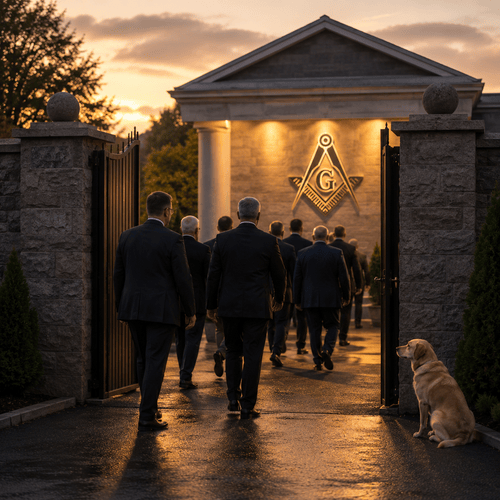
Somewhere in your family there may be a faded photograph: a grandfather in a dark suit, a white apron tied at his waist, an odd set-square and compasses badge pinned to his lapel. For a great many families that photograph is all they know about Freemasonry—a respectable older relative, a charity dinner, a strange handshake.
Freemasonry doesn’t present itself as a threat to anyone’s faith. It calls itself a fraternity, not a religion. It speaks of brotherhood, charity and becoming a better man. Many of its members are churchgoing Christians who’d be baffled, even hurt, to hear anyone doubts whether the two can sit comfortably together.
And yet the lodge has its own prayers, its own altar, its own sacred name for God, and its own ritual path out of darkness and into “light.” That’s what makes the question worth asking: can a man kneel at a Masonic altar on a weeknight and at the Lord’s Table on Sunday without one of those two loyalties quietly swallowing the other? Is Freemasonry biblical—and if not, where exactly does it part company with Christ?
This isn’t a hunt for conspiracies, hidden hand signals or shadowy world domination. It is a careful, fair look at what Freemasonry actually teaches, in its own words, and what the Bible says in reply.
What Freemasonry Actually Is
Modern Freemasonry traces itself to the founding of the Grand Lodge of England in 1717, though it borrows much of its imagery from the medieval stonemasons’ guilds that built Europe’s cathedrals. Those guilds guarded the “secrets” of their trade—the geometry and craft that let a man raise an arch that would not fall. The Freemasonry that exists today, sometimes called speculative Masonry, kept the tools as symbols. The chisel, the plumb line, the square and the compasses became moral metaphors: a man shaping his own rough character into something fit for a higher purpose.
The basic unit is the local lodge, and the heart of the system is what Masons call Craft or Blue Lodge Masonry—three degrees, or stages, through which every member passes:
- Entered Apprentice: the first degree, the “rough stone,” a man newly admitted and taught the basics.
- Fellowcraft: the second degree, the working journeyman, given further instruction.
- Master Mason: the third degree, conferring full membership and built around the legend of Hiram Abiff.
Above these three sit a host of further degrees and bodies—the Royal Arch, the Scottish Rite and others—but the three Craft degrees are the foundation every regular Mason shares. To be admitted, a candidate must profess belief in a Supreme Being; regular Freemasonry will not accept an atheist. He takes his promises on a “Volume of Sacred Law”—usually the Bible in Britain and America, but the Quran, the Vedas or another scripture for members of other faiths. The lodge does real and often generous charitable work, and many men join for exactly the reasons they give: friendship, structure and service.
The Great Architect of the Universe—Who Is Masonry’s God?
Freemasonry calls God the Great Architect of the Universe. At first hearing a Christian might nod along, because Scripture itself pictures God as the designer and builder of creation. (In the beginning, God created the heavens and the earth, Genesis 1:1.) Why not call him the Great Architect?
The problem isn’t in the title. It’s what the title is carefully designed to leave blank.
In Masonic teaching the Great Architect is a deliberately neutral name. It’s not a description of any particular God; it’s a placeholder that each member fills with the deity of his own religion. When a Christian, a Muslim, a Hindu and a Deist kneel together at the same lodge altar and address the Great Architect, the ritual intends them to be worshipping in harmony—each privately picturing his own god, all of them assured the differences don’t finally matter. A Masonic publication, The Square Magazine, describes the term as a deliberately worded “symbolic placeholder” that invites every Mason to think of his own interpretation of deity.
That single design choice is the theological heart of the whole question. It’s a worked example of what theologians call religious indifferentism—the belief that all religions are equally valid roads to the same God. And it runs head-on into the most basic claim Jesus ever made about Himself:
Jesus said to him, “I am the way, and the truth, and the life. No one comes to the Father except through me.” (John 14:6)
The Great Architect is a god who can be reached without Christ, named without Christ and worshipped without Christ. The God of the Bible cannot be. There is salvation in no one else, for there is no other name under heaven given among men by which we must be saved (Acts 4:12). You may keep the word “Architect”; you cannot keep the blank where the name of Jesus should stand.
There’s a sharper edge to this in the higher degrees. In the Royal Arch, a candidate is taught a supposed secret name for the Supreme Being: Jahbulon, a composite word that appears to stitch together divine names drawn from three different religions. Whatever its tangled history, Jahbulon makes plain what the Great Architect keeps polite: a god assembled by human hands out of many religions at once. This is precisely what the Church of England’s 1987 enquiry singled out as its gravest theological objection.
Inside the Lodge—Oaths, Aprons and the Death of Hiram Abiff
At each of the three degrees the candidate kneels and takes an obligation: a solemn sworn promise never to reveal the secrets of that degree. Historically these oaths carried vivid self-cursing penalties—the throat cut across, the tongue torn out, and worse—called down on anyone who broke his word. Most modern jurisdictions now treat these penalties as purely symbolic, but the structure of the sworn oath remains.
The emotional centre of the system is the third degree, and its hero is Hiram Abiff. Masonic legend casts him as the master builder of King Solomon’s Temple and the keeper of a secret “Master’s Word.” Three ruffians ambush him, demanding the word; he refuses to betray his trust and is murdered. The candidate for the Master Mason degree personally plays Hiram—he is symbolically “slain,” laid low, and then “raised” by the grip of a Master Mason to a kind of new life. The moral taught is that the faithful Mason may face death with composure and look forward to the “Celestial Lodge above, where the Supreme Architect of the Universe presides.”
Read that last phrase slowly, because it’s where the trouble hides in plain sight. The Mason is pointed toward heaven—but the bridge to it is his own fidelity and virtue, dramatised in a legend that has no room for the cross. There’s a resurrection in the ritual, but it’s Hiram’s, not Christ’s.
“Let Your Yes Be Yes”—The Trouble With Secret Oaths
Two threads from inside the lodge run straight into a biblical wall.
The swearing of oaths. On oaths, Jesus could hardly be more direct:
But I say to you, Do not take an oath at all … Let what you say be simply “Yes” or “No”; anything more than this comes from evil. (Matthew 5:34, 37)
James repeats it almost word for word: let your “yes” be yes and your “no” be no, so that you may not fall under condemnation (James 5:12). The Christian is to be a person whose plain word already binds him—who needs no dramatic self-cursing ceremony to guarantee his honesty.
The keeping of secrets. On secrecy, the difficulty is subtler but real. There’s nothing wrong with privacy. The question is whether a Christian should bind himself by oath to conceal teachings about God and salvation from his own wife, his own pastor, his own church. When Jesus stood on trial he answered, I have spoken openly to the world … I have said nothing in secret (John 18:20). The gospel is public truth, meant to be proclaimed from the housetops (Matthew 10:27). A system that ushers a man up a graded ladder of concealed religious “light,” sealed by oaths he may not discuss, is pulling in precisely the opposite direction.
Light, Darkness and the Unequal Yoke
Step back from the aprons and handshakes, and the deeper conflict comes into focus. It’s not mainly about ritual props. It’s about three things Freemasonry must believe in order to work as it does—and each one collides with the gospel.
- One God for all faiths: Because the lodge gathers men of every religion around one altar, it must treat their competing claims about God as compatible. That’s indifferentism, and Scripture will not have it—there’s one Mediator, the man Christ Jesus (1 Timothy 2:5).
- A gospel with the name of Jesus removed: So as not to offend non-Christian members, Masonic prayers and Scripture readings characteristically leave out the name of Christ. But the Christian is told: whatever you do, in word or deed, do everything in the name of the Lord Jesus (Colossians 3:17). A worship that deletes Jesus to keep the peace isn’t neutral; it’s a different religion in borrowed robes.
- Salvation by becoming a better man: Freemasonry’s promise is moral self-improvement—”making good men better,” polishing the rough stone until it’s fit for the Celestial Lodge. The gospel says the rough stone cannot polish itself (Ephesians 2:8–9).
The apostle Paul drew the line in words that could have been written for this exact question:
Do not be unequally yoked with unbelievers. For what partnership has righteousness with lawlessness? Or what fellowship has light with darkness? … What agreement has the temple of God with idols? (2 Corinthians 6:14, 16)
Freemasonry vs the Bible: Side by Side
| What Freemasonry teaches or practises | What the Bible teaches |
|---|---|
| God is the Great Architect, a Supreme Being each member defines for himself. | God has made himself known finally in Jesus Christ; no one comes to the Father except through him (John 14:6). |
| Men of every religion worship acceptably at one altar. | There is one God and one Mediator, the man Christ Jesus (1 Timothy 2:5); salvation is in no other name (Acts 4:12). |
| Prayers and readings omit the name of Jesus to include all faiths. | Whatever you do, do it all in the name of the Lord Jesus (Colossians 3:17). |
| Salvation pictured as moral self-improvement, fitting oneself for the “Celestial Lodge above.” | Salvation is by grace through faith, not by works, so that no one may boast (Ephesians 2:8–9). |
| Truth revealed by stages to initiates, sealed by secret oaths. | Jesus said nothing in secret (John 18:20); do not take an oath at all (Matthew 5:34). |
“But It’s Just A Social Club”—The Best Defence, Taken Seriously
A thoughtful Mason reading this will object, and his objection deserves a straight answer. Freemasonry, he will say, isn’t a religion at all. It has no doctrine of salvation it requires you to believe, no clergy, no plan to replace your church. It’s a fraternity that does good in the world and asks only that you believe in God and keep your word.
Take the objection at full strength—and the problem still does not dissolve.
On “not a religion”: Whether Freemasonry files itself under the heading “religion” is beside the point. It has an altar, prayers, a sacred name for God, a doctrine of the afterlife and a ritual path to “light.” If it walks and talks like worship, calling it a club doesn’t change what’s happening in the room.
On the “neutral” Architect: A Christian may indeed privately think of the Trinity when he hears “Great Architect.” But the ritual is built precisely so that the Muslim beside him can think of Allah and the Hindu of Brahman, and so all three may be assured their worship is equally acceptable. The Christian’s private orthodoxy doesn’t undo the system’s public message that Christ is optional. He hasn’t made the lodge Christian; the lodge has made his Christ unmentionable.
On the good works: The charity is real and should be honoured. But no amount of genuine good done by an organisation settles whether a Christian can swear its oaths and share its altar.
What the Churches Have Decided
Freemasonry’s compatibility with Christianity isn’t a fringe worry dreamed up by cranks. For nearly three centuries the major churches have studied it carefully and, with striking consistency, come down on the same side.
- 1738 — The first Catholic ban. Pope Clement XII forbade Catholics to join Masonic lodges, opening what would become more than 200 official Catholic pronouncements against the Craft.
- 1985 — The Methodists (Great Britain). The Methodist Conference warned that Christians who become Freemasons risk compromising their allegiance to Christ perhaps without realising what they’re doing.
- 1987 — The Church of England. After a 16-month enquiry, the General Synod voted 384 to 52 to accept a report concluding that Freemasonry and Christianity weren’t compatible—centring on the syncretistic name Jahbulon and Masonry’s works-righteousness.
- 1989 — The Church of Scotland judged membership inconsistent with a profession of the Christian faith.
- 1993 — The Southern Baptist Convention. A year-long study identified eight Masonic tenets incompatible with Christianity—from its “secret name” of God to its bloody oaths to its implied salvation by good works.
- 2023 — Rome again. The Vatican’s Dicastery for the Doctrine of the Faith reaffirmed that active membership in Freemasonry remains forbidden to Catholics, who are “in a state of grave sin.”
Add the Lutheran Church–Missouri Synod, the Wisconsin Evangelical Lutheran Synod, the Presbyterian Church in America, the Orthodox Presbyterian Church, the Assemblies of God and many more, and a pattern emerges that’s hard to wave away. Churches that agree on very little else have looked closely at Freemasonry and reached the same verdict.
Can a Christian Be a Freemason? A Direct Answer
After all the history and ritual, the question that brought most readers here is blunt and personal: can I, as a Christian, be a Freemason?
A Christian cannot, with a clear conscience, fully embrace what Freemasonry asks of him. Not because Masons are wicked men—many are kind, generous and sincere—but because the lodge asks three things the gospel will not allow:
- It asks him to treat his Saviour as one path among many, by worshipping at an altar built for every religion at once.
- It asks him to pray and read Scripture with the name of Jesus removed, so as not to divide the room.
- It asks him to seek a heaven earned by his own moral improvement, when the Bible says heaven is a gift no one can earn.
A Christian may, of course, love and respect individual Masons, work alongside them and honour the real good they do. The verdict here isn’t against people; it’s against a system. And it’s the same verdict the great mass of the worldwide church—ancient and modern, of almost every tradition—has reached after looking closely.
If you’re weighing membership, the kindest counsel is the plainest: you don’t need the lodge’s secret light. I am the light of the world, Jesus said; whoever follows me will not walk in darkness, but will have the light of life (John 8:12). That light isn’t earned by degrees, sworn in secret, or shared among the gods of every nation. It’s given, freely, to anyone who comes to Christ.
Tough Questions, Honest Answers
Is Freemasonry a religion?
Officially, no—Freemasonry insists it is a fraternity, not a religion, and asks for no particular creed beyond belief in a Supreme Being. In practice it carries much of religion’s furniture: an altar, ritual prayers, a sacred name for God, a doctrine of the afterlife and a graded path to spiritual “light.” It may not be a religion in the way a church is, but it is plainly doing religious things—and that is what raises the difficulty for a Christian.
Is the Great Architect of the Universe the same as the God of the Bible?
No—and this is the crux. The Great Architect is deliberately undefined, a name each member fills with the god of his own faith. The God of the Bible isn’t one option among many; He has revealed Himself finally and personally in Jesus Christ (Hebrews 1:1–3). A Christian Mason may privately mean the Trinity, but the lodge means “whichever god you prefer,” and those aren’t the same God.
What does the Bible say about Freemasonry by name?
Nothing—Freemasonry didn’t exist in biblical times, so no verse mentions it. But the Bible speaks directly to the principles Freemasonry runs on: the uniqueness of Christ (John 14:6), the danger of being unequally yoked with unbelievers in worship (2 Corinthians 6:14), the command not to swear binding oaths (Matthew 5:34–37), and salvation by grace rather than self-improvement (Ephesians 2:8–9). The word is absent; the issues are everywhere.
Aren’t the Masonic oaths just harmless symbolism now?
Most modern lodges do treat the old “bloody” penalties as symbolic, and many have softened the wording. But the deeper issue isn’t the gore; it’s the swearing of binding religious oaths of secrecy at all, which Jesus told His followers to avoid (Matthew 5:34). Softening the language doesn’t remove the oath.
Does Freemasonry really conflict with Christianity, or only with some churches?
The conflict is with the gospel itself, not merely with this or that denomination—which is why churches that agree on almost nothing else have reached the same conclusion. The sticking points are doctrinal: the uniqueness of Christ, salvation by grace, and worship that names Jesus. Any tradition that holds those firmly will run into the same wall.
My grandfather was a devout Christian and a Mason. Was he lost?
That isn’t ours to judge, and it’s the wrong burden to carry. Many sincere Christians have belonged to lodges without grasping the theology underneath, trusting Christ for their salvation while assuming the lodge was merely a charitable fellowship. Salvation rests on faith in Christ, not on having every association perfectly worked out. We can leave your grandfather’s soul in God’s hands while still being clear-eyed about what the system teaches.
How can someone leave Freemasonry?
A member is free to resign at any time—usually by writing to the lodge secretary to “demit,” or simply by ceasing to attend and pay dues. The lodge holds no power over a man who walks away. Many who leave find it helpful to talk it through with their pastor, to renounce any oaths they regret having sworn, and to rest again in the simple, public, unearned gospel of Jesus Christ.
Related Reads
- Is Jesus the Only Way to Heaven? Answering 5 Common Objections
- Salvation: By Faith Alone or by Works? The Biblical Answer
- The Day of the Lord: What It Means, When It Comes, and Why It Matters
- Is Jesus God? What the Bible Actually Claims About the Deity of Christ
- The Third Commandment: What Does “Taking God’s Name in Vain” Mean?