
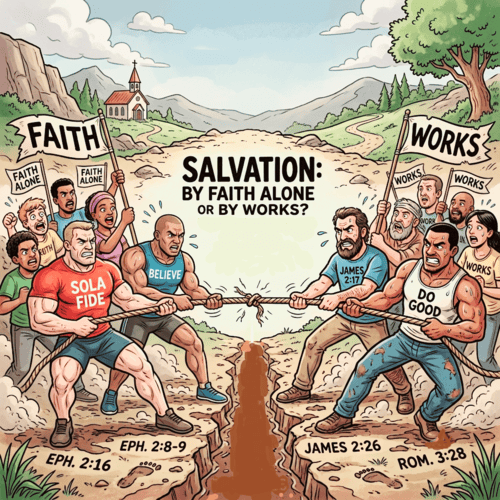
The question every person asks
Every honest person asks some version of this question, sooner or later: when I stand before God, will I have done enough? It’s the most natural question in the world, and almost every religious system answers it the same way—by handing you a ledger. Do more good than bad. Keep the rules. Tip the scales in your favour. Beneath the surface of nearly every faith lies the quiet assumption that heaven is a wage, and the wage must be earned.
The Christian gospel cuts clean across that instinct, and the doctrine at the heart of it is startling: salvation is a gift, received and not achieved—not by works, not by merit, not by the careful balancing of a moral account. So can we earn salvation? The biblical answer is a flat no. We cannot earn it, top it up, or hold on to it by our performance. So what does the Bible say about salvation and works? Not that the two are unrelated, but that the relationship runs in one direction only—and getting that direction right is everything.
That answer lands with an immediate objection, and it’s the right one to feel: doesn’t it matter how we live? If we’re saved by faith and not by works, why be good at all? Two positions present themselves. The first says we’re accepted by God on the basis of grace assisted by our cooperation—our merit topping up what Christ began. The second says we’re accepted on the basis of Christ’s work alone, received by the empty hand of faith, with works following on as the fruit of a faith already given. These aren’t two flavours of the same gospel. They’re two different gospels, and the difference is the subject of this article.
What Paul says—and what he means
No passage states the case more plainly than Paul does in Ephesians 2:8–9: For by grace you have been saved through faith. And this is not your own doing; it is the gift of God, not a result of works, so that no one may boast.
Read slowly, the verse does three things at once. It names the source of salvation (grace), the instrument by which it is received (faith), and the thing it categorically excludes (works). The hinge of the sentence is the phrase this is not your own doing. What is the “this” Paul has in mind? In Greek, the demonstrative pronoun translated “this”—touto—is neuter. The two nouns it might point back to, “grace” (charis) and “faith” (pistis), are both feminine. Grammatically, then, touto doesn’t single out faith as the gift; it gathers up the whole preceding clause—the entire event of being saved by grace through faith—and calls all of it the gift of God. As grammarian Daniel B. Wallace observes, the neuter most naturally refers to the concept of salvation-by-grace-through-faith as a package, not to one isolated word within it.
This matters enormously. It means even the faith by which we lay hold of Christ is not a contribution we bring to the table; it too is given. There’s no corner of salvation left over for us to claim credit for. Then comes the logic of the next line: not a result of works, so that no one may boast. Paul sets grace and merit against each other as mutually exclusive categories. Elsewhere he makes the principle explicit—if salvation is by grace, then it’s no longer on the basis of works, otherwise grace would stop being grace (Romans 11:6). A gift that must be earned isn’t a gift; a wage that’s freely given isn’t a wage. The whole point of grace is that it terminates boasting. Nobody in heaven will be able to say they made the difference.
This is what the Reformers meant by sola fide—faith alone: the conviction that we’re justified, declared righteous before God, through faith and not by any work we perform. Justification here is a courtroom word: to justify isn’t to make someone good but to declare them in the right, to pronounce a verdict of acquittal. Salvation by faith not works is, at root, the announcement of a verdict we could never have secured for ourselves.
What about James? Faith without works is dead
Here the careful reader raises a hand, because there is a verse that seems to say the opposite. James writes: You see that a person is justified by works and not by faith alone (James 2:24). Paul excludes works; James, remarkably, denies “faith alone” in those very words—the phrase the Reformation would later raise as its banner. Put the two side by side and we appear to have a contradiction at the centre of the New Testament.
This is the objection nearly every reader arrives with, and it deserves a real answer rather than a clever dodge. The resolution turns on three observations.
- Different questions, different audiences. Paul confronts people who imagine they can build a standing before God out of law-keeping. James confronts the opposite error: people who say they have faith while their lives show no trace of it. What good is it, my brothers, if someone says he has faith but does not have works? Can that faith save him? (James 2:14). Notice the wording—”someone says he has faith.” James isn’t asking whether real faith saves; he is asking whether a faith that is all talk is worth anything. His answer is no.
- Two senses of the word “justify.” Paul uses it forensically: to be justified is to be declared righteous in God’s court. James uses it demonstratively: to be shown, vindicated, proved genuine before the watching world. When James says works justify, he means works prove the reality of a faith that already exists—the faith does the saving, the works do the showing. The popular phrasing “faith without works is dead” catches his conclusion exactly (faith apart from works is dead, James 2:26), but the point is not that works keep faith alive; it is that the absence of works exposes a faith that was never living to begin with. James presses it with biting irony: You believe that God is one; you do well. Even the demons believe—and shudder! (James 2:19). Bare assent to true propositions is something demons manage. Saving faith is more than agreement; it is trust that takes hold of Christ and necessarily reshapes a life.
- The same man, Abraham, at two moments. Both writers cite him. Paul points to Genesis 15, where Abraham believed the LORD, and he counted it to him as righteousness—reckoned righteous on the spot, by faith, years before the deed James cites. James points to Genesis 22, the offering of Isaac decades later, where that long-held faith was visibly proved by obedience. Abraham was justified before God in Genesis 15 and justified before men in Genesis 22, and there is no quarrel between the two. The works did not earn the verdict; they displayed it.
So the tension dissolves once the order is right. Works are the fruit of saving faith, never its root—the evidence that justification has happened, never its cause. Paul and James are not two witnesses contradicting each other; they are two describing the same tree from different ends: one names the root, the other inspects the fruit.
Sola Fide: the Reformation’s defining conviction
The phrase sola fide—Latin for “by faith alone”—gave the 16th-century Reformation its battle cry, and it’s worth understanding why so much was staked on a single Latin word. When Martin Luther came to see that the righteousness God requires is a righteousness God gives, received by faith and not assembled by effort, the discovery reordered everything. He called justification by faith alone articulus stantis et cadentis ecclesiae—the article by which the church stands or falls. He wasn’t exaggerating for effect. In his judgement, get this doctrine right and we have the gospel; get it wrong and whatever we are left with is no longer Christianity, however much religious furniture remains.
What was actually at stake? In the late medieval church, salvation was widely understood as a process of grace and human cooperation working together—grace infused into the believer through the sacraments, making the person progressively righteous, with that inner righteousness then forming part of the ground on which God finally accepts them.
The practical effect, as Luther found in his own tormented conscience, was that assurance became impossible. If my acceptance rests partly on a righteousness still being worked into me, how could I ever know whether I had enough?
The Reformers answered with a different mechanism altogether. Justification, they argued, isn’t God making us inherently righteous and then accepting us for it; it’s God declaring us righteous by crediting to us a righteousness not our own—the righteousness of Christ, reckoned, or imputed, to the believer. To impute is to put something to someone’s account. Our sin was put to Christ’s account at the cross; his perfect record is put to ours by faith. We are, in John Calvin’s framing, accepted not because of what God finds in us but because of what he sees in Christ on our behalf. That’s why faith alone can justify—because faith is the empty hand that receives a finished righteousness, contributing nothing to it.
The Roman Catholic Church drew the opposite line, and drew it formally. At the Council of Trent (1545–1563), in its decree on justification, it pronounced its anathemas: if anyone says that the sinner is justified by faith alone, meaning that nothing else is required to cooperate, let him be anathema (Session 6, Canon 9). Trent affirmed grace, but a grace that infuses righteousness and is then increased by good works and merit—faith formed and completed by love as the thing that finally justifies. The two positions were stated with such precision that the disagreement could not be smoothed over, and despite warm modern dialogue it has never been formally dissolved. The divide isn’t a Reformation-era misunderstanding waiting to be cleared up; it’s a genuine difference about how a sinner comes to stand accepted before a holy God.
Justification, sanctification, and why works matter
To hold all this together without confusion, one distinction does most of the work—the difference between justification and sanctification:
| Justification | Sanctification |
|---|---|
| A single, decisive legal declaration | A lifelong, gradual process |
| God declares us righteous | God’s Spirit makes us righteous |
| Christ’s righteousness reckoned (imputed) to us | Christ’s righteousness worked out in us |
| Complete at once; never reversed | Begun now; finished only in glory |
| Our works contribute nothing | Our works follow necessarily, as fruit |
Collapse the two and we lose the gospel; keep them distinct and everything falls into place. This is the sense in which the Reformers could say, without contradiction, that faith alone justifies but the faith that justifies is never alone. The point is captured exactly by the Westminster Confession, which states that faith is the alone instrument of justification, yet adds that it is ever accompanied with all other saving graces, and is no dead faith, but worketh by love (11.2). Faith does the justifying single-handed; but real faith never arrives single. It comes carrying repentance, love, obedience and the slow harvest of a changed life.
Works are therefore necessary—not as the cause of acceptance but as its inevitable result. There is a deeper reason meritorious works are ruled out, and it reaches back to the beginning. Reformed theology speaks of a covenant of works made with Adam, under which perfect obedience was the condition of life—a probation Adam could, in principle, have passed. He failed, and with him the whole race, so that no son or daughter of Adam now stands in a position to earn anything by obedience; the terms were broken before we arrived. What replaces it is the covenant of grace, in which God provides in Christ—the second Adam—the very obedience we could not render. Christ keeps the covenant of works on our behalf and bears its penalty, and his record becomes ours by faith. Our standing, then, is never our performance measured against God’s law; it is Christ’s performance credited to us.
Does this open the door to antinomianism—the idea that, being saved by grace, we may live however we please? It doesn’t, and the structure of the doctrine itself closes that door. A faith that leaves the life untouched is, by James’s own test, dead faith, and dead faith justifies no one. The grace that pardons is the same grace that renews; we cannot receive the one without the other. Far from licensing sin, sola fide cuts its root—because the believer no longer obeys to win God’s favour but obeys because that favour is already, irreversibly, his.
What this means for ordinary Christian life
All of this lands somewhere very practical: in the matter of assurance. If our standing with God rested on our performance, our confidence would rise and fall with our week, and on our worst days we’d have no ground to stand on at all. But if we’re justified by faith alone, our acceptance doesn’t move, because it never rested on us in the first place. It rests on a finished work outside us. Assurance flows from grace, not from the quality of our last fortnight.
This reorders motivation from the ground up. The person trying to earn God’s favour obeys out of fear, watching the scales, never sure it’s enough. The person who knows he is already accepted obeys out of gratitude and love, free at last from the exhausting business of keeping score. Holiness stops being the price of God’s acceptance and becomes the natural response to it. This is the pastoral payoff of getting the doctrine right: it produces not careless Christians but glad ones, people who pursue godliness hard precisely because they’re no longer trying to purchase anything by it.
It also frees us from the tyranny of comparison and the despair of failure. When we sin, we don’t lose our justification and scramble to rebuild it; we return to the same grace that saved us in the first place, confess, and go on. The Christian life becomes a life lived from acceptance rather than for it. That’s the difference sola fide makes on an ordinary Tuesday—the quiet confidence that lets a believer get up after falling, because the verdict was never in his hands to begin with.
Tough Questions, Honest Answers
Doesn’t James 2 contradict Paul?
No—they’re answering different questions. Paul argues we’re justified before God by faith and not by earning, addressing people who tried to build a standing through law-keeping. James argues genuine faith always shows itself in works, addressing people who claimed faith but lived as though they had none. Paul speaks of justification before God; James speaks of faith being proved genuine before men. When James says works justify, he means works demonstrate the reality of faith, not that they contribute to God’s verdict. They’re describing the same tree—Paul names the root, James inspects the fruit.
What about Matthew 25 and the sheep and the goats?
In that scene the King separates the nations by what they did—feeding the hungry, clothing the naked—which can look as though works are the basis of salvation. But notice the detail: the righteous are genuinely surprised, asking when they ever did these things (Lord, when did we see you hungry and feed you?). Their good was unselfconscious, the overflow of a renewed heart, not a calculated bid for reward. The works are the evidence by which true faith is recognised on the last day, not the currency by which heaven is bought. Judgement according to works and justification by faith alone are perfectly compatible once you see that works are the fruit being inspected, not the root being planted.
Does this mean I can live however I like?
The opposite. A faith that leaves your life unchanged is exactly the dead faith James says cannot save anyone. The grace that forgives is the same grace that transforms; they are never separated. What sola fide removes is not the call to holiness but the lie that you obey in order to be accepted. Freed from earning, you obey out of love—and that, not fear, is the engine of real and lasting change.
What did the Catholic Church actually teach on this?
Fairly stated, Rome teaches that justification is a process in which grace is infused into the believer, chiefly through the sacraments, making the person inwardly righteous, with good works performed in grace genuinely meriting an increase of that righteousness. At the Council of Trent it formally condemned the teaching that we are justified by faith alone. The Reformed response is not that Catholics deny grace—they affirm it—but that they redefine justification as God making us righteous within rather than declaring us righteous in Christ, which reintroduces our works as part of the ground of acceptance. That single difference is why the Reformation divide remains real and not merely verbal.
How can I know whether my faith is the saving kind?
Not by achieving a certain score, but by looking for signs of life. Saving faith is more than agreement that Christian claims are true—even demons manage that much (James 2:19). It is trust that rests on Christ and, over time, bears fruit: a softening towards sin, a love for God and others, a desire to obey that was not there before. If you find that fruit appearing, however imperfectly, it is evidence of a living faith. And the assurance you are looking for finally rests not on the strength of your faith but on the object of it—Christ, who saves completely those who come to God through him.
Related Reads
- Why Can’t I Be Sure I’m Saved—and What Can I Do About It?
- What Role Does Repentance Play in the Christian Life?
- For Whom Did Christ Die? The Biblical Case for Definite Atonement
- The Synod of Dort: The Debate That Gave Us TULIP
- What Are the Marks of a True Church?
- The Ordo Salutis: What Are the Seven Steps in Our Salvation?
- Did Jesus Preach the Gospel?
- The Romans Road to Salvation: What Really Is It?
- What Does the Thief on the Cross Teach Us About Salvation?
- Abraham, Friend of God: What Does This Title Really Mean?
- What Does the Holy Spirit Do in Salvation?