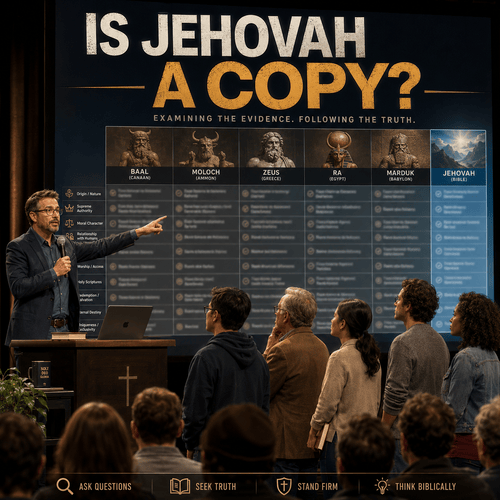
You’ve probably seen the meme. A grid of ancient statues, a few arrows, and the caption: “Your God is just a recycled Canaanite deity.” The meme offers no argument to examine, only a verdict to accept.
Underneath the slogan sit six academic claims—and not one claim agrees with the next. Jehovah began as El, the elderly high god of Ugarit. Or He was a storm god like Baal. Or Genesis 1 comes from a Babylonian poem. Israel’s monotheism sprang from an Egyptian pharaoh. Or Jehovah Himself originated with a tribe south of Canaan. The fact that each claim quietly contradicts the next is our first clue:
The problem lies in the method, not in the Bible.
What the ancient texts actually say
In 1929 a farmer’s plough struck a tomb at Ras Shamra in Syria. Beneath it lay Ugarit, destroyed around 1200 BC, and a library of tablets in a language close to Hebrew—Canaanite religion in its own words at last.
Three figures matter here:
- El. The father of the gods at Ugarit—old, tired and semi-retired. He fathers children by goddesses and in one tablet drinks himself into a stupor and has to be carried home. The word “el” is also the ordinary Semitic noun for “god”, just as “god” in English is both a common noun and a name.
- Baal. The storm god, the active young rival. He fights Yam (sea) and Mot (death), wins kingship, dies and returns—a cycle mirroring the farming year. He is powerful but not supreme—he’s often defeated.
- Marduk. The champion of Babylon in the poem Enuma Elish. He kills the sea goddess Tiamat, splits her corpse to make sky and earth, and forms humans from a rebel god’s blood to work as slaves so the gods can rest.
There are real overlaps of vocabulary and imagery here with the Old Testament. No serious scholar denies that. What they challenge instead is the question these overlaps prove.
Three thinking errors behind the claim
1. Parallelomania
In 1961 Jewish scholar Samuel Sandmel coined this word for a habit he saw everywhere: spot a similarity, leap to a source, treat the source as an explanation. But similarity has at least four causes, and only one is copying:
- Shared cultural language. Everyone in the ancient Near East described kings, thrones and storms in similar words—just as every modern culture pictures love with hearts.
- Common religious residue. Human beings everywhere reach for sacrifice, priesthood and temple because they’re made for God.
- Deliberate polemic. Sometimes a writer picks up his opponent’s imagery precisely in order to demolish it. John Currid calls this “polemical theology”—Scripture using the neighbours’ furniture to make the opposite point.
- Genuine borrowing. If there’s real literary dependence—or copying—it must be demonstrated, not assumed.
Almost everything offered as evidence for a borrowed Jehovah belongs to the first three.
2. The genetic fallacy
This is judging a thing by where its words came from rather than by what it says. Our word “God” descends from pagan Germanic religion, yet nobody thinks English-speaking Christians secretly worship Odin. Vocabulary tells you which language a person speaks, not which God he believes in.
3. A theory imposed, then “discovered”
The famous sequence—many gods, then one favoured god, then one only God—didn’t come out of the ground. It came out of 19th-century European philosophy, where every religion had to be climbing a ladder from primitive to refined. Julius Wellhausen and his followers brought that framework to the text and duly found it there.
The sharpest reply came not from a Christian apologist but from Jewish historian Yehezkel Kaufmann. Israelite monotheism behaves like a starting point, not a destination. Had it grown out of polytheism, the Old Testament would be full of half-digested mythology—gods born, married, dying. It has none. The leftovers are missing because they were never there.
The One Difference That Explains All the Others
John Oswalt argues the gap between Israel and its neighbours isn’t a difference in details but in the whole structure of reality.
Pagan religion is continuous. The gods come out of nature, are trapped inside it, and can be handled by ritual because they belong to the same system as the worshipper. Sex, storm and harvest are divine because divinity is just nature at its strongest.
Scripture is transcendent. God isn’t part of the world He made: no origin, no rival, no partner, no need. He’s known by His word and obeyed by covenant, not managed by technique. No shared vocabulary bridges that gap.
El: the same word, an opposite being
The El theory suggests Jehovah was once a junior member of El’s pantheon who later absorbed his boss, inheriting his titles—El Elyon, El Shaddai—and even his name inside the word “Israel”.
Read Genesis 14 and you find something else. Melchizedek blesses Abram in the name of God Most High; Abram swears to “the LORD, God Most High, possessor of heaven and earth” (14:22). Not a memory of promotion but an identification: the Most High whom you name is the LORD whom I know.
And when Ugarit’s El and Jehovah are set side by side, they’re not variations on a theme. They’re stark contradictions. Sample these:
| El at Ugarit | The God of Scripture | |
|---|---|---|
| Origin | He is part of a divine family with a genealogy | He is self-existent: “I AM WHO I AM” (Exodus 3:14) |
| Marriage | He has a consort and fathers other gods | He has no consort, no offspring by generation |
| Morality | He’s drunken, sexually driven, easily flattered | Holy, holy, holy (Isaiah 6:3) |
| Needs | Fed by sacrifices, must be housed and pleased | “If I were hungry, I would not tell you” (Psalm 50:12) |
| Rivals | Can be pushed aside by a younger god | “Besides me there is no god” (Deuteronomy 32:39) |
| Relationship | Bargaining and ritual technique | Covenant sworn by oath and kept by grace |
Deuteronomy 32:8-9 are used to demote Jehovah, since they have the Most High dividing the nations while Jacob becomes the LORD’s portion. But the same song calls Him Father and Maker (v. 6), sole guide (v. 12), the only God there is (v. 39). Michael Heiser’s reading fits far better: after Babel God handed the rebellious nations to lesser spiritual powers as judgement, and kept Israel for himself. We read Genesis 32 as a a courtroom sentence, not an organisation chart.
Psalm 82:7 works the same way. It’s often cited as proof that Jehovah sat on a committee of gods—yet it ends by sentencing those “gods” to die like men. As if pantheon rosters condemn their own members to death.
Baal: borrowed imagery, demolished claim
Psalm 29 is the favourite exhibit. Seven times “the voice of the LORD” thunders; cedars break, mountains skip, the wilderness shakes. Some suggest it was once a hymn to Baal with the divine name swapped in.
But notice where it goes: the LORD is enthroned over the flood, king for ever (v. 10). In the Baal Cycle, beating the sea is the struggle Baal barely survives; here the sea is the footstool of a King already seated. Shared imagery, flat denial.
And Israel didn’t stumble into this. Two passages show the Bible confronting Baal deliberately:
- Mount Carmel (1 Kings 18). The storm god is challenged to produce fire and cannot; Elijah prays and the rain comes. If Israel were quietly copying Baal, this is a strange way to do it.
- Hosea 2. Israel credits Baal with grain, wine and oil. God replies that it’s He who gave them these all along (Hosea 2:8), and promises to remove the very name of Baal from His people’s mouths (Hosea 2:16–17). That’s not absorption. But eviction.
The same answer covers the “chaos combat” claim, that Leviathan and Rahab are leftovers of a war between God and the sea. In Genesis 1 the sea is no enemy and the sea creatures are things God makes and blesses (1:21). There’s no fight in the Bible’s creation account at all. Later, Leviathan either pictures a real rescue—Isaiah 51:9–10 uses crushed-monster language for the Red Sea—or is a creature God treats as a plaything (Job 41). Scripture keeps the poetry and dismantles the myth.
Babylon: Genesis 1 and the flood
The claim that Genesis 1 is a tidied-up copy of the Babylonian creation epic, Enuma Elish sounds strong until the two are read side by side. Alexander Heidel showed decades ago how little survives.
| Question | Enuma Elish | Genesis 1–2 |
|---|---|---|
| How does creation begin? | Aa a war between gods | With the word: “Let there be” |
| What is the world made from? | The corpse of a defeated goddess | Nothing—God simply speaks |
| Why are human beings made? | From a rebel god’s blood, for slave labour | In God’s image, to rule and to rest |
| Is matter divine? | Yes—the gods and the world share one substance | No—creation is good, but it certainly isn’t God |
| How does it end? | A temple built so the gods can be fed | A Sabbath given so man can enjoy God |
The claim that the Hebrew tehom (“the deep”, Genesis 1:2) is borrowed from the goddess Tiamat also fails linguistically: the consonants don’t transfer that way between the languages. Tehom isn’t a monster. It’s water, and it has no will of its own.
Two ancient Mesopotamian stories, Atrahasis and the Epic of Gilgamesh, do share striking details with Genesis: a man who is warned, a boat, animals aboard, birds sent out to test the water, a landing on a mountain, a sacrifice afterwards. But stop and ask what we should expect if a real flood really happened, and only one family lived through it. Their descendants would spread across the earth and keep telling the story. Every version would drift over the centuries, yet each would keep the same bones. That’s exactly what we find: flood traditions on every continent—the fingerprint of a shared memory, not of literary theft.
Egypt, Soleb and the god from the south
Two theories look further afield.
The first, popularised by Sigmund Freud, says Israel got monotheism from Pharaoh Akhenaten, who raised the sun disc Aten above all other gods. But his reform barely outlived him: his successors erased it within a generation. Israel’s faith is nothing like this. It does not worship the sun. It outlived every empire that tried to crush it. And it centres on a God who cannot be seen at all—one who forbids images of Himself outright. Most critical scholars have quietly abandoned this theory.
The second theory is far more serious, and deserves a careful answer. Egyptian temple lists at Soleb and Amarah West, carved around 1400 BC, appear to name a place as “Yhw in the land of the Shasu”—the Shasu being nomads who roamed Sinai and Edom. Now add the Hebrew poems that picture God coming from the south, from Seir, Teman and Paran (Judges 5:4–5; Habakkuk 3:3).
Put the two together and you get the Midianite hypothesis: Jehovah was a desert god, and Israel picked Him up from Moses’ Midianite in-laws.
Suppose we granted that reading of the inscription in full. What would actually follow?
- Scripture places God’s covenant revelation in exactly that region. The burning bush burns in the wilderness, where Moses was keeping the flocks of Jethro, priest of Midian (Exodus 3:1). The southern imagery in Hebrew poetry remembers where God met His people. It does not tell us where He came from.
- The Bible itself says the name was known outside Israel. Jethro confesses that the LORD is greater than all gods, and offers sacrifice (Exodus 18:10–12). Melchizedek, Balaam and Job all stand outside the covenant line, and all of them know something true. Scripture never shuts the knowledge of God inside one nation.
- In the Bible’s own account, the name is far older than Sinai. “At that time people began to call upon the name of the LORD” (Genesis 4:26), and God introduces Himself to Abram as the LORD (15:7). Exodus 6:3 is not saying the patriarchs had never heard the syllables. It is about covenant knowledge of what the name means—the God who now steps in to redeem.
So the inscription, if the reading is right, tells us the name was in use in that corridor even before the exodus. That’s precisely what the Bible would lead us to expect. It comes nowhere near showing that Israel invented a god by adopting one.
Asherah: archaeology confirms what the prophets said
Then there are the inscriptions from Kuntillet Ajrud and Khirbet el-Qom, blessing by “Yahweh of Samaria and his asherah”. Here, surely, is Jehovah with a wife.
Two things need saying. First, the Hebrew resists reading “asherah” as a personal name, because Hebrew personal names do not normally take the possessive ending this word carries. A cult object or shrine—the wooden pole the Old Testament repeatedly condemns—reads more naturally.
Second, suppose it were a goddess. That would prove some Israelites worshipped Jehovah alongside a goddess—exactly what the Bible says they did, at length and with grief. Prophets denounce it; kings do it and are condemned; Josiah drags the Asherah out of the temple itself and burns it (2 Kings 23:6). These inscriptions come from the popular religion Scripture calls apostasy. They show the Bible telling the truth about its own people.
A Word About the Word “Jehovah”
God’s covenant name is written in Hebrew with four consonants, YHWH. Out of reverence, Jewish readers said “Adonai” (Lord) rather than pronounce it, and scribes who later added vowel marks inserted the vowels of Adonai as a reading cue. European scholars, not knowing this, fused the consonants with those borrowed vowels and produced “Jehovah”.
So the spelling is a hybrid with a traceable history. But spelling and bearer are different questions. “Jesus” reaches English through Greek and Latin, far from the Hebrew “Yeshua”, and nobody thinks that makes him another person. The form is medieval; the God is not.
Why the parallels actually support the Bible
Christians often treat the parallels as a problem. They needn’t be. They’re what Scripture predicts.
Paul’s account of religion in Romans 1 doesn’t run from primitive to refined. It runs downhill. Humanity knew God, refused to honour Him, and exchanged His glory for images (Romans 1:21–23). Idolatry is not a stage on the way up but a fall from something already held.
Which account fits the evidence better?
- The evolutionary account must explain why one small, insignificant nation produced, apparently out of nowhere, a creation account with no mythology, a God with no origin, and a law that condemned its own kings. An unexplained mutation.
- The biblical account expects fragments of true knowledge in every culture, because every culture descends from people who once knew God. Creation, a flood, sacrifice, a lost garden, a coming deliverer appear worldwide because they are memories, corrupted but not erased.
John Calvin described a sense of divinity engraved on every human mind, and a seed of religion no one can uproot—then added that the mind is a perpetual factory of idols. Both halves matter. The knowledge is real, which is why the parallels exist; the corruption is real, which is why they’re distortions.
Cornelius Van Til sharpens this. A pagan and a prophet can both say “god”, “sacrifice” and “holy” while meaning universes that cannot be reconciled. Comparing dictionaries will never settle the question; you have to compare the systems.
What Jehovah is that no ancient god ever was
Finally, set the arguments aside and look at the claims. The Bible’s God has attributes that appear nowhere in the ancient Near East and cannot be assembled from its materials:
- He made everything from nothing. No other ancient god creates without pre-existing material to work on, and none is beyond change or mood.
- He depends on nothing. He needs no temple, no food, no worshippers (Acts 17:24–25).
- He is morally holy and binds himself by his own law. Ancient gods are strong; rarely good, never accountable.
- He keeps promises by oath. Covenant—God binding Himself to unworthy people and refusing to let go—has no pagan parallel.
- He became man and died for His enemies. The dying-and-rising gods of the myths die because that’s what the seasons do. Christ died on a dated afternoon under a named governor, and rose in a body that could be touched.
The Westminster Confession gathers it up: God is infinite in being and perfection, most holy, most free, most absolute, working all things according to His own unchangeable and most righteous will. Try deriving that from a drunken banquet at Ugarit or a corpse split open to make the sky. It cannot be done.
So is Jehovah a copy of other ancient gods? He shares their language, their poetry, sometimes their furniture. He shares nothing of their nature. The ancient world was crowded with gods who were larger versions of ourselves—hungry, moody, manageable.
Only one God has ever said “I AM”. And only one has ever come looking for us.
Tough Questions, Honest Answers
Is Jesus a copy of Horus, Mithras or Dionysus?
The “dying and rising saviour” template that this claim depends on was largely constructed in the 19th century by stitching together details from different centuries and cultures. When the actual sources are read, the parallels collapse: Horus isn’t crucified, Mithras is born from a rock and has no resurrection, and most of the closest-sounding details in Mithraism come from documents written well after the New Testament. More importantly, the myths are cyclical—they happen every year, nowhere in particular. The Gospels report a public execution under a named Roman governor, in a named city, with named witnesses who could be interrogated and were. Paul stakes the entire faith on whether one historical event actually happened (1 Corinthians 15:14), which no mystery religion ever did.
Did the Jews get monotheism, angels and the resurrection from Zoroastrianism during the exile?
The dating works against this claim. The Avestan texts that describe Zoroastrian doctrine in detail were written down centuries after the Persian period, so we cannot be confident what 5th-century Persians actually believed, while Israel’s hope of bodily resurrection is already present in pre-exilic and early texts (Job 19:25–27; Isaiah 26:19). Beyond dating, the two systems are structurally opposed. Zoroastrianism is a dualism in which two roughly matched powers, good and evil, contend for the universe. Scripture has one Creator and no rival—Satan is a creature under judgement, not a counterweight. Borrowing cannot explain a system that denies the borrowed system’s central premise.
Is the Trinity borrowed from pagan triads such as Osiris, Isis and Horus?
A triad is three separate gods standing near each other, often as a family. The Trinity isn’t that, and the church has always refused to say it is. Christians confess one being, one essence, indivisible, existing eternally as Father, Son and Holy Spirit—not three gods cooperating, and not one god wearing three masks. Osiris, Isis and Horus are three distinct deities with a genealogy and a marriage; the Father doesn’t beget the Son the way Osiris fathers Horus, and the Spirit isn’t a consort. The doctrine also doesn’t come from speculation but from the New Testament’s insistence that there is one God (1 Corinthians 8:6) while Father, Son and Spirit are each addressed as that God. No pagan triad supplies material for all that.
Do the Elephantine papyri show Jews worshipping Jehovah alongside a goddess?
They show something less than that, and something the Bible has already told us. Elephantine was a Jewish military colony in southern Egypt in 5th century BC, cut off from Jerusalem, with its own temple and some evidence of syncretistic worship including a figure called Anat-Yahu. But a diaspora community drifting from the faith proves the drift, not the origin. Jeremiah devotes an entire chapter to condemning exactly this—Judeans in Egypt burning incense to the queen of heaven (Jeremiah 44). The papyri corroborate the prophets’ complaint; they do not contradict it.
Are the Ten Commandments copied from the Code of Hammurabi?
The two documents are different in kind. Hammurabi’s code is a long list of case laws—if this happens, then this penalty—presented as the king’s wisdom for his own glory. The Ten Commandments are covenant stipulations spoken in the first person by God himself, beginning not with a rule but with redemption: “I am the LORD your God, who brought you out of the land of Egypt” (Exodus 20:2). Hammurabi’s penalties also vary by social class, so a nobleman and a slave pay very differently for the same offence, whereas Israel’s law binds king and labourer to the same standard and repeatedly protects the foreigner, the widow and the poor. Shared legal vocabulary in the ancient world is expected; a law that governs the conscience and outlaws coveting is not.
Why do some groups insist on the spelling “Jehovah” if it’s a medieval form?
Because they treat the exact form of the name as the test of true worship, which Scripture never does. New Testament writers, quoting the Old Testament under the Spirit’s inspiration, regularly use the Greek word for “Lord” where the Hebrew has the covenant name, so the apostles themselves didn’t insist on a single pronunciation. That said, the honest response isn’t to sneer at the word. “Jehovah” is a legitimate English rendering with centuries of use in hymns and prayers, and English versions that print “LORD” in capitals are marking the same name. What matters isn’t the vowels but whether the God being named is the one who has revealed Himself in Jesus Christ.
Were Israel’s sacrifices and tabernacle copied from Canaanite and Egyptian worship?
Israel certainly used the shared architectural and ritual grammar of its world: a courtyard, a holy place, an inner sanctuary, an altar, a priesthood, offerings. That shouldn’t surprise us, since God was speaking to real people in a real culture using forms they could understand. But the theology inside the structure is reversed. Pagan temples exist to house and feed a god who needs them; the tabernacle exists because a God who needs nothing chose to dwell with sinners. Pagan sacrifice is payment offered upward to secure favour; Israel’s sacrifice is a substitute God himself provides and prescribes, pointing forward to the one offering that ends the system (Hebrews 10:11–14). The furniture is familiar; the God who fills the room is not.
Related Reads
- Is Jesus’ Resurrection Copied from Pagan Myths? Truth vs. Lies
- Ancient Flood Stories Compared: What Makes Noah’s Account Different?
- Did the Hittites Exist? How Archaeology Vindicates the Bible
- Babylon Archaeology: How the Ruins Confirm Bible Accounts
- Is the Bible Historically Reliable? Here’s What the Evidence Shows
- The Names of God and What Each One Really Means
- What Do Jehovah’s Witnesses Believe? A Biblical Examination of JW Doctrine
- Is Jesus a Mere Copy of Pagan Gods?
- The Second Commandment: Why Does God Forbid Idols?
- The First Commandment: Why Does God Demand Exclusive Worship?
- Mount Carmel in the Bible: Elijah’s Fire and the Cross of Christ