
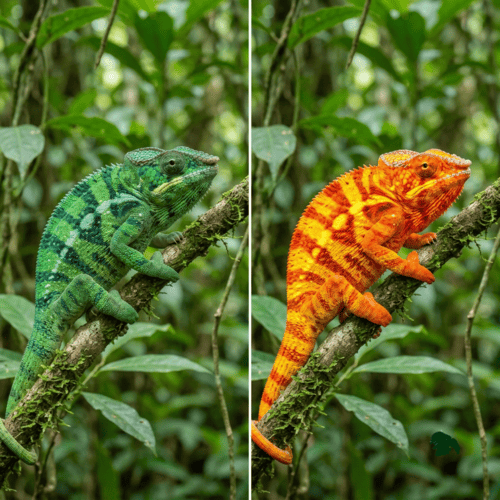
A panther chameleon sits on a branch in Madagascar, calm and green. Another male arrives. Within four seconds the first is blazing orange and yellow, every stripe lit up like a warning sign.
Ask most people how he did it, and they’ll tell you he moved pigment around under his skin. Sounds sensible. But it’s wrong.
In 2015, a team at the University of Geneva—Jérémie Teyssier, Suzanne V Saenko, Dirk van der Marel and Michel C Milinkovitch—published their findings in Nature Communications. They’d pointed serious optical instruments at chameleon skin, and what they found wasn’t a paint box. It was a machine: a tunable optical device, built at a scale smaller than a wavelength of light, wired into the nervous system, and driven by the animal’s mood.
What’s Actually Under the Skin
Start with the word pigment. A pigment is a chemical that absorbs some colours of light and reflects the rest. Ink, paint and our hair colour are all pigment. To change a pigment colour we must move the chemical, make more, or destroy it.
Now the word structural colour. This is colour with no chemical involved. It comes from tiny physical structures arranged so precisely they bounce back one colour of light and cancel out the rest. A soap bubble does this. So does a peacock feather—there’s no blue pigment in a peacock, and grinding the feather up destroys the blue, because we’ve destroyed the structure making it.
The chameleon uses both. But the dramatic work is structural, and the structure is astonishing.
Inside cells called iridophores (from iris, meaning rainbow), the chameleon grows a lattice of crystals made of guanine—the same substance found in DNA. Each crystal is about 127 nanometres across, one millionth of a millimetre. Roughly 800 of them side by side would span a human hair.
They’re not scattered randomly but stacked in a neat triangular grid—what physicists call a photonic crystal: a structure whose spacing is tuned to the wavelength of light itself, so waves reflecting off each layer line up and reinforce each other. Engineers build these in laboratories to make optical filters and laser mirrors. The chameleon grows one inside a cell.
Retuning, Not Repainting
Here’s the part that overturns the textbook. The chameleon doesn’t move the crystals. He changes the spacing between them.
Relaxed, the lattice sits tight and compact, and tight spacing reflects short wavelengths—blue. Excited, the cells swell, the lattice expands by around 30%, and the reflected colour slides up the spectrum: blue to green to yellow to orange to red. The tuning appears to be driven by water moving into and out of the cells.
It’s the difference between a painter and a radio. The painter has to fetch a new colour. The radio just turns a dial and a different station appears—because the wavelength it is tuned to has shifted.
SO WHY IS A RESTING CHAMELEON GREEN?
- Because green is a mixture. Above the crystal layer sits a layer of yellow-pigment cells called xanthophores. Structural blue shines up through yellow pigment, and blue plus yellow gives green. That’s how nearly every green frog and green bird gets its colour too.
- Now watch what happens when the lattice detunes to yellow. The blue vanishes. The yellow pigment layer, which had been subtracting from blue to make green, is suddenly adding to yellow. The animal flares orange. One change, two effects, both working together. That’s not luck. That’s layering.
The Infrared Layer Nobody Was Looking For
The Geneva team found something else, and it had nothing to do with display at all.
Beneath the tunable lattice lies a second layer of iridophores with larger, thicker, deliberately disordered crystals. These reflect near-infrared light—the invisible part of sunlight that carries heat.
This layer contributes nothing to colour. We cannot see it working. It’s a heat shield: a passive mirror throwing solar heat away from a small cold-blooded animal sitting exposed in tropical sun, where overheating can kill.
Notice what that means. One skin architecture. Two separate jobs, on two bands of the spectrum, handled by two purpose-built layers stacked one on the other. Visible light for talking. Infrared for surviving. And nobody predicted this layer—no story about camouflage would ever have suggested looking for it.
The Full Stack
Here’s the whole system, from the outside in.
| LAYER | WHAT IT CONTAINS | WHAT IT DOES |
|---|---|---|
| Xanthophores and erythrophores | Yellow and red pigments (carotenoids, pteridines) | Filters and adds warm colour over everything below |
| S-iridophores | Triangular lattice of guanine nanocrystals, ~127 nm | The engine. Tunable structural colour, blue through red |
| D-iridophores | Larger, disordered guanine crystals | The heat shield. Reflects near-infrared away |
| Melanophores | Melanin packets moved by motor proteins along tracks | Darkens or lightens the whole display |
That bottom layer deserves a second look. Melanophores hold dark pigment in packets hauled along microscopic tracks by motor proteins called kinesin and dynein—molecular machines that walk, step by step, carrying cargo. Spread the packets out and the animal darkens; pull them back and it lightens. So the old textbook answer wasn’t false. It was describing the volume knob and calling it the whole radio.
Crystal, Nerve, Eye, Software
A photonic crystal on its own is a pretty rock. To be useful, it needs four things at once.
- An actuator. Something must change the lattice spacing on demand—the water-driven swelling of the cell.
- A control line. Sympathetic nerves deliver noradrenaline to receptors on the cell, with the hormone MSH driving slower, longer shifts. Response time: seconds.
- A sensor. The animal must see the situation to respond to it—and the chameleon eye is remarkable in its own right, with two turrets that swivel independently and a telephoto optical design found in no other vertebrate.
- Software. Something must decide which display fits the moment. Rival male? Female? Hawk overhead? The wrong answer can be fatal.
Now ask the honest question: what use is any one of these alone? A tunable crystal with no nerve supply is decoration. A nerve running to nothing is a wire in the dark. Instinct with no display hardware is a message with no voice. The parts are only worth anything assembled.
The Bigger Surprise: It’s a Language, Not a Hiding Place
Now the correction that matters most, and it cuts against the popular headline. Chameleons are famous for camouflage. Almost everything we’ve read says colour change evolved to help them hide. The evidence doesn’t support it.
Devi Stuart-Fox and Adnan Moussalli studied dwarf chameleons across southern Africa, publishing in PLoS Biology in 2008. They asked what predicts how much colour-change ability a species has. Camouflage didn’t predict it. Social signalling did. The species with the loudest displays to other chameleons had the greatest range of change. The dial exists for talking, not hiding. Two more findings sharpen this.
- Camouflage is aimed at a specific viewer. The same researchers, with Martin Whiting, showed a chameleon hiding from a bird tunes its colours differently from one hiding from a snake, because bird eyes and snake eyes see differently. One animal, two rendering targets.
- Colour is honest fighting talk. Russell Ligon and Kevin McGraw found that in veiled chameleons, stripe brightness predicts whether a male will fight, and head colour and speed of change predict who wins. The display is not bluffing. It is reporting.
So the strongest case for design isn’t the one in the headlines. It’s stronger than that.
THE POINT MOST ARTICLES MISS
This isn’t a hiding trick. It’s a signalling system. And a signal is only a signal if something is built to read it. We need a sender with tunable hardware. We need a receiver with colour vision fine enough to tell the difference. And we need a shared convention—an agreement that this orange means back off, not come closer. Arrive with only one of those three and we have nothing. A code with no reader is noise. A reader with no code is a listener in silence.
Every code we can trace to its origin—every alphabet, every signal flag, every protocol—came from a mind. Not because minds are the only cause we can imagine, but because minds are the only cause we have ever observed producing one.
The Best Case Against Us, Stated Fairly
A case is only watertight if it can hold the strongest objection. Here’s the best reply available to the naturalist:
| THE OBJECTION | THE RESPONSE |
|---|---|
| Guanine crystals are everywhere in biology—fish scales, spider eyes, reptile skin. Iridophores are an ancient, widespread cell type. The chameleon didn’t invent them. | Agreed—which is why the claim isn’t about the crystal. It’s about the tuning, the wiring, the sensing and the code: the parts that make it a system rather than a shine. |
| Colour-change ability is graded across species, from nearly static to spectacular. A gradient is what step-by-step change predicts. | The gradient is real and undisputed. But look at what varies. Every species in that comparison already has the lattice, the actuator, the nerve supply, the colour vision and the behaviour. The variation is dial-turning on an assembled machine. |
| Every intermediate is useful. A slight shift is a slight signal, so a slight mating advantage. Selection does the rest. | This explains the range of the dial, not the machine it is attached to. That distinction is the whole argument. |
Be plain about the shape of this reasoning. We’re not claiming science cannot explain it, therefore God. That argument retreats every time a new paper appears. The claim is positive: integrated, code-dependent systems are the kind of thing minds produce, and we know of no other cause that produces them. That stands on what we do know.
Two Creatures, Two Solutions, One Job
Cuttlefish and octopuses change colour too, dazzlingly. But they do it a completely different way: sacs of pigment pulled open by rings of muscle. No lattice tuning, and no shared ancestor with any of this equipment. Two unrelated lineages, two unrelated engineering solutions, the same goal.
The standard reading calls this convergent evolution. The design reading calls it common design—a designer reusing a purpose while varying the implementation, as engineers do across a product line. Be honest: this is evidence consistent with design, not proof of it. But it’s worth asking why chance arrives twice at the same destination by two roads that share nothing.
Within the Kind
There are more than 200 chameleon species, concentrated in Madagascar and sub-Saharan Africa, with outliers reaching Europe, the Middle East, India and Sri Lanka.
The reading offered here is that the whole family represents one created kind, or very few—a founding population that came off the Ark carrying rich genetic variety, dispersed, and diversified rapidly. That population spreading outward from Ararat, reaching Africa and then Madagascar, then splitting in island isolation, accounts for the pattern we see. Islands are where rapid diversification happens, and Madagascar is where the chameleons are.
The dwarf chameleon data fits this picture exactly. The selection is real. The variation it works on is real. The new species it produces are real. But all of it is working on ability that was already built in. That process isn’t making the photonic machinery. It’s only using it in new ways. Both sides are reading the same data. The argument isn’t about the dial. It is about who built the radio.
Camouflage in a Fallen World
Camouflage is for defence. Defence means predators. Predators mean death. Yet Scripture says God looked at all He had made and called it very good (Genesis 1:31), and that death came in through sin (Romans 5:12). So what was a chameleon hiding from in Eden? This is where the corrected science helps.
- The system is built for courtship, not hiding. That’s what the evidence shows, and courtship needs no fall. Colour used to win a mate fits “Be fruitful and multiply” (Genesis 1:22) perfectly well. Hiding looks like a later use of equipment made for something else.
- Chameleons eat insects. Genesis 1:20-21 and 1:30 describe the “living creatures” in words that many readers take to mean animals with backbones. Insects do not clearly belong in that group. If that’s right, an insect being eaten isn’t the death Romans 5 is talking about.
- Some design may have been waiting. The ability could have been built in from the start, then turned up after creation was subjected to futility and began groaning in the pains of childbirth (Romans 8:20-22).
This does not answer every question. Scripture doesn’t tell us when each function changed. But the problem is answerable, and it gets much smaller once you know the chameleon is mainly talking, not hiding.
Two Books, One Author
The Belgic Confession, Article 2, says creation lies before our eyes as a most elegant book, in which all creatures are as so many characters leading us to contemplate the invisible things of God.
John Calvin called the universe the theatre of God’s glory—then, in the same work, called Scripture the spectacles without which fallen eyes read that theatre wrongly. Both halves matter. The chameleon is a character in the book. Scripture is the lens.
Which is why the nanocrystals won’t convert anyone. Paul says the invisible attributes of God have been clearly perceived, ever since the creation of the world, in the things that have been made. So they are without excuse (Romans 1:20). Three verses earlier he says the truth is suppressed. The problem was never a shortage of evidence.
What the chameleon does is remove the pretence that unbelief is simply where the data leads. A tunable photonic crystal, wired to a nervous system, reading a code another creature is built to decode, with a heat shield underneath that nobody thought to look for. Somewhere down that list, it just happened stops being an explanation.
The psalmist got there first, without a spectrometer: O LORD, how manifold are your works! In wisdom have you made them all (Psalm 104:24).
Tough Questions, Honest Answers
Do chameleons change colour to match their background, like a screen?
No—this is the most persistent myth about them. A chameleon cannot scan a tartan blanket and reproduce it. It shifts within its own species-specific range, and that range is limited. Put one on a red shirt and it will not turn red for you. The colours it produces are the colours its lattice allows, deployed according to mood, temperature and social context, not copied from its surroundings.
Can any chameleon make any colour?
No. Each species has a fixed palette set by its hardware: the crystal size and lattice geometry it grows, and the pigments above. Panther chameleons are famous partly because their range is unusually wide. Many species are far more limited, and some barely change at all. The range is a property of the equipment, not of the animal’s imagination.
Do females change colour too?
Yes, and it confirms the signalling picture. Males change dramatically for rivalry and courtship. Females of many species change to say something specific: readiness to mate, or refusal. A pregnant female may display strong colours that mean stop. If colour change existed mainly for hiding, there would be no reason for the sexes to differ this way. If it exists for talking, the difference is what you would expect.
Does temperature affect colour?
It does, and this is physiology rather than mood. A cold chameleon often darkens, because dark surfaces absorb more heat—useful for a cold-blooded animal starting its morning. A hot one lightens. Add the infrared-reflecting layer underneath and you have an animal with both an adjustable coat and a permanent parasol: thermal and social work at once, through the same skin.
Isn’t appealing to design just giving up on science?
It would be, if the argument were “we cannot explain this, so God did it”. It is not. The design inference rests on something positive: we know from wide experience what kind of cause produces integrated, code-dependent systems, and the answer is always a mind. Design thinking also sharpens science rather than stopping it. The most interesting question about chameleon skin—what is this “for”?—is a design question, and asking it is what turned up the infrared layer.
Why do so many biologists disagree, if the design case is this strong?
Partly because the design inference is ruled out before the evidence is examined, as a matter of method rather than data. If your framework permits only unguided explanations, an unguided explanation is the only thing you will ever report—not because you weighed the alternative and rejected it, but because it was never on the table. And partly because Romans 1 tells us the difficulty is not intellectual at the root. Evidence is not the bottleneck. It never was.
Does the Bible mention chameleons?
Possibly. The ESV translates the Hebrew word tinshemet as “chameleon” in Leviticus 11:30, among the unclean creeping things. But the identification is uncertain—the same word is rendered quite differently in Leviticus 11:18, and translators have long disagreed. Treat it as a footnote, not a foundation. The chameleon’s testimony is written in its skin, not in a disputed word list.