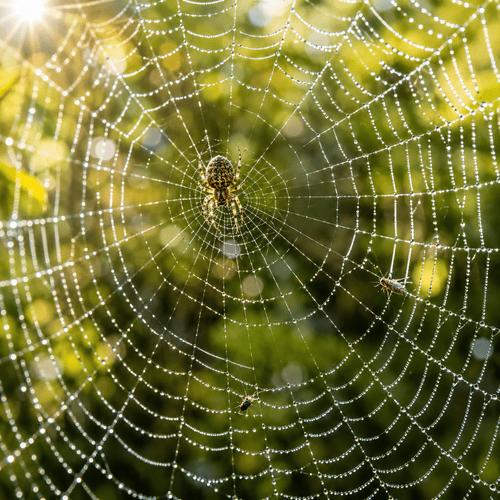
Every dawn, something extraordinary happens in gardens, forests, and window frames across the world. A spider—no bigger than our thumbnails—builds a structure that engineers have spent decades trying to copy, and still cannot. Stretched between branches, glistening with dew, an orb web holds the night’s catch without snapping. What, exactly, is this thread? And what does it tell us about the One who designed it?
The answer is more astonishing than most people realise.
Seven Tools in One Body
Before we get to what spider silk is, consider what the spider carries.
An orb-weaving spider—the kind that builds the classic wheel-shaped web—has not one but seven distinct silk-producing glands inside its abdomen, each making a chemically different silk for a different engineering purpose:
- Major ampullate (dragline) silk—the structural frame of the web and the spider’s own lifeline; the strongest type
- Minor ampullate silk—temporary scaffolding used during web construction, then discarded
- Flagelliform (capture spiral) silk—the elastic, rubbery threads that actually catch prey
- Piriform silk—a nano-fibril “cement” that anchors the web to surfaces
- Aciniform (wrapping) silk—immobilises captured prey and protects egg cases
- Tubuliform silk—tough, stable casing for the egg sac itself
- Aggregate silk—the sticky glue droplets coating the capture threads, which attract moisture from the air
Each of these silks has a different protein composition, a different mechanical property, and a different gland producing it. Remove any one type and the system fails. The web cannot be built without scaffolding silk. The frame has nothing to anchor without piriform cement. The capture spiral is useless without aggregate glue.
This isn’t the signature of accident. This is the signature of comprehensive forethought—seven problems, seven solutions, all present, all integrated, all working together from the start.
What Makes Dragline Silk So Astonishing
The most studied of the seven types is dragline silk—the one that forms the outer frame and radial spokes of a web. Its properties are, by any measure, remarkable.
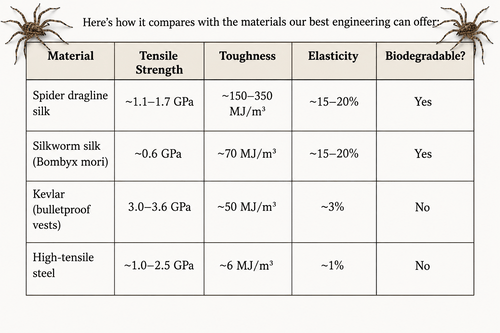
Two key terms help make sense of this:
- Tensile strength is how much pulling force a material can withstand before it snaps.
- Toughness is how much energy a material absorbs before it breaks—a combination of strength and the ability to stretch.
Kevlar beats spider silk on raw tensile strength. But silk is vastly tougher—it can absorb 180 MJ/m³ of energy compared to Kevlar’s 50. That’s why a web can stop a fast-flying insect without shattering. The silk doesn’t just resist—it absorbs, stretches, and holds. A brittle material, however strong, would simply snap on impact.
Then add this: steel is five to six times denser than spider silk. Gram for gram, silk outperforms steel by a wide margin.
And if that weren’t enough, consider Darwin’s bark spider (Caerostris darwini): this small orb-weaver from Madagascar builds webs spanning entire rivers, with anchor lines up to 25 metres long. Its dragline silk averages 350 MJ/m³ in toughness—with some fibres reaching 520 MJ/m³. That makes it the toughest biological material ever tested: more than twice as tough as any other known spider silk, and over ten times tougher than Kevlar. All of this from a creature barely two centimetres long.
Engineered at the Molecular Level
The secret behind these properties isn’t just what spider silk is made of—it’s how it’s arranged.
At the nanoscale (billionths of a metre), dragline silk has a precise two-zone architecture:
- Tiny crystalline regions—tightly folded protein sheets, locked together by hydrogen bonds—act as stiff, load-bearing anchors
- Surrounding these are looser, flexible protein chains that can unfold and extend under stress
Think of it like a rope woven from both rigid rods and elastic bands, interlocked at the molecular level. The rigid zones give strength; the flexible zones give stretch. Together, they give toughness—the ability to absorb impact without breaking.
This is hierarchical design: engineered not just at one level but at the nano-, micro-, and macro-scale simultaneously. No human factory replicates this. Our best synthetic fibres achieve either strength or elasticity—not both, not at this level, not at room temperature without toxic chemicals.
The Spinning Mill: The Size of a Fingernail
The silk itself is only half the story. How the spider makes it is equally extraordinary.
Inside the major ampullate gland, spidroin proteins (the building blocks of silk) are stored as a stable liquid at around 50% protein by weight—an extraordinarily concentrated solution that, remarkably, doesn’t solidify prematurely. As the spider draws the liquid through a narrow, S-shaped duct, several things happen at once:
- The duct walls remove water and adjust ion concentrations
- The pH drops progressively from near-neutral to acidic, triggering self-assembly
- Mechanical shear force—the physical pulling of the thread—causes the protein molecules to align
The result is an irreversible phase transition: liquid becomes solid, protein becomes fibre, and the nano-architecture locks into place. The finished thread cannot be re-dissolved. It’s done.
All of this happens at room temperature, using no toxic chemicals, consuming nothing but the proteins the spider itself produces. The finished thread is fully biodegradable, biocompatible (meaning it doesn’t trigger an immune reaction in living tissue), and in some species, antimicrobial.
Scientists have spent years and enormous resources trying to copy this process—growing silk proteins in bacteria, spinning them through artificial needles. They’ve made some progress. But as of today, no laboratory can reliably replicate what the spider does routinely, every morning, using dead insects as fuel.
Design Written in Protein
The apostle Paul writes in Romans 1:20 that God’s “eternal power and divine nature” have been “clearly perceived” in the things that have been made—so clearly, in fact, that they leave us without excuse.
Spider silk is a case study in that clarity.
Consider what’s required for the system to function at all. The correct protein sequences must be encoded in the spider’s DNA. The gland must store these proteins in a stable liquid without premature hardening. The duct must apply precisely the right pH gradient, ion balance, and shear force at precisely the right points. The spinneret—the external spinning nozzle—must draw the thread at the right speed.
Remove any single component and there’s no functional silk. There’s no advantage to a half-built spinning system; a protein that solidifies in the gland can kill the spider. A duct without the right chemistry produces a useless strand. The system works as a whole or not at all. This is what Michael Behe called irreducible complexity—a system of interacting parts in which the removal of any one part causes the whole system to collapse.
And then there’s the number seven: Seven gland types. Seven silk proteins. Seven engineering problems, each with its own tailored solution. The completeness and integration of this toolkit isn’t what we expect from a process of random variation and survival pressure. It’s exactly what we’d expect from a mind that surveyed the spider’s needs completely—before the first web was ever spun.
The spider is not the only creature making this case. The tardigrade makes it too—an animal barely visible to the naked eye, yet equipped with integrated survival systems that defeat boiling, freezing, crushing pressure, and the vacuum of space.
Tough Questions, Honest Answers
Is spider silk really stronger than steel?
It depends on what you mean by “stronger.” Steel and Kevlar can both withstand greater pulling force before snapping —that is tensile strength, where Kevlar wins outright. But spider silk is far tougher, meaning it absorbs much more energy before breaking, because it can stretch and hold rather than simply resist. Dragline silk absorbs around 180 MJ/m³ versus Kevlar’s 50, which is exactly why a web can stop a fast-flying insect without shattering. And because spider silk is five to six times less dense than steel, gram for gram it outperforms steel by a wide margin.
Why can’t scientists just mass-produce spider silk if they understand it?
This is one of the most telling facts in the whole story. Despite decades of work, billions of dollars, genetic engineering, computer modelling, and artificial spinning systems, no lab can yet reliably replicate what a thumbnail-sized spider does every morning. The proteins tend to clump together when grown in bacteria, and reproducing the precise liquid-to-solid spinning process has proven extraordinarily difficult. The spider does it at room temperature, with no toxic chemicals, fuelled by nothing but dead insects. When our most advanced technology cannot copy a creature’s routine handiwork, that’s not an argument against design—it’s the loudest possible argument for it.
Didn’t spider silk simply evolve gradually from simpler ancestral glands?
This is asserted far more often than it’s demonstrated. The honest admission within the field is that researchers don’t actually know how silk glands evolved; the gradual story is an assumption, not a finding. The deeper problem is that functional dragline silk requires many components simultaneously—the right protein sequence, a gland that stores it without premature hardening, a duct with precise pH and ion gradients, water removal, and a spinneret of the right geometry. Remove any one and we get no silk, just clogged protein—and a half-built spinning system offers no survival advantage to select for. The system works as a whole or not at all.
Can’t gene duplication explain how spiders got seven different silks?
Gene duplication is a mechanism, not an explanation. Duplicating a gene gives us more of the same protein—it doesn’t, by itself, produce a new gland, a new duct architecture, new chemical gradients, and new spinning behaviour, all coordinated to deploy a genuinely new silk type. A new protein produced in the wrong place, with no gland or duct to process it, is useless at best and lethal at worst. The coordination problem—getting all these elements to arrive together and integrate—is precisely what undirected processes cannot account for, but which intelligent design predicts.
Doesn’t Darwin’s bark spider, with its record-breaking silk, prove evolution can keep improving silk?
It actually points the other way. The extraordinary toughness of Caerostris darwini comes not from a single lucky mutation but from a coordinated suite of changes: a novel silk protein with a unique amino acid motif, combined with an unusually long spinning duct to align it, combined with a regulatory system that activates this costly silk only in large adult females when their ecology demands it. A new protein alone would achieve nothing without the matching duct and regulation. This multi-level, integrated redesign is the fingerprint of forethought, not blind chance.
What’s so significant about spiders having exactly seven silk types?
The number seven here isn’t a mystical claim but an observation about completeness and integration. Seven gland types map onto seven distinct engineering problems—frame, scaffolding, capture, anchoring, prey-wrapping, egg protection, and adhesive glue—each with its own tailored chemical and mechanical solution. A web cannot be built if even one is missing: no scaffolding, no construction; no anchor cement, no attachment; no glue, no capture. A toolkit this complete and this interdependent is exactly what we’d expect from a mind that surveyed the spider’s full set of needs in advance—and exactly what we do not expect from accumulated accidents.
If God designed spider silk so beautifully, why does the spider use it to kill?
Scripture lets us hold two truths at once. The engineering genius of the silk—its strength, its design, its molecular precision—testifies to the wisdom of the Creator who made it (Romans 1:20; Psalm 104:24). Its use in predation belongs not to the original creation but to a world subjected to futility, groaning under the effects of the Fall (Genesis 3; Romans 8:20–22). The web’s beauty whispers of Eden; what’s caught in it whispers of what was lost. Both are theologically instructive, and neither cancels the other.
Our Related Posts