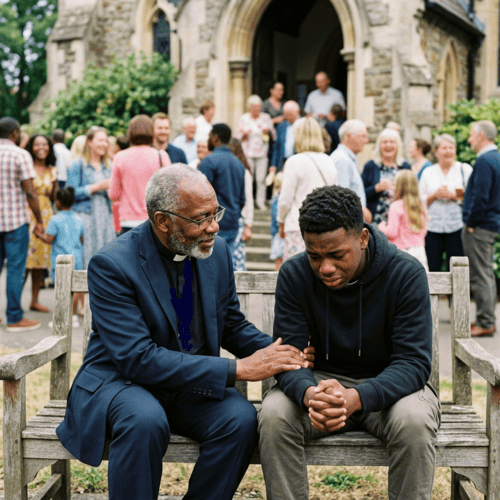

Why did God feel so close to Joseph in an Egyptian prison, yet feels so far away during our own ordinary struggles? And for those who aren’t even sure they believe—why does the universe sometimes feel so hauntingly empty of Him?
Picture Joseph, forgotten in Pharaoh’s dungeon, and Scripture quietly notes “the LORD was with Joseph” (Genesis 39:21). Picture Daniel, thrown to starving lions, and an angel shuts their mouths overnight (Daniel 6:22). Picture Paul, shipwrecked and terrified, receiving an angelic visit with a direct word of assurance (Acts 27:23). Then picture us—facing redundancy, illness, grief, or plain anxiety—with heaven feeling like brass overhead. Where’s our angel? Where’s the fourth man standing with us in the fire?
This isn’t a crisis unique to weak faith. It’s one of the oldest, most universal experiences in Scripture, and it touches both believers going through a dry season and people who’ve never yet believed at all. The two experiences aren’t identical, and it’s worth being precise about the difference from the outset. Believers who feel God is distant still have the Spirit permanently indwelling them, whether or not that can be felt on a given day (1 Corinthians 6:19). Their sense of distance is an experience, not a change in their actual standing before God. Someone who has never trusted Christ is in a genuinely different position: not merely feeling distant from God, but actually separated, in the way Scripture describes sin as creating real estrangement. Not just a felt one. Both experiences are real. Only one of them is a change in actual status rather than felt awareness. Let’s take both seriously, and let Scripture answer both.
A Struggle Even Biblical Saints Knew
Before assuming every biblical hero lived under constant divine sunshine, look at what Scripture actually records. David cried, “My God, my God, why have you forsaken me?” (Psalm 22:1)—words Jesus Himself repeated from the cross. Job searched desperately: “I go forward, but he is not there; backward, but I do not perceive him” (Job 23:8-9). Habakkuk pleaded, “How long, O LORD, must I call for help?” (Habakkuk 1:2). Jeremiah lamented that God had “wrapped yourself with a cloud so that no prayer can pass through” (Lamentations 3:44).
The theological term for this experience is divine hiddenness—the sense that God, who is really there, has withdrawn the felt awareness of His presence. Even Elijah, fresh off a spectacular victory over the prophets of Baal, collapsed under a broom tree wishing to die, convinced he was utterly alone (1 Kings 19:4,10)—only to discover God had preserved seven thousand faithful people he knew nothing about. The biblical pattern includes both divine nearness and divine hiddenness, and the difference was never that some saints were favourites while others were forgotten. It’s that God works through both kinds of seasons for purposes we don’t always see at the time, and often can’t see until much later, if at all.
God Never Changes, Even When Our Experience Does
Reformed theology anchors this whole subject in one unshakeable fact: God’s essential nature never varies. “I the LORD do not change” (Malachi 3:6). James adds that God is “without shadow due to change” (James 1:17). Theologians call this immutability—the doctrine that God’s character, promises, and disposition toward His people remain fixed, whatever our feelings suggest in a given week. When God feels absent, He hasn’t moved. Our perception has shifted, often for reasons hidden from us at the time.
Why would a loving God allow that shift to happen at all? Scripture treats felt absence as purposeful, not cruel. Isaiah says God tests His people “in the furnace of affliction” (Isaiah 48:10). Peter compares trials to gold refined by fire, proving “the genuineness of your faith” (1 Peter 1:6-7). Paul learned through his own despair to rely “not on ourselves but on God who raises the dead” (2 Corinthians 1:9).
Dane Ortlund, in his widely read book Gentle and Lowly, makes a case worth sitting with here. He says Christ’s own heart toward doubting believers who’re suffering is not one of irritation at their weakness but of deep, instinctive compassion. It’s the same compassion He showed struggling disciples throughout the gospels. Ortlund draws heavily on older Puritan writers, particularly Thomas Goodwin, to argue Christ’s heart doesn’t merely tolerate believers in their weak, doubting moments but is positively drawn toward them there, the way a parent’s heart moves toward a frightened child rather than away from one. On Ortlund’s reading, felt divine distance is never a sign that God has grown cold toward us. If anything, Scripture describes the opposite instinct in God at exactly those moments.
This matters practically, because the natural (and mistaken) assumption during a dry season is that God must be disappointed with us, or punishing some unconfessed failure. Sometimes seasons of hiddenness do follow genuine sin and call for honest repentance—Scripture doesn’t rule that out. But it isn’t the default explanation Scripture offers, and assuming it without evidence tends to produce exactly the wrong response: more anxious self-examination, rather than a renewed look toward Christ.
Why Biblical Times Can Feel So Different
The apparent gap between biblical and contemporary experience has real theological explanations, rooted in how God has revealed Himself across history.
| Explanation | What It Means | Key Text |
|---|---|---|
| Progressive revelation | Dramatic signs authenticated God’s messengers during foundational, unrepeated periods of redemptive history | Hebrews 1:1-2 |
| A greater gift, less dramatic | The Spirit’s permanent indwelling in every believer surpasses the Old Testament’s temporary, task-specific empowerments | John 14:16-17; Romans 8:9-11 |
| The nature of mature faith | Faith that depends on constant visible confirmation is spiritual infancy, not maturity | John 20:29; 2 Corinthians 5:7 |
That middle row deserves a moment’s pause, because it sounds almost backwards at first. Old Testament believers experienced the Spirit coming upon them for specific tasks, then lifting again—Saul’s own tragic history illustrates this starkly, since 1 Samuel records the Spirit departing from him after persistent disobedience (1 Samuel 16:14). We have something objectively greater and considerably more secure: the Spirit’s permanent residence in every believer, promised by Jesus Himself (John 14:16-17) and confirmed by Paul as the very mark of belonging to Christ at all (Romans 8:9-11). It feels less dramatic than an angel in a lion’s den. It is, in fact, the larger and safer gift, precisely because it doesn’t depend on our ongoing performance the way the Old Testament pattern sometimes did.
For Those Who Don’t Yet Believe: Could This Absence Be an Invitation?
Everything above addresses believers moving through a dry season. But there’s a second, different kind of divine absence worth naming honestly—the one felt by people who aren’t sure they believe at all, who sense there’s a “something more” to existence they can’t quite locate or name.
The philosopher and mathematician Blaise Pascal described this as a God-shaped vacuum: a hollow at the centre of every human life that no amount of wealth, achievement, or pleasure can ultimately fill, because it was never built to be filled by any of those things. Scripture traces this vacuum back to a specific historical rupture, not a vague cosmic mystery. When Adam and Eve sinned, they were banished from Eden’s immediate, walking-in-the-garden presence of their Creator (Genesis 3:23-24)—and the ache of that separation has echoed through every human life since, whether or not a person has language for what they’re actually missing.
Here’s the good news buried inside that ache: it isn’t permanent by design. When Christ died on the cross, Matthew records something startling happening at the very moment of His death—the temple curtain, which had physically separated ordinary people from God’s presence for centuries, “was torn in two, from top to bottom” (Matthew 27:51). That image is deliberate. The barrier separating sinful humanity from a holy God has been torn open, not patched over or left slightly ajar. The way back is now genuinely open to anyone who calls on Christ.
So the honest answer to someone who feels God is distant, and isn’t sure they even believe in Him, is not to explain the feeling away. It’s to say the feeling is pointing at something real—a real separation, with a real remedy already provided. Jesus put the invitation plainly: “Come to me, all who labour and are heavy laden, and I will give you rest” (Matthew 11:28). The vacuum Pascal described isn’t a design flaw. It’s a signpost.
It’s worth being honest, too, about what won’t fill that vacuum, because most people have already tried. Achievement fills it for a season, then demands another achievement to feel the same relief. Relationships genuinely help, yet even the best human relationship was never built to carry the weight of ultimate meaning, and eventually buckles under the attempt. Distraction works only as long as the distraction lasts. None of this is a criticism of ambition, love, or rest—it’s simply an observation that all three keep pointing past themselves toward something they can’t quite deliver on their own.
The Reformed theologian Michael Reeves has argued that this restlessness isn’t accidental but revelatory: human beings were made, quite specifically, for relationship with a Triune God who is Himself eternally relational—Father, Son, and Spirit in loving fellowship before the world even existed. On Reeves’s reading, our craving for connection, meaning, and belonging isn’t a random evolutionary itch. It’s the shape of a creature built for exactly the kind of relationship Christ’s death now makes possible again. That reframes the ache many people feel not as evidence against God, but as evidence of exactly what we were designed for.
For someone weighing all this honestly, the practical question is simple, even if answering it takes courage: “Who moved?” If the sense of God’s absence has always been there, it may be an invitation rather than a rejection—an ache placed there deliberately, pointing toward the God who tore the temple curtain to remove it.
Practical Strategies for Dark Seasons
Scripture doesn’t just diagnose the ache of divine hiddenness. It offers concrete, practical responses for believers walking through it.
- Remember past faithfulness. David made this a discipline: “I will remember the deeds of the LORD; yes, I will remember your wonders of old” (Psalm 77:11). Facing Goliath, he recalled God’s past deliverance from lion and bear (1 Samuel 17:37). Keep a record of God’s provision. When today’s circumstances cloud your view, yesterday’s faithfulness becomes a lamp for your feet.
- Cling to promises, not feelings. Paul insists nothing—tribulation, distress, danger, or death—can separate believers from God’s love (Romans 8:38-39). Moses promised God “will never leave you nor forsake you” (Deuteronomy 31:6). These promises don’t rise and fall with your emotional weather. They rest entirely on God’s unchanging character.
- Continue spiritual disciplines, even when they feel empty. Habakkuk modelled this precisely: even with no fruit on the vines, “I will rejoice in the LORD” (Habakkuk 3:17-18). David preached to his own soul rather than trusting it: “Why are you cast down, O my soul? Hope in God” (Psalm 42:5).
- Seek out community rather than isolating. “A threefold cord is not quickly broken” (Ecclesiastes 4:12). Hebrews warns against neglecting to meet together, urging believers to keep “encouraging one another” instead (Hebrews 10:25). Isolation deepens spiritual darkness; community brings light back in.
- Pray honestly rather than performatively. More than a third of the Psalms are laments—raw, unpolished complaints addressed directly to God rather than about Him. Psalm 13 opens with “How long, O LORD? Will you forget me forever?” before ending in renewed trust just six verses later. That pattern gives permission to bring genuine frustration to God rather than a tidied-up version of it, trusting that honest lament is itself an act of faith, not a failure of it.
The Deeper Reality: Union With Christ
Beyond coping strategies lies a sturdier truth still. If you’re a believer, you’re united to Christ regardless of how today feels. Paul wrote, “I have been crucified with Christ. It is no longer I who live, but Christ who lives in me” (Galatians 2:20). Elsewhere he says our lives are “hidden with Christ in God” (Colossians 3:3).
What doesn’t change, even in a dry season
- Christ lives within every believer, whether or not that’s felt today (Galatians 2:20)
- There is “no condemnation” for those in Christ Jesus, regardless of emotional state (Romans 8:1)
- God who gave up His own Son will not withhold anything else needed (Romans 8:32)
- Believers are already “blessed with every spiritual blessing” in Christ (Ephesians 1:3)
These aren’t hollow consolations offered to soften disappointment. They’re gospel realities more solid than whatever this week’s circumstances happen to be. Notice, too, what this means practically: your assurance before God was never meant to be built primarily on your feelings in the first place. It was always meant to rest on Christ’s finished work, received by faith—which is precisely why it can survive a season in which felt closeness to God has, for reasons known only to Him, temporarily receded.
Hope in the Darkness
One day, all of this resolves completely. Paul promised believers will see God “face to face” rather than “in a mirror dimly” (1 Corinthians 13:12). John envisioned the day when “the dwelling place of God is with man,” and He “will wipe away every tear” (Revelation 21:3-4). Paul assured us our present sufferings aren’t “worth comparing with the glory that is to be revealed” (Romans 8:18).
Until then, believers live in what theologians call the already but not yet: already united to Christ, not yet experiencing the fullness of His felt presence. That tension isn’t punishment. It’s the normal shape of Christian life in a world still waiting for its final restoration.
It’s worth naming plainly that this tension can last a long time—months, sometimes years, not merely a difficult afternoon. Scripture doesn’t promise a quick resolution to every dry season, and pretending otherwise sets believers up for a second disappointment on top of the first. What it promises instead is that the season is not the whole story, and that God’s fixed commitment to His people continues underneath it, whether or not it can be felt on a given day.
When God feels far, remember: He hasn’t moved. Feelings don’t define reality. Christ dwells within you, the Spirit intercedes for you, and the Father’s love for you hasn’t shifted an inch. In the darkness, that’s enough light for the next step.
Tough Questions, Honest Answers
What does Jesus’ cry, “My God, my God, why have you forsaken me?” teach us about divine absence?
Jesus’s cry of dereliction on the cross (Matthew 27:46) represents the ultimate experience of divine distance—yet it was precisely in this moment that He accomplished our salvation. Reformed theology reads this not as literal abandonment within the Trinity, but as the Son bearing the weight of sin and the spiritual darkness sin creates. Christ endured the ultimate divine absence so that believers would never have to face true, final abandonment themselves.
How do contemporary Reformed teachers approach the problem of divine silence?
John Piper has argued God’s hiddenness is designed to deepen dependence on His promises rather than on our feelings, teaching us to live by faith in His character rather than sight of His works. Tim Keller has made a related case: divine absence can drive believers deeper into the gospel, showing them their standing with God rests on Christ’s performance, not their own spiritual temperature. Both agree felt absence often precedes real spiritual growth.
Should I feel guilty for experiencing spiritual dryness when other Christians seem to have vibrant faith?
No. Spiritual dryness doesn’t indicate failure or lesser faith. Scripture gives explicit permission to lament through the honest prayers of David, Job, and Jeremiah—each felt spiritually distant from God without that experience disqualifying their faith. Comparing your inner experience to someone else’s apparent vitality is rarely accurate anyway, since nobody else’s inner life is fully visible to you.
What if a well-meaning Christian tells me to “just have more faith” during a season like this?
Their intentions are usually good, but the advice misreads both Scripture and spiritual maturity. Reformed theology teaches faith is God’s gift, not a product manufactured by willpower (Ephesians 2:8-9), so “trying harder” to feel more faithful rarely works. The better response is anchoring in objective gospel truths and continuing spiritual disciplines even while they feel dry, rather than chasing a feeling directly.
Is there a difference between clinical depression and ordinary spiritual dryness?
They can overlap, but depression typically affects sleep, appetite, and daily functioning broadly, while spiritual dryness concerns felt closeness to God specifically and can coexist with real hope in His promises. If symptoms are interfering with daily life, both pastoral and professional medical care are appropriate—God often works through ordinary medical means, and physical and spiritual health are genuinely connected.
Why do some believers experience more dramatic spiritual highs and lows than others?
Temperament and personality shape how any person experiences emotion, including religious emotion. Some believers are naturally more expressive and feel spiritual experience intensely; others have steadier temperaments producing less dramatic but equally real experience. Neither pattern is spiritually superior—Scripture nowhere ranks believers by emotional intensity, only by growth in faith, hope, and love.
How can I best support someone going through a season of feeling distant from God?
Avoid quick fixes or implying their struggle signals weak faith. Listen, validate the experience as a normal part of Christian life using the biblical examples above, and gently point to gospel truth without dismissing their pain. Encourage continued spiritual disciplines even when they feel empty, since faithfulness in dry seasons often precedes spiritual breakthrough—and let your own steady presence be part of how God’s presence reaches them.
Related Reads
- Intimate Nearness: What ‘Immanuel’ Really Means
- Near Yet Far: How Can God Be Both Transcendent and Immanent?
- Can We Really Know God? Understanding Divine Incomprehensibility
- Does God Still Talk Directly to His People?
- Assurance of Salvation: How Can I Know I’m Truly Saved?
- Seek God’s Face: What Does Scripture Mean?
- Prayerlessness and Spiritual Dryness: Does the Bible Offer a Remedy?