The question people are really asking
Ask whether Jesus is in the Book of Ruth, and you’ll usually hear one of two answers. And both are wrong.
The first answer treats Ruth like a secret code. Every detail is made to mean something. The barley is the bread of life. The six measures of grain are the six days of creation. The sandal is baptism. Nothing in the text asks to be read this way, and once you start, there’s no rule to tell you when to stop.
The second answer treats Ruth as a warm little story about hunger, loyalty and a happy marriage—true, moving, and with nothing to do with Christ at all.
The honest answer sits between the two, and the book itself hands it to us. Ruth doesn’t end with the wedding. It ends with a family tree (Ruth 4:18–22), and that family tree ends with one name: David. The narrator wants you to close the book and say, So that’s where the king came from. Roughly a 1000 years later, Matthew picks up the very same list and carries it 11 names further, to Jesus (Matthew 1:5–16).
So Jesus isn’t hidden in Ruth the way a code is hidden. He’s hidden the way a foundation is hidden—covered, unseen, and holding up everything built on top of it.
The claim of this article
Boaz isn’t a symbol scattered with clues. He’s a real man doing a real legal act in a real Israelite town—and that act is the small working model of what Christ would later do on a cross. The link isn’t clever. It’s structural.
What a kinsman redeemer actually was
The Hebrew word is go’el. It comes from the verb ga’al, “to redeem, to buy back, to act as a family protector.” Older English Bibles simply say redeemer; the ESV often keeps redeemer and lets the context explain it.
This wasn’t poetry. It was a job—a recognised office in Israelite family law, with four duties written into the Torah.
| Duty of the go’el | Where it is commanded | What it meant in practice |
|---|---|---|
| Buy back lost land | Leviticus 25:25 | If poverty forced a man to sell the family field, his nearest relative bought it back so the clan did not lose its inheritance. |
| Buy back a relative sold into slavery | Leviticus 25:47–49 | A brother, uncle or cousin paid the price and set him free. |
| Avenge a murdered relative | Numbers 35:19; Deuteronomy 19:6 | The go’el haddam, “redeemer of blood,” pursued the killer. |
| Receive money owed to a dead relative | Numbers 5:8 | The family’s claim didn’t die with the man. |
Notice the shape of the office. A redeemer steps in where someone else is helpless. The person in trouble cannot fix the problem. Someone with the right relationship and the right resources must act on their behalf, at his own cost.
The second law: levirate marriage
Running alongside this is a separate rule (Deuteronomy 25:5–10). Levirate comes from the Latin levir, “husband’s brother.” If a married man died with no son, his brother was to marry the widow, and the first son of that marriage carried the dead man’s name and inheritance. A brother who refused was publicly shamed: the widow pulled off his sandal and spat in his face, and his household was nicknamed the house of him who had his sandal pulled off.
The point almost every sermon misses
- Ruth 4 doesn’t follow either law cleanly. Boaz wasn’t Mahlon’s brother, so Deuteronomy 25 didn’t bind him. Leviticus 25 is about fields and says nothing about marrying anybody. What happens in Ruth is a fusion of the two—land redemption with a marriage attached—for which there is no statute anywhere in the Torah.
- Frederic W Bush argues the transaction is basically land redemption, with the marriage added by custom rather than commanded by law. Daniel Block presses it harder: Boaz is doing something the law doesn’t require of him.
- That’s not a weakness in the picture of Christ. It’s the whole engine of it.
What Boaz actually does in Ruth 3–4
Read the sequence slowly. The narrator is building a legal case, step by step.
- Ruth 2:20—Naomi names the possibility. The man is a close relative of ours, one of our redeemers. Read that carefully: one of. Boaz is a candidate. He is not first in the queue.
- Ruth 3:9—Ruth makes the ask. Spread your wings over your servant, for you are a redeemer. She uses the legal word, but the request is a marriage proposal. A destitute foreign widow proposes to a wealthy landowner in the middle of the night. It is astonishingly bold.
- Ruth 3:12—Boaz tells the truth against himself. There’s a redeemer nearer than I. He wants her. He could have said nothing. He doesn’t take what belongs to another man by right.
- Ruth 4:1–6—the nearer relative does the arithmetic. He’s never named. The Hebrew calls him peloni almoni, which is roughly “so-and-so,” “Mr Such-and-Such.” He wants the field. He does not want Ruth. I cannot redeem it for myself, lest I impair my own inheritance.
- Ruth 4:9–10—Boaz pays. I have bought—the language of purchase—the land and also Ruth the Moabite… to perpetuate the name of the dead in his inheritance.
Now notice what’s missing. Nobody spits. The shaming ceremony of Deuteronomy 25 has almost vanished; the sandal changes hands as a dry piece of paperwork, and the narrator has to pause and explain the custom to his readers (Ruth 4:7) because by his day it was already old-fashioned.
And notice something else: the nearer relative is never made into a villain. He’s simply careful. He works out the cost, sees that redeeming Ruth would divide his own estate among children who would legally belong to another man, and walks away. He is within his rights the entire time.
The hinge of the whole book
- The man who calculates walks away. The man who loves pays.
- Both men stood inside the law. Only one of them went beyond it.
Four things a redeemer had to be
Edmund P Clowney and Sinclair Ferguson both work this line, and it holds because it’s drawn from the office itself, not from the scenery. To redeem, a man had to meet four conditions—and each one lands somewhere in the New Testament.
| A redeemer had to be… | Why | How Christ meets it |
|---|---|---|
| Related by blood | Only kin could redeem. A kind stranger had no legal standing at all. | Since therefore the children share in flesh and blood, he himself likewise partook of the same things (Hebrews 2:14); he had to be made like his brothers in every respect (Hebrews 2:17). |
| Able to pay | Good intentions redeemed nobody. The price had to be met in full. | He is able to save to the uttermost those who draw near to God through him (Hebrews 7:25). |
| Willing | Nobody could be forced. The right to redeem came with the right to refuse—as peloni almoni proves. | No one takes it from me, but I lay it down of my own accord (John 10:18). |
| Free himself | A slave cannot buy slaves. A man in debt cannot clear debts. | He committed no sin, neither was deceit found in his mouth (1 Peter 2:22). |
Take the first one seriously and something important follows. The incarnation isn’t a decoration on the atonement; it’s the legal condition of it. God didn’t become man merely so we could relate to him. He became man because a redeemer must be kin. Without Bethlehem there’s no legal standing at Calvary.
The clue Isaiah gives
This is the strongest link in the chain, and it’s the one most often skipped.
The Old Testament does not leave go’el down in the world of fields and widows. It takes the word and gives it to God himself—over and over, and most densely in Isaiah 40–55.
- Fear not, you worm Jacob… your Redeemer is the Holy One of Israel (Isaiah 41:14)
- Thus says the LORD, your Redeemer, the Holy One of Israel (Isaiah 43:14)
- I am the first and I am the last; besides me there is no god—spoken by his Redeemer, the LORD of hosts (Isaiah 44:6)
- For your Maker is your husband, the LORD of hosts is his name; and the Holy One of Israel is your Redeemer (Isaiah 54:5)
And centuries before Isaiah, from a man on an ash heap: For I know that my Redeemer lives, and at the last he will stand upon the earth (Job 19:25). The Hebrew there is go’ali—”my kinsman redeemer.”
Follow the logic in four steps
- One. Israel’s Redeemer is Yahweh. Isaiah says so, repeatedly and deliberately.
- Two. A redeemer must be kin. That’s not a preference; it’s the definition of the office.
- Three. Yahweh isn’t kin. He is the Creator, not a cousin. The title looks like a beautiful impossibility.
- Four. Then Bethlehem. The Word became flesh, and the metaphor became a legal fact.
- So Jesus doesn’t merely resemble Boaz. Jesus is the God who called Himself Israel’s Redeemer, now qualified by flesh and blood to actually do the job.
Boaz is the miniature. Isaiah is the promise. Christ is the thing itself.
A Moabite in the king’s family tree
The narrator won’t let us forget where Ruth is from. Ruth the Moabite—he says it five times, long after we know it perfectly well. He’s pressing on a bruise.
Moab wasn’t a neutral foreign country. Moab began with the incest of Lot’s daughters (Genesis 19:37). Moab hired Balaam. At Peor, Moabite women seduced Israel into idolatry and 24,000 died (Numbers 25). And the law was blunt: No Ammonite or Moabite may enter the assembly of the LORD. Even to the tenth generation, none of them may enter the assembly of the LORD forever (Deuteronomy 23:3).
Now count the closing genealogy: Perez → Hezron → Ram → Amminadab → Nahshon → Salmon → Boaz → Obed → Jesse → David.
David is the tenth. The line of the excluded woman arrives at the throne exactly where the exclusion runs out.
Then Matthew does something no first-century Jewish genealogist would do by accident. He names women—four of them—and they’re Tamar, Rahab, Ruth and the wife of Uriah (Matthew 1:3–6). Three foreigners and a scandal. And look who Matthew gives as Boaz’s mother: Rahab of Jericho. The man who redeemed a Moabite was himself the son of a Canaanite. Grace had already been running in that family for a generation.
The line to draw isn’t to a symbol. It’s to a sentence: Remember that you were at that time separated from Christ, alienated from the commonwealth of Israel and strangers to the covenants of promise, having no hope and without God in the world. But now in Christ Jesus you who once were far off have been brought near by the blood of Christ (Ephesians 2:12–13).
If you’ve ever felt your past disqualifies you, Ruth is in the Bible for you. The Moabitess is in the family tree of the Messiah. So is the prostitute. So is the adulteress. Iain M Duguid observes the genealogy isn’t a list of respectable people; it’s a record of what grace does with a mess.
Love that goes beyond the law
One Hebrew word governs the whole book: hesed. English has no single equivalent. It means covenant love, loyal kindness, faithfulness that keeps going after the obligation has run out. The ESV usually renders it kindness or steadfast love.
It appears at three structural joints in the book, and each one is a hinge.
- Ruth 1:8—Naomi over her daughters-in-law: May the LORD deal kindly with you, as you have dealt with the dead and with me.
- Ruth 2:20—Naomi about Boaz: May he be blessed by the LORD, whose kindness has not forsaken the living or the dead. The Hebrew is deliberately ambiguous—is whose referring to Boaz or to the LORD? Commentators have argued it both ways for centuries. The likeliest answer is that the ambiguity is the message: when Boaz shows kindness, God is showing kindness.
- Ruth 3:10—Boaz over Ruth: May you be blessed by the LORD, my daughter. You have made this last kindness greater than the first.
Ronald M Hals’s classic study of the book fastens on precisely this: Ruth is about a God who runs the world through ordinary faithfulness. And hesed is exactly what separates Boaz from peloni almoni. Both men were law-abiding. One did the sum; the other went past what he owed.
Why this matters for the gospel
- Christ didn’t redeem us because a statute compelled him. Nothing compelled him. No law in heaven or earth obliged the Son of God to take our flesh, our debt and our death.
- Peloni almoni shows us what pure obligation looks like when it meets an expensive case: correct, careful, entirely within its rights—and empty-handed.
- Redemption, on the other hand, is always hesed.
The house of bread, and the hidden hand
Three quiet details are worth lingering over.
- A famine in Bethlehem. The town’s name is bêt leḥem—”house of bread.” The book opens with the house of bread having no bread (Ruth 1:1), which drives the family into Moab, where the men die. It closes in the same town, at harvest, with a baby.
- Ephrathah. Ruth 4:11 blesses Boaz in Ephrathah. Centuries later a prophet will use that same double name: But you, O Bethlehem Ephrathah, who are too little to be among the clans of Judah, from you shall come forth for me one who is to be ruler in Israel (Micah 5:2).
- “She happened to come.” Ruth 2:3 is one of the great sly sentences in the Hebrew Bible: she happened to come to the part of the field belonging to Boaz. The Hebrew is emphatic—literally something like her chance chanced upon. The narrator says “pure coincidence” with a perfectly straight face, two chapters after telling us that the LORD had visited his people and given them food (Ruth 1:6).
There are no miracles in Ruth. No prophet, no angel, no fire from heaven, no voice. God acts openly exactly twice in the whole book—he gives bread (1:6) and he gives conception (4:13). Everything else runs through barley, gleaning laws, a widow’s stubbornness and an old man’s decency.
This is the doctrine of providence told as a story. And it explains why nobody rebukes Naomi when she comes home and says Do not call me Naomi; call me Mara, for the Almighty has dealt very bitterly with me (Ruth 1:20). She isn’t being faithless. She’s right—God had dealt bitterly with her. She simply can’t see Chapter 4 from where she’s standing. Neither can we. That is what it means to walk by faith.
Where the picture stops
A type is a shadow, and shadows are always the wrong shape at the edges. Being honest about the seams makes the case stronger, not weaker—because it shows we’re reading the text rather than decorating it.
| Where Boaz genuinely pictures Christ | Where the picture breaks down |
|---|---|
| Kinship is the legal condition of redeeming. | Boaz wasn’t first in line. He had to wait for another man to refuse. Christ is nobody’s fallback. |
| The redeemer pays out of his own pocket. | Boaz had to be prompted. Naomi planned it; Ruth asked for it. Nobody talked Christ into Calvary. |
| Redemption goes to an outsider with no claim on him. | Boaz paid silver; Christ paid blood. You were ransomed… not with perishable things such as silver or gold… but with the precious blood of Christ (1 Peter 1:18–19). |
| Redemption restores a lost inheritance and a lost name. | Boaz rescued a widow from destitution. Christ redeems sinners from the curse of the law (Galatians 3:13)—from sin, death and the wrath of God. |
| Redemption ends in marriage and a child. | Boaz won an heir for a dead man’s name. Christ wins a bride, and a name of his own. |
| The redeemer acts freely, beyond what is owed. | Boaz’s own line needed redeeming. His great-grandson David would need a go’el himself—badly. |
One caution worth stating plainly
- A popular reading makes peloni almoni stand for the Law—the law that cannot save. It preaches beautifully. Arthur W Pink and others take that road.
- The text won’t support it. The nearer relative isn’t the Law. He’s a man protecting his estate, and the narrator neither condemns him nor allegorises him.
- Use it as an illustration if you must. Never call it exegesis. The moment our types stop being anchored in the text, they stop being arguments and become opinions.
So is Jesus in the Book of Ruth?
Here’s the distinction that keeps this discipline honest.
- Typology reads a real person, event or institution as designed by God to prefigure Christ—and it does so on the warrant of Scripture’s own direction of travel.
- Allegory assigns meanings to details regardless of what the text is doing. It is limited only by the preacher’s imagination, which is exactly the problem.
The warrant here isn’t our cleverness. It’s the risen Christ’s own reading lesson: And beginning with Moses and all the Prophets, he interpreted to them in all the Scriptures the things concerning himself (Luke 24:27). And again: Everything written about me in the Law of Moses and the Prophets and the Psalms must be fulfilled (Luke 24:44).
Geerhardus Vos gave us the principle that keeps this from running wild: revelation is organic. It grows the way a plant grows—the seed is genuinely the same life as the flower, but the seed is not the flower. The seed of the gospel is really present in Ruth. The flower is not, and pretending otherwise flattens the book.
Critical scholars such as Jack M Sasson resist christological reading of Ruth altogether, and they’re right to resist the code-breaking version of it. The answer to them is not louder allegory. The answer is Ruth 4:18–22—the book’s own hand, pointing forward, at the end of its own final page.
The honest formulation
- Jesus isn’t hidden in Ruth like a secret. He is foreshadowed in Ruth—and a shadow is always cast by a body that has not yet walked into the light.
- Read Ruth for what it is: a true story about a real redeemer, told by a narrator who knows exactly where the family tree is going. Then read it again, knowing what stands at the end of the line.
Tough Questions, Honest Answers
Why is Ruth placed after Judges in my Bible but in a different section of the Hebrew Bible?
In the Hebrew Bible, Ruth sits in the Writings, among the five festival scrolls, not immediately after Judges. English Bibles follow the Greek and Latin order, which places it after Judges because of its opening line: In the days when the judges ruled. Neither placement is a doctrinal claim, and neither changes a word of the text. If anything, the English position makes the point sharper: after twenty-one chapters of Judges ending in gang rape and civil war, Ruth is the answer to is there anyone decent left in this country? The answer is yes—and he is the great-grandfather of the king. Placement is a filing decision; the genealogy at the end is the author’s own argument.
What are we meant to make of Orpah? Is she the villain?
No, and preachers who make her one are being unfair to her. Orpah does exactly what Naomi tells her to do, twice, and she weeps when she goes. She is not wicked; she is normal. That is what makes Ruth’s refusal so remarkable—Ruth is not choosing between a good option and a bad one, but between a reasonable option and an unreasonable one. Orpah returns to her people and her gods; Ruth says your people shall be my people, and your God my God (Ruth 1:16). The contrast is not villain against heroine. It is prudence against faith, and faith always looks slightly mad from the outside.
Ruth asks Boaz to spread his “wings” over her. Is that just a figure of speech?
It is more than that, and the narrator plants it carefully. In Ruth 2:12 Boaz blesses Ruth for taking refuge under the wings of the LORD—Hebrew kanaph, which means both a bird’s wing and the corner of a garment. In Ruth 3:9 Ruth uses the identical word back at him: Spread your wings over your servant, for you are a redeemer. She is quietly saying: you prayed that God would shelter me; now be the answer to your own prayer. Daniel I. Block notes the boldness of it—she is holding his own piety to his own account. And it is a fair picture of how God usually shelters people: through the hands of someone who is willing.
Why do the women say the child was “born to Naomi” when Ruth gave birth to him?
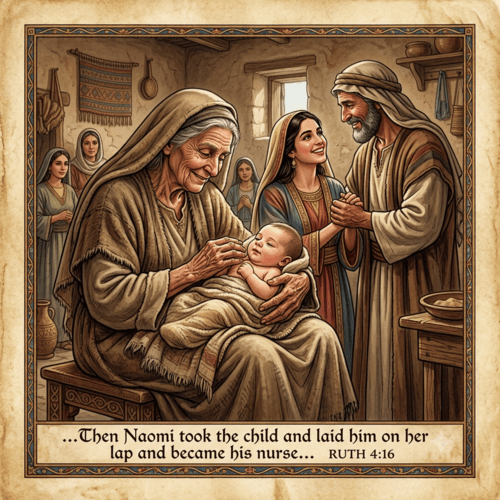
Ruth 4:17 is startling: A son has been born to Naomi. Legally, Obed carried on the line of Elimelech and Mahlon, so in that sense the child belonged to the dead man’s household. But the narrator is doing something deeper. The book opened with Naomi empty—husband gone, sons gone, future gone—and saying I went away full, and the LORD has brought me back empty (Ruth 1:21). It ends with the same woman holding a baby on her lap, and the neighbours telling her that Ruth is more to you than seven sons (Ruth 4:15). The emptiness that God permitted, God filled. He did it by ordinary means, over ten years, through a foreigner Naomi had tried to send away.
Did Boaz know he was pointing to Christ?
Almost certainly not, and that is not a problem. A type does not depend on the awareness of the person who fills it; it depends on the intention of the God who governs history. Boaz was doing what he understood to be right by his relative’s widow, at cost to himself, in a small town, on an ordinary morning. Peter says that the prophets themselves searched to work out what the Spirit in them was indicating (1 Peter 1:10–11)—so even the men who spoke Christ’s coming did not always see it whole. The author of Ruth almost certainly did know he was writing towards David; that is why the genealogy is there. God knew the rest.
Jewish tradition reads Ruth at the Feast of Weeks. Does that mean anything for Christians?
It is a lovely convergence, though it should be held lightly rather than pressed into proof. Ruth is read at Shavuot partly because the story unfolds during the barley and wheat harvest, and partly because of the theme of a Gentile embracing the covenant. Christians know that feast by its Greek name: Pentecost. On the day Israel remembers a Moabite widow being brought into the household of God, the Spirit fell and the gospel went out in every language under heaven (Acts 2). One is a synagogue custom, not a prophecy—but it is the kind of quiet rhyme that Scripture is full of, and it is worth noticing without turning it into an argument.
If Boaz pictures Christ, does Ruth picture the church?
Carefully, and not too far. The bridegroom imagery is genuinely biblical—Paul takes marriage all the way to Christ and the church in Ephesians 5:25–32, and Isaiah 54:5 has already said your Maker is your husband. So the resonance is real. But Ruth herself is presented by the narrator as a model of faith and hesed, a real woman making costly choices, not a code for an institution. Sinclair B. Ferguson’s instinct is the sound one here: let the type carry what Scripture gives it and no more. Ruth shows us the outsider brought near at a redeemer’s cost. That is quite enough without turning her into a diagram.
Related Reads
- Esther and Mordecai: Do They Foreshadow Christ and the Church?
- Shepherd-King: How David Is a Type of Christ
- The Rahab Mystery: Why Is A Prostitute in Jesus’ Family Tree?
- The Bethlehem Connection: Why God Chose a Humble Town For His Son
- Genesis 49: Does Jacob’s Blessing of Judah Point to Christ?
- Jesus in the Old Testament: Where He Appears In All 39 Books
- Jesus in Genesis: The Promised Seed Who Crushes the Serpent
- Jesus in the Book of Ruth: Redeemer, Bridegroom, Son of David