Psalm 89 begins as one of the happiest songs in the Bible, but ends as one of the angriest. It opens with a poet promising to sing of God’s steadfast love for ever. Then God Himself speaks, and swears an oath to King David: “I will establish his offspring for ever and his throne as the days of the heavens” (Psalm 89:29). And then the song falls apart: “you are full of wrath against your anointed. You have renounced the covenant with your servant; you have defiled his crown in the dust” (Psalm 89:38–39).
That’s not a hymn. That’s an accusation. God had promised David a throne that would never end, yet by the time we get to this psalm, the throne was gone, the city was rubble, and the last king in David’s line was eating his meals as a prisoner in Babylon. So there are only two options. Either God broke His word—or the promise was pointing at somebody the poet hadn’t yet met. This doctrine begins there: not with pretty comparisons, but with a promise that history could not keep.
A word on the key term. A type is a real person or event that God designed as an advance preview of something greater—the antitype. It’s not a code: David was a flesh-and-blood king with a real sword and real enemies. Two rules keep the method honest. A type must be authorised by Scripture itself, not invented by a clever reader; and the antitype always exceeds the type, a principle theologian Geerhardus Vos called escalation.
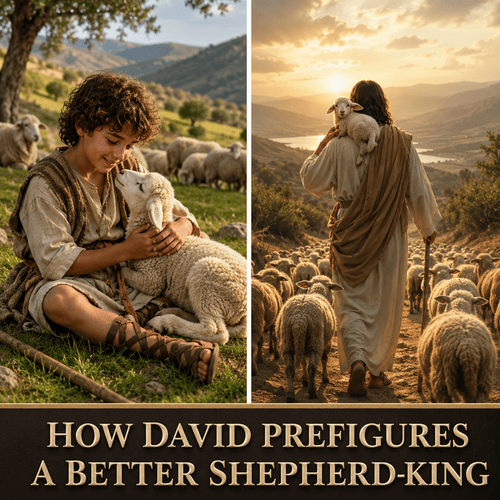
A shepherd’s crook is a crown
Modern readers hear “shepherd” and picture a Sunday school wall. Ancient readers heard a political title.
- Hammurabi of Babylon opens his famous law code by calling himself the shepherd appointed by the gods.
- Pharaoh’s regalia included the crook, crossed on his chest with the flail. Homer’s Agamemnon is “shepherd of the peoples”.
Across the ancient Near East, “shepherd” meant ruler. So when Israel demanded a king “like all the nations” (1 Samuel 8:5) and God answered by fetching a boy in from the sheepfolds, he wasn’t being sentimental. He was defining what a king is for. The nations’ kings called themselves shepherds while eating the flock; Israel’s king was to feed it. And behind him stood the real one—“The LORD is my shepherd” (Psalm 23:1). Israel’s king was never the Shepherd, only an under-shepherd minding sheep that were not his.
God’s own reading of David
We didn’t turn David into a shepherd-king. God did. The crook-and-crown link isn’t a literary flourish of ours; it’s divine commentary, written into the text.
- At his coronation—“You shall be shepherd of my people Israel, and you shall be prince over Israel” (2 Samuel 5:2). Shepherd and prince, side by side, as one job.
- In the covenant oath—“I took you from the pasture, from following the sheep, that you should be prince over my people Israel” (2 Samuel 7:8). The pasture was the training ground for the palace.
- In Israel’s hymn book—“He chose David his servant and took him from the sheepfolds… With upright heart he shepherded them” (Psalm 78:70–72).
The oath that history couldn’t keep
In 2 Samuel 7, God makes David a promise so extravagant that David can only sit under the weight of it: a son, a house, a kingdom, and a throne “established for ever” (2 Samuel 7:13–16). Psalm 132:11 calls it “a sure oath from which he will not turn back.” Then watch what happens to it.
Timeline: the promise and the wreckage
- c. 990 BC—The shepherd turns predator. David takes Bathsheba and kills Uriah.
- c. 930 BC—The kingdom splits. Solomon’s idolatry tears ten tribes away (1 Kings 11–12).
- 597–586 BC—The throne falls. Babylon burns Jerusalem. Zedekiah is blinded. The lamp goes out.
- c. 560 BC—The last king eats in exile. Jehoiachin is let out of prison to dine at a foreign king’s table (2 Kings 25:27–30). Kings ends there—on a pension, not a throne.
So Psalm 89 isn’t faithless. It’s accurate. The dynasty ended. Every ordinary fulfilment of the oath had been tried and had failed. Something else had to be meant.
Ezekiel’s impossible promise
This is the hinge. Around 590 BC—four centuries after David died—God speaks through Ezekiel to a nation of prisoners, indicting Israel’s rulers as shepherds who fed themselves and not the flock. Then something startling: “I myself will search for my sheep… I myself will be the shepherd of my sheep” (Ezekiel 34:11, 15). God will do it Himself. No middleman.
Eight verses later: “And I will set up over them one shepherd, my servant David, and he shall feed them… and my servant David shall be prince among them” (Ezekiel 34:23–24).
First, the Old Testament is already reading David as a type before a single New Testament word is written. David is centuries dead and buried. Ezekiel isn’t predicting a resurrection of the man; he’s using the name as a job title for a coming king. Hosea does the same (Hosea 3:5), and so does Jeremiah 30:9. Typology isn’t a Christian trick played on the Hebrew Bible. It’s the Bible’s own trajectory.
Second, Ezekiel fuses two shepherds into one office. Either the prophet contradicts himself inside 12 verses, or the coming son of David is somehow the LORD himself. Old Testament scholar Iain Duguid observes Ezekiel holds the two together without resolving the tension, because the resolution isn’t yet available. Only one event can hold both statements at once: God becomes a man and shepherds His people in person.
Which is precisely the claim Jesus makes. John 10 isn’t a general reflection on sheep. It’s a targeted exposition of Ezekiel 34—the false shepherds, the scattered flock, the seeking God, and then: “There will be one flock, one shepherd” (John 10:16), the very phrase of Ezekiel 34:23. He takes up both halves of the promise and applies them to himself.
The pattern, point by point
With that framework in place, the correspondences stop being decorative and start being evidence. In every case the second column isn’t merely similar to the first—it’s greater.
| David | Christ |
|---|---|
| One champion fights at Elah; the nation is credited with his victory (1 Samuel 17) | One man obeys and dies; His people are credited with His righteousness (Romans 5:19) |
| Crushes the giant’s head, then kills him with his own sword | Crushes the serpent’s head (Genesis 3:15) and destroys death “through death” (Hebrews 2:14)—the enemy’s weapon turned back on him |
| Gathers at Adullam “everyone who was in distress… in debt… bitter in soul” (1 Samuel 22:2) | Gathers a church of the weak, the foolish and the despised (1 Corinthians 1:26–29) |
| Dies and is buried; the dynasty needs an heir | Dies and rises; He has “the power of an indestructible life” (Hebrews 7:16) and needs no successor |
The Elah row is worth a second look, because that story is almost always preached backwards. Old Testament commentator Dale Ralph Davis presses the obvious question: what does Israel actually do in 1 Samuel 17? Nothing. They watch. It’s not a lesson in slaying the giants in your life. It’s one champion fighting alone while the people who benefit stand still. That’s not inspiration. That’s substitution.
Where the type breaks—and why that proves the point
If David matched Christ at every turn he’d be a mirror, and mirrors are useless. He works as a promise precisely because he keeps failing to be what the promise requires. Theologian Patrick Fairbairn made this the heart of his work on typology: the inadequacy of the type is what drives the reader forward. Watch where the failures land.
- He stole a lamb. Nathan’s parable is a scalpel: a rich man takes a poor man’s “one little ewe lamb” (2 Samuel 12:3). The shepherd-king had become the wolf. Christ gives Himself instead of taking.
- He died. Peter’s argument at Pentecost turns on it: “He both died and was buried, and His tomb is with us to this day” (Acts 2:29). A king who dies cannot be an everlasting king.
No, David is no photograph of Christ. He’s an unpaid invoice. Every failure raises the bill, and every raised bill makes the promise more specific: the coming king must be sinless, must not die, and must somehow be God Himself.
The throne is occupied now
So who paid it? Peter answers on the day the church is born. He quotes Psalm 16, points at David’s tomb, and reasons: David was a prophet, God had sworn the oath, David spoke of a resurrection—therefore “God has made him both Lord and Christ, this Jesus whom you crucified” (Acts 2:36).
The apostles don’t treat the Davidic throne as a future arrangement. They treat it as a present fact. Psalm 110—the most quoted Old Testament text in the New—has God saying, “Sit at my right hand, until I make your enemies your footstool.” Jesus uses it to corner His critics: how can the Christ be David’s son and David’s Lord at once (Matthew 22:41–46)? He can, if the son of David is more than a son of David.
James finishes it at the Jerusalem council. Amos had promised God would rebuild “the tent of David that is fallen” so that the Gentiles might seek the Lord. And James, watching Gentiles stream into the church, says: that is this (Acts 15:16–18). David’s kingdom is restored as an ingathering, already under way.
Why this matters to the flock
And the grant spreads. Isaiah hands David’s promise over to the whole flock—“my steadfast, sure love for David” made public property (Isaiah 55:3)—which is why Peter calls ordinary believers “a royal priesthood” (1 Peter 2:9). The sheep become princes. And in John 10, that shepherd-kingship becomes the ground of assurance.
- He knows his own. “My sheep hear my voice, and I know them” (John 10:27). Note the order in verse 26: “you do not believe because you are not among my sheep.” Belonging comes first. Believing follows.
- He died with a definite flock in view. “I lay down my life for the sheep” (John 10:15)—not sheep in general, but his own.
- He does not lose them. “No one will snatch them out of my hand” (John 10:28).
That last one changes how a Christian sleeps at night. Our security doesn’t rest on our grip on the Shepherd but on his grip on us. Sheep aren’t famously competent animals. That’s rather the point.
So when Psalm 89 accuses God of throwing David’s crown into the dust, the answer is not that the psalmist was wrong. The crown really did go into the dust. It was picked up three days later, outside a tomb in Jerusalem, by a shepherd who is also a king—and who is also the Lamb that “will be their shepherd” (Revelation 7:17). God kept his oath, in a way no one saw coming.
Tough Questions, Honest Answers
Isn’t typology just allegory—finding Jesus wherever you like?
No, and the difference is testable. Allegory ignores the plain sense of a text and imports meaning from outside it; typology rests on the plain sense and traces a pattern Scripture itself establishes. The theologian Edmund Clowney offered a useful control: ask what a passage reveals about God and his saving purpose, and follow that line forward rather than leaping from a stray detail to Jesus. David passes on every count. The five smooth stones do not.
What does “a man after God’s own heart” actually mean?
It is almost always preached backwards, as a compliment about David’s piety. In context it describes God’s choosing: Saul is rejected, and “the LORD has sought out a man after his own heart” (1 Samuel 13:14)—a man of God’s own selecting, set against Saul, the man after the people’s heart, tall and impressive and exactly what they asked for. The phrase describes the chooser, not the chosen—as it must, since this man will shortly commit adultery and arrange a murder. It is not a standard to live up to. It is grace.
Was the Davidic covenant conditional or unconditional?
Both, at different levels—which is exactly what makes it point to Christ. God attaches a condition to individual kings: “If your sons pay close attention to their way… you shall not lack a man on the throne” (1 Kings 2:4). But he attaches none to the promise itself: “my steadfast love will not depart from him” (2 Samuel 7:15). So the covenant needs a son who meets the condition perfectly and so secures the promise for ever. The theologian O. Palmer Robertson notes that the two strands are not rivals; they converge on one obedient Son.
Doesn’t Jeconiah’s curse (Jeremiah 22:30) disqualify Jesus’s royal line?
It is a fair challenge. The usual answer is that Matthew traces Joseph’s legal line through Jeconiah, giving Jesus the throne right, while Luke traces a blood line through David’s son Nathan that bypasses the curse—and since Jesus was not Joseph’s biological son, the curse never touches him while the title still transfers. That is reasonable but not certain, so two firmer points should stand beside it. Jeremiah’s curse was reversed by name: God tells Jeconiah’s grandson Zerubbabel, “I will make you like a signet ring” (Haggai 2:23). And the curse concerns a throne in Jerusalem—Christ’s is at the right hand of God.
In Psalm 23, is David the shepherd or the sheep?
He is the sheep—the most striking thing about the psalm. Israel’s most powerful man, a shepherd by trade and by office, writes his best-loved song from the position of livestock, confessing dependence rather than competence. This is a tension the Old Testament cannot resolve: every shepherd of Israel is himself a sheep needing shepherding. Only in Christ does it settle, and in an unexpected direction—the Shepherd becomes a sheep, “like a lamb that is led to the slaughter” (Isaiah 53:7), and the slaughtered Lamb then shepherds (Revelation 7:17).
Doesn’t God’s promise require a literal throne in Jerusalem one day?
The apostles show no sign of thinking so. Gabriel promises Mary that God will give her son “the throne of his father David” (Luke 1:32), and Peter announces at Pentecost that it has happened: God raised Jesus and seated him at his right hand, in fulfilment of the oath (Acts 2:30–36). To call that a postponement is to read Peter against Peter. Jeremiah had prepared us—a day was coming when nobody would even miss the ark, because “Jerusalem shall be called the throne of the LORD” (Jeremiah 3:16–17). Hebrews locates the true Zion above (12:22). A plot of land would be a demotion.
If Jesus is reigning now, why does the world look like this?
Scripture faces this squarely rather than explaining it away: “At present, we do not yet see everything in subjection to him” (Hebrews 2:8). The reign is real but not yet fully displayed, and Paul supplies the grammar: “he must reign until he has put all his enemies under his feet” (1 Corinthians 15:25)—present tense, unfinished business. The theologian Anthony Hoekema described it as living between the decisive battle and the final surrender. David’s life is the template: he was the anointed king throughout those years hiding in caves with a company of debtors, and his kingship was no less real for going unrecognised. The church is Adullam. The King is on the throne.
Related Reads
- Esther and Mordecai: Do They Foreshadow Christ and the Church?
- Boaz the Kinsman Redeemer: A Type of Christ
- Son of David: How Scripture Confirms Jesus’ Royal Lineage
- Messianic Prophecies: Progressive Specificity You Just Can’t Ignore
- Jesus in the Old Testament: Glimpses of the Coming Saviour
- Jesus in 1 Chronicles: How David’s Story Points to Christ