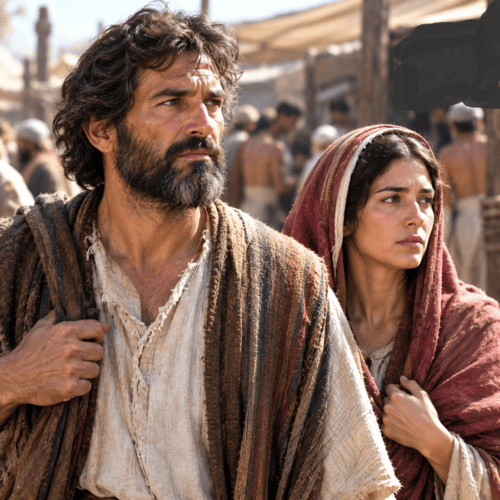
Imagine this. A wife leaves her husband for other men, time and again. Years later, the husband finds her in a slave market, for sale—used, broken and ashamed.
Most men would walk away. But God told one man to go and buy her back—and love her again.
That man was Hosea, a prophet (a messenger who speaks God’s words) who lived about 750 years before Jesus. His painful marriage became a living picture of God’s love for unfaithful people. And read beside the New Testament, it shows us something greater. The husband who buys back his bride isn’t finally Hosea. It’s Jesus.
Here are 9 places where Jesus appears in Hosea—and honest answers to the strongest objections. Finding Christ here isn’t a clever trick. It’s exactly how the apostles read this book.
Jesus in the Old Testament — Book 28 of 39
This post is the 28th instalment in our series tracing Christ through every book of the Old Testament. See the full series index.
Can We Really Find Jesus in Hosea?
Some people say Christians “force” Jesus into the Old Testament. It’s a fair question. But after Jesus rose from the dead, Luke tells us, “beginning with Moses and all the Prophets, he interpreted to them in all the Scriptures the things concerning himself” (Luke 24:27).
Hosea is one of “the Prophets”. So, according to Jesus, Hosea is about him.
The apostles followed his lead. Almost every time the New Testament quotes Hosea, it points to Christ.
How the New Testament Uses Hosea
| WHAT HOSEA SAYS | WHERE THE NEW TESTAMENT USES IT | HOW IT POINTS TO JESUS |
|---|---|---|
| “Out of Egypt I called my son” (11:1) | Matthew 2:15 | Jesus is God’s true Son, who lives out Israel’s story |
| “I desire steadfast love and not sacrifice” (6:6) | Matthew 9:13; 12:7 | Jesus shows God’s mercy to sinners |
| “Not my people” become “my people” (1:10; 2:23) | Romans 9:25–26; 1 Peter 2:10 | Jesus gathers a new people, including non-Jews |
| “O Death, where are your plagues?” (13:14) | 1 Corinthians 15:55 | Jesus’ resurrection defeats death |
| “Cover us… Fall on us” (10:8) | Luke 23:30; Revelation 6:16 | Jesus spoke these words on his way to the cross |
| “On the third day he will raise us up” (6:2) | 1 Corinthians 15:4 (likely background) | Jesus rose on the third day |
John Calvin said in his comments on John 5:39: “We ought to read the Scriptures with the express design of finding Christ in them.” But not every line of Hosea is a direct prediction. Jesus appears in 4 main ways, and each sighting below is labelled.
Four Ways Jesus Appears in the Old Testament
| KIND | WHAT IT MEANS | EXAMPLE IN HOSEA |
|---|---|---|
| Prophecy | A direct promise about the coming Messiah (the chosen King God promised to send) | “David their king” (3:5) |
| Type | A real person or event that God designed as a preview of Christ | Hosea buying back Gomer (3:2) |
| Christophany | An appearance of God the Son before he was born as a man | The angel who wrestled Jacob (12:4) |
| Theme | A big idea that finds its fullest meaning in Christ | Mercy, not sacrifice (6:6) |
9 Places Jesus Appears in Hosea
1. The Faithful Husband (Hosea 1–3)
Kind: Type and theme
God told Hosea, “Go, take to yourself a wife of whoredom and have children of whoredom, for the land commits great whoredom by forsaking the LORD” (Hosea 1:2). Whoredom means sexual unfaithfulness. Hosea married a woman called Gomer, and she was unfaithful to him.
Why? Hosea’s home was to become a sermon everyone could see. Israel had been “married” to God at Mount Sinai through his covenant (a binding promise-relationship). But the people ran after other gods, like a wife running after other lovers—spiritual adultery.
The New Testament takes this picture and gives the husband a name. John the Baptist called Jesus the Bridegroom (John 3:29). Jesus called Himself that too (Mark 2:19). And Paul tells husbands to love their wives “as Christ loved the church and gave Himself up for her” (Ephesians 5:25).
Jesus didn’t choose a pure bride. He chose people like Gomer—people like us—and He stayed faithful.
2. The Bride Bought Back (Hosea 3:1–2)
Kind: Type
Gomer left Hosea and seems to have ended up as a slave. Then God said, “Go again, love a woman who is loved by another man and is an adulteress, even as the LORD loves the children of Israel” (Hosea 3:1).
Hosea obeyed: “So I bought her for 15 shekels of silver and a homer and a lethech of barley” (Hosea 3:2). (A shekel was a weight of silver; a homer and a lethech were measures of grain.) Many scholars think the total was worth about 30 shekels—the price of a slave in Exodus 21:32.
Now think. Jesus was sold by Judas for 30 pieces of silver (Matthew 26:15). The Bridegroom was himself priced like a slave, so He could buy back His bride. Yet the true price was far higher. Peter says we were ransomed “not with perishable things such as silver or gold, but with the precious blood of Christ” (1 Peter 1:18–19).
Derek Kidner subtitled his commentary on Hosea perfectly: Love to the Loveless. That’s exactly what we see here.
KEY TERM: REDEEM
To redeem means to buy back someone who belongs to you by paying a price to set them free. Hosea redeemed Gomer with silver and barley. Christ redeems His people with his own blood.
3. God’s True Son Out of Egypt (Hosea 11:1)
Kind: Type
“When Israel was a child, I loved him, and out of Egypt I called my son” (Hosea 11:1). Hosea looks back to the exodus, when God led Israel out of slavery. God had called Israel “my firstborn son” (Exodus 4:22).
Matthew quotes this verse about baby Jesus, who fled to Egypt from King Herod and later came back (Matthew 2:15). Because Jesus lives out Israel’s story again—without failing:
- Egypt: Israel came out of Egypt as God’s son. So did Jesus (Matthew 2).
- The waters: Israel passed through the Red Sea. Jesus passed through the waters of baptism (Matthew 3).
- The wilderness: Israel was tested for forty years and failed. Jesus was tested for forty days and won (Matthew 4).
Edmund Clowney, a former president of Westminster Theological Seminary, often made this point: Jesus is the true Israel, the faithful Son that Israel never was.
4. One Head over a New People (Hosea 1:10–11; 2:23; 3:5)
Kind: Prophecy
Hosea’s 3rd child was named Lo-ammi, which means “Not my people”. It was a terrible sign of judgement. Then came a promise: “in the place where it was said to them, ‘You are not my people,’ it shall be said to them, ‘Children of the living God’” (Hosea 1:10).
Who are these new children? Paul says they include non-Jews (Gentiles) who trust in Christ (Romans 9:24–26). Peter tells believers, “Once you were not a people, but now you are God’s people” (1 Peter 2:10).
And who leads this new people? Hosea says they will “appoint for themselves one head” (Hosea 1:11). Then he names him: “Afterward the children of Israel shall return and seek the LORD their God, and David their king” (Hosea 3:5).
But King David had died about 200 years before Hosea was born. So this “David” must be a future king from David’s family. Other prophets say the same (Jeremiah 30:9; Ezekiel 34:23–24). Even the Targum—an ancient Jewish Aramaic paraphrase of the Bible—read this verse as “Messiah son of David”. The New Testament opens by calling Jesus “the son of David” (Matthew 1:1).
5. Raised on the Third Day (Hosea 6:1–2)
Kind: Type
“Come, let us return to the LORD… After two days He will revive us; on the third day He will raise us up, that we may live before Him” (Hosea 6:1–2).
Paul says Christ “was raised on the third day in accordance with the Scriptures” (1 Corinthians 15:4). Which Scriptures? Hosea 6:2 is one of very few Old Testament verses that link “the third day” with being raised to life. The Targum even read it as “the day of the resurrection of the dead”.
Honestly, in context these words are Israel’s shallow prayer. God answers, “Your love is like a morning cloud, like the dew that goes early away” (Hosea 6:4). So how can this point to Christ?
The answer is representation. In the Bible, what happens to a king counts for his people. Israel couldn’t raise itself. But Christ, the true Israel, was raised on the third day—and all who belong to Him are raised with Him (Ephesians 2:6).
KEY TERM: REPRESENTATIVE HEAD
A representative head is one person who acts on behalf of a whole group. What he does counts for everyone he represents. Adam and Christ are the two great examples in the Bible (Romans 5:12–19).
6. Mercy, Not Sacrifice (Hosea 6:6)
Kind: Theme
“For I desire steadfast love and not sacrifice, the knowledge of God rather than burnt offerings” (Hosea 6:6). The Hebrew word for “steadfast love” is hesed—loyal, covenant love that keeps its promises no matter what.
Jesus quoted this verse twice. When religious leaders complained that he ate with sinners, he said, “Go and learn what this means: ‘I desire mercy, and not sacrifice.’ For I came not to call the righteous, but sinners” (Matthew 9:13; see also 12:7).
Here’s the wonderful twist. Jesus is the perfect picture of God’s hesed. But He is also the final sacrifice. Because He offered himself “once for all” (Hebrews 10:10), the animal sacrifices are finished. Now we show hesed because we have received it.
7. The Angel Who Wrestled Jacob (Hosea 12:3–5)
Kind: Christophany
Hosea reminds Israel of their forefather Jacob: “He strove with the angel and prevailed; he wept and sought his favour. He met God at Bethel, and there God spoke with us—the LORD, the God of hosts, the LORD is his memorial name” (Hosea 12:4–5).
Hosea calls the wrestler “the angel”, then in the next breath “the LORD, the God of hosts”. This angel is God Himself.
John Calvin argued in his Institutes (1.13.10) the Angel of the LORD was the eternal Son. So Jacob wrestled through the night with the One who’d one day wrestle with death for us. And like Jacob, we win not by strength but by clinging on and weeping for his blessing.
8. The Holy One in Your Midst (Hosea 11:8–9)
Kind: Theme
After many warnings, God’s heart seems to break open: “How can I give you up, O Ephraim? How can I hand you over, O Israel?… My heart recoils within me; my compassion grows warm and tender… for I am God and not a man, the Holy One in your midst” (Hosea 11:8–9). Ephraim is another name for the northern kingdom of Israel.
Here is the Bible’s deepest problem. God is holy, so sin must be punished. God is loving, so he longs to save. How can both be true?
The answer is the cross. There, God’s justice and mercy meet. Christ took the punishment, so God could be “just and the justifier of the one who has faith in Jesus” (Romans 3:26). And “the Holy One in your midst” came closer than Hosea ever imagined: “the Word became flesh and dwelt among us” (John 1:14).
9. Death Defeated and a Door of Hope (Hosea 13:14; 2:15; 14:8)
Kind: Prophecy and theme
Hosea’s darkest valleys open onto bright doors:
- Death defeated: “O Death, where are your plagues? O Sheol, where is your sting?” (Hosea 13:14). Sheol is the Hebrew word for the grave. Paul turns this into a victory song about Christ’s resurrection: “O death, where is your victory? O death, where is your sting?” (1 Corinthians 15:55).
- A door of hope: God promises to make “the Valley of Achor a door of hope” (Hosea 2:15). Achor means “trouble”. It was where Achan was punished for his sin (Joshua 7:24–26). The place of curse becomes a doorway—because Christ became “a curse for us” (Galatians 3:13).
- Fruit from him: Hosea ends with God saying, “I am like an evergreen cypress; from me comes your fruit” (Hosea 14:8). Jesus says, “I am the vine; you are the branches… apart from me you can do nothing” (John 15:5).
DID YOU KNOW? HOSEA’S NAME MEANS “SALVATION”
Hosea’s name in Hebrew is Hoshea, meaning “salvation”. It was also Joshua’s first name before Moses renamed him (Numbers 13:16). The names Joshua and Jesus come from the same Hebrew root, meaning “the LORD saves”. Even the prophet’s name points to the Saviour.
4 Objections—and Honest Answers
- “Matthew took Hosea 11:1 out of context.” Hosea’s own chapter looks forward to a new exodus (11:10–11; see also 2:14–15). John Sailhamer argued Hosea was echoing Balaam’s prophecy about a future king: “God brings him out of Egypt” (Numbers 24:8). Gregory Beale has shown Matthew was reading the whole storyline of Hosea, not grabbing one verse at random.
- “Hosea 6:2 is about Israel, not the Messiah.” In the Bible, the King and his people share one story. Isaiah even calls God’s Servant “Israel” (Isaiah 49:3)—yet this same Servant restores Israel (49:5–6).
- “Hosea 13:14 is a threat, not a promise.” The Hebrew can be read either way—as God calling death to punish, or God mocking death. But Hosea’s pattern is always judgement first, then restoration, and the book ends in hope (Chapter 14). Paul shows us the final word: death loses.
- “Christians force Jesus into every verse.” We don’t find Jesus by guessing. We follow the apostles. We don’t turn small details, like the barley, into hidden symbols. Geerhardus Vos, a pioneer of biblical theology at Princeton, taught God’s revelation grows like a seed into a tree. Christ isn’t pasted onto Hosea. He’s the tree the seed was always becoming.
What Hosea Means for Us Today
Hosea speaks straight into our lives:
- We are Gomer. Every one of us has loved other things more than God. The gospel begins with His faithfulness, not ours.
- The Father runs to meet us. Jesus’ story of the prodigal son (Luke 15:11–32) is Hosea 11 told as a story—a father whose heart “grows warm and tender”.
- Guard your first love. Jesus warned the church in Ephesus, “you have abandoned the love you had at first” (Revelation 2:4). Spiritual adultery is still real today. Money, comfort or approval can become rival lovers.
- There’s always a door of hope. However deep your Valley of Achor, Christ has walked through it before you.
The Husband Who Never Gives Up
Hosea’s story is full of betrayal and shame. Yet it’s one of the most beautiful love stories ever written.
Hosea went to the market and bought back his unfaithful wife. Jesus went further. He went to the cross and paid for his bride with his own life. He rose on the third day, and he will one day present her to himself “without spot or wrinkle” (Ephesians 5:27).
If you’ve wandered far from God, the Husband is still coming to the market. He still knows your name. And He has already paid the price.
Tough Questions, Honest Answers
Was Gomer a prostitute when Hosea married her?
Christians hold 3 main views. Some think Gomer was already sexually immoral when Hosea married her. Others think “wife of whoredom” describes what she’d later become, since God knew her future—just as someone might say “I met my wife at school” before she was his wife. John Calvin held a third view: the marriage took place in a vision, like a parable acted out. Most modern scholars, however, believe it was a real marriage, because the names and details read like history. Whichever view we hold, the lesson is the same: God chooses to love people who don’t deserve it.
What happened to Gomer in the end?
The Bible doesn’t tell. The last time we see her, Hosea has bought her back and tells her, “You must dwell as mine for many days” (Hosea 3:3). After that, the book turns from Hosea’s family to the whole nation. This silence has a purpose: the story isn’t really about Gomer but about God and His people. We do know how God’s side of the story ends—with a bride made ready, clothed in “fine linen, bright and pure” (Revelation 19:7–8).
Is Redeeming Love based on the book of Hosea?
Yes. Francine Rivers’ 1991 novel Redeeming Love, made into a film in 2022, retells Hosea’s story during the California Gold Rush of the 1850s. A farmer named Michael Hosea marries Angel, a young woman trapped in prostitution, and keeps loving her even when she runs away. Many readers have found it deeply moving. But it’s fiction, and some Christians find parts of the film too explicit. The Bible’s version is better still, because its true hero isn’t a human husband but God Himself. And its climax is the cross.
What does “My people are destroyed for lack of knowledge” mean?
Hosea 4:6 is often quoted about education or money skills, but that’s not its meaning. The “knowledge” Hosea means is knowing God personally, through His word and His covenant. The priests of Israel had stopped teaching God’s law, so the people didn’t know Him and fell into idol worship. The verse is a warning to pastors to teach the Bible faithfully, and to all believers to know it for themselves. Jesus said, “this is eternal life, that they know you, the only true God, and Jesus Christ whom you have sent” (John 17:3).
What does “sow the wind and reap the whirlwind” mean?
Hosea 8:7 says, “For they sow the wind, and they shall reap the whirlwind.” Israel had put its trust in idols and in deals with foreign nations, which were as empty as wind. The harvest would be far bigger than the seed: a storm of judgement when Assyria invaded. The principle still stands: “whatever one sows, that will he also reap” (Galatians 6:7). But the gospel adds good news. On the cross, Christ faced the whirlwind of God’s judgement so His people wouldn’t have to.
Does Hosea 11:8 mean God changes His mind?
No. The Bible teaches that God doesn’t change (Malachi 3:6; Numbers 23:19). When Hosea says God’s “heart recoils”, he uses human language so we can grasp God’s real compassion. Theologians call this an anthropopathism—describing God with human feelings. God’s plan to save His people was never in doubt, and He was never surprised or confused. The verse shows us how deeply He loves, not that his love goes up and down like ours. In fact, His love is steadier than any human love could ever be.
When did Hosea live, and who was he preaching to?
Hosea preached in the 8th century BC, from about 755 to 715 BC, during the reigns listed in Hosea 1:1. He spoke mainly to the northern kingdom of Israel, though he also warned Judah in the south. It was a rich and comfortable time under King Jeroboam II, but full of idol worship, especially of Baal, a Canaanite god believed to send rain and harvests. Hosea warned judgement was coming, and it did: Assyria destroyed Samaria, the northern capital, in 722 BC. He preached around the same time as Amos, Isaiah and Micah.