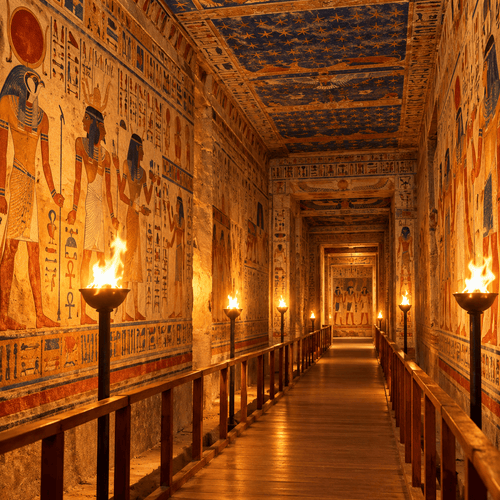
In 1898, French archaeologist Victor Loret crawled down a dark, steep passage in Egypt’s Valley of the Kings. At the bottom, inside a huge stone coffin, he found a king still lying where his servants had laid him more than 3,000 years earlier.
If many Bible scholars are right, Loret was looking at the face of the man who once stood in front of Moses and said:
‘Who is the LORD, that I should obey his voice and let Israel go? I do not know the LORD, and moreover, I will not let Israel go.’
Exodus 5:2
But wait. Didn’t Pharaoh drown in the Red Sea? If he did, how can he have a tomb—let alone a body you can visit in a museum today?
THE SHORT ANSWER
Yes—very probably. If Israel left Egypt around 1446 BC, as the Bible’s own numbers suggest, the pharaoh was most likely Amenhotep II. His tomb was found in 1898 with his mummy still inside his own coffin. In fact, the tombs of every serious candidate are now known, and the last missing one from that royal family was found in 2025. None of this goes against the Bible.
5 Words to Know Before We Start
| WORD | WHAT IT MEANS |
|---|---|
| Pharaoh | The title of Egypt’s king, like ‘king’ or ‘emperor’. It is not a personal name. |
| Mummy | A dead body that was dried, treated with salts and oils, and wrapped in cloth so it would last. |
| Sarcophagus | A large stone box that held the coffin and the mummy. |
| Dynasty | A family line of kings who ruled one after another. |
| Egyptologist | An expert who studies ancient Egypt. |
First, What Does the Bible Actually Say?
Most people ‘know’ that Pharaoh drowned. But let us read what Moses actually wrote.
- Pharaoh led the chase himself. ‘So he made ready his chariot and took his army with him’ (Exodus 14:6).
- His army was wiped out. ‘The waters returned and covered the chariots and the horsemen; of all the host of Pharaoh that had followed them into the sea, not one of them remained’ (Exodus 14:28).
- Israel saw the bodies. ‘Israel saw the Egyptians dead on the seashore’ (Exodus 14:30).
- Later songs look back on it. ‘Pharaoh’s chariots and his host he cast into the sea’ (Exodus 15:4). God ‘overthrew Pharaoh and his host in the Red Sea’ (Psalm 136:15).
Notice what is missing. Exodus 14 never says in plain words, ‘Pharaoh went into the sea and died.’ It says his chariots, horsemen and army went in. In Psalm 136:15, the Hebrew word for ‘overthrew’ (na‘ar) means to ‘shake off’ or ‘toss’. It is the same word used in Exodus 14:27, where ‘the LORD threw the Egyptians into the midst of the sea.’ So Pharaoh’s death in the sea is a fair reading. But the text does not spell it out.
Good Bible teachers have read it both ways. The Puritan pastor Matthew Henry (1662–1714) was sure Pharaoh perished, picturing him ‘buried in the deep, a perpetual monument of divine justice.’ Egyptologist Douglas Petrovich argues that these passages describe the destruction of Pharaoh’s army, not necessarily his own death.
The Red Sea Passages: What They Say and What They Don’t
| WHAT THE BIBLE SAYS | WHAT THE BIBLE DOES NOT SAY |
|---|---|
| Pharaoh rode out in his own chariot (Exodus 14:6). | Where exactly Pharaoh was when the waters came back. |
| ‘Not one’ of the soldiers who followed Israel into the sea survived (Exodus 14:28). | That Pharaoh’s body was lost forever. |
| Israel saw Egyptian bodies on the shore (Exodus 14:30). | That no Egyptian body was ever buried. |
| God ‘overthrew Pharaoh and his host’ (Psalm 136:15). | The pharaoh’s name. |
3 Reasons a Tomb Is Exactly What We Should Expect
Here is the key point. Whichever reading you take, the Bible gives us no reason to expect a missing grave.
- Kings built their tombs early. A new pharaoh usually began cutting his tomb into the rock soon after he came to the throne. The work took years. So the Exodus pharaoh had a tomb waiting for him, however and wherever he died.
- Bodies came back to shore. Israel ‘saw the Egyptians dead on the seashore’ (Exodus 14:30). If Pharaoh died in the sea, his body could have washed up with the rest. Matthew Henry noted the irony: ‘The Egyptians were very nice and curious in embalming and preserving the bodies of their great men’. (‘Nice and curious’ is old English for ‘very careful’.) Yet at the Red Sea, God left Egypt’s great men lying on the sand.
- Mummies were moved. About 3,000 years ago, Egyptian priests moved many royal mummies into secret group graves, called caches, to protect them from tomb robbers. So a king’s tomb and his body are often found in different places.
So a tomb—or even a mummy—proves nothing against the Bible. A sceptic who says, ‘Pharaoh has a tomb, so Exodus is false,’ is attacking a claim the Bible never makes.
So Which Pharaoh Was It?
The Bible never names him (we will see why later). So how do scholars work it out?
The Bible’s Own Clock
‘In the 408th year after the people of Israel came out of the land of Egypt, in the 4th year of Solomon’s reign over Israel … he began to build the house of the LORD.’
1 Kings 6:1
Solomon’s fourth year was about 966 BC. Count back 480 years and you arrive at about 1446 BC. Judges 11:26 agrees: around 1100 BC, judge Jephthah said Israel had lived east of the Jordan for ‘300 years’. This is called the ‘early date’ of the Exodus.
Some other Bible-believing scholars, such as Kenneth Kitchen and James Hoffmeier, prefer a ‘late date’ of around 1260 BC, under Rameses II. Their main reason is the store city called ‘Rameses’ (Exodus 1:11). But the same name appears in Joseph’s day, centuries before any king called Rameses lived (Genesis 47:11). That suggests a later scribe updated an old place name so readers would know where it was. A modern writer might do the same, saying a story from 1950 happened in ‘Mumbai’ even though the city was then called ‘Bombay’.
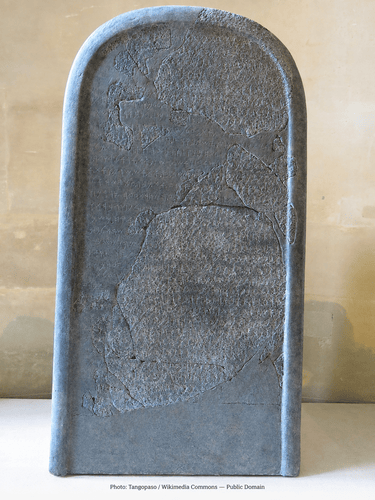
There’s another problem. An inscription of Pharaoh Merneptah from about 1208 BC already names ‘Israel’ as a people in Canaan. That leaves little time for a late Exodus and 40 years in the wilderness.
The Main Candidates
Notice the last two columns: every candidate has a known tomb.
Who Was the Exodus Pharaoh? The Main Candidates and Their Tombs
| PHARAOH | WHO FAVOURS HIM | HIS TOMB | HIS MUMMY |
|---|---|---|---|
| Amenhotep II | Most early-date scholars | KV35, found in 1898 | Found in his own sarcophagus |
| Thutmose III | Some early-date scholars | KV34, found in 1898 | Found in the Deir el-Bahri cache, 1881 |
| Thutmose II | A small minority | Tomb C4, identified in 2025 | Uncertain; a second tomb may hold it |
| Ramesses II | Late-date scholars | KV7, open since ancient times | Found in the Deir el-Bahri cache, 1881 |
| Merneptah | Older writers; many Muslim writers | KV8, open since ancient times | Found inside KV35 in 1898 |
Note: ‘KV’ means ‘Kings’ Valley’. Each tomb there has its own number.
The Case for Amenhotep II
Douglas Petrovich has made one of the most detailed cases for this king. Here are the main lines of evidence.
- He fits the Bible’s dates. On one widely used Egyptian timeline, Amenhotep II was on the throne in 1446 BC. (Other timelines move his reign by about 20–25 years—see the box below.)
- The king before him reigned a long time. Thutmose III ruled over 50 years. Exodus says the king who wanted Moses dead died ‘during those many days’ (Exodus 2:23), while Moses spent about forty years in Midian (Acts 7:30).
- He was not a firstborn son. The tenth plague killed every firstborn in Egypt (Exodus 12:29), yet Pharaoh lived. Amenhotep II had an older brother who died before him, so he was not his father’s firstborn.
- His own heir did not become king. His son Thutmose IV later set up the Dream Stele (an inscribed stone) at the Great Sphinx, claiming a god promised him the throne in a dream. Why tell that story unless you weren’t the expected heir? Early-date scholars see a dead firstborn behind it.
- A sudden hunt for slaves. In his ninth year, Amenhotep II marched into Canaan and brought back a huge number of captives. Petrovich suggests he was replacing the slave workforce Egypt had just lost.
- His tomb and mummy survive. Loret found the king in his own sarcophagus—rare in the Valley of the Kings, where most royal mummies had been moved.
WHERE WE SHOULD BE CAREFUL
Honest defence of the Bible means never claiming more than the evidence shows.
- Egyptian dates aren’t fixed. Experts use different timelines, and these can differ by two decades or more.
- The eldest son is debated. Scholars still disagree about which of Amenhotep II’s sons was born first.
- The Dream Stele is a later copy. The stone we have today was carved centuries after Thutmose IV died. Charles Aling, a Bible-believing Egyptologist, thinks it faithfully copies the original message. But he raises a fair question. In the story, Thutmose IV is old enough to go hunting in the desert. Was he really that old when the Exodus happened, or was he still a small boy?
- Strong isn’t the same as proven. Amenhotep II is the strongest candidate, not a certain one.
The good news? The Bible’s truth doesn’t hang on any of these details.
Timeline: How Egypt’s Royal Tombs and Mummies Came to Light
- 1881—Thutmose III, Ramesses II and dozens of other royal mummies are found hidden together in the Deir el-Bahri cache near Luxor.
- 1898—Loret enters KV35. He finds Amenhotep II in his own coffin, plus a hidden room of other kings, including Merneptah.
- Early 1900s—Christian visitors are puzzled to see ‘the Pharaoh of the Exodus’ in a museum. The story of ‘Red Sea salt’ on his body begins.
- 1976—Ramesses II’s mummy is flown to Paris for treatment and examined by a French doctor, Maurice Bucaille.
- 2021—22 royal mummies are paraded through Cairo to the National Museum of Egyptian Civilization.
- 2025—Thutmose II’s tomb is identified: the last missing royal tomb of the 18th Dynasty.
The 2025 Discovery That Completed the Set
In February 2025, Egypt announced the first discovery of a pharaoh’s tomb since Tutankhamun’s in 1922. A joint British and Egyptian team led by Piers Litherland found it in a valley about 2.4 km west of the Valley of the Kings. Then they found pieces of alabaster jars naming Thutmose II as ‘the deceased king’, together with his wife, Hatshepsut.
The tomb was nearly empty. A flood struck soon after the burial, and the contents—including the king’s body—were moved. The team believes a second tomb lies hidden under a man-made mound of rock about 23 metres high. They also doubt whether the mummy long labelled ‘Thutmose II’ is really him.
Why does this matter? Tomb C4 was the last missing royal tomb of Egypt’s 18th Dynasty—the very family of kings that ruled when, by the Bible’s own numbers, Israel left Egypt. So archaeology has not found a ‘missing’ Exodus pharaoh. It has found what Exodus leads us to expect: proud kings who, in the end, were buried like every other man.
2 Myths to Avoid
Good arguments for the Bible don’t need bad ones.
- ‘Salt in his lungs proves he drowned.’ In the early 1900s, visitors noticed salt on Merneptah’s mummy and decided it came from the Red Sea. But embalmers (the people who made mummies) used large amounts of salt. A museum record of this mummy says plainly that nothing about it supports the drowning theory.
- ‘A French doctor proved Pharaoh drowned.’ Maurice Bucaille claimed Ramesses II’s mummy showed signs of drowning, and he linked this to the Qur’an. Later scientific scans of the royal mummies have not confirmed drowning.
What About the Qur’an’s Claim?
The Qur’an (Surah 10:90–92) says Pharaoh drowned, and that God would ‘save’ his body as a sign for later generations. Many Muslim writers point to the royal mummies in Cairo as proof. Our Muslim neighbours deserve a careful answer, not a mocking one.
- The Bible makes no promise about Pharaoh’s body. So whatever is found, or not found, the Bible’s account stands.
- There is no agreement on which mummy it is. Some name Ramesses II; others, Merneptah.
- Merneptah is an unlikely Exodus king. His own inscription speaks of Israel as already living in Canaan.
- Preserved royal bodies are common. Dozens of royal mummies from this era survive, so one more is not unusual.
Why Did God Leave Pharaoh Unnamed?
Exodus names 2 humble midwives—Shiphrah and Puah (Exodus 1:15)—but never names the most powerful man on earth. That’s no accident. In Egypt, Pharaoh was treated as a god. In Exodus, he is simply ‘Pharaoh’: a title, a man, a creature. The true main character is God.
‘On all the gods of Egypt I will execute judgements: I am the LORD.’
Exodus 12:12
John Currid, an Old Testament scholar who has written widely on ancient Egypt, argues the plagues were a direct attack on Egypt’s gods—the Nile, the sun, and finally Pharaoh himself. The Red Sea was the last blow. John Calvin (1509–1564) saw it the same way. God had already won many victories over Pharaoh, he wrote, and ‘the last act still remained to overwhelm him and his army in the sea.’
The apostle Paul tells us why God allowed this proud king to rise at all:
‘For this very purpose I have raised you up, that I might show my power in you, and that my name might be proclaimed in all the earth.’
Romans 9:17
Pharaoh spent his life building a tomb so his name would live forever. Today most people couldn’t tell you his name. But the name of the LORD is still proclaimed in all the earth. Matthew Henry put it memorably: ‘those whom he is not honoured by he will be honoured upon.’ In other words, God receives glory from every life—either through a person’s worship or through his judgement.
So, Was the Tomb Found?
Very probably, yes. If the Exodus took place around 1446 BC, its pharaoh was most likely Amenhotep II, and his tomb and body were found in 1898. Even if scholars one day settle on a different king, his tomb is already known too. Nothing found in Egypt has contradicted a single line of Exodus.
But the deepest lesson isn’t about Pharaoh’s tomb. It’s about another one. When Jesus met Moses and Elijah on the mountain, they spoke of His ‘departure’ (Luke 9:31)—in Greek, His exodus—which He would accomplish at Jerusalem. Through His death and rising, He led his people out of a slavery far worse than Egypt’s.
Pharaoh’s tomb was found with the king still inside. Jesus’ tomb was found too—and it was empty.
Tough Questions, Honest Answers
Which pharaoh made the Israelites slaves in the first place?
Exodus simply says, ‘there arose a new king over Egypt, who did not know Joseph’ (Exodus 1:8). On the early date, this was probably one of the first kings of the 18th Dynasty. These kings had just driven out the Hyksos—foreign rulers from Canaan who had controlled northern Egypt—so they were suspicious of other foreigners living in the Nile Delta. Some scholars link the order to kill Hebrew baby boys with Amenhotep I or Thutmose I, but this cannot be proved. What we can be sure of is that none of it surprised God. Centuries earlier he told Abraham that his offspring would ‘be servants there, and they will be afflicted for four hundred years’ (Genesis 15:13).
Was Hatshepsut the ‘daughter of Pharaoh’ who adopted Moses?
She might have been, but we cannot be sure. Some early-date scholars place Moses’ birth in the time of Thutmose I, whose daughter Hatshepsut later ruled Egypt as pharaoh herself. A royal woman that powerful could have defied her father’s order and raised a Hebrew boy in the palace. Still, this depends on which Egyptian timeline is used, and the Bible does not name her, so we should hold the idea loosely. The bigger point is God’s providence: he used Pharaoh’s own household to raise the man who would bring Pharaoh down. And Moses, ‘when he was grown up, refused to be called the son of Pharaoh’s daughter’ (Hebrews 11:24).
Is there any Egyptian record of the ten plagues?
Not a clear one. Some people point to the Ipuwer Papyrus, an Egyptian poem that describes national disaster and even says ‘the river is blood’. But most Egyptologists believe the poem was first written well before the Exodus, so we shouldn’t lean on it. Nor should the silence surprise us. Egyptian kings carved their victories in stone, not their humiliations. God told Pharaoh plainly why the plagues came: ‘so that you may know that there is none like me in all the earth’ (Exodus 9:14).
Where did the Red Sea crossing actually happen?
Nobody knows for certain. The Hebrew name is Yam Suph, often translated ‘Sea of Reeds’, but the Bible uses the same name for the Gulf of Aqaba (1 Kings 9:26). Scholars suggest three main areas: the lakes along today’s Suez Canal, the Gulf of Suez, or the Gulf of Aqaba. The places named in Exodus 14:2—Pi-hahiroth, Migdol and Baal-zephon—have not yet been firmly identified. Wherever it was, the Bible is clear that this was no ordinary event: ‘the LORD drove the sea back by a strong east wind all night’ (Exodus 14:21). God used the wind, but God was the one who acted.
Have chariot wheels been found at the bottom of the Red Sea?
No verified ones. From the late 1970s, an amateur explorer named Ron Wyatt claimed to have found coral-covered chariot wheels in the Gulf of Aqaba, and the story still spreads online. But no professional archaeologist has confirmed these finds, and no object has been published for experts to study. Christians should not build their faith on claims like this. Scripture says Israel crossed ‘by faith’, while the Egyptians ‘were drowned’ (Hebrews 11:29). Our confidence rests on God’s Word, not on rumours from the sea floor.
Was it fair for God to harden Pharaoh’s heart?
Yes. Pharaoh was not a good man whom God forced to become evil. Exodus tells us more than once that Pharaoh hardened his own heart (Exodus 8:15, 32). When God hardened him further, he was handing a proud man over to what he already wanted—a judgement on sin, not the cause of it. Paul writes, ‘he has mercy on whomever he wills, and he hardens whomever he wills’ (Romans 9:18). Matthew Henry explained, ‘it is a righteous thing with God to put those under the impressions of his wrath who have long resisted the influences of his grace.’ If you are worried that your own heart is hard, that very worry is a sign that God is still at work in you.
Can you see the pharaohs’ mummies today?
Yes. Since 2021, many royal mummies have been on display in the Royal Mummies Hall of the National Museum of Egyptian Civilization in Cairo. They include Amenhotep II, Thutmose III, Ramesses II and Merneptah—all the main Exodus candidates. Visitors often find it a sobering experience. These men ruled the greatest empire of their day, yet they lie silent behind glass. ‘When his breath departs, he returns to the earth; on that very day his plans perish’ (Psalm 146:4).
Related Reads
- BC 1446 or 1250: When Did the Exodus Really Happen?
- Why Did God Harden Pharaoh’s Heart? The Reformed View
- Jesus in Exodus: Did Moses Write About Christ?
- Examining Ron Wyatt’s Mount Sinai Claims
- Archaeology: Confirming Bible Names, Places, Dates
- The Fall of Jericho: Does Archaeology Back the Bible Account?
- Were the Pyramids Built Before Noah’s Flood? What the Rock Reveals
- Christian Answers to Islamic Challenges: Clarifying Monotheism
- The Empty Tomb: Did the Disciples Steal Jesus’ Body?