Jeremiah isn’t a book most people read for comfort. It has 52 chapters of warnings, tears and war. The prophet was beaten, thrown into a muddy pit, called a traitor. In the end he watched his city burn.
Yet here’s a surprising claim: some of the clearest pictures of Jesus in the Old Testament are found in this sad book. One of Jeremiah’s promises is quoted in the New Testament at greater length than any other Old Testament passage. And on the night before He died, Jesus took Jeremiah’s words on His own lips.
In this post we shall look at 3 lines of evidence: the King Jeremiah promised, the covenant he announced and the life he lived. By the end, you’ll agree Jeremiah isn’t just a book about sorrow. It’s a book about the Saviour.
Jesus in the Old Testament — Book 24 of 39
This post is the 24th instalment in our series tracing Christ through every book of the Old Testament. See the full series index.
Can We Really Find Jesus in Jeremiah?
Some say Christians “read Jesus into” the Old Testament. But Jesus Himself taught us to read it this way:
And beginning with Moses and all the Prophets, He interpreted to them in all the Scriptures the things concerning Himself. (Luke 24:27)
Jeremiah is one of “the Prophets”. Peter adds the prophets searched to understand “the sufferings of Christ and the subsequent glories” (1 Peter 1:11). As the London preacher Charles Spurgeon said, “from every text in Scripture, there is a road towards the great metropolis, Christ.” We’re not forcing Jesus into Jeremiah. We’re reading Jeremiah the way Jesus taught us to.
KEY WORDS EXPLAINED
Messiah: a Hebrew word meaning “anointed one”, the same as the Greek word “Christ”. God promised a special King from David’s family.
Type: a real person or event in the Old Testament that God designed as a picture of something greater to come.
Covenant: a binding agreement in which God makes promises to His people and binds Himself to keep them.
Fulfil: to bring a promise or picture to its full meaning.
Jeremiah’s World in Brief
Timeline: Jeremiah and the Fall of Jerusalem
- 627 BC: God calls the young Jeremiah (Jeremiah 1:2, 6).
- 609 BC: Good King Josiah is killed in battle. Judah quickly returns to idols.
- 605 BC: Babylon takes the first captives from Judah, including Daniel.
- 597 BC: King Jehoiachin (also called Coniah or Jeconiah) is taken to Babylon.
- 586 BC: Babylon destroys Jerusalem and the temple.
- After 586 BC: Jeremiah is taken to Egypt against his will.
Into this dark story God speaks words of hope. And that hope has a name.
1. The Righteous Branch: A King with God’s Name
Behold, the days are coming, declares the LORD, when I will raise up for David a righteous Branch, and he shall reign as king and deal wisely, and shall execute justice and righteousness in the land. In his days Judah will be saved, and Israel will dwell securely. And this is the name by which he will be called: “The LORD is our righteousness.” (Jeremiah 23:5–6)
A branch here means a new shoot growing from a tree that has been cut down. Babylon was about to chop down David’s royal family tree. But God promised new life from the stump (see Isaiah 11:1).
A clever contrast with a failed king
Judah’s last king was Zedekiah, whose name means “The LORD is my righteousness”. The promised King’s name is almost the same. God is saying: “You have a king who carries this name but doesn’t live up to it. I will send One who will.”
Table 1: Two kings with almost the same name
| KING ZEDEKIAH | THE RIGHTEOUS BRANCH | |
|---|---|---|
| Meaning of the name | “The LORD is my righteousness” | “The LORD is our righteousness” |
| Who gave the name | Nebuchadnezzar, king of Babylon (2 Kings 24:17) | God Himself (Jeremiah 23:6) |
| How he ruled | Weak and fearful; broke his promises | Wisely, with justice and righteousness |
| How it ended | Blinded and taken in chains to Babylon (Jeremiah 52:11) | Judah saved and Israel living safely |
A name that belongs only to God
“LORD” in capital letters stands for God’s personal name, Yahweh. So this King is called Yahweh Tsidqenu, by the holy name of God Himself. No ordinary son of David could carry that name. It fits only a King who’s both truly human and truly God.
Reformer John Calvin argued from this verse that the Messiah is truly God, and that our righteousness comes not from ourselves but from Him. Even ancient Jewish teachers read the verse this way. The Aramaic paraphrase called Targum Jonathan speaks here of a “Messiah of righteousness”, and the Babylonian Talmud (Bava Batra 75b) calls the Messiah by this name. Christians didn’t invent this reading.
Why “the Lord is our righteousness” matters
Righteousness means being right with God, and none of us has that on our own. But this King doesn’t just have righteousness. He is our righteousness:
For our sake he made him to be sin who knew no sin, so that in him we might become the righteousness of God. (2 Corinthians 5:21)
Jeremiah 33:16 even gives this same name to God’s city, as a bride takes her husband’s name. God’s people carry Christ’s name because they’re given His righteousness. The Bible calls this being counted righteous (Romans 4:5).
A STORY WORTH TELLING: “JEHOVAH TSIDKENU”
In 1834 young Scottish minister Robert Murray M’Cheyne wrote a poem on this name. It begins: “I once was a stranger to grace and to God, / I knew not my danger, and felt not my load.”
For years, he admits, the name meant “nothing to me”. He was religious but trusted in himself. By the end of the poem, it’s his only hope in life and death.
But wasn’t the Branch just Zerubbabel?
Some say the “Branch” was Zerubbabel, a leader who returned from Babylon (Zechariah 3:8; 6:12). But Zerubbabel was a governor, never a king, and never called by God’s name. Zechariah himself looked further ahead, to a Branch who’d be priest and king on one throne (Zechariah 6:13).
A King Who Is Also a Priest
I will make him draw near, and he shall approach me, for who would dare of himself to approach me? declares the LORD. (Jeremiah 30:21)
Coming near to God was a priest’s work. Then God promises David will never lack a man on the throne, nor the priests a man to offer sacrifices (33:17–18). Yet after 586 BC no son of David reigned for centuries. The answer is Jesus: the Son of David who reigns forever (Luke 1:32–33) and the High Priest who “always lives to make intercession” for us (Hebrews 7:25).
The Curse on Coniah: A Puzzle Solved
None of his offspring shall succeed in sitting on the throne of David and ruling again in Judah. (Jeremiah 22:30)
Here’s the puzzle. The Messiah had to come from David’s royal line, but that line ran through Coniah, whose descendants were cut off from the throne. The two family trees of Jesus give a remarkable answer.
Table 2: How Jesus’ two family trees answer the Coniah curse
| MATTHEW 1 | LUKE 3 | |
|---|---|---|
| Which son of David? | Solomon, the royal line | Nathan, another son of David |
| Includes Coniah (Jeconiah)? | Yes (Matthew 1:11–12) | No |
| Through whom? | Joseph, Jesus’ legal father | Many hold this is Mary’s line |
| What it proves | Jesus has the legal right to David’s throne | Jesus is David’s son by blood |
Since Jesus was born of a virgin, He wasn’t Coniah’s physical descendant. Yet as Joseph’s adopted son He held the legal right to the throne. The curse stood, and the promise was kept. (Some point instead to Haggai 2:23, where God seems to reverse the curse. Either way, God’s word doesn’t fail.)
2. The New Covenant: God’s Answer to the Human Heart
Behold, the days are coming, declares the LORD, when I will make a new covenant with the house of Israel and the house of Judah… I will put my law within them, and I will write it on their hearts… For I will forgive their iniquity, and I will remember their sin no more. (Jeremiah 31:31, 33–34)
O Palmer Robertson famously defined a covenant as “a bond-in-blood sovereignly administered”: a life-and-death promise that God sets up on His own terms. Bible covenants were sealed with blood. So how would this one be sealed?
Jesus names the new covenant
This cup that is poured out for you is the new covenant in my blood. (Luke 22:20)
No one had spoken of a “new covenant” this way since Jeremiah. At the Last Supper, Jesus announced Jeremiah’s promise was coming true, sealed with His own blood. Hebrews 8:8–12 then quotes the whole of Jeremiah 31:31–34. Puritan John Owen gave a large part of his great commentary on Hebrews to these verses, seeing them as central to the gospel.
Table 3: The old covenant and the new covenant compared
| THE COVENANT AT SINAI | THE NEW COVENANT | |
|---|---|---|
| Where the law is written | On tablets of stone | On the hearts of God’s people (31:33) |
| The big problem | “My covenant that they broke” (31:32) | God keeps His people from turning away (32:40) |
| Dealing with sin | Animal sacrifices, repeated every year (Hebrews 10:3–4) | Sin forgiven and remembered no more (31:34) |
| Go-between | Moses | Jesus, mediator of a better covenant (Hebrews 8:6) |
Why we need a new heart
The old covenant did not fail because God’s law was bad. It failed because human hearts were bad:
The heart is deceitful above all things, and desperately sick; who can understand it? (Jeremiah 17:9)
We can no more change our hearts than a leopard can change its spots (13:23). So God does what we cannot: “I will give them a heart to know that I am the LORD” (24:7). This is the work of the Holy Spirit (Ezekiel 36:26–27). And God promises to keep His people: “I will put the fear of me in their hearts, that they may not turn from me” (32:40). Those who truly belong to Christ will not finally fall away.
IS THE NEW COVENANT ONLY FOR JEWS?
Jeremiah says it is made “with the house of Israel and the house of Judah”. But the New Testament applies it to all believers:
Hebrews: quotes Jeremiah 31 to Christians and calls the old covenant “obsolete” (Hebrews 8:13).
The Lord’s Supper: Paul gave the words “new covenant in my blood” to a mostly non-Jewish church (1 Corinthians 11:25).
Jesus, the true Israel: all joined to Him by faith are grafted into God’s one family tree (Romans 11:17; Galatians 3:29).
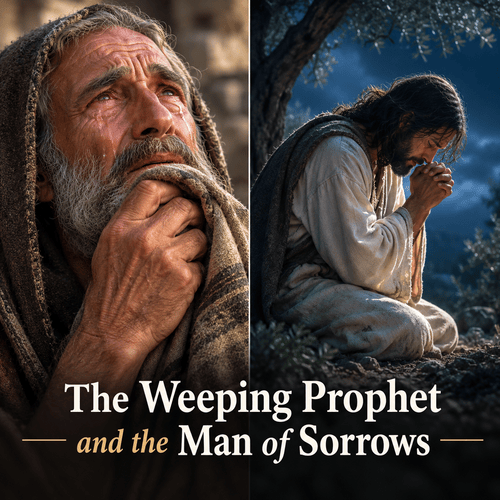
3. The Weeping Prophet Who Pointed Past Himself
Jeremiah’s life also points to Jesus. He is a type of Christ. Edmund Clowney taught that we should first see what a type meant in its own day, then see how Christ fulfils it. Do that with Jeremiah, and the likeness is striking.
Table 4: How Jeremiah’s life previews the life of Jesus
| WHAT HAPPENED | JEREMIAH | JESUS |
|---|---|---|
| Rejected by his hometown | Men of Anathoth plot to kill him (11:21) | Nazareth tries to throw Him off a cliff (Luke 4:29) |
| A lamb led away | “Like a gentle lamb led to the slaughter” (11:19) | The Lamb of God led to the cross (John 1:29) |
| “Den of robbers” | Preaches against the temple (7:11) | Quotes Jeremiah while cleansing the temple (Matthew 21:13) |
| Weeping over Jerusalem | “Oh that my head were waters” (9:1) | Weeps over the city (Luke 19:41) |
| Put on trial | “This man deserves the sentence of death” (26:11) | “He deserves death” (Matthew 26:66) |
| Innocent blood | Warns of “innocent blood” (26:15) | “His blood be on us” (Matthew 27:25) |
When Jesus asked His disciples who people thought He was, some answered, “Jeremiah” (Matthew 16:14). People saw the likeness. But as we will see, the likeness also has limits.
WHERE JEREMIAH FALLS SHORT—AND JESUS DOES NOT
In suffering: Jeremiah prayed, “Let me see your vengeance upon them” (11:20). Jesus prayed, “Father, forgive them” (Luke 23:34).
In tears: Jeremiah could weep over sin but not remove it. Jesus wept, then died to take it away.
In the end: Jeremiah disappeared in Egypt. Jesus rose and reigns forever.
More Pictures of Christ in Jeremiah
- The cup of wrath (25:15): Jeremiah carries “this cup of the wine of wrath” to the nations. In Gethsemane Jesus prays, “let this cup pass from me” (Matthew 26:39), then drinks it for His people.
- The fountain of living waters (2:13): Israel left God for broken water tanks. Jesus says, “If anyone thirsts, let him come to me and drink” (John 7:37).
- The Good Shepherd (23:1–4): God condemns Israel’s selfish shepherds and promises to gather His flock. Jesus is “the good shepherd” (John 10:11).
- Rachel weeping (31:15): Matthew applies this to Bethlehem’s grief (Matthew 2:17–18). But the next verse promises return from exile (31:16), which Jesus, the true Israel, brings about.
- The potter and the clay (18:1–11): Paul uses this picture of God’s freedom in salvation (Romans 9:21). See our post on Romans 9.
- The seventy years (25:11): Daniel prayed over this prophecy, and God answered with the seventy weeks pointing to the Messiah (Daniel 9). See our post on Daniel’s 70 Weeks.
HANDLE WITH CARE: “A WOMAN ENCIRCLES A MAN”
Some early writers, including Jerome, read Jeremiah 31:22 as a prophecy of the virgin birth. Most careful interpreters today think it pictures Israel turning back to hold on to her God. Our case doesn’t need weak links. It stands on the strong ones.
Answering Two Common Objections
- “Matthew made a mistake.” Matthew 27:9–10 credits “Jeremiah” with words that sound like Zechariah 11:12–13. But Matthew is combining both prophets: Jeremiah’s potter (chapters 18–19) and field purchase (chapter 32) with Zechariah’s silver. Writers often named only the major prophet, as Mark names only Isaiah for a quotation that includes Malachi (Mark 1:2–3).
- “Christians force Jesus into old texts.” Jesus taught this way of reading (Luke 24:27), ancient Jewish teachers read Jeremiah 23 as messianic, and no king of Judah ever fitted the name “The LORD is our righteousness”.
Conclusion: From Tears to Hope
Jeremiah’s book is full of tears, but not without hope. In Judah’s darkest hour, God promised a righteous King with God’s own name, a new covenant written on hearts, and a weeping prophet whose life pointed to a greater Man of sorrows. All these promises find their “Yes” in Jesus (2 Corinthians 1:20).
So Jeremiah leaves every reader with one question: whose righteousness are you trusting? Your own, like Zedekiah? Or the King whose name is “The LORD is our righteousness”? The Branch has grown from David’s stump. The new covenant cup has been poured out. He’s the fountain of living waters, and He still invites the thirsty to come and drink.
Tough Questions, Honest Answers
What does Jeremiah 29:11 really mean for Christians today?
Jeremiah 29:11 says, “For I know the plans I have for you, declares the LORD, plans for welfare and not for evil, to give you a future and a hope.” It was first written in a letter to Jewish captives in Babylon. God was telling them to settle down, because they would stay there for 70 years (29:10). So it’s not a promise of an easy life or quick success. But Christians may still take great comfort from it, because God’s good plans for His people all come true in Jesus (2 Corinthians 1:20). Even in hard seasons, God is working for the good of those who love Him (Romans 8:28).
Is Jeremiah 1:5 about Jesus?
Not directly. “Before I formed you in the womb I knew you” is God speaking to Jeremiah about Jeremiah. But the verse teaches 2 important truths. First, God knows and cares about a person before birth, which gives great value to unborn life (see also Psalm 139:13). Second, God chose Jeremiah for his work before Jeremiah had done anything. This shows us God’s calling rests on His grace, not our merit. In this way Jeremiah’s calling gently mirrors Christ, who was sent by the Father from before the world began.
Why is Jeremiah called the “weeping prophet”?
Jeremiah often speaks of his own tears. He wished his eyes were “a fountain of tears” so he could weep day and night for his people (9:1; see also 13:17). He wept because he loved them and because he saw the judgement coming. Many also believe he wrote the book of Lamentations, a song of grief over fallen Jerusalem. His tears show us God isn’t cold when He judges sin. They also prepare us for Jesus, who wept over the same city.
Did Jeremiah hide the Ark of the Covenant?
A story in 2 Maccabees 2:4–8 claims Jeremiah hid the ark in a cave on Mount Nebo. But 2 Maccabees belongs to the Apocrypha, books that aren’t part of inspired Scripture, and the Bible itself never says what happened to the ark. In fact, Jeremiah said a day would come when people wouldn’t even miss it (3:16). Why? Because the ark was only a picture of God living among His people. Now Jesus Himself is that meeting place between God and humanity.
Why did God tell Jeremiah not to marry?
In Jeremiah 16:2 God told him, “You shall not take a wife, nor shall you have sons or daughters in this place.” This was a living sermon. Terrible suffering was coming on Judah, and families would be torn apart. Jeremiah’s lonely life was a warning sign to everyone who saw him. This was a special command for one prophet, not a rule for all believers; the Bible honours marriage (Hebrews 13:4). But it reminds us following God can be costly.
What’s the “balm in Gilead”?
In Jeremiah 8:22 the prophet asks, “Is there no balm in Gilead? Is there no physician there?” Gilead was a region known for a healing ointment made from tree resin. Jeremiah’s point was painful: healing was close by, yet God’s people refused to come to Him to be healed. Christians have long seen this as a picture of Jesus, who called Himself a doctor who came for the sick (Mark 2:17). The old spiritual song answers Jeremiah’s question: yes, there is a balm in Gilead.
How did Jeremiah die?
The Bible doesn’t tell us. The last time we see him, he has been taken to Egypt against his will, still warning his people (Jeremiah 43–44). An ancient Jewish writing called The Lives of the Prophets says he was stoned to death by his own people there. Some think Hebrews 11:37, “They were stoned”, may include him. We can’t be certain. But it fits the pattern of his whole life: faithful to the end, rejected by those he loved, just like the One he pointed to.