A book in the Bible makes some Christians blush. It talks about kisses, perfume and a bedroom. It hardly mentions God. In the 1500s, one scholar in Geneva wanted it removed from the Bible. Churches seldom ever preach from it.
So here’s a bold question: what if this ‘embarrassing’ book is one of the clearest pictures of Jesus in the whole Old Testament?
In this series, we’re looking for Jesus in every book of the Old Testament. After He rose, ‘beginning with Moses and all the Prophets, he interpreted to them in all the Scriptures the things concerning himself’ (Luke 24:27). If Jesus is in all the Scriptures, He’s in the Song of Songs too. But we mustn’t push Jesus into a text where He doesn’t belong. So we will build the case step by step, letting the Bible explain the Bible.
Jesus in the Old Testament — Book 22 of 39
This post is the twenty-second instalment in our series tracing Christ through every book of the Old Testament. See the full series index.
THE BIG IDEA IN ONE MINUTE
The Song of Songs is a real love song about a real husband and wife. But God designed marriage from the beginning to be a picture of Jesus and His people (Ephesians 5:32). So the Bible’s greatest song about marriage also points to the greatest marriage of all: Christ the Bridegroom and His bride, the church.
First, What’s the Song of Songs?
The book begins: ‘The Song of Songs, which is Solomon’s’ (Song 1:1). In Hebrew, saying a word twice like this means ‘the very best’. Think of ‘King of kings’. So the ‘Song of Songs’ means the greatest song of all.
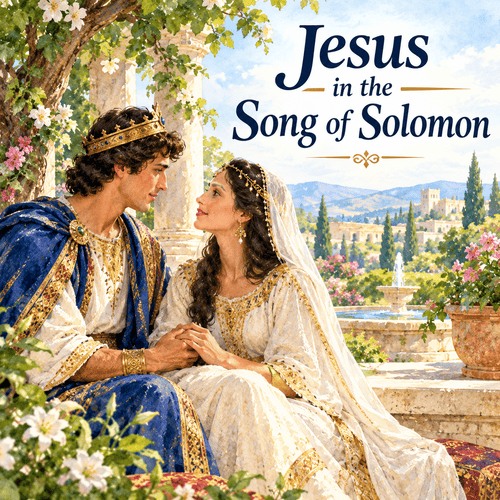
It’s a set of love poems between a king and a young woman called ‘the Shulammite’ (6:13). She calls him ‘my beloved’—simply, ‘the one I love’. A group of women, ‘the daughters of Jerusalem’, listen in. The couple long for each other, lose each other and find each other again. At the centre is a royal wedding (3:6–5:1).
| Question | Answer |
|---|---|
| Other names | Song of Solomon (the ESV title), Canticles (from the Latin for ‘songs’) |
| Who wrote it? | King Solomon, son of David (1:1) |
| Who speaks? | The king (the beloved), the Shulammite (the bride) and the daughters of Jerusalem |
| Main theme | Faithful, joyful, married love |
3 Ways to Read the Song
Over the centuries, Christians have read the Song in three main ways. 2 go wrong. 1 gets it right.
| WAY OF READING | WHAT IT SAYS | THE PROBLEM |
|---|---|---|
| 1. Secret code only | Every detail is a hidden code. The real couple doesn’t matter. | Readers invent meanings. Some old writers said the bride’s two breasts stood for the two Testaments. That’s guesswork. And sounds far-fetched |
| 2. Romance only | The Song is only about love in marriage. It says nothing about Jesus. | It ignores what the rest of the Bible says about marriage and about Solomon’s greater Son. |
| 3. Real love that points to Christ (our view) | The Song is truly about a husband and wife. Because God made marriage a picture of Christ, it also points to Jesus. | None. The Bible explains the Bible. |
2 key words explained
Allegory: a story where every detail is a code for something else, and the story itself does not really matter. Way 1 reads the Song like this.
Typology: from ‘type’, meaning a pattern or picture. A type is a real person, event or thing in the Old Testament that God designed to point forward to Jesus. The Passover lamb was a real lamb, yet ‘Christ, our Passover lamb, has been sacrificed’ (1 Corinthians 5:7).
Allegory throws away the real story. Typology keeps it and lets the rest of the Bible show where it points.
6 Reasons the Song Points to Jesus
1. Marriage Was Made to Point to Christ
This is the key that opens the whole book. Paul quotes the first wedding in Genesis 2: ‘the two shall become one flesh.’ Then he adds: ‘This mystery is profound, and I am saying that it refers to Christ and the church’ (Ephesians 5:31–32). In the Bible, a ‘mystery’ is a truth once hidden and now made clear.
So marriage was always about more than marriage. From the start, God designed it as a picture of Christ and His people. So the Bible’s greatest song about marriage can’t be silent about Christ. When we see Jesus in the Song, we’re not being fanciful. We’re following Paul.
2. The Whole Bible Is One Long Love Story
Timeline: God’s love story from beginning to end
- Genesis: God brings the first bride to the first husband in a garden (Genesis 2:22–24).
- The Prophets: God says to Israel, ‘your Maker is your husband’ (Isaiah 54:5), and promises, ‘I will betroth you to me forever’ (Hosea 2:19). To ‘betroth’ means to promise to marry.
- The Gospels: John the Baptist says of Jesus, ‘The one who has the bride is the bridegroom’ (John 3:29).
- The Letters: Paul tells a church, ‘I betrothed you to one husband, to present you as a pure virgin to Christ’ (2 Corinthians 11:2).
- Revelation: History ends with a wedding: ‘the marriage of the Lamb has come’ (Revelation 19:7).
The Bible begins and ends with a wedding. It would be strange if the one book given entirely to this theme had nothing to do with the Bridegroom at the centre of it all.
3. The New Testament Already Reads a Royal Love Song as About Jesus
Some say, ‘The New Testament never quotes the Song, so it can’t be about Jesus.’ But look at Psalm 45. It’s a song for a royal wedding. It praises the king—‘You are the most handsome of the sons of men’ (Psalm 45:2)—and describes his bride in gold. It’s the same kind of poem as the Song.
Hebrews quotes this wedding song and says it’s about Jesus: ‘But of the Son he says, “Your throne, O God, is forever and ever”’ (Hebrews 1:8). So the apostles believed an Old Testament royal love song could speak of Christ. If that’s true of Psalm 45, why not the Song?
4. The King Is a Son of David
The bridegroom in the Song is King Solomon (3:7–11). God had promised David a son whose throne would last forever (2 Samuel 7:12–16). Solomon took that throne, but he died and his kingdom split. God’s people kept waiting for a greater Son of David.
Here’s a lovely detail. God gave Solomon a second name, Jedidiah, meaning ‘beloved of the LORD’ (2 Samuel 12:24–25). It sounds close to the bride’s favourite word in the Song: dodi, ‘my beloved’. Centuries later, the Father said of Jesus, ‘This is my beloved Son’ (Matthew 3:17). Jesus said plainly, ‘something greater than Solomon is here’ (Matthew 12:42). Solomon is the shadow. Jesus is the real thing.
5. The Song Undoes the Curse of Eden
After Adam and Eve sinned, God told the woman, ‘Your desire shall be contrary to your husband’ (Genesis 3:16). Sin spoiled love. The Hebrew word for ‘desire’ there, teshuqah, appears only 3 times in the whole Old Testament:
| VERSE | WHAT IT SAYS | WHAT IT SHOWS |
|---|---|---|
| Genesis 3:16 | ‘Your desire shall be contrary to your husband’ | Love spoiled by sin |
| Genesis 4:7 | Sin’s ‘desire is contrary to you’ (said to Cain) | Sin wants to control us |
| Song 7:10 | ‘I am my beloved’s, and his desire is for me’ | Love healed and made whole |
In Eden, desire became a struggle. In the Song, desire is healed, and the book is full of gardens, fruit and springs (4:12–5:1). It feels like Eden again. But no human husband can undo the curse. Only Jesus, ‘the last Adam’ (1 Corinthians 15:45), can. The Song gives us a taste of love restored. Jesus restores it.
6. A Love Stronger Than Death
The Song reaches its high point here: ‘love is strong as death, jealousy is fierce as the grave. Its flashes are flashes of fire, the very flame of the LORD. Many waters cannot quench love, neither can floods drown it’ (Song 8:6–7).
Many scholars believe ‘the very flame of the LORD’ contains a short form of God’s name, Yah. If so, God is named at the very moment the Song describes the strongest love of all. And only one love in history has fought death and won. Jesus went into death for His bride and walked out of the grave on the third day. The ‘many waters’ of God’s judgement could not put out His love.
Where We See Jesus in the Song
| VERSE IN THE SONG | WHAT IT SAYS | HOW IT POINTS TO JESUS |
|---|---|---|
| Song 1:5 | ‘I am very dark, but lovely’ | Christians are sinners in ourselves, yet beautiful in Christ’s eyes. |
| Song 2:4 | ‘his banner over me was love’ | A banner was an army’s flag. Christ’s love covers and protects His people. |
| Song 2:16 | ‘My beloved is mine, and I am his’ | Jesus belongs to us, and we belong to Him. |
| Song 3:1–4 | ‘I sought him whom my soul loves’ | Mary Magdalene searched for Jesus in a garden and found Him risen (John 20:15). |
| Song 3:11 | The king crowned ‘on the day of his wedding’ | Jesus was crowned with thorns (Matthew 27:29) to win His bride. |
| Song 4:7 | ‘there is no flaw in you’ | Christ will present His church ‘without spot or wrinkle’ (Ephesians 5:27). |
| Song 5:2 | ‘My beloved is knocking’ | Jesus says, ‘Behold, I stand at the door and knock’ (Revelation 3:20). |
| Song 8:6–7 | ‘Many waters cannot quench love’ | Christ’s love came through the cross and the grave. |
The Bride With No Flaw
How can a holy King look at His people and say, ‘there is no flaw in you’? We are full of flaws. The answer is the gospel. Jesus ‘gave himself up for her, that he might sanctify her’—make her holy (Ephesians 5:25–26). When we trust in Jesus, His perfect goodness is counted as ours. The Bible calls this being ‘justified’—declared right with God. In Song 1:5, the bride says, ‘I am very dark’. In Song 4:7, the king says, ‘there is no flaw in you’. Both are true of every Christian: sinful in ourselves, spotless in Christ.
The Knock at the Door
In Chapter 5, the king knocks at night. The bride is comfortable and slow to get up. When she opens the door, he has gone, and she must search the streets for him (Song 5:2–6). Jesus uses the same picture for a lukewarm church: ‘If anyone hears my voice and opens the door, I will come in to him and eat with him’ (Revelation 3:20). Christ is still knocking.
What Great Bible Teachers Have Seen
Timeline: how God’s people have read the Song
- Around AD 100: Jewish teachers debated the Song. Rabbi Akiva defended it strongly, and Jewish readers saw God’s love for Israel in it.
- 3rd century: Origen, an early Christian teacher, read it as the love between Christ and His church.
- AD 553: Theodore of Mopsuestia’s view that it was only a human love poem was among the views condemned at the Second Council of Constantinople.
- 12th century: Bernard of Clairvaux preached 86 sermons on the Song—and only reached Chapter 3.
- 1544: John Calvin opposed Sebastian Castellio, who called the Song a worldly love poem and wanted it out of the Bible. Geneva refused to make Castellio a pastor, partly for this reason.
- 1600s: Puritans such as Richard Sibbes, John Owen, James Durham and Samuel Rutherford treasured it as one of the sweetest books in Scripture.
- Today: Scholars such as Iain Duguid and James M. Hamilton Jr. argue it is truly about human love and truly points to Christ.
VOICES WORTH HEARING
Rabbi Akiva (c. AD 50–135): ‘All the Writings are holy, but the Song of Songs is the holy of holies.’
The Westminster Annotations (1600s): These notes by Westminster Assembly members said the Song shows ‘the true Prince of peace, and His rich affections to His Church’.
Richard Sibbes (1577–1635): His sermons on Song 4–6 are called Bowels Opened. ‘Bowels’ was an old word for deep, tender feelings. Sibbes wanted weak Christians to see Christ’s tender heart towards them.
John Owen (1616–1683): In Communion with God, he used the Song to show that Christians shouldn’t just believe facts about Jesus. They should enjoy Him, as a bride enjoys her husband.
Iain Duguid (today): The Song shows a love none of us fully lives up to. That should humble us and send us to Christ, the only perfect Husband.
Honest Answers to 4 Objections
- ‘The New Testament never quotes the Song.’ True. It also never directly quotes Esther or Ecclesiastes. But it reads Psalm 45 as about Christ, calls marriage a picture of Christ (Ephesians 5) and echoes the Song in Revelation 3:20.
- ‘The Song is too sexual to be about Jesus.’ Christ’s love for us isn’t sexual. The picture works through closeness, joy, faithfulness and belonging. The physical love is real and good for married couples, and the picture only works because the marriage is real.
- ‘Solomon had 700 wives’ (1 Kings 11:3). Yes, and that’s the point. Every Old Testament type is flawed, and Solomon’s failure makes us long for a King faithful to one bride. Even in the Song, the king says, ‘There are 60 queens… My dove, my perfect one, is the only one’ (6:8–9). Christ’s love for His own people is that personal.
- ‘Isn’t this just making things up?’ Not when we only see Christ where clear Bible passages show the link.
Conclusion: The Song Behind All Songs
So is the Song of Songs an embarrassing book? Only if we miss its point. It’s a real love song about a real couple. And because God made marriage to point to His Son, it’s also a song about the greatest love of all.
It’s about a King who was crowned with thorns on the way to His wedding. He went through the ‘many waters’ of death for His bride and came out alive. One day, He will present her to Himself with no flaw at all. That’s why Christians can sing the bride’s words as our own: ‘My beloved is mine, and I am his’ (Song 2:16).
Tough Questions, Honest Answers
Why is the Song of Solomon in the Bible if it hardly mentions God?
Many people ask this, because God’s name may appear only once, in Song 8:6. But a book doesn’t need to repeat God’s name to be God’s Word. The book of Esther never names God either, yet His care shines through every chapter. Both Jews and Christians accepted the Song as Scripture from very early times. It’s in the Bible because God cares about love, marriage and the bodies He made. It teaches us faithful love is holy, not dirty.
Is Jesus the ‘Rose of Sharon’ and the ‘Lily of the Valleys’?
Many hymns call Jesus ‘the Rose of Sharon’. But in Song 2:1, it’s actually the bride who says, ‘I am a rose of Sharon, a lily of the valleys.’ She’s calling herself a simple wildflower, a common flower of the fields. The king replies, ‘As a lily among brambles, so is my love among the young women’ (2:2). So strictly, these words describe the bride, not the groom. It’s still right to call Jesus lovely, because the Song itself says He is ‘altogether desirable’ (5:16). We should simply use the verse with care.
Who is the Shulammite woman?
The bride is called ‘the Shulammite’ only once, in Song 6:13. No one really knows for sure what the name means. Some think it means a woman from the town of Shunem. Others notice that ‘Shulammite’ sounds like a female form of the name Solomon, rather like ‘Mrs Solomon’. If so, the bride carries her husband’s name. That’s a beautiful picture of the church, which carries Christ’s name, since believers ‘were first called Christians’ at Antioch (Acts 11:26).
Is the Song of Solomon one story or a collection of love poems?
Scholars disagree about this. Some see one story that moves from love to wedding to married life. Others see a collection of love poems gathered around one couple and one theme. Either way, the book has a clear shape, with the wedding near the centre (3:6–5:1) and the great statement about love near the end (8:6–7). What matters most isn’t the exact order of events but the message. Faithful love is precious, strong and worth waiting for.
What does ‘do not stir up or awaken love until it pleases’ mean?
The bride says this 3 times (Song 2:7; 3:5; 8:4). It’s a warning to the young women listening. Romantic and physical love is powerful, like fire. It shouldn’t be woken up too early or with the wrong person. The right time and place is within the confines of marriage. This is wise advice for young people today, when the world pushes them to rush into romance.
Does the Song of Solomon approve of sex before marriage?
No. Before the wedding night, the bride is called ‘a garden locked’ (Song 4:12). This means she has kept herself for her husband. The couple’s fullest joy comes after the royal wedding, in the garden scene of 4:16–5:1. The repeated warning, ‘do not stir up or awaken love until it pleases’, points the same way. The Song celebrates sex as God’s good gift inside marriage. Jesus taught marriage joins one man and one woman as one flesh (Matthew 19:4–6), and the Song agrees with Him.
Were young Jewish people forbidden to read the Song?
There’s an old story that Jewish young men couldn’t read the Song until they were 30. Early Christian writer Origen said Jewish teachers kept the Song, along with some other difficult parts of Scripture, for mature readers. Later, Jerome mentioned the age of 30. We can’t be sure how strict this rule really was. But it shows how seriously God’s people took the Song. Parents and teachers today can share its big message of faithful love with children, and save the details for when they’re older.
Related Reads
- Jesus in the Old Testament: Where He Appears In All 39 Books
- Jesus in Ecclesiastes: Finding Christ When Life Feels Meaningless
- Jesus in Isaiah: The Old Testament’s Portrait of the Coming Messiah
- The Divine Romance: Finding Jesus in the Song of Solomon
- What Is the Rose of Sharon? Why Do Folks Link It To Jesus?