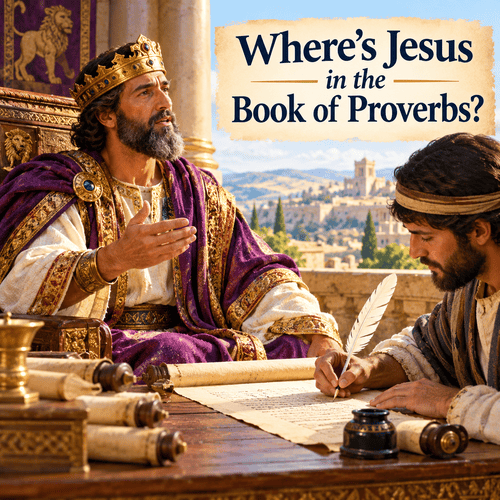
Read all 31 chapters of Proverbs and you won’t find the name “Jesus” even once. There’s no mention of the baby in Bethlehem. No suffering servant. No empty tomb. Some Bible scholars say Christians should stop looking for Jesus in Proverbs altogether. To them, it’s simply a book of wise sayings for daily life—nothing more.
But Jesus said the whole Old Testament was about Him. And when you read Proverbs carefully, side by side with the New Testament, you find something amazing. Proverbs doesn’t only talk about wisdom. It talks about Someone who is Wisdom.
In this post, part of our series on Jesus in the Old Testament, we shall see where Jesus appears in Proverbs—and why this isn’t wishful thinking.
Jesus in the Old Testament — Book 20 of 39
This post is the twentieth instalment in our series tracing Christ through every book of the Old Testament. See the full series index.
Three ways the Old Testament points to Jesus
| Way | What it means | Example |
|---|---|---|
| Prophecy | A direct promise about the coming Messiah (God’s promised King) | Micah 5:2—the Messiah will come from Bethlehem |
| Type (typology) | A real person, event or object that is a picture of something greater to come | King Solomon—a picture of the greater King |
| Fulfilled theme | A big Old Testament idea that finds its full meaning in Jesus | God’s wisdom—which becomes a Person in Jesus |
Proverbs has no direct prophecies about Jesus. It points to Him in the second and third ways. This matters. We’re not forcing Jesus into every verse. We’re following the path the New Testament itself shows us. As Australian Bible scholar Graeme Goldsworthy argues in Gospel and Wisdom, the wisdom books only make full sense when we read them in light of the gospel.
Did Jesus Say We’d Find Him in Proverbs?
He did. After He rose from the dead, Jesus met 2 sad disciples on the road to Emmaus. “Beginning with Moses and all the Prophets, He interpreted to them in all the Scriptures the things concerning Himself” (Luke 24:27). Later He said everything written about Him “in the Law of Moses and the Prophets and the Psalms must be fulfilled” (Luke 24:44).
The Jews divided their Bible into three parts: the Law, the Prophets and the Writings. Scholars believe “the Psalms”, the first book of the Writings, stands for that whole section—which includes Proverbs.
The rest of the New Testament makes the link clear:
- Jesus is greater than Solomon. Solomon wrote most of Proverbs. Yet Jesus said, “Something greater than Solomon is here” (Matthew 12:42).
- Jesus speaks as Wisdom. In Luke 11:49 we read, “the Wisdom of God said, ‘I will send them prophets and apostles.’” In Matthew 23:34, Jesus says the same thing in His own name: “I send you prophets.” Luke calls the speaker “the Wisdom of God”. Matthew shows us the speaker is Jesus.
- All wisdom is found in Jesus. Proverbs 2:4 tells us to search for wisdom “as for hidden treasures”. Paul tells us where that treasure is hidden: in Christ “are hidden all the treasures of wisdom and knowledge” (Colossians 2:3).
Proverbs 8: When Wisdom Speaks Like a Person
In Proverbs 1–9, wisdom is pictured as a woman calling people in the streets. Writers call this personification—describing an idea as if it were a person. We do the same in English when we say, “Time waits for no one.”
But in Proverbs 8, something unusual happens. Wisdom starts to speak about her life before the world was made:
“The LORD possessed me at the beginning of his work, the first of his acts of old. Ages ago I was set up, at the first, before the beginning of the earth … then I was beside him, like a master workman, and I was daily his delight, rejoicing before him always” (Proverbs 8:22–23, 30).
Now read what the New Testament says about Jesus. The match is striking.
What Proverbs 8 says about Wisdom, and what the New Testament says about Jesus
| PROVERBS 8 SAYS WISDOM… | THE NEW TESTAMENT SAYS JESUS… |
|---|---|
| Existed “at the beginning”, before the earth (8:22–23) | “In the beginning was the Word” (John 1:1) |
| Was “beside him” (8:30) | “The Word was with God” (John 1:1) |
| Was present when God made the world, “like a master workman” (8:27–30) | “All things were made through him” (John 1:3; see Colossians 1:16) |
| Is called “the beginning” in the Greek Old Testament (8:22) | “He is the beginning” (Colossians 1:18) |
| Gives life: “whoever finds me finds life” (8:35) | “In him was life” (John 1:4) |
| Was God’s “delight” (8:30) | “You are my beloved Son; with you I am well pleased” (Mark 1:11) |
Note: The Greek Old Testament is called the Septuagint. Jewish scholars translated it from Hebrew before Jesus was born, and the apostles often quoted from it.
In 1926, Oxford scholar Charles Fox Burney argued Paul wrote Colossians 1:15–18 with Proverbs 8:22 in mind. The Hebrew word for “beginning” can mean first, head or firstfruits, and Paul applies each meaning to Christ. In simple words: the Wisdom by which God made the world has a name. His name is Jesus.
There’s another clue. The Hebrew word translated “set up” in Proverbs 8:23 is the word used in Psalm 2:6, where God says, “I have set my King on Zion.” In the very next verse God calls this King “my Son” (Psalm 2:7). Wisdom and God’s royal Son share the same language.
To be honest, Proverbs 8 is mainly a poem about God’s own wisdom. Bruce Waltke, a leading expert on Proverbs, warns against saying simply, “Wisdom equals Jesus.” He sees Jesus as the One who fulfils and embodies this wisdom. We agree. God’s eternal wisdom isn’t just a quality. It’s a Person—God the Son. What Proverbs pictures in poetry, the New Testament reveals in flesh: “the Word became flesh and dwelt among us” (John 1:14).
DOES PROVERBS 8:22 MEAN JESUS WAS CREATED?
Jehovah’s Witnesses say yes, following Arius, a church leader in Egypt around AD 318. Both point to the Septuagint, which reads “The Lord created me.” Here are 3 answers.
- The Hebrew word. The Hebrew word is qanah. It usually means “to get” or “to own”—hence the ESV’s “possessed”. Verses 24–25 also say “I was brought forth”—the language of birth, not of building. A son comes from his father; he is not built like a table.
- The logic. Athanasius, the bishop of Alexandria who fought Arius, gave a simple answer. God has always been wise. If Wisdom had a beginning, there was a time when God had no wisdom. That’s impossible.
- The rest of the Bible. John 1:3 says of the Son, “without him was not any thing made that was made.” If Jesus made everything that was made, He cannot be one of the things that were made.
Christians call this truth eternal generation: the Son has always come from the Father, like light from the sun, yet He never had a beginning.
Timeline: How the Church Has Read Proverbs 8
- AD 155–160: Justin Martyr, an early defender of the faith, teaches that the Wisdom of Proverbs 8 is the Son, begotten before all creation (Dialogue with Trypho, 61).
- AD 318–325: Arius uses Proverbs 8:22 to claim the Son was created. The Council of Nicaea replies that the Son is “begotten, not made”.
- 1559: John Calvin, in his Institutes of the Christian Religion (1.13.7), uses Proverbs 8 to show that God’s Wisdom was begotten before all ages and was at work in creation.
- 1846: Charles Bridges, an English pastor, publishes his commentary on Proverbs, reading chapter 8 as pointing to Christ.
- 1926: Charles Fox Burney shows how Colossians 1 builds on Proverbs 8:22.
Jesus, the Son Who Listened
Proverbs 1–9 is mostly a father speaking to his son: “Hear, my son, your father’s instruction” (Proverbs 1:8). This son was probably a prince who would one day rule. His father begs him to choose wisdom and run from the woman who leads to death.
Every human son fails this test. Solomon’s son Rehoboam ignored wise advice and split the kingdom (1 Kings 12). But one Son listened perfectly:
- He grew in wisdom. As a boy, “Jesus increased in wisdom” (Luke 2:52).
- He was filled with wisdom. Isaiah promised that “the Spirit of wisdom and understanding” would rest on the Messiah (Isaiah 11:2).
- He obeyed His Father. “Although he was a son, he learned obedience through what he suffered” (Hebrews 5:8).
And here’s the good news. Through Jesus, we become God’s sons and daughters too. Hebrews 12:5–6 quotes Proverbs 3:11–12 and applies it to Christians: “My son, do not regard lightly the discipline of the Lord.” The Father’s words in Proverbs now speak to us as His children, because we are joined to His Son.
Jesus, the King Greater Than Solomon
Proverbs is a royal book. It opens with “The proverbs of Solomon, son of David, king of Israel” (Proverbs 1:1). Many proverbs teach how a good king should rule (16:10–15; 25:2–5).
But there’s a sad twist. Solomon didn’t keep his own book. Proverbs 5–7 warns again and again against the “forbidden woman”. Yet Solomon “had 700 wives … and 300 concubines. And his wives turned away his heart” (1 Kings 11:3).
Solomon and Jesus: the wise king compared
| AREA | SOLOMON | JESUS |
|---|---|---|
| Wisdom | Asked God for wisdom (1 Kings 3:9) | Is the wisdom of God (1 Corinthians 1:24) |
| Temple | Built a temple of stone | His own body is the true temple (John 2:19–21) |
| Heart | Turned away from God by his wives | Always did what pleased His Father (John 8:29) |
| Kingdom | Split in two after his death | Will never end (Luke 1:33) |
So Proverbs leaves us waiting. Who’s the wise son of David who will truly live out this book? Edmund Clowney, former president of Westminster Theological Seminary, taught that every failed king made God’s people long for the perfect King. Jesus is that King. “Something greater than Solomon is here.”
“What’s His Son’s Name?” (Proverbs 30:4)
Near the end of Proverbs, a wise man named Agur asks some remarkable questions:
“Who has ascended to heaven and come down? Who has gathered the wind in his fists? Who has wrapped up the waters in a garment? Who has established all the ends of the earth? What’s his name, and what is his son’s name? Surely you know!” (Proverbs 30:4).
First, these questions point to God the Creator. The “son” may be Israel, whom God called “my firstborn son” (Exodus 4:22).
But look closely. Agur asks about someone who goes up to heaven and comes down again. Jesus gives the answer directly: “No one has ascended into heaven except He who descended from heaven, the Son of Man” (John 3:13). Paul says the same (Ephesians 4:9–10).
Agur didn’t know the name “Jesus”. But his question finds its full answer in Him. “Surely you know!” Today, we do.
Wisdom’s Feast and the Perfect Bride
In Proverbs 9, Wisdom builds a house, prepares a meal and sends out an invitation: “Come, eat of my bread and drink of the wine I have mixed” (Proverbs 9:5). Lady Folly also calls out to people, but “her guests are in the depths of Sheol” (9:18), the place of the dead. Two women, two meals, two endings: life or death.
Jesus spoke the same way. He said, “I am the bread of life” (John 6:35). He told of a great feast whose host sends servants into the streets (Luke 14:15–24). And He gave His church bread and wine. Wisdom’s invitation becomes the gospel’s invitation.
Proverbs ends with “An excellent wife” (31:10). She is first a real model of a godly woman. But the book begins with Lady Wisdom and ends with a wise wife—and the whole Bible ends with a wedding. Christ the Bridegroom “loved the church and gave himself up for her” (Ephesians 5:25), and one day “the marriage of the Lamb has come, and his Bride has made herself ready” (Revelation 19:7). Many teachers see the church, made wise and beautiful by Christ, as the final “excellent wife”.
The Fear of the LORD Is the Fear of Jesus
The key verse of Proverbs is this: “The fear of the LORD is the beginning of wisdom” (Proverbs 9:10; see 1:7). When you see “LORD” in capital letters, it stands for God’s personal name, Yahweh.
Here is the surprise. The New Testament applies Yahweh verses to Jesus. God says, “To me every knee shall bow” (Isaiah 45:23); Paul says “at the name of Jesus every knee should bow” (Philippians 2:10). Joel 2:32 is applied to faith in Jesus in Romans 10:9–13.
So when Proverbs says, “The name of the LORD is a strong tower” (18:10), Christians rightly run to Jesus.
How the New Testament Uses Proverbs
The apostles used Proverbs as God’s living word for the church.
Proverbs in the New Testament
| PROVERBS | USED IN | WHAT IT TEACHES |
|---|---|---|
| Proverbs 3:34 | James 4:6; 1 Peter 5:5 | God opposes the proud but gives grace to the humble |
| Proverbs 3:11–12 | Hebrews 12:5–6 | God disciplines those He loves, as His children |
| Proverbs 25:6–7 | Luke 14:8–10 | Jesus turns this proverb into a story about humility |
| Proverbs 25:21–22 | Romans 12:20 | Feed your enemy and do good to those who hate you |
| Proverbs 26:11 | 2 Peter 2:22 | A dog returns to its vomit—a warning against turning back from Christ |
Answering the Objections
- ”You are just reading Jesus into the text.” Allegory means inventing hidden meanings. We are simply following the New Testament, which calls Jesus “the wisdom of God”. We do not claim every proverb is secretly about Him.
- ”Wisdom is a woman, so she cannot be Jesus.” The Hebrew word for wisdom, chokmah, is grammatically feminine—just as many words are in French or Hindi. Folly is pictured as a woman too. This is poetry, not a statement about gender.
- ”Wisdom is the Law of Moses.” The Jewish book of Sirach (around 180 BC, not part of the Bible) says Wisdom came to “dwell” in Israel as the Law. John answers that the Word “dwelt” (literally “pitched his tent”) among us, and “the law was given through Moses; grace and truth came through Jesus Christ” (John 1:14, 17).
- ”Wisdom is a goddess called Sophia.” Some modern spiritual groups say this. But Proverbs 8 says the LORD possessed Wisdom. She is His wisdom, not a rival god.
- ”Proverbs says good people always do well.” Proverbs gives general truths, not guarantees. The most righteous man who ever lived was crucified. But God raised Him from the dead. In Jesus, wisdom’s final reward is certain.
Why This Matters for You
If Proverbs is only a list of rules, it will crush us. We will fail by lunchtime. But Proverbs points to a Person.
Pastor Jeff Medders puts it well: Jesus lived the Proverbs for us, and Jesus lives the Proverbs through us. He kept every word of wisdom in our place, and by His Spirit He makes us wise. That’s why Paul says Christ “became to us wisdom from God, righteousness and sanctification and redemption” (1 Corinthians 1:30).
Wisdom still stands in the streets and calls. And Jesus still says, “Come to me” (Matthew 11:28). The invitation is open. Will you come to the table?
Tough Questions, Honest Answers
Is the Holy Spirit, rather than Jesus, the Wisdom of Proverbs?
Some early Christians, such as Irenaeus of Lyon, linked the Wisdom of Proverbs 8 with the Holy Spirit. The Bible does connect wisdom with the Spirit—Isaiah 11:2 speaks of “the Spirit of wisdom and understanding”. But the New Testament never calls the Spirit “the wisdom of God”. It gives that title to Christ (1 Corinthians 1:24). The best way to put it is this: the Son is God’s Wisdom, and the Spirit gives that wisdom to us (Ephesians 1:17). Father, Son and Spirit always work together.
Who wrote the book of Proverbs?
King Solomon wrote most of it (Proverbs 1:1; 10:1). About 250 years later, the men of King Hezekiah copied and arranged more of his proverbs (25:1). Other sections come from “the wise” (22:17; 24:23), from Agur (chapter 30) and from King Lemuel (chapter 31). So Proverbs has several human writers. But behind them all stands one divine Author, for “men spoke from God as they were carried along by the Holy Spirit” (2 Peter 1:21).
Are the proverbs promises from God?
Mostly, no. They are wise general truths about how life usually works. Proverbs 22:6 says, “Train up a child in the way he should go; even when he is old he will not depart from it.” This is wise and usually true, but it does not guarantee that every child will believe. The books of Job and Ecclesiastes remind us that life in a broken world does not always follow the pattern. God’s firm promises are found in Christ, for “all the promises of God find their Yes in him” (2 Corinthians 1:20).
Does Proverbs contradict itself?
Proverbs 26:4 says, “Answer not a fool according to his folly,” and verse 5 says, “Answer a fool according to his folly.” It looks like a contradiction, but the writer placed these verses side by side on purpose. Sometimes arguing with a foolish person only drags you down to his level. At other times, staying silent lets him think he is wise. Wisdom is not a list of fixed rules. It is the skill of knowing which truth fits which situation.
Who were Agur and King Lemuel?
We know very little about them. Agur, son of Jakeh, wrote Proverbs 30, and Lemuel recorded what his mother taught him in Proverbs 31. Both may have come from Massa, a people possibly descended from Ishmael (Genesis 25:14). Some old Jewish writers thought Lemuel was another name for Solomon, but there is no clear proof. If they were not Israelites, their place in Proverbs shows that God always meant His wisdom to reach the nations.
Should I read one chapter of Proverbs every day?
Proverbs has 31 chapters, so many Christians read 1 chapter a day to match the date of the month. This is a helpful habit that fills your mind with wisdom in small, memorable pieces. But don’t read Proverbs on its own. It’s part of the whole Bible story, and it makes most sense beside the Gospels. As you read, ask 2 questions: “How did Jesus live this out?” and “How can His Spirit help me live it out today?”
What is the difference between wisdom and knowledge?
Knowledge is knowing facts. Wisdom is knowing how to use those facts to live well before God. Charles Spurgeon put it simply: “Wisdom is the right use of knowledge.” James I Packer described wisdom as “the power to see, and the inclination to choose, the best and highest goal, together with the surest means of attaining it.” A person can know a great deal and still live foolishly. That’s why Proverbs says true wisdom begins with the fear of the LORD (9:10).