This post is part of our series, Famous Last Words. In our main post, Famous Last Words: What Believers Said Before They Died, we gathered the dying words of Christians across 20 centuries. In this series we look closely at believers in the Bible whose final words still speak today.
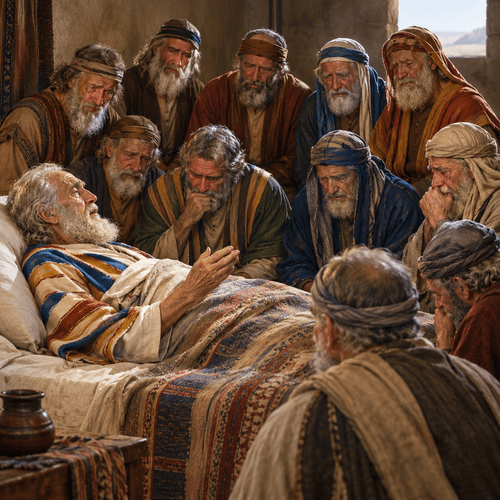
Jacob’s deathbed is the longest in the Bible. It fills almost 3 chapters of Genesis (47:28–49:33). An old man, nearly blind, far from home in Egypt, gathers his family around his bed. He makes his son swear an oath, blesses his grandsons, speaks a prophecy over each of his 12 sons—and in the middle of it all, he suddenly cries out to God: “I wait for your salvation, O LORD” (Genesis 49:18).
Jacob began life as a schemer and a cheat. He ended it as a worshipper, leaning on his staff. His last words show what God’s grace can do with a very imperfect man.
IN SHORT
Who: Jacob, son of Isaac and grandson of Abraham, renamed Israel by God.
When: At 147 years of age, after 17 years in Egypt (Genesis 47:28).
His last words: a burial oath (47:29–31), a blessing on Joseph’s sons (Genesis 48), prophecies over his 12 sons (Genesis 49:1–27) and final instructions (49:29–33).
Why they matter: Jacob died trusting God’s promises, worshipping God as his lifelong Shepherd, and pointing forward to the King who’d come from Judah.
From Heel-Grabber to Israel
To understand Jacob’s death, we need to remember his life. His name sounds like the Hebrew word for “heel,” because he was born holding his twin brother Esau’s heel (Genesis 25:26). It came to mean “one who grabs” or “one who cheats.” And Jacob lived up to it. All his life.
Timeline of Jacob’s Life
- Birth (Genesis 25). Born holding Esau’s heel. God says, “the older shall serve the younger” (25:23).
- The stolen blessing (Genesis 27). Jacob tricks his blind father Isaac into blessing him instead of Esau, then runs for his life.
- Bethel (Genesis 28). Alone at night, Jacob dreams of a stairway to heaven. God repeats His promise to Abraham to him.
- Twenty years with Laban (Genesis 29–31). The cheater is cheated. He marries Leah and Rachel and has eleven sons and a daughter.
- Wrestling with God (Genesis 32). At Peniel, Jacob wrestles through the night and is renamed Israel. He walks with a limp for the rest of his life.
- Grief upon grief (Genesis 35–37). Rachel dies giving birth to Benjamin. His sons sell Joseph, and Jacob believes him dead.
- Egypt (Genesis 46–47). Jacob discovers Joseph is alive and moves his whole family to Egypt to escape famine.
When Pharaoh asked his age, Jacob gave an honest answer: “Few and evil have been the days of the years of my life” (Genesis 47:9). He was 130 years old, but he felt his life had been short and full of trouble. Much of that trouble he’d brought on himself. Yet God never let him go.
“Do Not Bury Me in Egypt”
Jacob lived 17 more years in Egypt. He had food, safety and his beloved Joseph close by. Then “the time drew near that Israel must die” (47:29). His first concern wasn’t comfort or legacy. It was his grave.
“Do not bury me in Egypt, but let me lie with my fathers. Carry me out of Egypt and bury me in their burying place” (47:29–30). He made Joseph swear an oath to do it.
Why did this matter so much? Egypt was the greatest nation on earth, and Joseph could have given his father a splendid tomb there. But God had promised the land of Canaan to Abraham, Isaac and Jacob. Jacob didn’t own that land. He’d only lived in it as a traveller. Yet he believed God’s promise so firmly he wanted his body laid there, waiting for the day God would keep His word.
His burial request was an act of faith. Hebrews 11 says of Abraham, Isaac and Jacob: “These all died in faith, not having received the things promised, but having seen them and greeted them from afar… they desire a better country, that is, a heavenly one” (Hebrews 11:13, 16).
Worshipping on His Staff
After Joseph swore the oath, Genesis says, “Israel bowed himself upon the head of his bed” (47:31). But Hebrews 11:21 describes the same moment differently: “By faith Jacob, when dying… bowing in worship over the head of his staff.”
Is this a contradiction? No. The original Hebrew was written without vowels. The same 3 letters can be read as mittah (“bed”) or matteh (“staff”). The later Hebrew text reads “bed”; the ancient Greek translation, which the writer of Hebrews used, reads “staff.” Both pictures fit. An old man, sitting up in bed, leans on his staff and bows his head in worship.
And the staff is a fitting detail. Years earlier Jacob had said, “with only my staff I crossed this Jordan” (Genesis 32:10). After wrestling with God, he limped. Now, at the end, the man who once relied on his own cleverness leans on a stick and worships. That is a picture of grace.
The Shepherd and the Angel Who Redeemed Me
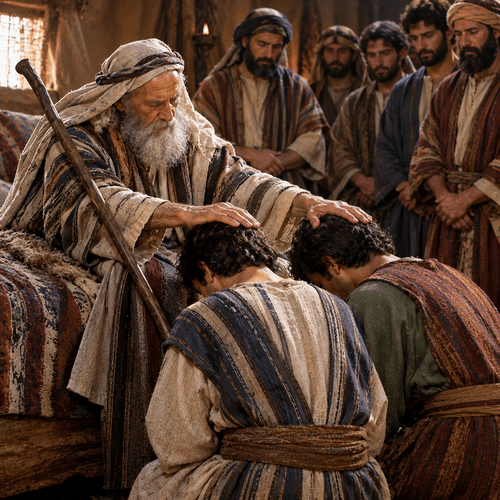
In Genesis 48, Joseph brings his two sons, Manasseh and Ephraim, to their dying grandfather. Jacob is moved: “I never expected to see your face; and behold, God has let me see your offspring also” (48:11).
Then he blesses them with some of the most beautiful words in Genesis:
“The God before whom my fathers Abraham and Isaac walked, the God who has been my shepherd all my life long to this day, the angel who has redeemed me from all evil, bless the boys”
Genesis 48:15–16
- God the Shepherd. This is the first time in the Bible that God is called a shepherd. Jacob, a shepherd himself, knew what it meant to guide, feed and protect a flock. Looking back on a messy life, he saw that God had been shepherding him all along. David would later sing, “The LORD is my shepherd” (Psalm 23:1), and Jesus would say, “I am the good shepherd” (John 10:11).
- The Angel who redeemed. Jacob speaks of “the angel” in the same breath as God. Many Christian interpreters see here the Angel of the LORD—the one who wrestled with Jacob at Peniel, whom Jacob recognised as God (Genesis 32:30; Hosea 12:3–5). Many believe this was the Son of God appearing before He became man.
- Grace crosses its hands. Jacob deliberately crossed his arms and placed his right hand on the younger boy, Ephraim (48:14–19). Joseph objected, but Jacob knew what he was doing. God’s blessing does not follow human rank. Jacob, the younger son who received the blessing, understood that better than anyone.
Jacob ends this blessing with a promise to Joseph: “Behold, I am about to die, but God will be with you and will bring you again to the land of your fathers” (48:21). He was dying. God was not.
Gathering His Sons: Genesis 49
Then Jacob called all his sons: “Gather yourselves together, that I may tell you what shall happen to you in days to come” (49:1). What follows is not just a father’s farewell. It is prophecy about the future of the twelve tribes of Israel.
| SON | KEY WORDS | WHAT FOLLOWED |
|---|---|---|
| Reuben | “Unstable as water, you shall not have pre-eminence” (49:4) | He lost the firstborn’s place because of his sin with his father’s concubine. |
| Simeon and Levi | “Cursed be their anger… I will scatter them in Israel” (49:7) | Both tribes were scattered—but in very different ways (see below). |
| Judah | “The sceptre shall not depart from Judah” (49:10) | Israel’s kings, including David and Jesus, came from Judah. |
| Zebulun, Issachar, Dan, Gad, Asher, Naphtali | Short word-pictures: a seashore, a donkey, a serpent, raiders, rich food, a doe | Each tribe’s character and land in later history. |
| Joseph | “The Mighty One of Jacob… the Shepherd, the Stone of Israel” (49:24) | The longest and richest blessing, given to the son who had suffered most. |
| Benjamin | “A ravenous wolf” (49:27) | A fierce warrior tribe; Saul and the apostle Paul came from it. |
Hard Words That Turned to Grace
Some of Jacob’s words are severe. Simeon and Levi had massacred the men of Shechem in revenge (Genesis 34). On his deathbed, Jacob did not excuse them: “Cursed be their anger, for it is fierce… I will divide them in Jacob and scatter them in Israel” (49:7).
Both tribes were indeed scattered. Simeon’s land lay inside Judah’s territory (Joshua 19:1, 9), and over time the tribe faded into Judah. But watch what God did with Levi. Centuries later, at the golden calf, the Levites stood with Moses on the Lord’s side (Exodus 32:26–29). God made them the priestly tribe. They received no single territory, but lived in towns spread throughout Israel to teach God’s law. The scattering that began as a judgement became a blessing to the whole nation.
This is the pattern of Jacob’s own life. God does not ignore sin. But He is able to turn even judgement into mercy for those He calls.
The Lion of Judah
The most important words in Genesis 49 are spoken to Judah:
“Judah is a lion’s cub… The sceptre shall not depart from Judah, nor the ruler’s staff from between his feet, until tribute comes to him; and to him shall be the obedience of the peoples”
49:9–10
The phrase “until tribute comes to him” is hard to translate. Older Bibles read “until Shiloh come.” Others translate it “until he comes to whom it belongs.” But every reading points the same way. A King will come from Judah to whom the royal power truly belongs, and “the peoples”—not just Israel, but the nations—will obey Him. Ancient Jewish interpreters also read this verse as a promise of the Messiah.
The New Testament gives the answer. In heaven, John is told: “Weep no more; behold, the Lion of the tribe of Judah, the Root of David, has conquered” (Revelation 5:5). And when John looks, he sees not a lion but a Lamb that had been slain. Jacob’s dying prophecy is fulfilled in Jesus, who conquered by dying for His people.
“I Wait for Your Salvation, O LORD”
Right in the middle of the blessings, after a dark word about Dan, Jacob suddenly stops and prays: “I wait for your salvation, O LORD” (Genesis 49:18).
It is the only prayer in the whole chapter, and it seems to burst out of him. Perhaps, as he saw the struggles and failures ahead for his sons, he looked past them all to God. His family could not save themselves. Only the LORD could.
The Hebrew word for “salvation” here is yeshuah. It is closely related to the name Yeshua—the Hebrew form of the name Jesus, which means “the LORD saves” (Matthew 1:21). Jacob did not know that name. But he died waiting for exactly what that name promises.
WAITING AND SEEING
Jacob, nearly two thousand years before Christ: “I wait for your salvation, O LORD” (Genesis 49:18).
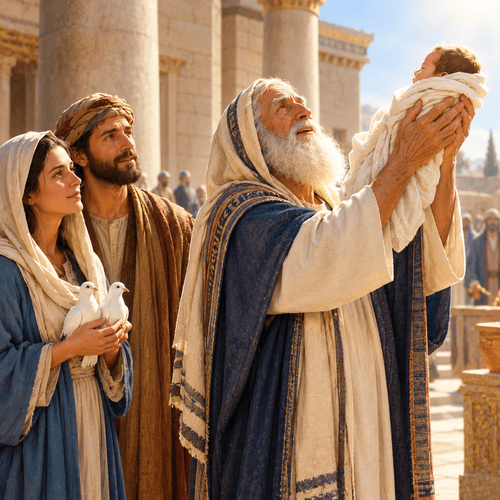
Simeon, holding the baby Jesus in the temple: “my eyes have seen your salvation” (Luke 2:30).
The same salvation Jacob waited for, Simeon held in his arms. We will look at Simeon later in this series.
Gathered to His People
Jacob’s final words were practical. He told his sons exactly where to bury him: in the cave of Machpelah, near Hebron, where “they buried Abraham and Sarah his wife. There they buried Isaac and Rebekah his wife, and there I buried Leah” (49:31).
Then comes one of the calmest death scenes in the Bible: “When Jacob finished commanding his sons, he drew up his feet into the bed and breathed his last and was gathered to his people” (49:33).
Notice the phrase “gathered to his people.” Jacob was not buried for weeks afterwards, and his tomb was hundreds of miles away in Canaan. So “gathered to his people” cannot simply mean “buried.” It points to something beyond the grave—joining those who had gone before. Jesus made the same point when He reminded the Sadducees that God calls Himself “the God of Abraham, and the God of Isaac, and the God of Jacob.” Then He added, “He is not God of the dead, but of the living” (Matthew 22:32). Jacob is alive to God today.
What Jacob’s Last Words Teach Us Today
- God can redeem a messy life. Jacob was a liar, a cheat and a favouritist father. Yet he died a worshipper. No one is too crooked for God’s grace.
- Look back and see the Shepherd. In hard times we may not see God’s hand. Like Jacob, we will one day look back and see that He was shepherding us “all my life long.”
- Die trusting the promises. Jacob did not see the promised land become Israel’s home. He trusted God anyway. Faith rests on God’s word, not on what we can see.
- Speak truth in love to your family. Jacob’s words were honest, even hard. Real love does not pretend that sin does not matter.
- Keep waiting for salvation. Jacob waited for the Saviour to come. We wait for Him to come again (Titus 2:13).
Conclusion: The God of Jacob
It is remarkable that God is happy to be called “the God of Jacob.” Not the God of the perfect, or the God of the impressive, but the God of the heel-grabber. The psalmist rejoiced in this: “The LORD of hosts is with us; the God of Jacob is our fortress” (Psalm 46:7).
Jacob died far from home, in a foreign land, leaning on a staff. But he died with his eyes on God’s promise, worshipping his lifelong Shepherd, and waiting for the LORD’s salvation. That salvation has now come in Jesus, the Lion of Judah. Everyone who trusts Him can say with Jacob, and with far greater clarity, “I wait for your salvation, O LORD.”
FAMOUS LAST WORDS SERIES
Start here: Famous Last Words: What Believers Said Before They Died
Earlier posts: Stephen’s Last Words; Paul’s Last Words; David’s Last Words
Coming next: Joseph (Genesis 50), Simeon (Luke 2) and the seven sayings of Jesus from the cross.
Tough Questions, Honest Answers
Where is Jacob buried today?
Jacob was buried in the cave of Machpelah near Hebron (Genesis 50:13). The traditional site, known as the Cave of the Patriarchs or Tomb of the Patriarchs, is still in Hebron. A massive stone enclosure built around it in the time of Herod the Great still stands today. The site is holy to both Jews and Muslims and is divided between a synagogue and a mosque.
Who were the 12 sons of Jacob, and who were their mothers?
Leah bore Reuben, Simeon, Levi, Judah, Issachar and Zebulun. Rachel bore Joseph and Benjamin. Rachel’s servant Bilhah bore Dan and Naphtali. Leah’s servant Zilpah bore Gad and Asher (Genesis 35:23–26). Jacob also had a daughter, Dinah. The rivalry between these mothers and their sons lies behind much of the pain in Jacob’s family.
Why was Jacob’s name changed to Israel?
After Jacob wrestled all night with a mysterious man at Peniel, he was told, “Your name shall no longer be called Jacob, but Israel, for you have striven with God and with men, and have prevailed” (Genesis 32:28). The name is usually understood to mean “he strives with God” or “God strives.” It marked a turning point: the cheat who grabbed blessings now clung to God for one.
Was Jacob embalmed like an Egyptian?
Yes. Joseph ordered his physicians to embalm his father. It took forty days, and the Egyptians mourned for him seventy days (Genesis 50:2–3). This was an honour usually given to important Egyptians. Then a great procession carried his body to Canaan, as Jacob had asked (50:7–13).
Why are Ephraim and Manasseh tribes instead of Joseph?
Jacob adopted Joseph’s two sons as his own: “Ephraim and Manasseh shall be mine, as Reuben and Simeon are” (Genesis 48:5). This gave Joseph a double share, the right of the firstborn that Reuben had lost (1 Chronicles 5:1–2). So Joseph’s family became two tribes. Because Levi received no territory, the land of Israel was still divided into twelve portions.
What does “Jacob I loved, but Esau I hated” mean?
God says this through the prophet Malachi (Malachi 1:2–3), and Paul quotes it in Romans 9:13. It describes God’s free choice: before the twins were born or had done anything good or bad, God chose Jacob to carry His promise (Romans 9:11–12). “Hated” here means not chosen for that covenant role. The point is that God’s blessing rests on His grace, not on human merit—and Jacob’s life proves he did not earn it.
Why is the tribe of Dan missing from Revelation 7?
Revelation 7:5–8 lists 12 tribes but leaves out Dan, while including both Joseph and Manasseh. The Bible does not explain why. Many think it is because Dan was the first tribe to set up idol worship (Judges 18:30). Some early writers connected Jacob’s description of Dan as “a serpent in the way” (Genesis 49:17) with this. It’s wise not to be dogmatic.
Related Reads
- Famous Last Words: What Believers Said Before They Died
- Stephen’s Last Words: “Lord Jesus, Receive My Spirit”
- Paul’s Last Words: “I Have Fought the Good Fight”
- David’s Last Words: The King Who Looked for a Better King
- Joseph’s Last Words: “God Will Surely Visit You”
- Simeon’s Last Words: “Now You Are Letting Your Servant Depart in Peace”
- Genesis 49: Does Jacob’s Blessing of Judah Point to Christ?
- Jesus in Genesis: The Promised Seed Who Crushes the Serpent
- Jacob’s Ladder: How Jesus Bridges Earth and Heaven
- The Mystery Duel at Peniel: Why Would God Wrestle with Jacob?
- The Star Out of Jacob: Who Is Numbers 24:17 Really About?
- The Promised Land: A Type of Heaven or of Christian Life? Or Both?