This is the final post in our Famous Last Words series. In our main post, Famous Last Words: What Believers Said Before They Died, we gathered the dying words of Christians across 20 centuries. In this series we’ve looked closely at the believers in the Bible whose final words still speak today: Stephen, Paul, David, Jacob and Joseph.
We end with Simeon, an old believer in Jerusalem who appears in the Bible for just 11 verses (Luke 2:25–35). He didn’t die as a martyr like Stephen or a king like David. He simply walked into the temple one day, took a baby in his arms and told God he was ready to die.
One honest note before we begin. The Bible doesn’t record Simeon’s death. His words in Luke 2 aren’t words spoken on a deathbed. They’re the words of a man who has seen what he was waiting for and is now ready to go. Yet they’ve become some of the best-loved words about death ever spoken—and a fitting place to end this series.
IN SHORT
Who: Simeon, a righteous and devout man in Jerusalem, “waiting for the consolation of Israel” (Luke 2:25).
When: 40 days after Jesus’ birth, when Mary and Joseph brought Him to the temple.
His words: “Lord, now you are letting your servant depart in peace, according to your word; for my eyes have seen your salvation” (Luke 2:29–30).
Why they matter: Simeon shows a believer can face death in peace because God keeps His promises—and because salvation is a Person, Jesus Christ.
Who Was Simeon?
Luke introduces Simeon with 4 short descriptions. Each one tells us something about the kind of person God was preparing for this moment.
- Righteous. He lived rightly before God and other people.
- Devout. He took God seriously and worshipped Him carefully.
- Waiting. He was “waiting for the consolation of Israel”—longing for the day God would comfort His people by sending the Messiah.
- Spirit-filled. “The Holy Spirit was upon him” (2:25). This was rare before Pentecost, and it marked Simeon as someone God was using in a special way.
Then Luke adds a remarkable detail: “it had been revealed to him by the Holy Spirit that he would not see death before he had seen the Lord’s Christ” (2:26). Simeon had a personal promise from God. Death wouldn’t come for him until he’d seen the Messiah with his own eyes.
Interestingly, Luke never actually says Simeon was old. Most readers assume he was, because of this promise and because of his words about departing. It’s a reasonable assumption, but it’s worth noticing what the text does and does not say.
“The Consolation of Israel”
What exactly was Simeon waiting for? The phrase “the consolation of Israel” takes us back to the prophet Isaiah. After warning Israel of judgement and exile, God spoke tender words: “Comfort, comfort my people, says your God” (Isaiah 40:1). Isaiah went on to promise a Servant who would bring salvation not only to Israel but to the whole world.
By Simeon’s time, those promises were centuries old. Israel had returned from exile, but it was still under foreign rule—now the Romans. The temple stood, but the glory seemed far away. There had been no prophet for about 400 years. Many had given up hope.
Simeon hadn’t. He was part of a small group of faithful people who were still watching and praying. Luke tells us about another of them, the prophetess Anna, who spoke about Jesus “to all who were waiting for the redemption of Jerusalem” (Luke 2:38). These were people whose whole lives were shaped by a promise they hadn’t yet seen fulfilled.
The Day the Promise Came True
Simeon’s great day began like any other. But Luke says “he came in the Spirit into the temple” (2:27). God led him there at exactly the right moment.
Timeline of Jesus’ First Weeks
- Day 1—Birth in Bethlehem (Luke 2:1–20). Shepherds hear the angels and come to see the baby.
- Day 8—Circumcision (Luke 2:21). The child is named Jesus, as the angel had said.
- Day 40—The temple (Luke 2:22–24). Mary and Joseph travel to Jerusalem to complete Mary’s purification and to present their firstborn son to the Lord, as the Law required (Leviticus 12:2–8; Exodus 13:2).
- The same day—Simeon and Anna (Luke 2:25–38). 2 elderly believers recognise the baby as the Messiah.
- Afterwards—Home (Luke 2:39–40). The family returns to Nazareth, where “the child grew and became strong.”
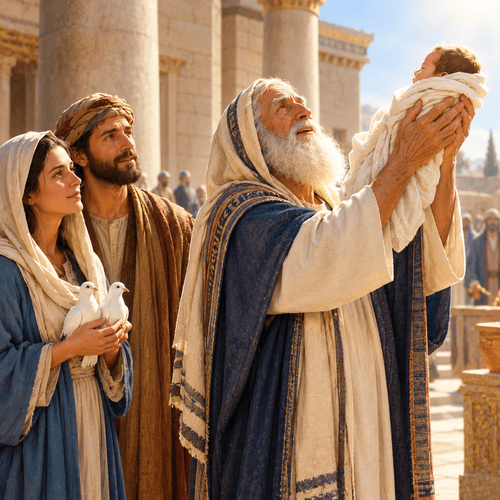
Picture the scene. The temple courts were busy with worshippers, priests and families. Mary and Joseph were just one more poor couple from Galilee. Their offering showed they could not afford a lamb—they brought “a pair of turtledoves, or two young pigeons” (2:24), the offering the Law allowed for the poor (Leviticus 12:8). Nothing about them looked special.
But Simeon knew. Led by the Spirit, he walked up to this ordinary family, “took Him up in his arms and blessed God” (2:28). After a lifetime of waiting, he was holding the answer to his prayers.
There’s a wonderful irony here. 400 years earlier, prophet Malachi had promised: “the Lord whom you seek will suddenly come to his temple” (Malachi 3:1). Many expected that to happen with fire and glory. Instead, the Lord came to His temple as a 40-day-old baby, carried by a poor young mother, paid for with 2 small birds. Almost no one noticed. The priests went on with their duties. But 2 old believers, taught by God’s Spirit, saw what everyone else missed. God often fulfils His greatest promises in the quietest ways.
Simeon’s Song
Then Simeon spoke:
“Lord, now you’re letting your servant depart in peace, according to your word; for my eyes have seen your salvation that you have prepared in the presence of all peoples, a light for revelation to the Gentiles, and for glory to your people Israel”
Luke 2:29–32
These words have been sung by Christians for centuries. They’re often called the Nunc Dimittis, from the first words in Latin, “Now you dismiss.” Let us look at them phrase by phrase.
| PHRASE | WHAT IT MEANS |
|---|---|
| “Lord… your servant” | The Greek word for “Lord” here is despotēs, a master who owns servants. Simeon sees himself as a servant who has finished his assignment. |
| “Depart in peace” | The verb means “release” or “dismiss.” It was used for releasing a slave, freeing a prisoner, or relieving a soldier at the end of his watch. Simeon’s watch was over. |
| “According to your word” | God had promised he would see the Christ. God kept His word, to the letter. |
| “My eyes have seen your salvation” | Simeon is looking at a baby. He calls that baby God’s salvation. Salvation is not just an idea or a feeling. It is a Person. |
| “In the presence of all peoples” | This salvation is for the whole world, not just one nation. |
| “A light… to the Gentiles” | This echoes Isaiah 49:6: “I will make you as a light for the nations, that my salvation may reach to the end of the earth.” |
| “Glory to your people Israel” | The Messiah is Israel’s greatest honour. God kept His promises to Abraham’s family. |
Death as a Release, Not a Robbery
The most striking thing about Simeon’s words is how he speaks of death. He doesn’t call it an enemy that steals his life. He calls it a release—his Master kindly dismissing him from duty.
Think of a watchman on a city wall. All night he stands at his post, scanning the horizon, waiting for the signal that the king is coming. At last, as dawn breaks, he sees it. The king has arrived. Now he can finally go home and rest. That is Simeon. He had been on watch his whole life. Now that he had seen the King, he was free to go.
Simeon could depart “in peace” for 2 reasons. First, God had kept His word to him. If God had kept that promise, He could be trusted with every other promise—including the promise of life beyond death. Second, he had seen God’s salvation. The deepest fear about death is facing God with our sins. But Simeon held in his arms the One who would take those sins away. As Paul later wrote, “since we have been justified by faith, we have peace with God through our Lord Jesus Christ” (Romans 5:1).
This is exactly what we heard from many believers in our main post. Moody said, “If this is death, it is sweet!” Baxter said, “I have peace, I have peace.” They were walking the path Simeon walked first. According to one account of John Calvin’s last appearance in church, he joined, with a trembling voice, in singing Simeon’s song.
From Waiting to Seeing: Jacob and Simeon
In our post on Jacob, we noticed a prayer that bursts out in the middle of his dying blessings: “I wait for your salvation, O LORD” (Genesis 49:18). Nearly 2,000 years later, Simeon stood in the temple and said, “my eyes have seen your salvation” (Luke 2:30).
WAITING AND SEEING
Jacob waited. Old, nearly blind, far from home in Egypt, he looked forward to a salvation he would not see on earth.
Simeon saw. In the temple at Jerusalem, he held that salvation in his arms.
We believe. We have not seen Jesus with our eyes as Simeon did. But Jesus said, “Blessed are those who have not seen and yet have believed” (John 20:29).
Between Jacob and Simeon lies the whole Old Testament—centuries of promises, prophecies and patient waiting. Simeon is the bridge. He is one of the last Old Testament believers and one of the first to see the Christ. In his arms, the waiting ends and the fulfilment begins.
A Hard Word for Mary
Simeon’s words did not end with joy. He turned to Mary and said something difficult:
“Behold, this child is appointed for the fall and rising of many in Israel, and for a sign that is opposed (and a sword will pierce through your own soul also), so that thoughts from many hearts may be revealed”
Luke 2:34–35
- Fall and rising. Jesus would divide people. Some would stumble over Him and fall; others would trust Him and be raised up. Isaiah had spoken of a stone that would cause people to stumble (Isaiah 8:14), and the New Testament applies this to Christ (1 Peter 2:6–8).
- A sign that is opposed. Jesus would be rejected. The baby Simeon held would grow up to face hatred, plots and finally a cross.
- A sword through Mary’s soul. 33 years later, Mary would stand at the foot of the cross and watch her son die (John 19:25). Simeon saw that day coming.
- Hearts revealed. How people respond to Jesus shows what is really in their hearts. No one can stay neutral about Him.
Simeon wasn’t naive. He knew salvation would come at a terrible cost. The peace he felt wasn’t the peace of someone who ignored suffering. It was the peace of someone who trusted God’s plan, including the suffering. That’s why our series on Jesus’ last words from the cross belongs with this one. Simeon held the baby; the cross shows what that baby came to do.
What Simeon’s Last Words Teach Us Today
- Keep waiting faithfully. Simeon waited his whole life without giving up. We wait for Christ’s return. Keep watching, keep praying, keep hoping.
- God keeps His word. Every promise God made to Simeon came true. Every promise He has made to us in Christ will come true too (2 Corinthians 1:20).
- Salvation is a Person. We are not saved by a set of ideas but by Jesus Himself. To have Him is to have salvation.
- You can die in peace. If you belong to Christ, death is not a robbery but a release—your Master calling you home from your watch.
- The light has reached the nations. Simeon said Jesus would be “a light for revelation to the Gentiles.” If you are reading this in India, Africa or anywhere outside Israel, you are part of the fulfilment of his words.
Conclusion: The End of the Series
Across this series, we have heard the last words of six believers from the Bible. Each faced death in a different way. But one thread runs through them all.
| BELIEVER | LAST WORDS | THEIR HOPE |
|---|---|---|
| Jacob | “I wait for your salvation, O LORD” (Genesis 49:18) | The coming salvation and the King from Judah |
| Joseph | “God will surely visit you” (Genesis 50:24) | God’s promise to bring His people home |
| David | “He has made with me an everlasting covenant” (2 Samuel 23:5) | The perfect King from his family |
| Simeon | “My eyes have seen your salvation” (Luke 2:30) | The Christ, held in his arms |
| Stephen | “Lord Jesus, receive my spirit” (Acts 7:59) | The risen Jesus, standing at God’s right hand |
| Paul | “I have fought the good fight…” (2 Timothy 4:7) | The crown on the day of the Lord’s appearing |
The Old Testament saints looked forward to the Saviour. Simeon held Him. Stephen and Paul served Him and died for Him. Every one of them died resting on the same thing: not their own goodness, but God’s promise in Jesus Christ.
Simeon’s words can be ours too. When our time comes, if we know Christ, we can pray: “Lord, now you are letting your servant depart in peace, according to your word; for my eyes have seen your salvation.”
FAMOUS LAST WORDS SERIES
Start here: Famous Last Words: What Believers Said Before They Died
The series: Stephen; Paul; David; Jacob; Joseph; Simeon
Read next: our series on the last words of Jesus from the cross.
Tough Questions, Honest Answers
What is the Nunc Dimittis, and where is it sung?
The Nunc Dimittis is Simeon’s song in Luke 2:29–32, named after its first words in Latin (“Now you dismiss”). Since early times, churches have sung it at evening worship, as the day closes. It is part of Evening Prayer in the Anglican Book of Common Prayer, and versions of it appear in many hymnbooks and metrical psalters. Its theme of resting at the end of the day makes it a natural evening prayer.
Was Simeon a priest?
Luke does not say so. He calls Simeon “righteous and devout” and says the Holy Spirit was on him, but he gives him no official title. Some later traditions made Simeon a priest or a famous rabbi, but there is no evidence for this. It seems more likely that he was an ordinary believer whom God chose to honour—which is part of the beauty of the story.
Who was Anna the prophetess?
Anna was an elderly widow from the tribe of Asher who “did not depart from the temple, worshipping with fasting and prayer night and day” (Luke 2:37). She arrived as Simeon was speaking, thanked God and began telling everyone who was waiting for redemption about Jesus. Luke often pairs a man and a woman in his Gospel, and Simeon and Anna are a beautiful example.
Why did Mary and Joseph offer two birds instead of a lamb?
The Law required a mother to bring a lamb and a bird after childbirth. But it allowed a poorer family to bring “two turtledoves or two pigeons” instead (Leviticus 12:8). Mary and Joseph brought the poor family’s offering (Luke 2:24). The Son of God was born into a humble home. As Paul wrote, “though he was rich, yet for your sake he became poor” (2 Corinthians 8:9).
What is Candlemas or the Feast of the Presentation?
Many churches remember Jesus’ presentation in the temple on 2 February, 40 days after Christmas. It’s often called Candlemas, because in some traditions candles were blessed and carried that day. The candles recall Simeon’s words that Jesus is “a light for revelation to the Gentiles.” Not all churches keep the day, but the Bible event behind it is worth remembering.
How did Simeon know which baby was the Messiah?
Luke makes clear it was the work of the Holy Spirit. The Spirit had promised Simeon he would see the Christ (2:26), and the Spirit led him into the temple at exactly the right time (2:27). Nothing about Jesus’ appearance would have marked Him out. Only God could reveal who He was. In the same way, Jesus later told Peter that no human being had shown him who Jesus was, “but my Father who is in heaven” (Matthew 16:17).
Did Simeon die soon after seeing Jesus?
The Bible does not say. Simeon’s words suggest he expected to die soon, and he is never mentioned again, but Luke does not record his death. Later legends added details about his life and death, but these aren’t reliable. What we can say is that Simeon was ready. Whether he died that week or years later, he went in peace.
Related Reads
- Famous Last Words: What Believers Said Before They Died
- Stephen’s Last Words: “Lord Jesus, Receive My Spirit”
- Paul’s Last Words: “I Have Fought the Good Fight”
- David’s Last Words: The King Who Looked for a Better King
- Jacob’s Last Words: “I Wait for Your Salvation, O LORD”
- Joseph’s Last Words: “God Will Surely Visit You”
- Anna the Prophetess: The Widow Who Waited for Jesus
- Where Did Luke Get His Gospel Details? The Case for Mary
- Jesus in Isaiah: The Old Testament’s Portrait of the Coming Messiah
- What Happens to Our Souls When We Die?
- ‘Behold Your Mother’: Why Does Jesus Entrust Mary to John?